

JiCheng Dental Files IPO Prospectus: Pioneering Gamified Pediatric Dentistry Inspired by Disney

Group photo of Taer Gai (center), Gao Zhaojun (left), and Yun Xiaofei (right)
Alongside the clamor of renovation came a sense of excitement. On June 22, at his dental clinic under renovation in Xuhui District, Shanghai, Targai once again stood beneath the portico, watching the busy renovation workers slowly paint the walls orange.
As a highly marketized segment of consumer healthcare, the dental industry has long been favored by investors. The high gross margins and rapid cash flow have attracted a large number of entrepreneurs like him to establish dental clinics, most of whom are seasoned veterans with years of hands-on experience in the dental sector.
However, entrepreneurs in the dental sector face a dilemma: on one side lies the tempting reality of high profit margins, while on the other is the unbearable burden brought by chain expansion. This instability has spread across the entire Chinese market.
“China now has more than 60,000 private dental clinics, offering consumers a wide range of choices. The biggest problem for large dental chains that are generally operating at a loss is their lack of distinctive features,” Taergai said with satisfaction as he showed reporters how the renovation materials imported from South Korea some time ago had finally been put to use. “The way for dental clinics to break through lies in truly dedicating time and money to solving problems for their customers.”
Jicheng Dental, a chain of clinics specializing in pediatric dentistry, is dedicated to making dental visits a joyful experience for children. With the vision of becoming the “Disney” of pediatric dentistry, it aims to pioneer a new direction in children’s oral healthcare. What kind of enterprise is Jicheng Dental? To find out, VCBeat (WeChat ID: vcbeat) conducted an exclusive interview with Taiergai, Founder and CEO of Jicheng Dental, along with its founding team.
A Tumultuous Overseas Journey
Both of Talgai’s parents were teachers, and he was a top student in high school. As a student admitted to Tsinghua University’s Department of Electrical Engineering without taking the national college entrance examination, he embarked on his journey from Hohhot, Inner Mongolia, to Beijing. From that moment on, Talgai experienced it all—the exhilarating, the restless, the joyful, and the disappointing.
“After the college entrance examination, there was a period when I felt invincible, because I believed I had only tapped into 50% of my potential,” recalled Talgai. “Many subsequent experiences have proven that whenever I harbored such thoughts, reality would swiftly and harshly slap me in the face, reminding me of who I really am.”
His university grades in major-related courses were consistently lower than those in non-major subjects. He always ranked in the middle of his class and even failed C++. This made Talgai recognize a fact: he was simply not suited to be a science student.
In 2000, with his elder brother’s financial support, Targa applied to study in the United States. He first enrolled at Rensselaer Polytechnic Institute to pursue a Ph.D. in Electrical Engineering. Although he had always disliked the subject, engineering was the only field in which Targa could secure a scholarship. What followed was a period of intense, dedicated study.
By chance, he was able to transfer to Gannon University for his master’s degree. Although it was a relatively obscure Catholic institution, the university had partnered with General Electric (GE) on a program that allowed students to work 1,500 hours per year at GE during their two-year master’s program. Crucially, GE covered tuition costs and provided an annual living stipend of $25,000. This arrangement held considerable appeal for Targaie at the time.
For engineering students studying abroad, this program was nearly perfect, meaning that Talgai could not only earn a master’s degree but also accumulate nearly two years of work experience at General Electric. Moreover, graduates of this program had often been hired by General Electric before graduation. However, in the end, GE did not offer him the opportunity.
Fate played another trick on him, and Talgai felt as if he had plunged back into the low point he experienced when he first arrived in Beijing to study. “In such circumstances, pursuing an MBA seemed like the only way out.” He also harbored a broader business ambition; compared with cold, impersonal machines, he preferred interacting with people—a latent capability perhaps waiting to be tapped.
To borrow a trendy phrase, Talgai was completely drained during the year-and-a-half-long preparation process, dedicating all his spare time to applying for MBA programs. When he received the news, “Congratulations, you have been admitted to Stanford Graduate School of Business,” Talgai said, “I was so excited that my hands went numb.”
During his advanced studies at Stanford Graduate School of Business, Taer Gai systematically acquired management expertise. A prime example is the renowned “Touchy Feely” course at Stanford GSB: Interpersonal Dynamics. Through his dedication, earnest engagement, and willing commitment, the course provided him with a transformative experience akin to a phoenix rising from the ashes. “It is no exaggeration to say that this course changed the trajectory of my life.”
"Two years of study have equipped him with knowledge and friends, while broadening his horizons."
As one’s career advances, the importance of knowledge and skills diminishes, while the significance of open-mindedness and insight grows. Knowledge and skills can often be acquired through diligent effort, whereas broadening one’s perspective and insight cannot be achieved by individual effort alone; it also depends on many other factors, such as one’s surrounding environment. As Talgai said, “Everyone is inevitably a frog in the well, but we can frequently change wells to gain new views.”
Getting Started with Dental Instruments
After graduating from Stanford Graduate School of Business, Talgai received job offers from Google, Apple, and Danaher, as well as a return offer from PRTM. He ultimately chose Danaher, a company primarily focused on instruments.
“The choice wasn’t difficult; I quickly settled on Danaher, as I felt its approach aligned most closely with my own at the time.” Talgai has vivid and lasting memories of his graduation.
The opportunity at the time was to rotate through KaVo, a dental medical device company under Danaher, three or four times, with the potential to be groomed for a general manager role. For Talgai, this rotation offered an attractive chance to rapidly address weaknesses in areas such as sales and marketing.
If time could be turned back to 2008, Talgai’s choice might have been Google. The opportunity at that time was for an Online Sales and Operations Manager position in Beijing. “I felt I wasn’t cut out for the tech industry, so I didn’t give it serious consideration. Looking back, I was quite short-sighted; I failed to recognize the trend of the internet sweeping across the globe.”
KaVa is a sales-driven company, with 80% of its presidents and vice presidents coming from sales backgrounds. Yet it is no easy job. “Just as much as you dislike receiving calls from real estate agents or financial product managers, front-desk staff at U.S. dental clinics disliked me. The experience was bittersweet,” recalled Talgai. To secure deals, he even worked as a sales assistant to a recent college graduate.
Finally, one day, a clinic placed a $50 order for a few small parts, thus securing his first sale.
After two uneventful years working at the U.S. headquarters, Talgai has always regarded his sales experience as the most precious period of his life. The obstacles we cannot overcome are merely inner demons; only by surmounting them can we embrace true freedom.
In early 2010, Talgai was officially reassigned to China.
Starting a Business: Find Your Co-Founders First
At that time, Kava’s Chinese subsidiary was starting from scratch. The company had been established for only a few months and had virtually nothing besides its office space. Two months later, the General Manager of the China region was dismissed due to disagreements with the U.S. headquarters, and Targai became the interim head.
Subsequently, a series of tasks awaited him to build a new team and open up new fronts: recruiting, procurement, and training, all starting from scratch. From products to philosophy, from corporate culture to rules and regulations, and from IT support to financial data, he would step in to handle whatever needed doing.
The team was built, and performance gradually improved. Although busy, this was the state that Talgai liked. Later, his resignation had a lot to do with the loss of this state.
“At Kava, the team I managed was highly valued by the U.S. headquarters. In the four years since returning to China, I have been promoted three times and am on track to become general manager in the near future, with strong potential for career growth. However, the work has become increasingly repetitive and lacks challenge,” he told the reporter.
In June 2014, entrepreneurial plans were put on the agenda, with strong support from his family, particularly his elder brother in the United States. Around the same time, Chen Ou, a junior fellow alumnus from Stanford University, had already taken Jumei Youpin public on the New York Stock Exchange. Amidst the dynamic golden age of entrepreneurship, Talgai, who excelled at embracing new challenges, decided to start his own venture.
Finding co-founders was the first priority. Targei immediately reached out to two colleagues, Gao Zhaojun and Yun Xiaofei. Gao Zhaojun, also with a science background, holds a bachelor’s degree in Mechanical Engineering from Harbin Institute of Technology and an MBA from CEIBS (China Europe International Business School). He serves as Marketing Manager for the Ormco division at KaVo Kerr. Yun Xiaofei is KaVo Kerr’s Hong Kong Marketing Manager, holds a doctoral degree in Stomatology from West China School of Stomatology, Sichuan University, and comes from a family with seven generations of physicians.
When Ta’ergai outlined his entrepreneurial plans, the two were not particularly surprised; in a way, starting a business even aligned with long-held aspirations they had both harbored.
In the spring of 2015, three individuals resigned from their jobs to start a business.
“At the time, there were no particular advantages. If one had to name any, it would be that the three founders collectively brought nearly 30 years of dental experience.”
Tarqui candidly admitted that he had always been bullish on the dental market, so he initially sought opportunities within the sector. His primary target was the then-trendy “internet dentistry” model, which focused mainly on online consultations. However, he ultimately concluded that:
1. The team lacks an Internet DNA;
2. The core value creation in dentistry occurs offline, with online services serving only as a supplementary component;
3. Dental services must be consumer-centric to deliver sufficient value and engagement, with brick-and-mortar clinics representing the most direct channel for patient interaction.
Given that license processing in Beijing and Shanghai is exceptionally slow, taking up to a year, they chose Tianjin as the location for their first clinic.
Gao Zhaojun said, “Dr. Yun and I drove north from Shanghai to the unfamiliar city of Tianjin. Before preparing to open our first clinic in Tianjin, I had never visited the city, nor was I familiar with its local customs and consumer habits. However, we were determined to create a family dental clinic that de-emphasizes the traditional medical atmosphere.”
The clinic is named “Ji Cheng Dental.” On a literal level, the name embodies the hope of earning public trust through “utmost sincerity,” while also evoking the natural, appealing, and vibrant qualities of an orange.
A Team with Complementary Personalities
During the interview, the reporter learned that the three founders possess highly complementary personalities and skill sets. Gao Zhaojun, Co-founder and COO, offered a vivid analogy to the reporter: “Taiergai is PowerPoint, I am Excel, and Yun Xiaofei is Word. What does this mean? Simply put, Taiergai is persuasive and excels at ‘selling’ our vision, overseeing strategy and marketing; I am meticulous with numbers, managing finance and operations; Dr. Yun is driven by passion and possesses strong technical expertise, leading medical affairs and human resources.”
“Since we had already worked together and fine-tuned our collaboration before starting the business, the three of us found it easy to cooperate. ‘Our decision-making approach is to communicate extensively, regardless of whether the matter is major or minor. We discuss complex issues together; if we reach a consensus, we make the decision accordingly. When there is no consensus, we tend to defer to the person with the most expertise on the issue,’ said Targa, who is usually steady and composed, adding humorously that if no agreement could be reached, he would ultimately make the final call.”
However, as the three of us share very similar values, we have never had disagreements on fundamental issues. The team enjoys a strong sense of security, with no mutual suspicion among members, and no one requires constant reassurance.
If one had to choose a single adjective to describe the founding team, this reporter believes “gentle” is most fitting—unlike some companies that advocate a “wolf culture.” The three founders collectively hold three bachelor’s degrees, four master’s degrees, and one doctoral degree. “Since starting the company, I have maintained the habit of reading 30 to 50 books per year,” said Taiergai.
This gentle quality inadvertently shaped JiCheng’s later focus on pediatric dentistry. After all, pediatric healthcare does not require the same level of aggressive competitiveness. In adult dentistry, medical treatment is the absolute centerpiece, demanding a certain degree of seriousness. In pediatric dentistry, however, the overall experience becomes far more important, allowing for full creativity and a truly playful approach.
Transitioning to Focus Exclusively on Pediatric Dentistry
Ji Cheng’s initial concept was relatively simple: to create a hassle-free clinic that embodies cleanliness, transparency, and comfort. Its core target audience initially comprised middle-class individuals who were dissatisfied with the services provided by public hospitals and who pursued a higher quality of life. At the same time, the brand aimed to address the uneven quality of dental clinics on the market, thereby fostering consumer trust in private dental healthcare.
Based on recognition of the team and the strategic need to expand its presence in the dental care sector, Jicheng Dental has secured RMB 5 million in angel investment from ZhenFund. Regarding the investor, Taiergai stated, “ZhenFund’s hallmark is its hands-off approach; it hardly participates in management at all.”
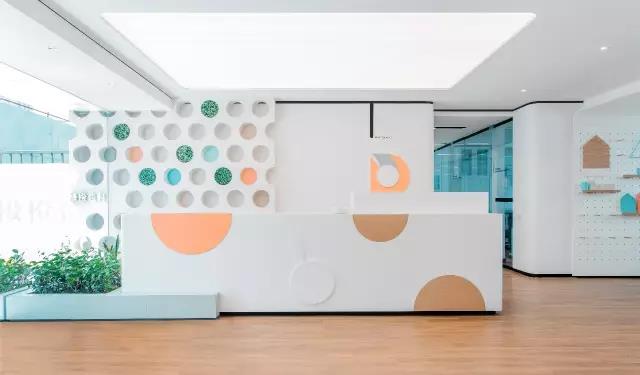
Tianjin’s First Clinic: Perforated Walls Symbolizing Cheese, Eating, and Smiling Faces—So Aesthetically Pleasing It Hardly Looks Like a Clinic.
Recommended by friends, they chose a dilapidated former instrument factory complex in Nankai District, Tianjin, as the location for their first clinic. This was followed by an approximately nine-month preparatory period, during which they applied for the Approval Certificate for Establishing a Medical Institution, carried out renovations, and secured the Medical Institution Practice License along with other required permits and certifications (including environmental impact assessment, radiation safety, and fire safety approvals), before finally obtaining all necessary licenses.
In January 2016, Jicheng Dental opened its first clinic for trial operation. The facility spanned 400 square meters, equipped with seven dental chairs and staffed by 17 employees. Initially, its services covered both adult and pediatric dentistry. Pediatric dental care primarily focused on three major categories: prevention, caries treatment, and orthodontics.
Currently, the clinic sees an average of approximately 15 patients per day, with this number roughly doubling on weekends. The average transaction value per patient is around RMB 1,000–1,500, which is higher than that of public hospitals and comparable to high-end private clinics. The primary customer base consists of urban white-collar professionals, and the Tianjin clinic has already achieved profitability.

A chalkboard in the clinic for free drawing, giving children freedom.
All revenue related to pediatric services at the Tianjin clinic is derived from clinical consultations and treatments. Customer acquisition channels include online self-media marketing, cross-industry partnerships, and collaborations with high-quality offline kindergartens, schools, and early childhood education institutions. The clinic has also established partnerships with certain banks and insurance companies. Another significant source of new patients is word-of-mouth referrals, with at least 50 new clients each month in Tianjin attracted through this channel.
Jicheng Dental has also established more than 10 oral health support groups in Tianjin, providing daily dental education to mothers and promoting preventive care concepts. These measures primarily fall into two categories: home-based care, focusing on diet and oral hygiene; and clinic-based services, including annual regular check-ups, fluoride varnish applications, and pit and fissure sealants. These initiatives have received widespread acclaim.
“We are in no rush to explore new profit models. Dentistry is inherently a business with strong profit margins, robust cash flow, and high customer stickiness. I believe that by simply excelling in pediatric dental care, profitability is never a concern.”
In September 2016, Jicheng Dental secured tens of millions of RMB in Pre-A round financing from Fenxiang Investment. Currently, Jicheng Dental’s second clinic, located in Xuhui District, Shanghai, is under construction and renovation, with operations scheduled to commence in July 2017. The company aims to operate at least 10 clinics in Shanghai. It primarily adopts a direct-operation model to ensure service quality and brand integrity. The initial investment for each clinic is approximately RMB 4–5 million.
Initially, Jicheng Dental did not intend to specialize in pediatric dentistry; rather, it aimed to use pediatric services as a customer acquisition channel to attract the parents of these children. However, after a period of operation, they found that few parents came for their own dental care, while Jicheng’s reputation in pediatric dentistry gained significant traction.
Why focus on and transition to pediatric dentistry? Targai revealed that while operating the Tianjin clinic, they found that the pain points in children’s dental care were particularly evident. Not every clinic is willing to treat children with gentleness and patience. For instance, while adults can seek treatment at public hospitals, children have far fewer options; many clinics simply do not treat young children. There are many children with cavities whose parents are eager to have them treated, but due to the children’s inability to cooperate, after much struggle, they ultimately give up.
The crux of pediatric dentistry lies in children’s fear of dental visits. There is a scarcity of clinics where children feel at ease during treatment. Addressing this issue resolves the core pain point.
China’s pediatric dentistry market lags far behind that of the United States, presenting substantial growth potential. China’s dental services market is currently valued at approximately RMB 100 billion, and it is entirely plausible that it will evolve into a trillion-yuan market within a decade, matching the current scale of the U.S. market. By then, the pediatric dentistry segment alone should constitute a market worth at least hundreds of billions of yuan. For Jicheng, this represents a sufficiently significant opportunity.
Pain Points in Pediatric Dental Anxiety
There is no particularly effective solution to the problem of children’s fear of dental visits that satisfies both adults and children. Some children exhibit strong resistance from the moment they enter the clinic. In some cases, dentists, nurses, and parents must work together, employing a combination of coercion and inducement, and even physically restraining the child’s arms and legs, to barely complete the treatment.
What other approaches can pediatric dental clinics adopt to better serve children? Conventionally, there are two solutions for managing uncooperative children: restraint therapy and treatment under general anesthesia.
In plain terms, restraint therapy involves securing a child to a restraint board during treatment. Under specific circumstances, this approach has its rationale. However, one can imagine the psychological impact on a child when they are forcibly restrained for half an hour and have their mouth propped open for treatment against their will.
In the worst-case scenario, this can cause children to develop psychological trauma toward dental clinics and even all medical institutions, potentially leading to dental phobia.
Another approach is treatment under general anesthesia, which involves administering medications to induce a state of unconsciousness in children during the procedure. Under general anesthesia, children are unable to maintain normal spontaneous respiration and require endotracheal intubation via the mouth or nose to support complex and prolonged treatments.
Although the risk of general anesthesia at accredited medical institutions is extremely low, parents inevitably have concerns. Additionally, the high cost of treatment under general anesthesia is another factor that must be taken into account.

Treatment under general anesthesia requires endotracheal intubation.
Talge believes that while the aforementioned two methods are indeed effective, they each have their drawbacks and are not suitable for widespread use. “I once observed a general anesthesia treatment firsthand. When I saw the pale-skinned little girl with her eyes taped shut, lying limply in the dental chair, I immediately thought of my own daughter and felt deeply unsettled. Although rationally I know that general anesthesia is a routine therapeutic procedure in hospitals, I still couldn’t help but worry.”
Drawing on U.S. Experience
Jicheng Dental decided to draw on American experience. On Amazon US, it purchased the five highest-rated books related to pediatric dentistry, including Pediatric Dentistry: Building a No-Fear Practice by Dr. Pike.
Drawing on his personal experiences and over 40 years of expertise in pediatric dentistry, Dr. Pike demonstrates how to empower children and build trust with them, thereby enabling them to take charge during dental visits and alleviating their fear. “This approach, which eschews coercion and minimizes reliance on medication, has profoundly resonated with us.”
In fact, the vast majority of dental conditions are not life-threatening. Therefore, with sufficient patience and compassion, it is entirely possible to facilitate a child’s acceptance of treatment through an approach grounded in equality and respect.
As dental healthcare professionals, we must safeguard not only children’s physical health but also their psychological well-being. In fact, the focus of pediatric dentistry should not be on “teeth,” but rather on “the child.” It has long been advocated that attention should be paid to children’s psychological state, not merely to the technical aspects of dental procedures. Today, it is time to revisit this issue.
The second book, Behavior Management in Dentistry for Children, provides a comprehensive and systematic introduction to various behavior management techniques, their advantages and disadvantages, and the underlying child psychology. One sentence in the book struck Talgai’s team with profound insight: “Although the operative dentistry may be perfect, the appointment is a failure if the child departs in tears.” (Even if the dental procedure is technically flawless, the entire treatment is considered a failure if the child leaves in tears.)
As for the following two books, Pediatric Dentistry: Infancy through Adolescence and Dentistry for the Child and Adolescent, these substantial volumes of over 600 pages are regarded as bible-level classic monographs in the field of pediatric dentistry. From different perspectives, both books provide detailed accounts of diseases, etiologies, management strategies, and treatment principles in pediatric dentistry, offering authoritative answers to many clinical questions.
The next step for the Jicheng team is to translate these two books into Chinese, helping to improve the overall standard of pediatric dental care in China.
The Path to Seeking Scriptures in the United States
Despite having read extensively, Tarqai felt it was not sufficiently satisfying. Consequently, the three founders of the Jicheng team decided to conduct an on-site investigation in the United States.
On January 9, 2017, the three individuals arrived in the United States. After conducting an investigation, they identified three major differences between U.S. clinics and those in China:
First, the United States has numerous pediatric specialty clinics, whereas China has very few.
Second, two-thirds of Americans have dental insurance, whereas such coverage is very rare in China;
Third, the United States extensively utilizes auxiliary teams in pediatric dentistry, whereas such practice is rare in China.
In the United States, pediatric dentistry practices operate under various models: independent clinics, chain clinics, dedicated pediatric treatment rooms within general dental practices, and combined pediatric and orthodontic practices. All of these models serve as valuable references.
The first destination Tarquay and his party wished to visit was Dr. Pike’s clinic in Portland, United States.

Targai (far right) holding the precious book and Dr. Pike (Second from the right) Group Photo
Regarding the one-day visit, Yuan Xiaofei, founder of Jicheng Dental, shared his impressions: “Dr. Pike unreservedly shared with us the lessons he has accumulated over more than 40 years of practice, covering everything from broad principles to subtle techniques, from disease management to psychological care, and from instruments to workflows. Examples include the ‘No Fear, No Tears’ philosophy, the design of anxiety-reduction procedures, the efficient scheduling of more than 80 patients in a single day, and team management. We have benefited immensely. What moved us most was his steadfast commitment to safeguarding children’s mental well-being. We are determined to integrate these core elements into our own system.”
They also visited Cavity Buster, a pediatric dental chain and the largest and most successful of its kind in the Philadelphia area, with seven locations and a history spanning more than 30 years.
In stark contrast to the minimalist style of Dr. Pike’s clinic, Cavity Buster’s flagship store leaves visitors jaw-dropped from the moment they step inside. Vintage cars, gaming consoles, murals, and colorful lights create a dazzling array of designs that almost make one forget it is a dental clinic.
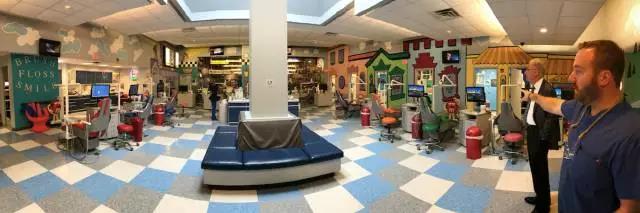
Cavity Buster’s flagship store, converted from a large warehouse, resembles an amusement park.
“During our conversations with the two founding brothers, Dr. Bressler and his sibling, we realized that this represented an entirely different approach. By employing exaggerated visual elements, children forget they are undergoing dental treatment, thereby reducing anxiety and improving cooperation,” said Talgai.
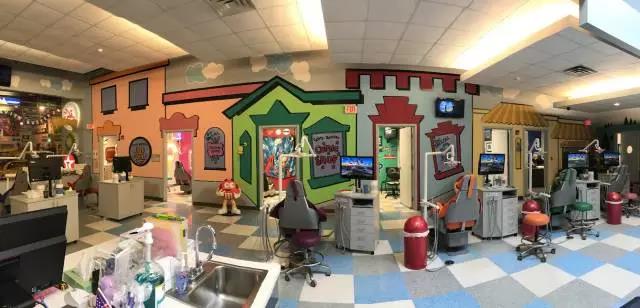
The consultation room was filled with various exaggerated visual elements.
After concluding their two-week trip to the United States, the three individuals engaged in an enthusiastic discussion for seven to eight hours on the flight back to China. Their conversation covered the characteristics of pediatric dentistry, industry development trends, and the future direction of Jicheng Dental. The outcome of their discussion was Jicheng Dental’s decision to focus on doing one thing well: establishing a pediatric dental clinic that “helps children enjoy happy dental visits.”
Entrepreneurship remains arduous, and inner anxiety persists, but Yun Xiaofei believes the venture will succeed. The team possesses an innate ability to bring joy to children: “Like most clinics, we initially hoped to attract more patients for dental implants and orthodontics—these are considered high-value cases. However, perhaps due to the team’s distinctive simplicity and cheerfulness, along with their love and patience for children, we have attracted an increasing number of young patients.”
Gamified Dental Care and Space Theme
Because children’s mental health is just as important as their physical health. While providing high-quality dental care, it is even more crucial to help them develop a positive attitude toward maintaining oral health, ensuring lifelong benefits.
Children are naturally drawn to games. Orange Dental integrates treatment steps into game-based workflows, using gamification to help children reduce anxiety and improve cooperation. Without relying on coercion or intimidation, the company quickly committed to the “gamified dental care” approach.
The team decided to adopt Disney’s approach. Before visiting the clinic, children are familiarized with the dental environment and the entire process through picture books and a game-based app; upon arrival at the clinic, they complete the dental visit by playing a game that frames the experience as “leveling up and defeating monsters.”
How to Set the Themes for Picture Books and Games? After carefully comparing several options, Jicheng Dental decided to adopt a space theme. This choice fully leverages the inherent technological appeal of the dental clinic’s equipment and instruments, while also stimulating children’s enthusiasm for exploring the world.
To provide children with an immersive experience, all visual elements—from the clinic’s interior design and staff uniforms down to individual sheets of paper—strictly adhere to this theme. Even the business cards are designed in the shape of cartoon rockets.
“We have identified an exceptional software design team in the UK, PogoLab/Flying Hammer, who will assist us in developing the picture book and toothbrushing app.”
In terms of clinic space design, Orange was fortunate to engage an architectural design team that had won the first international prize for child-friendly space planning—Peng Architects (Zhang Pengqian Architectural Design & Consulting).
Lead designer Peng, an American architect and LEED (Leadership in Energy and Environmental Design) Accredited Professional, will lead the team to comprehensively ensure that the clinic uses compliant green materials, creating a healthier and more environmentally friendly medical environment for children.

Shanghai Clinic Rendering Designed by Peng Architects
Targay is confident about the upcoming opening of the Shanghai clinic: “Drawing on our experience at Cava, procurement of medical supplies is one of our core strengths. We will exclusively source the highest-quality imported products available on the market. Our sterilization protocols strictly comply with national laws and regulations, while also incorporating best practices in infection control from the United States.”
Drawing on the experience of its Tianjin clinic, Jicheng Dental is reorganizing its service workflows and staffing structure, fully aligning with the clinical guidelines of the American Academy of Pediatric Dentistry. Warm, relaxed, and delightful patient experiences will be one of their key distinguishing features in the future.
In August, Jicheng Dental will launch a new round of financing. In the future, Jicheng Dental will first focus on several first-tier cities, and then penetrate downward after thorough development.
When dental institutions merely establish their physical infrastructure without cultivating distinct characteristics, consumers will not make purchases solely based on modest scale. Some large dental chains appear to serve investors rather than patients. Jicheng Dental aims to uphold “utmost sincerity” while infusing children’s care with innocence and whimsy.