

WeDoctor's Pharmacy-Clinic Integration Model: Scaling 18,000 Pharmacies into 'Pharmacy + Clinic' in One Year
When minor ailments arise in daily life, our first instinct is not to register and wait in line at a hospital, but rather to visit a pharmacy to ask which medications to take. This demonstrates that pharmacies inherently possess certain medical attributes. However, due to a lack of qualified professionals and professional service capabilities, pharmacies are often unable to provide users with effective advice.
Is it possible to make professional pharmacy services simple and accessible, thereby better serving users? Wei Yiyao Zhen Dian is precisely such a project. Backed by Wuzhen Internet Hospital, it provides pharmacies with services such as precise appointment scheduling, remote consultation, and electronic prescriptions, enabling pharmacies to easily transform into “clinics” and comprehensively meet users’ healthcare needs.
Since its inception in March last year through June this year, Wei Medicine’s Pharmacy-Clinic initiative has partnered with 18,000 pharmacies, equivalent to 30–40 new pharmacies joining the system daily. In terms of consultation volume, the platform averages 36,000 consultations per day, with a cumulative total exceeding 4 million—nearly matching Peking Union Medical College Hospital’s annual patient volume.
Recently, VCBeat (WeChat ID: vcbeat) conducted an exclusive interview with Zhang Yong, General Manager of the Micro-Pharmacy Business Division, to comprehensively review the Micro-Pharmacy Clinic project and interpret the new trend of “pharmacy + clinic” in pharmaceutical retail.

Zhang Yong, General Manager of the Micro-Pharmacy Business Division
Project Initiation for Pharmacy-Clinic Integration: Addressing the Lack of Professional Services in Pharmacies
Zhang Yong, a former journalist in the pharmaceutical industry, is well-versed in pharmaceutical consumer behavior and the pharmaceutical retail market. He told VCBeat that retail pharmacies have long aspired to provide professional pharmaceutical care and diagnostic and treatment services. However, constrained by resources and costs, few retail pharmacies have been able to deliver high-quality pharmaceutical care, while offering diagnostic and treatment services proves even more challenging.
However, under the “Internet + Healthcare” boom, accessibility to medical resources has become extremely high, allowing users to seek medical consultations via their smartphones. By shifting the consultation scenario to pharmacies, these interactions can be integrated with pharmaceutical retail, thereby creating a closed loop of diagnosis and treatment plus medication management. Furthermore, pharmacies can assist patients who have limited digital literacy in accessing diagnostic and therapeutic services, representing a natural extension of internet-based healthcare.
WeDoctor has already made successful forays into the field of internet healthcare and is actively exploring additional application scenarios for internet hospitals. Upon identifying the pain points in pharmaceutical retail, WeDoctor initiated the “Pharmacy + Internet Hospital” model to address these challenges, thereby launching the “Pharmacy-Clinic-Store” project.
Zhang Yong stated that the Pharmacy-Clinic Project is underpinned by WeDoctor’s profound expertise in internet healthcare. He noted that, starting with the Wuzhen Internet Hospital, WeDoctor has established 19 provincial-level internet hospitals across China. Meanwhile, leveraging three organizational models—medical consortia, medical communities, and specialty alliances—WeDoctor has deeply integrated 1,000 central hospitals at the provincial, municipal, and county levels with 100,000 primary care facilities nationwide.
In terms of physician resources, WeDoctor has connected with more than 280,000 doctors across China, enabling the provision of services such as online consultations, remote case discussions, and electronic prescriptions. Extending these medical and physician resources to pharmacy services would allow for the most direct delivery of care to users.
Specifically, WeDoctor has designed dedicated interfaces and applications for Yaozhen Dian (Pharmacy-Clinic Stores) and allocated specialized on-duty physician resources. Among these, 2,000 physicians are permanently assigned to on-duty roles, while other doctors contracted with the Wuzhen Internet Hospital can accept consultation requests from Yaozhen Dian through a first-come, first-served order-grabbing model.
By logging into the Wuzhen Internet Hospital Pharmacy System, partner pharmacies can provide members with services such as precise appointment scheduling, remote consultation, and electronic prescriptions.
Starting in June this year, the pharmacy-clinic model has also launched dedicated hardware devices, which will be gradually deployed to partner pharmacies. In the future, these devices will be equipped with auxiliary hardware, such as blood glucose and lipid analyzers and blood pressure monitors, enabling basic testing at pharmacies with real-time data upload to support diagnosis.
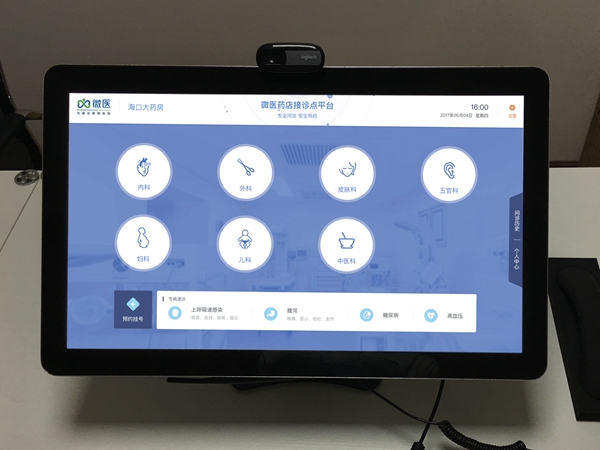
Pharmacy-Clinic Terminal Device
VCBeat’s evaluation of the device revealed that it enables rapid selection of medical departments and entry of patients’ chief complaints. After initiating a consultation, users receive prompt responses from physicians, with response times not exceeding one minute.
“Pharmacies should focus on their core retail operations, while WeDoctor provides professional medical services, reflecting a refined division of labor. The ‘medical-care-driven pharmaceutical sales’ model enables pharmacies to better meet user needs and serve public health.” Zhang Yong believes that the synergy between the Pharmacy-Clinic System and pharmacies represents an excellent integration of pharmaceutical retail and internet healthcare.
Regarding the direction of development, Zhang Yong believes that pharmacy-clinics can benchmark against the U.S. “MinuteClinic” model, enabling pharmacies to serve as a supplement to medical resources. He elaborated that in 2015, there were more than 2,100 retail clinics across the United States. According to estimates by Accenture, the number of such clinics in the U.S. was projected to exceed 2,800 by 2017, with the capacity to serve over 25 million people annually at that time.
The key to the success of U.S. minute clinics lies in their ability to achieve high medical efficiency at a lower cost. Minute clinics typically operate under a unified branded chain model, co-located within pharmacies and supermarkets, enabling widespread deployment and promotion. No appointment is required for consultations, with wait times ranging from 15 to 20 minutes. Prices are transparent and affordable, more than 50% lower than those of standard outpatient clinics.
It separates low-risk routine treatments—such as those for allergies, colds, coughs, and diarrhea—from primary care clinics, addressing these issues through the most cost-effective and efficient methods. Clinic staff are typically nurse practitioners (accounting for 95%) or physician assistants, with a physician providing remote support.
The model of Weiyao Medicine Clinics is very similar, as it can also transform pharmacies into primary healthcare institutions to meet users’ need for convenient medical access.
Beyond Medical Services: Pharmacy-Clinics Must Also Assist Pharmacies with Marketing
According to data provided by Zhang Yong, from the project’s inception in March last year to June this year, Wei Medicine’s “Pharmacy-Clinic” initiative has established partnerships with 18,000 pharmacies. These partner pharmacies include major chains such as Guoda Pharmacy, Yixintang, Laobaixing, Shuyu Civilian Pharmacy, and Jiashitang, equivalent to 30–40 pharmacies joining the Pharmacy-Clinic system every day. In terms of consultation volume, the Pharmacy-Clinic handles an average of 36,000 consultations per day, with a cumulative total exceeding 4 million—nearly matching the annual patient volume of Peking Union Medical College Hospital.
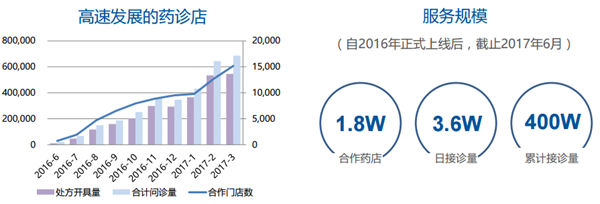
Growth Data for Pharmacy-Clinics
In addition to enhancing service capabilities, the increased foot traffic and sales volume driven by Yaodianzhu are also key factors influencing pharmacies’ decision to join the platform.
Zhang Yong cited a specific example, stating that while evaluating the practical effectiveness of “pharmacy-clinics” in a certain location in Henan Province, he encountered a user who had visited every pharmacy across the city in search of such a facility, thereby gaining a keen sense of users’ enthusiasm for pharmacy-clinics.
Monitoring of customer traffic data during the promotional period for five stores in a pharmacy chain by "Medicine & Consultation Stores" also showed that, during the promotion, foot traffic at these five locations increased two- to threefold. Among patients seeking consultations, 40%–60% were new customers; the patient return rate exceeded 80%, and sales of prescription drugs doubled.
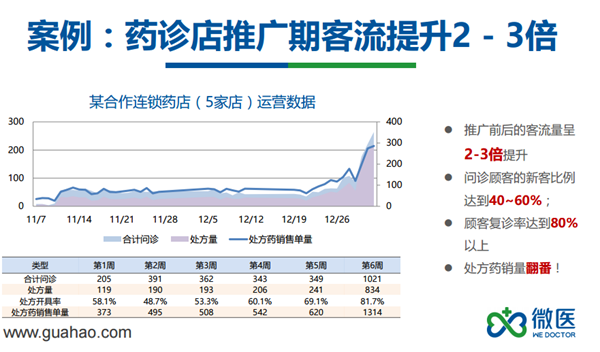
Practical Efficacy of Pharmacy-Clinics
Zhang Yong also stated that the “pharmacy + clinic” model can be viewed as an experiment in new retail within the pharmaceutical sector. He noted that new retail, which originated in the e-commerce sector, emphasizes consumer-centric experiences and data-driven operations. In the pharmaceutical context, this translates to a focus on rational medication use by patients, driven by professional services. Essentially, new retail in the pharmaceutical industry represents a transition from marketing-driven to service-driven models.
What pharmacy-clinic models are doing is leveraging the enhancement of retail pharmacies’ professional service capabilities to comprehensively meet patients’ diagnostic and treatment needs as well as pharmaceutical care needs, thereby stimulating customer visits and helping pharmacies increase foot traffic and sales.
However, Zhang Yong also emphasized that although the “pharmacy-clinic” model has gained the ability to issue prescriptions by integrating with Wuzhen Internet Hospital, it will never abuse its prescribing authority. Instead, it prioritizes rational drug use and pharmaceutical care services.
He stated that pharmacy-clinics primarily target common and chronic diseases. They provide professional medical services to patients with minor ailments who engage in self-medication, guiding them on rational drug use to prevent improper medication from allowing minor conditions to escalate into serious illnesses. Additionally, they establish real-name health records for customers with chronic diseases, offering adherence management and disease risk control tailored to this population.
In addition, on the B2B side, Yaozhen Dian will provide retail pharmacies with a suite of management tools, including Huiyuan Bao (Member Treasure), Yingxiao Bao (Marketing Treasure), and Yongyao Bao (Medication Treasure). Specifically, Huiyuan Bao will integrate with pharmacy membership systems to deliver personalized diagnosis and treatment services based on member data; Yingxiao Bao will enhance the precision of terminal-controlled sales strategies; and Yongyao Bao will leverage supply chain insights, combining actual sales and inventory data to offer professional medication solutions.
The Changing Landscape of Pharmaceutical Retail: How Should Pharmacy-Clinics Respond?
In fact, beyond Weiyaozhendian, numerous other enterprises have launched projects aimed at “empowering” retail pharmacies, with focus areas including procurement, services, management, and marketing. These include pharmaceutical e-commerce platforms dedicated to serving pharmacies; diagnostic and chronic disease management tools that, like Yaozhendian, enhance professional service capabilities; as well as information management systems and internet-based marketing tools. Following the surge of interest in “Internet + Healthcare,” a wave of innovation and entrepreneurship in “Internet + Pharmacy” has begun to emerge.
From the perspective of overall trends in pharmaceutical retail, the most intuitive characteristic is that market growth has slowed down; the disappearance of demographic dividends and economic structural adjustments have led to a stabilization of pharmaceutical consumption growth.
The slowdown in the growth of pharmaceutical retail has manifested in specific retail pharmacies as a relatively stable total number of stores, accompanied by intensified mergers and acquisitions within the industry. According to the annual reports published by the China Food and Drug Administration (CFDA), the total number of retail pharmacies stood at 420,000 at the end of 2012 and increased only slightly to 440,000 by the end of November 2016. During this period, the number of independent pharmacies decreased by 50,000, while the number of chain pharmacies increased by 70,000, a trend that can be summarized as “independent pharmacies retreat, chain pharmacies advance.”
In summary, the changes in the total industry size and the number of retail pharmacies indicate that retail pharmacies must move toward high-end, professional, and diversified development.
However, the pharmaceutical retail sector is not entirely devoid of positive signals. Against the broader backdrop of healthcare reform, factors such as the separation of prescribing and dispensing, the outflow of prescriptions from hospitals, and the deregulation of online pharmaceutical sales have brought a glimmer of hope to the industry.
In particular, the outflow of prescription drugs is expected to generate a trillion-yuan incremental market for out-of-hospital pharmaceutical retail. Relevant reports indicate that, based on an analysis of overall growth trends in the drug retail market, prescription outflows are projected to contribute over RMB 250 billion in incremental sales to retail pharmacies by 2018, with the volume of prescribed medications dispensed outside hospitals reaching RMB 800 billion by 2020.
Whether prescription outflow can occur on a large scale largely depends on whether pharmacies can obtain compliant prescription sources. The circulation and supervision of traditional paper prescriptions are not easy, so electronic prescriptions may become the main carrier of prescription outflow.
In this context, the qualification to issue electronic prescriptions may become a scarce resource. WeDoctor’s Wuzhen Internet Hospital is one of the few internet hospitals possessing such qualifications, and its affiliated “Pharmacy-Clinic” project will naturally benefit from this advantage. In other words, only retail pharmacies that have integrated electronic prescription capabilities will be among the first to reap the benefits of prescription outflow.
Industry insiders also stated that the national requirement for prescriptions to purchase prescription drugs is not intended to restrict the industry, but rather to supervise rational drug use. Electronic prescriptions are likely to become mainstream due to their traceability and ease of regulatory oversight, and various stakeholders will undoubtedly compete for control over electronic prescription entry points in the future.
Zhang Yong also mentioned in the interview that pharmacy-clinics have compliant sources of electronic prescriptions, and prescription drugs will become a very important growth driver for their performance. In addition, pharmacy-clinics are also developing interfaces for administrative regulation to provide convenient access for relevant authorities.
Overall, YaodianDian provides pharmacies with a range of services, including free medical consultations in various formats, electronic prescription issuance following consultations, and in-store marketing support. These offerings comprehensively enhance pharmacies’ professional service capabilities, equipping them with sufficient competitiveness amid the evolving landscape of pharmaceutical retail.
Furthermore, against the backdrop of healthcare reform, the “pharmacy-clinic” model transforms retail pharmacies into “clinics,” addressing primary care challenges and aligning with the requirements of tiered diagnosis and treatment. By leveraging Wuzhen Internet Hospital to channel high-quality medical resources down to the grassroots level, this model enhances primary care service capacity and helps alleviate, to some extent, the difficulty of accessing medical care.