

Baiyang Smart Tech Secures Exclusive Distribution Rights for IBM Watson for Genomics in China, Advancing Precision Oncology
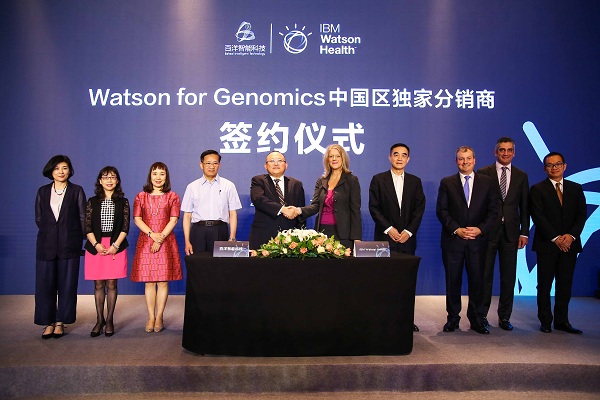
VCBeat (WeChat ID: vcbeat) has learned that on June 21, 2017, Baiyang Smart Technology, a subsidiary of Baiyang Pharmaceutical Group, and IBM Watson Health jointly announced in Beijing that Baiyang Smart Technology had become the partner for Watson for Genomics (Watson Genomics Solution) in China.Exclusive Distributor, both parties will jointly promote the practical application of tumor genomic analysis, providing pathologists and oncologists with precise treatment recommendations based on oncogenic mutations.
This is the second Watson Health cognitive intelligence product introduced by Baiyang Smart Technology following its strategic partnership with IBM across all product lines on March 28. The Watson for Oncology collaboration, established three months ago, is progressing steadily and is expected to cover 150 tertiary general hospitals by the end of the year.
Precision Medicine Is the Trend, but Two Key Challenges Remain to Be Addressed
Among the projects outlined in the “13th Five-Year Plan” released by the National Development and Reform Commission (NDRC), “accelerating the large-scale application of biotechnologies such as genomics” was explicitly included, elevating “genomics” to a national strategic priority. In fact, as early as March 2015, the Ministry of Science and Technology (MOST) convened China’s first expert meeting on precision medicine strategy, proposing the Chinese Precision Medicine Initiative. One year later, MOST issued the guidelines for the five-year (2016–2020) Key Special Project on “Precision Medicine Research,” marking the imminent implementation of China’s national strategic deployment for precision medicine.
In March 2015, the Ministry of Science and Technology convened China’s first expert conference on the national precision medicine strategy. The conference confirmed that China would invest RMB 60 billion in precision medicine by 2030.
Despite precision medicine being the prevailing trend, its development faces a variety of scientific, medical, and clinical challenges. The two most significant difficulties are: first,The lack of standardization in genetic testing laboratories can lead to inaccurate test results, as non-compliant practices throughout the entire process—from sample collection and specimen processing to sequencing—compromise result accuracy., there are over 200 independent clinical laboratories conducting genetic testing in China, and a significant proportion of these laboratories have issues with the accuracy of their test results.
The second challenge lies in the interpretation of sequencing results,The continuous generation of bioinformatics data through high-throughput sequencing technologies urgently requires interpretation and research. Meanwhile, the vast volume of scientific and medical literature necessitates extensive reading and information extraction, with its quantity accelerating in growth. These factors further diminish the feasibility of manual analysis.. Meanwhile, Watson Health’s cognitive computing tool, designed specifically for tumor gene mutations based on big data, has become the most mature gene analysis application.
Urgent Market DemandIntelligent Tool for Tumor Gene Cognition
According to BBC Research statistics, the global gene sequencing market size was $790 million in 2007, reached $4.5 billion in 2013, and is projected to reach $11 billion in 2018, with a compound annual growth rate (CAGR) of 29%. Additionally, data from Illumina indicates that the market capacity for gene sequencing services will reach $20 billion in the coming years, with oncology accounting for approximately $12 billion.
In China, due to its large population base and aging demographic trend, the incidence of cancer is rising year by year, with 4.3 million new cases diagnosed and 2.8 million cancer-related deaths annually. The market size for tumor genetic testing applications is also expected to expand continuously. With advances in medicine, cancer is no longer considered a terminal illness. Experts state that if detected early, one-third of tumors are preventable, one-third are curable, and the remaining one-third can be managed through treatment to improve patients’ quality of life and extend survival.
During the course of treatment, oncologists require intelligent tools to provide precise decision support, while patients need precision medicine solutions.
Rob Merkel, General Manager of IBM Watson Health Oncology & Genomics, stated, “In light of the surge in clinical, research, and genomic data, we are proud to partner with Baiyang to bring cognitive computing solutions to physicians and researchers in China. Watson for Genomics enables oncologists to gain insights into patients’ genomic alterations more quickly and easily. We believe it expands access to specialized expertise, helping oncology experts develop more effective treatment strategies.”
The implementation of Watson for Genomics in the Chinese market will help oncologists overcome the burdensome and inaccurate interpretation of tumor genomic data, thereby facilitating broader adoption of precision medicine.
How Watson for Genomics Helps Doctors and Patients
Currently, cancer gene mutations are identified in the field of oncology, and these mutations are matched with molecular targeted therapies by searching multiple data sources. Manually interpreting cancer gene reports for patients can take several days or even weeks. In addition, the continuous increase in complex genetic data and clinical trial data has further reduced the feasibility of manual analysis of cancer genes.
Watson for Genomics, a cognitive computing tool, incorporates more than 10,000 new scientific papers and 100 new clinical datasets on average each month. It can generate annotation files for every genomic variant in just a few minutes, enabling cognitive computing to handle large-scale workloads that are beyond the capacity of manual human effort.
Watson for Genomics can read genomic sequencing data and compare it with extensive clinical, scientific, and pharmacological databases to help physicians identify potential treatment options that match the patient’s tumor gene mutations.
Watson for Genomics provides practicing physicians with analytical tools that process de-identified tumor biopsy sequencing data uploaded by clinicians. By analyzing patients’ genomic data, it identifies DNA alterations associated with disease progression and generates evidence-based reports outlining precise therapeutic options. These reports assist physicians in evaluating and determining treatment plans tailored to the patient’s oncogenic drivers or standard care regimens.
Fu Gang, Chairman of Baiyang Intelligent Technology, stated that in the field of oncology treatment, the FDA has currently approved more than 80 targeted therapy drugs for tumors. However, there are tens of millions of potential interactions between these mutations and medications, a computational workload too vast for manual processing to handle while guaranteeing 100% accuracy. By leveraging cognitive computing, it is possible to center the analysis on patients’ genetic mutations and evaluate all marketed blockbuster drugs to identify precise medical solutions.
He also stated, “We are honored to serve as the exclusive distributor of Watson for Genomics in China, which represents another significant benefit for oncology patients, pathologists, and the broader medical community. We are dedicated to exploring innovative models of healthcare informatization. With the advancement of information technology, platforms for sharing medical knowledge and data have emerged; however, our greatest challenge lies in the capacity for data analysis and interpretation. In this regard, IBM Watson Health undoubtedly holds a position of absolute leadership.”
However, the accumulation of data does not mean that doctors can be discarded and exist independently. Doctors are the core link in activating big data. Without professional doctors, all data is worthless. In other words, doctors remain the core of treatment.