

Four Key Breakthroughs to Unlock the Trillion-Dollar Senior Tourism Market
In our previous report on innovative cases in aging, we discussed the intergenerational learning center model through the lens of the documentary Present Perfect. In exploring the reasons behind the emergence of this model, we found that older adults often experience monotonous lives and crave a richer spiritual life. Following this thread, we turned our attention to the senior tourism industry, which similarly aims to enrich the spiritual well-being of the elderly.
According to data from the National Bureau of Statistics, by the end of 2016, China’s population aged 60 and above had risen to 230 million, accounting for 16.7% of the total population—meaning one in six Chinese citizens was an older adult. A survey conducted by the National Working Commission on Aging revealed that elderly travelers now constitute more than 20% of the country’s total tourist volume, with this demographic demonstrating a stronger willingness to travel compared to the national average.
Faced with a huge market pie, domestic travel service platforms have been actively entering the senior tourism market. The characteristics of elderly travelers are quite distinct, and companies have made corresponding adjustments to cater to this segment. However, the lack of unified industry standards has led to a mixed bag of tourism products on the market. In September 2016, China’s first national-level industry standard for senior tourism, the *Specification for Travel Agency Services for Elderly Tourists*, was implemented, bringing order to the industry.
Driven by both policy regulations and market forces, we are witnessing new developments in the senior tourism industry. Six months after the implementation of industry standards for senior tourism, VCBeat seeks to explore, through interviews and analysis, how the senior tourism sector will continue to advance amid an aging population and the release of dual dividends from policy and market dynamics. What are the key moves by major market participants, and where does the future potential of the market lie?
This report will address the following questions:
1. How Do Policy and Market Forces Jointly Drive the Rapid Development of the Senior Tourism Industry?
2. How Does the New Benchmark Set by Industry Standards Promote the Standardized Development of the Elderly Tourism Industry?
3. How to Analyze the Current Market Status of the Elderly Tourism Industry Based on the Travel Characteristics of the Elderly?
4. How can travel providers cater to the senior tourism market and develop innovative travel products for older adults?
5. How to Tap into the Trillion-Yuan Market of the Elderly Tourism Industry Through Four Key Breakthroughs?
The aging of China’s population is intensifying. Data from the National Bureau of Statistics show that by the end of 2016, the number of people aged 60 and above in China had reached 230 million, accounting for more than 16.7% of the total population. According to international conventions, if the proportion of the population aged 60 and above reaches 10% of the total population in a country or region, it is considered an aging society.
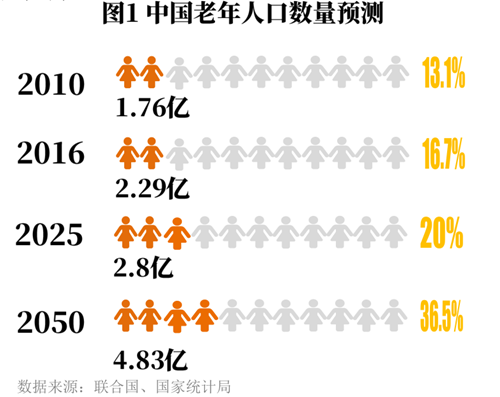
According to United Nations data projections, China’s elderly population is expected to reach approximately 280 million by 2025, accounting for nearly 20% of the total population. By 2050, the elderly population will surpass 480 million, representing 36.5% of the total population. China will become one of the countries with the most severe aging populations globally.
The rapid growth of the elderly population is driving the expansion of the silver economy, while the implementation of relevant regulations provides a legal framework for senior tourism, promoting market compliance and accelerated development.
As previously mentioned, policy incentives serve as a key driver for the development of senior tourism. In recent years, a series of policies related to senior tourism have been successively issued. These policies not only bring regulatory dividends to the industry but also establish clear standards and requirements for all stakeholders, providing a legal framework for the senior tourism market and facilitating its rapid growth.
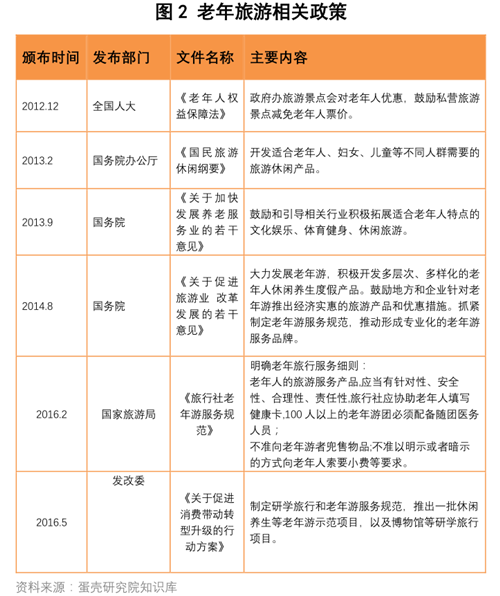
Among the aforementioned policies, the "Specifications for Elderly Tourism Services of Travel Agencies," promulgated in February 2016 and officially implemented in September, marks the first regulatory framework specifically targeting elderly tourism. These new regulations not only establish requirements for service quality during tours but also provide detailed standardized provisions for pre-trip preparations, contract signing, and post-trip complaint handling.
Next, we will closely examine which industry phenomena the first industry standard for elderly tourism targets, and combine this with interview data to analyze market changes six months after the policy’s implementation. Did the policy rollout proceed as smoothly as expected?
<See the full report for specific policy highlights>
Scan the QR code at the end of the article,Become a Member, you can obtainFull Version: "Report on the Senior Tourism Industry—Four Major Breakthroughs in a Trillion-Yuan Market"
We conducted a survey on the implementation of the “Standard” and found that travel agencies currently exhibit significant divergence in their attitudes toward standards for elderly tourism.
Most traditional travel agencies, driven by cost considerations, have not established dedicated “senior tour groups” and remain cautiously watchful of this market, continuing to attract elderly travelers with low-priced general “sunset tours.”
Only a small number of tourism enterprises have responded and launched products that meet the requirements.For example, China Railway International Travel Service has launched “Special Tourist Trains for Middle-Aged and Elderly Passengers,” adopting a single-ticket-throughout system, providing 24-hour onboard attendant services, and assigning accompanying healthcare physicians to provide full-journey medical support. In principle, the product does not impose age restrictions on tourists; however, it is recommended that travelers aged 75 and above join the tour with family members accompanying them.
Online OTAs quickly followed suit.For example, Ctrip Travel has launched the “Peace of Mind Tours for Parents” product, which stipulates that tour leaders must be star-rated guides holding first aid certification; single leg travel time should preferably not exceed two hours; meals should primarily consist of hot food, and arrangements for upper sleeper berths on trains and red-eye flights should be avoided as much as possible; and high-coverage travel accident insurance is provided to elderly tourists.
Travel agencies hold varying attitudes toward the “national standard” for senior tourism.Most travel agencies are resistant to implementation, citing significant operational difficulties. Some agencies have stated that travelers over the age of 70 must provide a health certificate, be accompanied by relatives, or purchase insurance. One agency even explicitly declared that it does not accept outbound tourists in their seventies, arguing that “they are unable to participate in many activities.”
Beyond concerns about the operational complexity of service delivery, many travelers are more focused on the cost increases brought about by the new regulations. The gradual improvement in the quality of tour groups is a welcome development for both consumers and tourism professionals. However, there is concern that during the transitional period of implementing these new rules, market competition has not yet become fully orderly, leading to rising tourism costs. This may not be favorable for price-sensitive elderly travelers. Prices for senior tour groups have increased, which remains the most challenging area for reaching consensus between elderly customers and tourism enterprises.
From the perspective of marketing conditions, multiple travel agency representatives stated that the consumption mindset of elderly individuals has not yet fully shifted, with many still placing significant emphasis on price. Budget-friendly tour groups are often more popular than those that strictly adhere to the "Specifications" in terms of facility provisioning but come at a slightly higher price.
At the implementation level, the “Guidelines” also contain ambiguous areas, leading relevant enterprises to opt for less stringent compliance measures when selecting operational plans. For instance, within tourism products, there are specialized “Sunset Red” tour packages designed specifically for seniors, as well as standard tour packages. While implementing the “Guidelines” is relatively straightforward for specialized “Sunset Red” products, it remains unclear whether standard tour packages—which cater to both elderly and younger participants—must comply with these requirements. This lack of explicit clarification creates room for maneuvering among tourism enterprises.
To address the challenges encountered in the implementation of the “Guidelines,” the market must first undergo a period of adjustment to facilitate the quality transition of elderly tourism from mere sightseeing to leisure and vacation-oriented travel, while properly balancing the relationship between service quality and pricing.
“The Specifications” themselves carry no legal force and lack punitive measures, thus failing to impose binding constraints on travel agencies during implementation. To effectively implement the new national standards for elderly tourism, tourism authorities and law enforcement agencies must guide travel agencies in incorporating these new regulations into actual contract texts, thereby granting them legal validity.
>>>>
1. Older adults have a strong willingness and ability to travel
According to the survey, if their physical and financial conditions permit, 81.2% of middle-aged and elderly respondents expressed willingness to travel, while only 9.7% explicitly stated they were unwilling to do so.
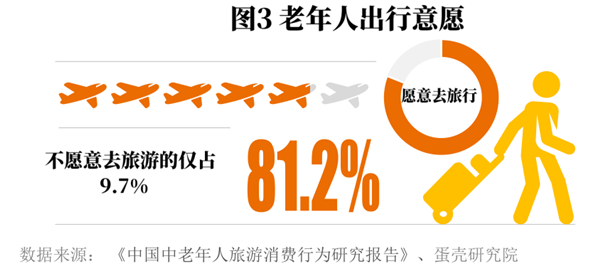
Subjectively, older adults exhibit a strong willingness to travel. Objectively, data shows that 57.8% of middle-aged and elderly tourists have a monthly income exceeding RMB 5,000, with high-income individuals earning more than RMB 7,000 per month accounting for 31.3%.
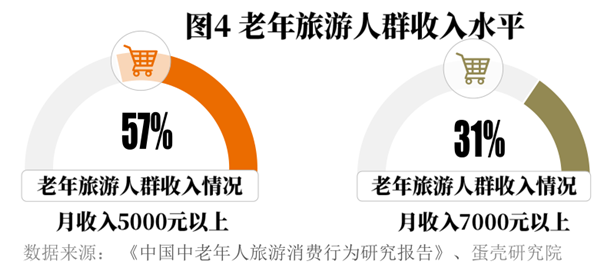
Tier-1 and Tier-2 cities, along with other regions boasting stronger economic conditions, currently serve as the primary points of origin for elderly travelers.
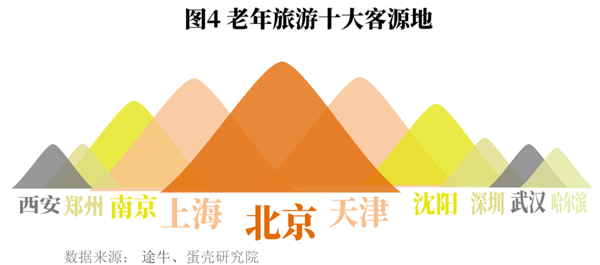
2. Elderly tourism is characterized by “high-frequency, long-haul” trips and off-peak travel.
As retirees enjoy more leisure time, elderly travelers exhibit greater flexibility and diversity in scheduling their trips, showing a distinct trend of off-peak travel. Their travel activities are primarily concentrated in March–June and September–October. In contrast to the mainstream tourism market, where peak seasons are heavily focused on October and the Spring Festival, monthly variations in elderly travel are relatively minor, with less pronounced clustering of travel demand.
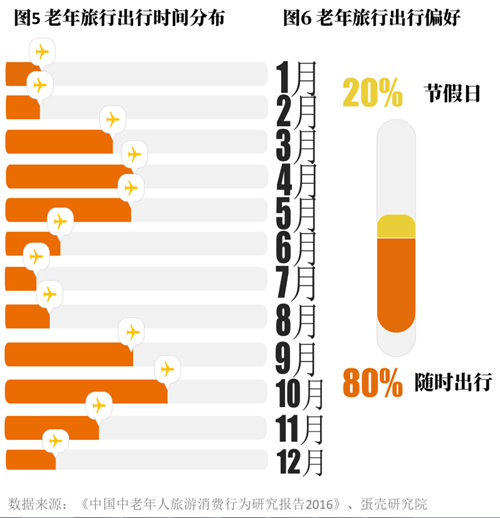
In terms of consumption motivation,Compared to the mass travel market, objective factors such as the onset of holidays have a relatively limited impact on driving tourism among the elderly; instead, subjective and impulse-driven factors—such as merchant promotions, recommendations from friends, and even reading travel blogs—have become significant motivators for senior travel.
Compared with younger people, the actual travel spending of the elderly seems to better align with the ideal of “spontaneous travel.”
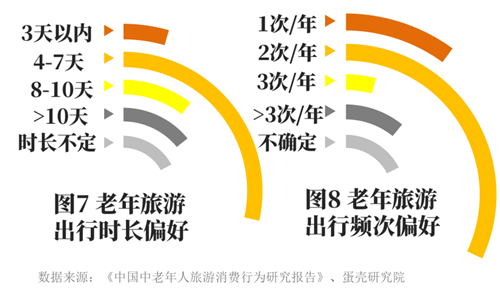
Supported by greater leisure time and financial stability, older adults exhibit higher travel frequency and spending. They show a stronger preference for medium- to long-haul trips (lasting more than three days), with an average trip duration of 4 days and an average travel frequency of twice per year.
3. Traditional travel agencies remain the primary channel for booking trips, while online platforms rely on “filial piety tours.”
Travel agencies continue to hold absolute dominance in the distribution channels for senior tourism: they and their affiliated channels account for approximately 70% of elderly tourist traffic, with traditional brick-and-mortar travel agency outlets serving as the most important sales channel, representing nearly 60%.
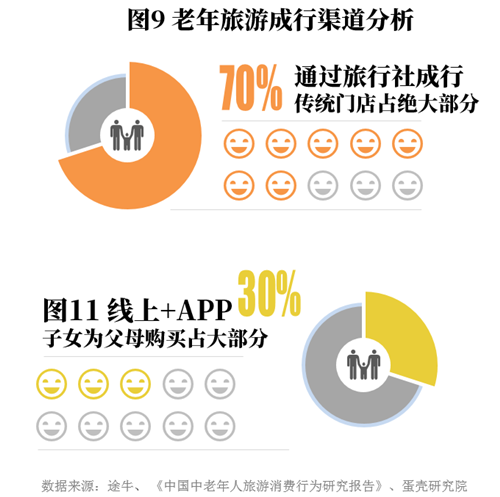
Elderly individuals prefer offline booking methods, with telephone and in-store reservations accounting for 62% of the total volume, while mobile app bookings are more frequently completed by their children on their behalf.
The China Consumers Association’s survey report, “How Much Are Silver-Haired Consumers Willing to Spend on Tourism?,” reveals that elderly individuals are willing to allocate 15% of their annual income to travel, marking a significant increase from previous levels.

Currently, the average expenditure for elderly travelers stands at approximately RMB 3,000. This figure is projected to rise above RMB 5,000 by 2025. Furthermore, as population aging intensifies, China’s elderly population is expected to reach 283 million by 2050, at which point the senior tourism industry will undoubtedly become a trillion-yuan market.
The above is an excerpt from this report,The report also includes the following content:
1. Traditional Travel Agencies' Layout for Senior Tourism;
2. Analysis of Major Senior Tourism Products on Online Travel Agencies (OTAs);
3. Four Major Breakthroughs in Senior Tourism;
4. Online Travel Industry Chain;
5. Specific Entry Points for Breakthroughs in Elderly Tourism;
6. Key Points of the “Service Specifications for Elderly Tourism by Travel Agencies”
This is a research report on the trillion-yuan market for senior tourism, titled “Senior Tourism Industry Report: Four Major Breakthroughs in a Trillion-Yuan Market.” Using industry standards as its entry point, the report examines the current state of the sector six months after the implementation of these standards and explores development opportunities within the senior tourism industry.
Scan the QR code below to becomeVCBeat Official Member, you can obtainFull Version"Senior Tourism Industry Report: Four Major Breakthroughs in a Trillion-Yuan Market". And, in the coming year, you will have unlimited access to the completeIndustry Trend Report, timely grasp the latest globalInvestment and Financing Information, boasting a comprehensive range ofMedical Enterprise Database, and alsoMassive Resource Integration。

Scan the code to become a VCBeat member,
Beta Version Trial Price: 365 yuan/year.