

WeDoctor Announces Completion of Integrated Specialty, Primary Care, and Insurance Model, Pioneering 'Chinese-Style Kaiser Permanente'
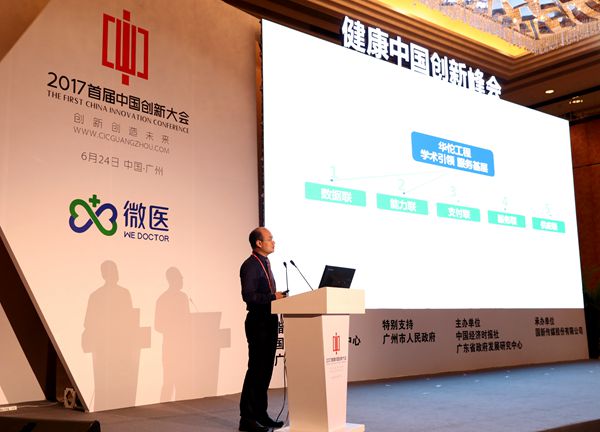
Recently, at the inaugural China Innovation Conference, WeDoctor announced the integration of its three major business lines—specialty care, primary care, and insurance—marking its upgrade from an internet healthcare platform to a new-type health security system. Positioning itself against the U.S.-based Kaiser Permanente, WeDoctor aims to become the “Chinese-style Kaiser.”
In August 2016, the National Conference on Health and Wellness, convened by the Central Committee of the Communist Party of China and the State Council, proclaimed that “without universal health, there can be no comprehensive well-being,” and called for a shift from a disease-treatment-centric model to a people’s-health-centric model. This transition toward a health-centered approach hinges on an efficient health security system. Leveraging advanced technologies such as the internet and artificial intelligence, WeDoctor has optimized the allocation of specialized and general practice medical resources, integrated ecosystem resources spanning pharmaceuticals, health insurance, and healthcare services, and provided users with continuous, proactive family doctor services, thereby becoming one of the earliest pioneers in China’s new health security system.
Specialty discipline system construction is the “flagship” of WeDoctor’s health insurance ecosystem. Currently, WeDoctor has co-established internet hospitals with central hospitals in 19 provinces and municipalities, set up 12 specialty remote consultation centers led by academicians, formed the Huashan Medical Consortium with Shanghai Huashan Hospital (ranked among the top 10 hospitals in China), jointly established the first Traditional Chinese Medicine (TCM) Medical Consortium with Guangdong Provincial Hospital of Chinese Medicine, co-created the Pancreatic and Hepatobiliary Surgery Medical Consortium with Shanghai Changhai Hospital, and partnered with the Bao’an District Government in Shenzhen to build the Bao’an Medical Consortium. Recently, ten branch chairpersons from the China Medical Promotion Association, represented by Qiao Jie, President of Peking University Third Hospital, and Wang Ningli, Vice President of Beijing Tongren Hospital, have joined the Huatuo Project as a group to jointly promote the development of academic medical consortia. By collaborating with leading specialties at key hospitals nationwide, WeDoctor has constructed a “wall-less” general hospital.
Comprehensive care services form the “foundation” of WeDoctor’s health insurance system. Led by He Chao, former president of Sir Run Run Shaw Hospital, Zhejiang University School of Medicine, the WeDoctor General Practice Center was established in accordance with JCI (Joint Commission International) accreditation standards, the highest global benchmark for healthcare services. It provides individuals, families, and enterprises with one-stop health maintenance and medical services encompassing prevention, diagnosis, treatment, and rehabilitation. The first WeDoctor General Practice Center opened in Hangzhou this March, with site selection and construction underway in Beijing, Jinan, Nanjing, Shenzhen, Chongqing, and other cities. A total of 100 centers are planned to be established nationwide within three years. Meanwhile, WeDoctor has partnered with Professor Zhu Shanzhu’s team from the Department of General Practice at Fudan University to establish the WeDoctor Academy of General Practice. The academy offers systematic, blended online-offline training for family doctor teams, thereby enhancing the service capabilities of general practice professionals.
Insurance serves as the key “link” in WeDoctor’s health security system. Leveraging its medical service supply network that integrates general practice with specialty care, WeDoctor has launched health plans tailored for individuals, families, and enterprises. Since its launch, the Health Account has accumulated over 2.4 million activations, while the number of users enrolled in its HMO (Health Maintenance Organization) contracts has reached 4.6 million. Earlier this year, WeDoctor partnered with ZhongAn Insurance, China’s first internet insurance company, to introduce “Family Guardian,” jointly pioneering China’s first outpatient insurance product for internet hospitals.
“WeDoctor has achieved integration of online and offline services, as well as convergence of healthcare and insurance, and is gradually expanding its layout from a comprehensive platform to vertical specialties including general practice, Traditional Chinese Medicine (TCM), and women’s and children’s health. It is China’s most innovative platform resembling Kaiser Permanente.” On that day, Duan Tao, a renowned domestic hospital management expert and former president of the First Maternity and Infant Health Hospital affiliated with Tongji University, announced his appointment as the President-General of WeDoctor’s Women’s and Children’s Medical Consortium. Nanfang Hospital of Southern Medical University, Guangzhou Pharmaceutical Holdings Limited, and Shenzhen Heshuntang also signed agreements with WeDoctor to jointly advance the ecological layout of healthcare and pharmaceuticals. WeDoctor’s business strategy of “empowering the healthcare ecosystem and innovating the health insurance system” has gained increasing recognition from both the medical and industrial sectors.
Kaiser Permanente is the pioneer of Health Maintenance Organizations (HMOs) in the United States and the largest HMO nationwide, serving over 11.7 million members in 2016. By integrating patients, physicians, clinics, hospitals, and insurance entities, Kaiser Permanente has established a closed-loop healthcare service model based on a shared value system, reducing overall medical service costs by 17%. Benchmarking against Kaiser Permanente in the U.S., Liao Jieyuan, Chairman and CEO of WeDoctor, stated that WeDoctor has constructed a Chinese-style healthcare security service system through the integration of online and offline services, the convergence of healthcare and insurance, and the coordination of general practice with specialized care, thereby carving out its own path of innovation.
“The continuous emergence of emerging technologies, driving significant industrial transformation, is becoming a prevailing trend.” Li Wei, Director of the Development Research Center of the State Council, pointed out in his keynote address at the conference that the integration of the internet with traditional industries has spurred incessant innovation in business models, leading and catalyzing revolutionary shifts in development approaches across various sectors, and will comprehensively transform human production and lifestyles.