

Baxter Greater China President Shirley Xu Focuses on Nephrology and Chronic Disease Management to Penetrate China's Primary Healthcare Market

Xu Runhong, President of Baxter Greater China
As healthcare reform advances and the tiered diagnosis and treatment system is implemented in greater depth, the medical market is witnessing a downward shift in focus, expanding from large tertiary Grade A hospitals to the vast primary care sector. This trend presents both significant opportunities and challenges for all healthcare enterprises.
Since entering the Chinese market in 1989, Baxter has been deeply rooted in China for 28 years, introducing Baxter International’s advanced and diversified medical products and services to China in the fields of biotechnology, renal care, infusion therapy, anesthesia, and nutrition.
So, in the field of primary healthcare, how does Baxter integrate its positioning and market layout to build capabilities for primary healthcare services? Shifting from previously serving large hospitals to focusing on primary healthcare institutions represents a significant strategic transition. What are Xu Runhong, President of Baxter Greater China’s views on this?
On June 15, at the Digital Healthcare China (DHC) 2017 conference hosted by DXY and attended by numerous multinational pharmaceutical companies, VCBeat conducted an exclusive interview with Xu Runhong, President of Baxter’s Greater China region, to address the aforementioned questions.
With over 20 years at Baxter, Xu Runhong has served as the head of various business departments. She has witnessed Baxter’s 28-year journey in China and its innovative development amidst new opportunities and challenges in the healthcare sector.
“Globally, Baxter’s products and therapies can be found in nearly every department of every hospital, and even on every floor,” said Xu Runhong.
As the new healthcare reforms advance, Xu Runhong strongly supports the government’s strategic layout of empowering primary healthcare and reshaping the industry ecosystem. In this process, she will leverage Baxter’s expertise in chronic disease management to contribute to the development of this new ecosystem. As a company specializing in medical technologies, Baxter prioritizes meeting the healthcare needs of Chinese patients. By adopting a unique closed-loop disease management model, the company aims to expand patient access to care, elevate the standard of care received, and further improve therapeutic services and public welfare support systems, thereby enabling more patients to benefit from high-quality medical products and services.
Over the past three decades, Baxter has collaborated closely with Chinese government agencies and healthcare institutions to actively expand access to care, delivering high-quality, cost-effective medical products and services to a broader patient population. Meanwhile, Baxter is committed to providing professional education to healthcare professionals to enhance treatment outcomes.
Collaborate with government bodies and industry associations to promote the decentralization of technology, diagnosis and treatment, and services, thereby expanding healthcare accessibility: Partner with the Hospital Management Research Institute of the National Health and Family Planning Commission to develop and implement sustainable peritoneal dialysis treatment and delivery models for patients with end-stage renal disease (ESRD) in grassroots areas, exploring new disease management models for tiered diagnosis and treatment of ESRD at the primary care level; collaborate with the Chinese Hospital Association to jointly launch quality improvement initiatives aimed at enhancing safety standards in clinical settings.
Prioritize product quality and patient safety, leverage expertise in specialized therapeutic areas, actively participate in the establishment and enhancement of industry standards, conduct quality assessments of peritoneal dialysis fluid packaging materials; support the Chinese Pharmacopoeia Commission in establishing an international system for the management and evaluation of pharmaceutical packaging materials; carry out quality assessments and safety studies on intravenous infusion packaging systems; support the Chinese Pharmacopoeia Commission in researching the management, quality evaluation, and tracking systems for pharmaceutical packaging materials in China; explore applied technology assessment research projects for continuous renal replacement therapy.
Sharing Professional Expertise with Healthcare Providers: Partnered with DXY to launch the "Baxter Medical Channel," a science-based platform for clinicians; launched the "Baxter Acute and Chronic Kidney Disease WeChat Platform," providing educational content on kidney diseases and their treatments to over 10,000 healthcare professionals.
So, how exactly does Baxter operate in terms of services for physicians and patients?
According to Xu Runhong, first, at the level of government collaboration, Baxter has partnered with the Hospital Management Institute under the National Health and Family Planning Commission since 2012 to jointly develop and implement sustainable peritoneal dialysis treatment and delivery models for patients with end-stage renal disease (ESRD) living in grassroots areas. The aim is to expand access to peritoneal dialysis therapy for ESRD patients and to promote the management model adopted by the project toSix pilot provinces, 75 pilot medical institutions, 23 prefecture-level cities, 29 districts and counties, and two ethnic minority autonomous counties in China.
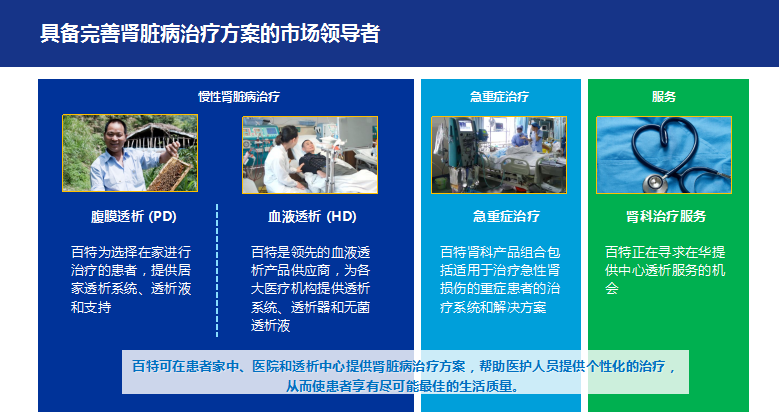
Secondly, collaborate with industry professionals.In collaboration with the Chinese Hospital Association, we jointly launched over 100 quality improvement projects across more than 80 hospitals, focusing on intravenous infusion safety, medication safety, infection prevention and control, and perioperative safety. Among these initiatives, nearly 20 were recognized as Excellent Cases in Patient Safety in China, demonstrating our proactive efforts to enhance patient safety, improve clinical medication safety, and foster a safer healthcare work environment.
Meanwhile, Baxter has also been actively involved in establishing and advancing industry standards, such as parametric release testing and research on large-volume packaging materials, as well as contributing to the development of diagnostic and therapeutic consensus guidelines. Its collaborative efforts with internet platforms have also been noteworthy. For instance, since 2013, Baxter has engaged in deep cooperation with DXY.cn to jointly create a scientific platform tailored for clinicians—the “Baxter Medical Channel.” On this platform, physicians can pursue continuing medical education at their own pace and share experiences with their peers.
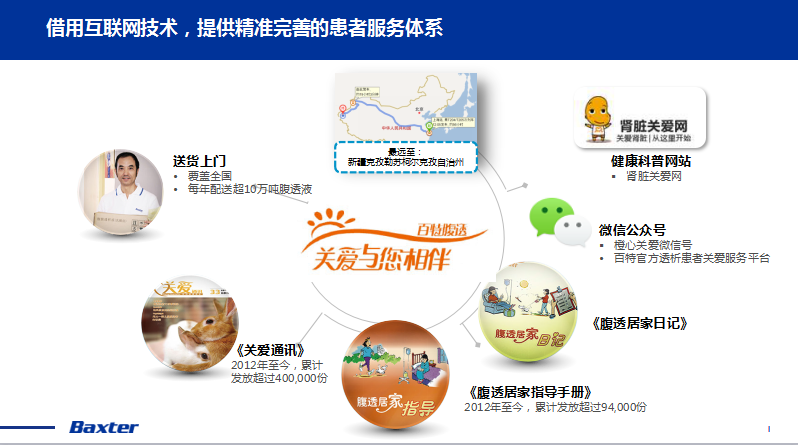
Finally, establish a closed-loop patient care model.Leverage Baxter’s expertise and resource advantages in the field of chronic diseases to create end-to-end disease management solutions covering the entire patient journey. In addition to the Baxter-exclusive home delivery service for peritoneal dialysis fluids mentioned in my earlier presentation—which delivers nearly 2.5 tons of peritoneal dialysis fluid annually to each of the majority of patients across China using Baxter’s peritoneal dialysis products—we also serve patients by helping grassroots healthcare professionals enhance their diagnostic and treatment capabilities. This includes promoting and providing training on surgical catheter implantation techniques.
In mid-July, Baxter will also launch a newly upgraded peritoneal dialysis patient care system. By providing a digital patient care platform, it aims to genuinely help uremia patients enjoy convenient treatment and return to normal social life.