

PeptiCube Leverages AI for Diabetic Retinopathy Screening in China's $3 Billion Blue Ocean Market
“Leveraging AI-powered peptide building block technology, lesion marking on a single fundus image can be completed in 13–15 seconds, compared to the 3–5 minutes required by physicians. This represents an approximately 20-fold increase in speed while maintaining diagnostic accuracy. Given the severe shortage of ophthalmologists in China, the widespread adoption of this technology holds great promise for significantly alleviating screening challenges for the country’s 110 million patients with diabetic retinopathy.”
Peptide Blocks founder Wenjie Bai articulated the significance of her product in an interview with VCBeat. What is the current state of the diabetic retinopathy screening market in China? How does Peptide Blocks leverage AI for the screening and diagnosis of diabetic retinopathy? To address these questions, VCBeat has conducted follow-up reporting.

Bai Wenjie, Founder of Peptide Building Blocks
Bai Wenjie told VCBeat,From the Perspective of AI, there are two reasons for choosing diabetic retinopathy, also known as DR, as the entry point:First, fundus data for diabetic retinopathy is highly accessible.。
A substantial amount of data is available across various publicly accessible international datasets. For instance, a previous Kaggle competition featured 80,000 medical images encompassing multiple classifications. In addition to Kaggle, other well-known databases such as ADCIS, DRIVE, STARE, HRF, DRIONS, and DIARE are also undergoing corresponding curation and organization.
There are nearly 100,000 fundus images available in datasets across the public market and within the industry. This provides a relatively high-quality dataset for many startups in the fields of deep learning and artificial intelligence.
Second,The patient's condition can be reliably assessed based solely on fundus images of diabetic retinopathy.. If policies permit, AI-powered fundus image diagnostic systems can be directly integrated into the treatment workflow, serving as a tool to assist primary care physicians or doctors at tertiary hospitals in screening and diagnosing diabetic retinopathy.
In contrast, conditions in other areas, such as pulmonary diseases, are relatively complex. Even if AI is used to screen for pulmonary nodules, further clinical information is required to determine the specific type of disease; therefore, it cannot serve directly as a guide for treatment.
From the perspective of market demand,, according to a report by the World Health Organization (WHO),Approximately 500 million adults in China are in a prediabetic state, with around 110 million diagnosed diabetic patients and 30 million suffering from diabetic retinopathy. As diabetic patients require two diabetic retinopathy screenings per year at an approximate cost of RMB 100 per screening, the annual market size for diabetic retinopathy screening reaches RMB 20 billion.。
Such high-frequency screening is warranted because the probability of eye disease is 60%–70% in patients with diabetes for more than 10 years, and rises to 80% in those with diabetes for more than 15 years. A subset of these patients may progress to blindness or even require enucleation.
Therefore, it is essential for patients with diabetes to undergo regular screening for diabetic retinopathy.In the early stages of diabetic retinopathy, patients are often asymptomatic; however, fundus disease screening can detect the condition, enabling early intervention to maximize vision preservation.
There is a large population of patients with diabetic retinopathy and a high demand for fundus screening, yet China has an alarmingly small number of ophthalmologists.In 2016, China had only 30,000 ophthalmologists, with even fewer specializing in diabetic retinopathy screening., because simple diabetic retinopathy screening is a task that does not require high technical expertise and can be mastered by physicians after a short period of training. However, as physicians strive to pursue new technologies and engage in scientific research, few are willing to remain in diabetic retinopathy screening roles long-term.
The most pressing issue in diabetic retinopathy screening is the severe shortage of specialized physicians at primary care levels, while specialists at tertiary hospitals are overwhelmed and have limited time for image interpretation. The purpose of artificial intelligence systems is to assist physicians in screening and diagnosis, serving as an auxiliary tool.
Wenjie Bai is a serial entrepreneur in the big data sector. She was a core founding member of the operations teams at Xinbai Technology and Social Touch, both big data companies. Recognizing the opportunities, market demand, and pain points in screening and diagnosing diabetic retinopathy, she assembled a team of AI experts and founded Tai Jimu, a company specializing in AI-assisted medical imaging diagnosis. The company currently has a team of more than ten people.
Bai Wenjie stated that, in terms of products, Peptide Blocks has launchedAI-Assisted Medical Imaging Reading Platform, AI Training Platform for Medical Big Data, and AI-Powered Fundus Image Reading App for Consumer Customers。
AI-Assisted Medical Imaging Reading PlatformIt is a low-cost, high-efficiency AI-powered tool for auxiliary image interpretation, designed for diverse medical institutions. Leveraging artificial intelligence technology, it enables precise image analysis within seconds and provides comprehensive clinical decision support across the entire care continuum, including disease diagnosis, severity grading, lesion annotation, automated case report generation, treatment regimen recommendations, and disease progression prediction.
AI Training Platform for Medical Big Data, comprising four core modules: data integration and cleaning, annotation via a labeling platform, rapid robot training, and application of standardized interfaces. While enabling high-quality acquisition of medical imaging and annotated data, the system allows practicing physicians to perform data annotation and train AI assistants for diagnostic support, thereby facilitating the generation of research outcomes and helping doctors achieve their desired results.
App for Consumer-Facing Customers— “Tang Jimu,” a powerful self-screening tool for diabetic retinopathy, allows patients to upload images obtained from hospital examinations to the “Tang Jimu” app on Tai Jimu, thereby quickly receiving disease severity grading and lesion analysis, effectively obtaining a second diagnostic opinion. Bai Wenjie stated that self-screening for consumer-end users is free; however, fees apply if patients require in-home examination services or remote expert image interpretation.
In terms of diagnostic speed,Peptide Blocks leverages AI technology to complete lesion marking on a single fundus image in just 13–15 seconds (compared to 3–5 minutes for physicians), with the entire process—including case generation, lesion assessment, and grading—taking no more than 30 seconds.。
Regarding the accuracy of the product, Wenjie Bai told VCBeat that for certain specific lesions, such as exudation or hemorrhage, the system’s accuracy can reach 97%, surpassing physicians in identification capability. Of course, this statement is intended to facilitate understanding. In clinical practice, physicians need to integrate additional patient information to make a final diagnosis, which cannot be replaced by AI.
Bai Wenjie told VCBeat that there is an urgent need for an industry standard in diabetic retinopathy screening.Enterprises or hospitals collect a certain volume of imaging data comprising fundus photographs of varying quality, engage a panel of experts to perform annotations and establish grade classifications, and then input these images into the fundus AI-assisted diagnostic and screening systems developed by various startups. The accuracy derived from comparing the systems’ outputs with the experts’ annotations is what lends meaningful validity to the results.
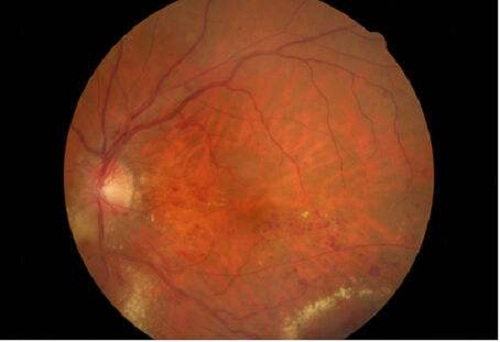
High-Quality Fundus Images
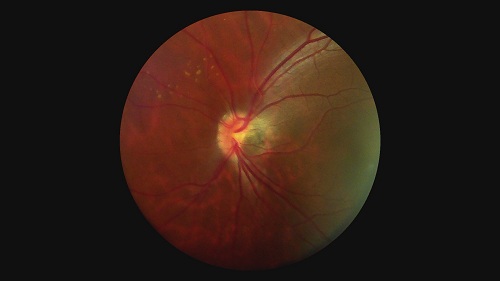
Low-Quality Fundus Images
Otherwise, data quality varies across institutions. While high-quality data naturally yields higher accuracy, in real-world applications, the system encounters a wide variety of fundus images. If image quality is poor, accuracy cannot be guaranteed.
Peptide Blocks has established strategic collaborations in ophthalmic artificial intelligence with more than ten Grade-A tertiary hospitals, including the Zhongshan Ophthalmic Center, Peking Union Medical College Hospital, Beijing Tongren Hospital, Peking University People’s Hospital, Peking University First Hospital, the Chinese PLA General Hospital (301), and Guangdong Provincial People’s Hospital. Additionally, it has partnered with over 20 primary-care hospitals to implement data and product deployment.
In terms of its business model, Peptide Blocks is exploring two approaches,One model charges per diagnosis, while the other generates referral fees by driving patient traffic to hospitals; both models involve charging hospitals.
In January 2017, Peptide Blocks secured millions in angel investment from a pharmaceutical group and is currently undertaking a new round of financing. In the future, Peptide Blocks aims to clarify its consumer-facing business model and expand its product portfolio into various areas of ophthalmology, such as glaucoma and cataracts.