

Neocis Files IPO: The Maker of Yomi, the World’s First and Only FDA-Approved Dental Robotic Guidance System
With the advent of smart healthcare, medical robots have long become a fiercely contested battleground for companies. As early as February 2017, VCBeat (WeChat ID: vcbeat) reported that the FDA had granted its first approval to a dental robotic navigation system—Yomi—for use in dental implant surgery. This remains the first and only dental assistance system to have received FDA approval.
What is particularly intriguing is that this robot does not come from top-tier medical robotics companies such as Intuitive Surgical or Verb Surgical, but rather from Neocis, a privately held company. Prior to the Yomi robotic navigation system, Neocis had no other flagship products, and industry perception of the company was limited to its manufacture of “robotic arms.”
What kind of company is this? What makes the Yomi robot unique? In the fiercely competitive “red ocean” of medical robotics, how is Neocis carving out its own “blue ocean”? These questions await our exploration.
About Neocis
Neocis, headquartered in Miami, Florida, was founded in 2012 and primarily develops robotic technologies for the medical industry to improve healthcare. The company’s team consists of 11 members, mainly comprising robotics engineers, engineers, and physicians.
To date, Neocis has completed three rounds of financing: it raised $1.1 million in seed funding in 2012, with its first investor being Fred Moll, the founder of medical robotics giant Intuitive Surgical; in August 2014, Neocis secured $1.32 million in Series A financing. Following FDA approval of the first-generation Yomi system, Neocis is currently raising additional funds for research and development.
Founders Emerging from Startups
Neocis was founded by Dr. Alon Mozes and his partner Juan Salcedo, both of whom possess extensive backgrounds in biomedical science and computer science. Dr. Mozes has dedicated nearly 15 years to computer graphics and image-guided applications for startups, while Mr. Salcedo brings over a decade of experience in manufacturing and mechanical design within the medical device industry.
Both individuals previously worked at MAKO Surgical, a young robotics startup. In 2005, Moze became one of the first 20 employees at MAKO Surgical, where he helped develop the software for the company’s groundbreaking Rio system for robotic orthopedic surgery, established its first human cadaver lab, and secured its first FDA approval. Salcedo also played a significant role in the design of Mako’s first- and second-generation systems, laying a solid foundation for the subsequent development and regulatory approval of the Yomi robot.
During their market analysis, the two founders recognized that robotic surgery had yet to fulfill the demand and potential within the rapidly growing dental implant market. According to Dr. Alon Mozes, their idea originated in 2009, with the initial prototype being a robot constructed from scrap metal. “It looked exactly the same as it does now,” said Salcedo. “We started out working nights and weekends in a garage.” Although it began as just a model, one must admire Neocis’s patience; after five years of development, the company launched its core product, which has largely freed the hands of hundreds of thousands of dentists across the United States.
What is Yomi?
Yomi is a dental robotic navigation system developed by Neocis, a US-based company. It is designed to assist surgeons with preoperative and intraoperative dental implant procedures, enabling precise surgical planning. By providing a visual interface that ensures accurate control of surgical trajectory—preventing deviations from the planned position and depth—Yomi establishes a true digital dentistry workflow. The system offers haptic guidance and multisensory feedback, facilitating minimally invasive techniques. These features contribute to faster surgeries, quicker recovery times, and reduced patient pain. Furthermore, the dental navigation robotic system allows clinicians to modify surgical plans directly within the software, enhancing efficiency and convenience.
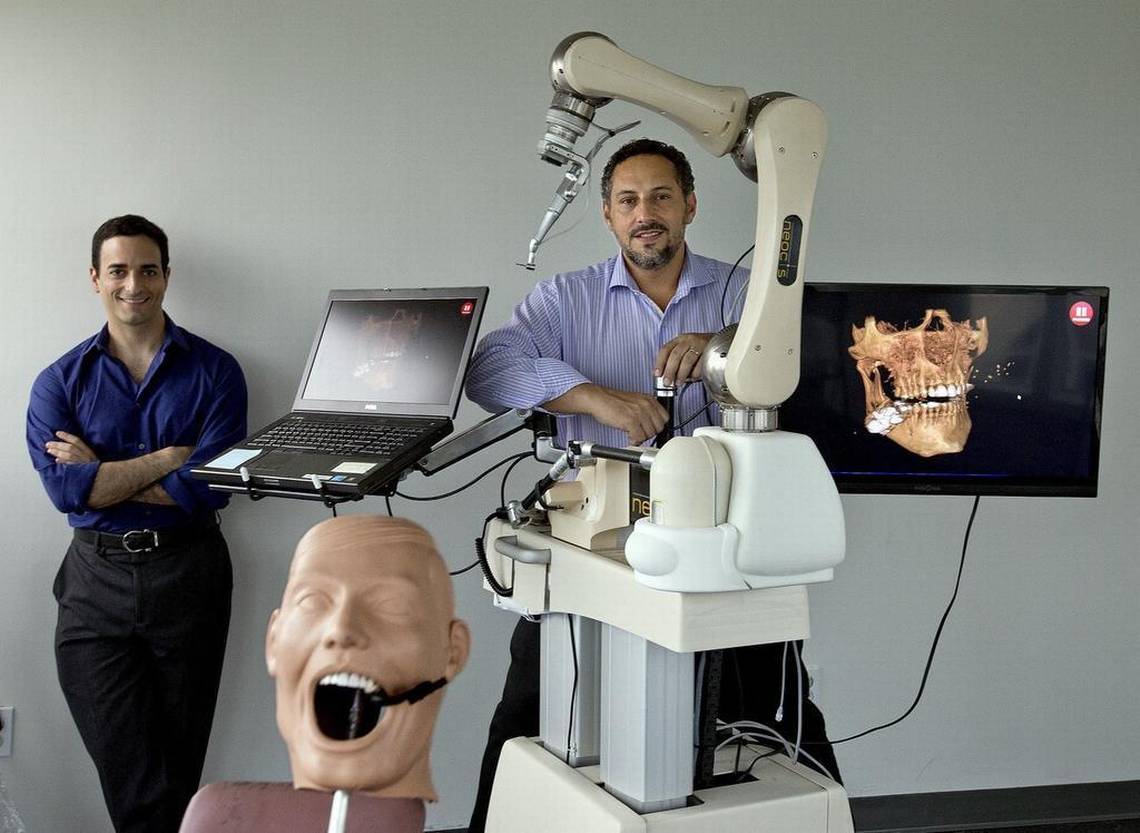
Yomi Dental Navigation Robot
Neocis’s official website prominently features the five-word tagline, “Redefining the standard of care.” With Yomi as its sole highlighted product and focus, the platform underscores that Yomi represents a groundbreaking innovation for Neocis and the entire dental implant industry.
Neocis's Business Model
Value Proposition:Redefining Standardized Care, Revolutionizing Healthcare;
Core Resources:1. Yomi is FDA-cleared, ensuring safety and reliability; 2. The advanced robotic navigation system enables clear visualization of the surgical site and allows surgeons to dynamically adjust the surgical plan;
Key Business:Develop dental implant robots;
Customer Relationships:1. Pilot hospitals and dental center activities; 2. Neocis official website;
Source of Income:Yomi Robot Sales Revenue;
Target Market:Positioned in the field of dental implants, targeting dental implantologists who perform dental auxiliary surgeries;
Distribution Channels:Sales to key accounts such as hospitals, clinics, and companies.
Seizing the Opportunity: Exploring Niche Markets in Dental Implantology
In the field of dentistry, the United States is undoubtedly the most fertile ground for dental development. The domestic dental market is mature with robust demand, and basic dental implantation has become the standard of care for replacing missing teeth in the U.S. Each year, 15,000 dental specialists and nearly 150,000 general dentists perform close to 4 million implant procedures. On a global scale, there are over 15 million implant procedures performed annually. Given this vast volume, the broad application prospects of Yomi are clearly evident.
In the global market for medical robots, there is no shortage of surgical robot varieties. However, in the field of dental robotics, prior to Yomi, only Japan had developed a medical simulation robot specifically designed to assist in training young dentists through simulated procedures. Additionally, institutions such as Peking University School of Stomatology and Beijing Institute of Technology jointly developed a prosthodontic robot that leverages computer-aided design and robotic assistance to fabricate complete dentures with artificial teeth, replacing manual tooth arrangement with precise digital operations. Therefore, in the realm of dental implant robots, Yomi should be regarded as a pioneering innovation.
Currently, only 5%–10% of surgeries worldwide are performed by robots, indicating immense market growth potential. Neocis has targeted the dental sector and carved out its own niche in the surgical robotics market.
Building Word-of-Mouth: Precision Point-to-Point Marketing
In Neocis’s marketing model, the company primarily focuses on direct, point-to-point promotion of its robotic systems to dentists and patients, highlighting the benefits and convenience of the technology. It also leverages endorsements from key opinion leaders in the dental industry to build word-of-mouth reputation. On the bottom section of its official website, purchase channels are made available to interested buyers. This seemingly “clumsy” approach is, in fact, the most effective way for a small company to demonstrate its sincerity and commitment.
Industry Overview: A Growing Ecosystem for Medical Innovation
In South Florida, where Neocis is based, the typical environment for robotics and medical device innovation is not visible from the outside, and funding remains a challenge. However, the industry has fostered a growing ecosystem of medical innovation, with companies such as MAKO, Ortho Sensor, Modernizing Medicine, and CareCloud emerging as industry leaders. Dr. Mozes stated, “It is very rewarding to see them grow and succeed here.” The leadership demonstrated by these industry pioneers within their field is undoubtedly of immense significance to startups in their early stages.
Cutting-edge, complex high-tech innovations and multidisciplinary integration have long positioned robotics at the apex of the pyramid as a high-barrier, high-value sector. Despite significant technical challenges, the market opportunities are substantial and profitability is considerable. Currently, da Vinci, the most robustly growing player, achieved global sales of $633 million in 2013, accounting for 42.43% of the market. According to data from Boston Consulting Group (BCG), by January 2016, the global medical robotics industry had reached an annual revenue of $7.47 billion, continuously attracting numerous enterprises to join R&D efforts and thereby fostering a medical innovation ecosystem. The compound annual growth rate (CAGR) is projected to remain stable at 15.4% over the next five years, with the global medical robotics market expected to reach $11.4 billion by 2020. Surgical robots account for approximately 60% of the market share, and the future medical robotics market is poised to evolve into a trillion-dollar industrial chain.
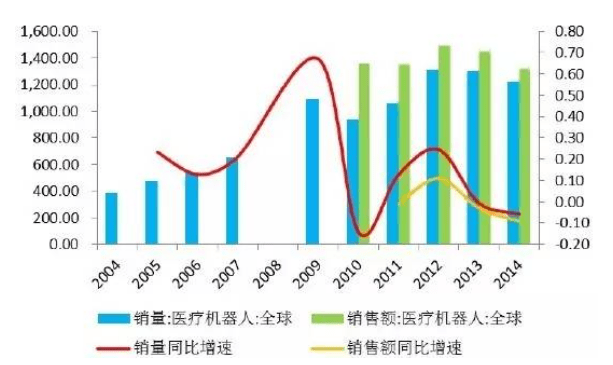
Global Sales of Medical Robots, 2004–2014
Data Source: China Investment Consultant Industry Research Center
Domestic R&D conditions are not as advanced as those in developed countries abroad. In contrast to the substantial demand and favorable R&D environment in the North American market, most teams and technologies in China’s medical robotics industry remain at the laboratory stage, with many challenges still to be addressed before true commercialization can be achieved.
However, in terms of policy support, this is the best era for medical innovation. From the opening-up of upstream robotic components to the development of downstream smart healthcare, medical robots have formed a complete industrial chain and become an important part of the national strategy for Industry 4.0. The State Council has proposed in the "13th Five-Year Plan" outline and subsequent guiding documents such as "Made in China 2025" to focus on developing high-performance diagnostic and therapeutic equipment like medical robots, actively encouraging innovation in domestic medical devices. With fierce competition in overseas markets, Asia has become a strategic key market for medical robot companies such as Intuitive Surgical.
International Comparable Companies
As Neocis operates in the field of dentistry, this article selects for analysis companies engaged in the research and development of dental-assistive robots, enterprises related to oral treatment, or those with experiences similar to Neocis.
Sirona: With a history spanning over 130 years, the German company Sirona is an enterprise dedicated to dental equipment, including integrated dental treatment units, X-ray imaging diagnostic systems, therapeutic instruments and sterilization equipment, as well as CAD/CAM computerized all-ceramic restoration systems (known as CEREC). Its products are marketed in more than 100 countries and regions worldwide, establishing a global sales network. It is currently the world’s largest supplier of dental equipment with the most comprehensive product range. Compared to Neocis, Sirona offers a more diversified product portfolio. In the field of dental implantology, the company provides solutions such as Sirona Connect digital impressions, the CEREC integrated implant system, and 3D aesthetic sculpting robots. These serve as auxiliary devices for dental diagnosis and treatment, ranging from scanning and diagnosis to restorative surgery, enabling intelligent operations across all stages of dental care.
Auris: Founded in 2007, Auris did not launch its first medical robot product, ARES, until June 2016. The company is dedicated to addressing conditions of the larynx, lungs, and digestive system by enabling surgical robots to access these areas through the body’s natural orifices (particularly the mouth), and it has received FDA approval. During the preceding nine years, the company had no products, revenue, or public technological disclosures, yet it generated significant industry interest and continuously attracted investors. Before officially launching its product, this seemingly asset-light enterprise secured $150 million in 2015—the largest financing round in the healthcare sector that year—and acquired Hensena in April 2016 for $80 million. This momentum was largely driven by its founder, Dr. Frederic H. Moll, who also founded the industry giant Intuitive Surgical, as well as a board of directors that included Ajay Royan (founder of Mithril Capital) and Peter Hebert (co-founder of the venture capital firm Lux Capital). Similar to Neocis, Auris had only one core product, ARES, during its first nine years. However, Hansen Medical held a substantial portfolio of relevant patents, which would pave the way for Auris’s entry into the flexible robotics market. Although ARES was its only commercialized product, Auris itself possessed multiple patents in the field of surgical robotics, facilitating the development of its next-generation surgical robots.
In summary, Neocis differs significantly from the aforementioned companies. Its key advantage lies in Yomi, the first FDA-approved navigational robot for dental implant surgery, a product that effectively fills a market gap. According to VCBeat, Neocis ranks among the five healthcare startups with the greatest investment value. However, as a startup, its weaknesses include a relatively limited product portfolio, a simplistic marketing model, and low brand recognition, which hinder its ability to attract more investors in the early stages. Its financial position may improve significantly after Yomi receives FDA approval.
Competitive Landscape of the Domestic Dental Industry
According to a report by the research firm GCiS, the value of China’s medical robotics market in 2016 was RMB 791 million, representing a 34.4% increase from 2015. By 2021, the industry’s value is projected to grow to at least RMB 2.2 billion. Currently, there are fewer than 20 medical robot manufacturers in China; however, at least six or seven emerging companies are in the product development or clinical trial stages, while most enterprises have completed clinical trials and are awaiting approval from the China Food and Drug Administration (CFDA). The market outlook presents a blue-ocean opportunity.
According to the findings of China’s third national oral health epidemiological survey, the rate of tooth loss among the elderly is significantly higher than that among middle-aged and younger populations, while dental consultation rates remain persistently low. It is projected that as population aging continues, the market potential for dental treatment and healthcare in China will further expand. Compared with developed countries abroad, China’s dental market is still in its early stages of development, with the dental profession having started relatively late; the penetration rate of dental implants is negligible compared to that in developed nations. The overall market size remains small, indicating substantial room for growth in high-value-added services.
In the field of surgical robotics, China’s landscape for dental robot development is virtually barren. Only a few medical and research institutions are attempting to develop robots for dentistry. According to data from VCBeat, since 2011, nearly half of the 14 companies in the dental sector have been focused on O2O applications for offline dental clinics, online marketplaces for dental equipment, or tools for dentists, leaving a significant gap in the development of dental robots.
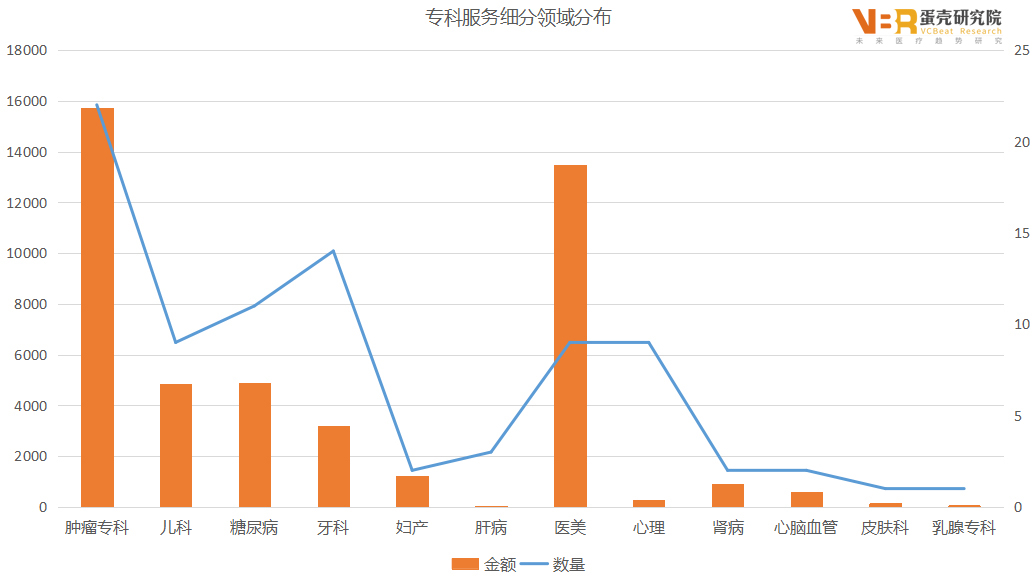
Figure: Distribution of Specialized Service Sub-sectors Since 2011
Unit: USD 10,000
Data Source: VCBeat · VCBeat
R&D Status of Related Products
Currently, based on information available to VCBeat, R&D resources for robotic systems in the dental field are scarce. Product development is primarily focused on innovative hardware and platform construction. Given the high risks associated with investing in robotic system R&D, such initiatives are generally led by national medical institutions, while private enterprises are mostly involved in software development areas such as SaaS solutions for dental clinics and internet-based patient referral platforms. Regarding intelligent hardware in the oral care sector, only a few representative products are listed below:
Miniature Robotic System for Automated Laser Tooth Preparation: Developed by the National Engineering Laboratory for Digital Dental Technology and Materials at Peking University School of Stomatology, this system features a refined design that utilizes robotic control of femtosecond laser beams to achieve precise intraoral positioning and “precise” cutting and ablation of teeth requiring treatment.
3D-Printed Personalized Dental Implants (Undergoing Clinical Trials): Developed by a team led by Professor Tang Zhihui from the Peking University School and Hospital of Stomatology, future 3D-printed dental implants are expected to significantly reduce surgical trauma, simplify the implantation procedure, shorten the treatment cycle to one to two hours, and cut costs by half.
Spectral Dental Cone-Beam CT System: Developed by Shanghai UEG Medical Imaging Equipment Co., Ltd. (UEG), the company’s medical product portfolio includes dental CT scanners, surgical navigation systems, silicon-based wound repair materials, innovative disposable trocars, and innovative endoscopic surgical instruments. UEG’s spectrally enhanced dental CBCT system, which features independent intellectual property rights, is the world’s first of its kind and has recently secured tens of millions of RMB in Series A financing from Huayi Capital. To explore the in-depth application of this novel technology in dentistry, UEG has established a collaborative partnership with KU Leuven in Belgium, laying the groundwork for significant expansion in China’s dental CT market based on its spectral dental CBCT platform.
Implications for Entrepreneurs
1. Identify a suitable niche. The healthcare ecosystem is vast; Neocis has secured an appropriate niche and established a strong foothold for growth. While the medical robotics sector encompasses numerous categories, and you may not be able to compete with listed companies such as Truking Technology and Siasun Robot & Automation, the market growth potential in specialized niches is substantial. Neocis targeted gaps in the U.S. dental implant market and, with a team of only 11 members, became one of the first FDA-cleared dental navigation robotic systems. Identifying a domain aligned with your development strategy is undoubtedly crucial.
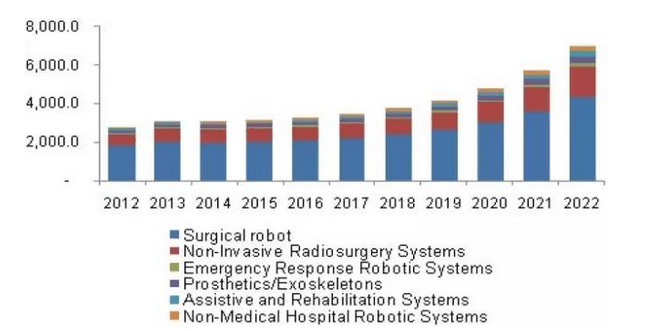
Figure: Growth Rates of Various Medical Robot Product Segments, 2012–2022
Unit: Million USD
Data Source: China Investment Advisor Industry Research Center
2. Implement ideas in a timely manner; product success lies not in quantity, but in quality. According to Dr. Alon Mozes, founder of Neocis, it took eight years (2009–2017) to bring Yomi from concept to market, strictly speaking turning the idea into practice. Similarly, Auris’s ARES robot only emerged after ten years since the company’s founding. Such an extended period allows time for making mistakes and correcting them, ultimately leading to the successful development and launch of the product.
3. Enter the healthcare industry first, then develop medical products. Only by thoroughly understanding market operation rules can a company function effectively. The two co-founders of Neocis previously worked at startups and were key participants in FDA approval projects, gaining hands-on knowledge of regulatory processes and standards. This experience provided valuable guidance for bringing their later products to market and securing regulatory approval.
4. In terms of marketing strategy, strive to gain endorsement from Key Opinion Leaders (KOLs), as their influence within the industry is sufficient to make your product a household name.