

Tencent Partners with Guangdong Provincial People's Hospital to Co-Build a Smart Hospital
On June 28, VCBeat (WeChat Official Account: vcbeat) received news that Guangdong Provincial People's Hospital and Tencent have entered into a strategic partnership. The two parties will collaborate strategically in numerous areas, including innovative health insurance payment models, AI-assisted diagnosis and treatment, online consultations, electronic prescription circulation, and regional coordination, with the aim of jointly establishing a benchmark for smart hospitals.
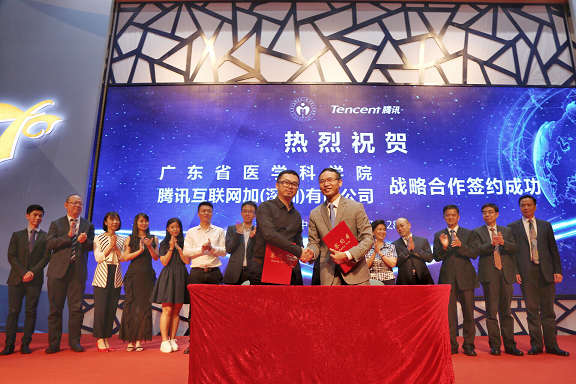
Chang Jia, Head of Tencent’s Internet+ Healthcare (left), and Zhuang Jian, President of Guangdong Provincial People’s Hospital (right), sign a strategic cooperation agreement
Founded in 1946, Guangdong Provincial People's Hospital is the largest comprehensive hospital in Guangdong Province and one of the largest and most comprehensively capable hospitals in China. With an average daily outpatient volume exceeding 10,000 visits, its strategic partnership with Tencent in the field of "Internet + Healthcare" will play a significant role in advancing the level of smart healthcare in Guangdong.
Pursuant to the Strategic Cooperation Framework Agreement signed by both parties, Tencent will fully leverage its strengths in internet technology applications, information systems, big data, and cloud computing to support Guangdong Provincial People’s Hospital in delivering a wide range of innovative services:
Mobile appointment services for patients, including registration and examinations; digitization of physical hospital visit cards to enhance the real-name database for hospital visit cards; online consultations and medication services via text and images for follow-up and chronic disease patients; electronic prescription circulation to both in-hospital pharmacies and external retail pharmacies, allowing patients to choose between pharmaceutical logistics delivery or self-pickup.。
Chen Guangyu, Vice President of Tencent’s Mobile Internet Group and General Manager of the “Internet Plus” Cooperation Division, stated, “We hope that through our joint efforts, we can work together to establish a benchmark for smart hospitals, further improving and enhancing patients’ experience in accessing medical services.”
In addition, both parties will alsoMedical Innovation Payment Models and Applicationsreached a strategic partnership to jointly explore breakthrough applications of financial payment and insurance services in the healthcare sector, achievingWeChat Pay, WeChat Medical Insurance Payment, Real-time Cross-provincial Settlement for New Rural Cooperative Medical Scheme (NRCMS), and Commercial Insurance Claims Paymentand other innovative payment models, benefiting more patients and jointly shaping the healthcare ecosystem.
It is reported that WeChat’s medical insurance payment service has already been launched in multiple regions, including Guangxi, Shenzhen, Chengdu, Zhengzhou, Shantou, Tongchuan, and Xiamen, enabling in-hospital consultation payments and WeChat Pay for prescription purchases at pharmacies. Meanwhile, numerous other cities across China, such as Xinjiang, Weifang, Jiaxing, Taizhou, Xiamen, Harbin, Nanchang, Shenyang, Yongkang, and Kaifeng, are accelerating their deployment of the service.
WeChat medical insurance payment not only alleviates the management pressure on hospitals but also significantly improves patients’ healthcare experience. Calculations show that using WeChat for medical insurance payments saves users an average of 43.6 minutes in queuing time during medical visits.
It was revealed that the two parties will also explore advancing innovations in commercial insurance claims payment to enable instant “second-level claims settlement,” allowing users to complete the previously cumbersome process online, thereby saving patients’ time and alleviating their financial burden for medical care.
Furthermore, both parties will jointly promote the expansion and enhancement of “Internet+” applications in the healthcare sector through various measures. By implementing functionalities such as WeChat-based electronic medical cards, mobile healthcare services, remote outpatient consultations, two-way patient referrals, and electronic signing of family doctor contracts, they will help medical consortiums achieve innovation in tiered diagnosis and treatment.
The application of artificial intelligence will also be an indispensable and important element in both parties' efforts to promote smart healthcare.
Both parties will collaborate on the research and development of medical big data and artificial intelligence, exploring and applying medical imaging technologies as well as AI-driven products and services based on healthcare data, enabling computers“Learning”Expert physicians' medical knowledge, simulating clinical thinking and diagnostic reasoning to deliver reliable diagnostic and treatment plans, thereby supporting medical research innovation in hospitals andAIThe Widespread Application of Assisted Diagnosis and Treatment.
It is understood that both parties will continue to innovate their collaboration and expand into a broader range of applications, gradually forming a systematic and mature “Integrated Smart Hospital Solution” to jointly establish Guangdong Provincial People’s Hospital as a benchmark model for comprehensive smart hospitals.