

Sinopharm Online Secures RMB 120 Million Series A Funding Led by Yunfeng Capital and Longsen Investment to Accelerate Pharmacy Digitization
Another Major Financing Round Completed in the Pharmaceutical E-commerce Sector. On July 5, Sinopharm Online, the pharmaceutical e-commerce brand under China National Pharmaceutical Group (Sinopharm), announced the completion of its RMB 120 million Series A financing round, with Yunfeng Capital and Langsheng Investment as the investors.
Wang Letian, General Manager of Sinopharm Online, stated that this round of financing will be used to integrate offline retail and distribution resources, including the deployment of physical cloud pharmacies across various regions, to support Sinopharm Group’s strategic transformation towards an integrated wholesale and retail model.
Sinopharm Online, invested and established by China National Pharmaceutical Group in 2015, is positioned as an e-commerce platform for health products and pharmaceuticals. Its primary business is a B2C online pharmacy, serving as an intermediary hub within Sinopharm’s e-commerce ecosystem.
In its first year of operation, Sinopharm Group achieved strong sales results. Wang Letian stated that GMV on Sinopharm Online reached RMB 600 million over the past 12 months.
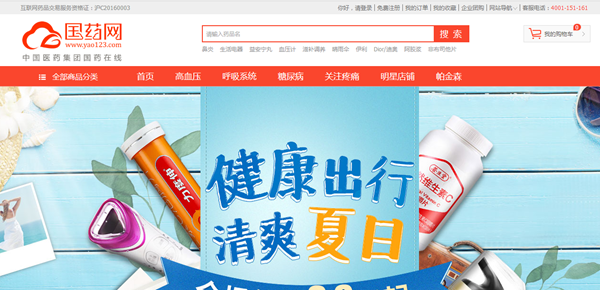
Sinopharm Online Official Website
Nevertheless, the endorsement of Sinopharm Group has played a pivotal role in Guoyao Online’s remarkable achievements. Sinopharm Group is China’s largest, most comprehensively integrated, and strongest pharmaceutical and healthcare industrial group, directly supervised by the State-owned Assets Supervision and Administration Commission of the State Council.
Its core business focuses on the distribution, retail, research and development, and manufacturing of pharmaceutical and healthcare products. It owns 10 wholly-owned and holding subsidiaries, as well as six listed companies: Sinopharm Group Co., Ltd., Sinopharm Co., Ltd., Sinopharm Accord Co., Ltd., Beijing Tiantan Biological Products Corporation Limited, Shanghai Modern Pharmaceutical Co., Ltd., and China Traditional Chinese Medicine Holdings Co. Limited.
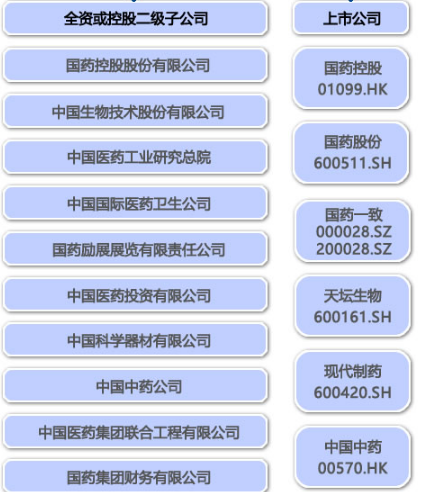
Sinopharm Group Structure
From 2006 to 2016, Sinopharm Group achieved a compound annual growth rate (CAGR) of 26.47% in operating revenue, with revenues exceeding RMB 300 billion, and a CAGR of 31.92% in total assets. It is the largest and fastest-growing pharmaceutical industry group in China.
Backed by Sinopharm Group, Guoyao Online naturally enjoys the advantage of “finding shade under a large tree.”
Sinopharm’s e-commerce ecosystem includes Sinopharm 1 Health, Sinopharm Reagents, Sinopharm Online, Sinopharm Holding Guangzhou Pharmaceutical Network, Guoda Drugstore, and Sinopharm Mall, integrating pharmaceutical B2B and B2C operations and covering a wide range of businesses such as pharmaceutical distribution, wholesale, and retail.
However, Sinopharm Online’s entry into the market may have come somewhat late, as the golden period for online pharmacies to exert their competitive advantage has already passed.
China's pharmaceutical e-commerce market originated in 2005, when the "Interim Provisions on the Approval of Internet Drug Transaction Services" were issued, marking the inception of the sector.
The first boom period of pharmaceutical e-commerce occurred around 2010. A large number of online pharmacies, including Jianke, 111.com.cn, Qilekang, Kangaiduo, and Jiujiuweikang, were founded around 2010.
With the establishment of third-party online pharmaceutical retail pilot platforms such as Tmall Pharmacy, Yihaodian, and 800 Fang, online pharmacies witnessed their first wave of rapid growth. Transaction volume expanded from less than RMB 100 million in 2005 to nearly RMB 10 billion by the end of 2014.
By 2014, the pharmaceutical e-commerce sector entered its second phase of rapid growth, with numerous B2B platforms established during this period, including Weiming Penguin, Yaomaitong, Zhao Yaocai, Yaodou.com, Yaoyaohao, and Putian Pharmaceutical & Medical Device Network. These platforms targeted the demand side—such as clinics and retail pharmacies—with a focus on online drug procurement.
Subsequently, online pharmacies and digital procurement spurred the pharmaceutical industry to actively embrace e-commerce. Many retail pharmacies began venturing into the “Internet + Pharmaceuticals” sector, leveraging their physical stores as service hubs to deploy O2O medicine delivery services. Notably, Dingdang Kuaiyao and Kuaifang Songyao, two prominent O2O medicine delivery platforms currently active in the industry, were both founded around the same time.
By early this year, the State Council’s administrative order abolished the approval requirements for Class B and Class C qualifications in pharmaceutical e-commerce, lowering entry barriers and ushering the sector into its third growth cycle.
Meanwhile, Document No. 13 issued by the General Office of the State Council requires the standardization of online retail services provided by retail pharmacies, promoting new delivery models such as “online ordering with in-store pickup” and “online ordering with store-based delivery,” thereby encouraging pharmaceutical O2O and integrated online-offline pharmaceutical retail.
According to the "Blue Book of Pharmaceutical E-commerce," the annual average growth rate of China's B2C pharmaceutical e-commerce market exceeded 100%, rising from less than RMB 2 billion in 2012 to RMB 28.6 billion in 2016, a 17-fold increase over five years.