

Philips' Acquisition of Spectranetics: Uncovering the Patent Portfolio Behind the $2.16 Billion Deal

In recent years, it has become an undisputed fact within the industry that Philips has increasingly shifted its business focus toward the healthcare sector. In key segments such as personal health care, diagnostic imaging and therapy, and health informatics, Philips has continued to strengthen its presence, achieving remarkable results in both technological innovation and market revenue.
In addition to actively investing in the research and development of new technologies and market promotion, Philips’ continued expansion in the healthcare sector naturally involves mergers and acquisitions. Recently, Philips officially announced that it had acquired Spectranetics, a U.S.-based medical device company specializing in minimally invasive surgical procedures, for €1.9 billion. (See details:Philips Acquires Medical Device Manufacturer Spectranetics for €1.9 Billion, Accelerating Expansion of Image-Guided Therapy Devices)
This move aims to expand downstream into cardiovascular therapeutic technologies, synergistically integrating Philips’ proprietary interventional imaging systems with Spectranetics’ cardiovascular interventional consumables to provide physicians with more highly integrated solutions for cardiac and peripheral vascular treatments.
Behind every alliance and partnership lies an inevitable assessment and scrutiny of each party’s strength, resources, and value. In the corporate “marriages” formed through mergers and acquisitions, due diligence on the background of future “family members” is naturally indispensable. This is particularly true for technology-driven companies, where evaluating the target’s technological background before acquisition is of paramount importance. So, what are Spectranetics’ technical advantages that have earned it such high regard from Philips? To answer this question, we can gain some insights by examining Spectranetics’ patent portfolio.
As a longstanding leader in the medical device industry, Spectranetics has been in operation for 33 years, accumulating substantial technical expertise. Since 1989, this Colorado-based company has filed a total of 426 patent applications worldwide. In terms of International Patent Classification (IPC), its patented technologies are primarily concentrated in three categories: A61B (Diagnosis; Surgery; Identification), A61N (Electrotherapy; Magnetotherapy; Radiation Therapy; Ultrasound Therapy), and A61M (Devices for Introducing Media Into or Onto the Body).
These three categories account for 80% of the total patent portfolio and represent Spectranetics’ primary R&D focus. The products corresponding to these three patent categories mainly include various medical devices used during interventional procedures, such as laser catheters (US8628519B2), optical fibers (US8758333B2, US7563262B), drug-coated balloon catheters (US9198968B2), and debris removal devices for thrombectomy (US20100145259A1). In particular, the prevalence of patents in the A61N category indicates that a significant portion of the company’s technologies requires close integration with radiation and electromagnetic therapies. This suggests a high degree of technological relevance to Philips’ radiotherapy imaging technologies and substantial potential for technological integration.
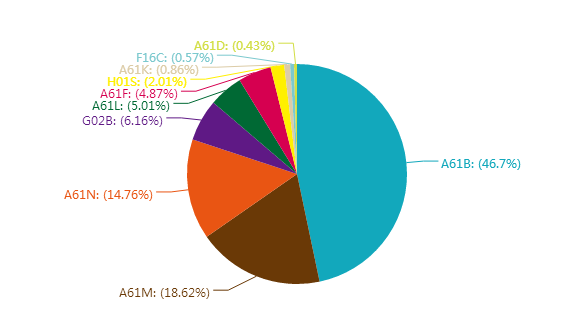
Spectranetics Patented Technology Composition Chart
In addition to the above categories, 6% of patent applications fall under G02B (Optical Elements, Systems, or Instruments). Although the number of patents in this category is relatively small, the products involved are more inclined toward electronic components. As such, they have a closer association with Philips’ imaging equipment as part of hardware systems. Moreover, this category includes a number of patents with strong foundational significance and broad application potential.
For instance, the optical polarization sensor disclosed in Patent No. US20090147257A1 can be utilized in RF ablation, laser ablation catheters, catheters, stent placement, endoscopy, and industrial non-destructive testing, reducing polarization loss of light through waveguides by 40% and demonstrating a high degree of innovativeness. Another example is the proximal optical coupler disclosed in Patent No. US7050692B2, which enables fiber optic fixation without the need for adhesives; in addition to being filed in the United States, this patent was also filed in Germany via the European Patent Office.
Notably, more than half (52%) of Spectranetics’ patents have undergone assignment procedures. Most of these assignments involved Spectranetics pledging individual patents or patent portfolios to commercial banks or financial trust institutions as collateral for financing, with subsequent redemption within a specified period. A significant number of patents and patent portfolios went through multiple cycles of pledging and redemption; for instance, Patent No. US20080154296A1 was pledged five times between 2011 and 2015 before ultimately returning to Spectranetics. Among these financial institutions, Wells Fargo Bank and MidCap Financial Trust each acquired approximately 40% of the patents, collectively accounting for over 80% of the share. Additionally, Silicon Valley Bank, which specializes in serving technology-driven innovative enterprises, also participated in these transactions.
Spectranetics’ large-scale patent pledge activities indicate that its patents have undergone risk assessment by professional financial institutions. This implies that these patents possess strong market prospects and high legal stability, with a low likelihood of being invalidated or involved in subsequent administrative litigation disputes. This undoubtedly serves as a reassurance for Philips, potentially even saving a portion of the costs associated with evaluating a large portfolio of patents prior to the acquisition.

Chart of Spectranetics Patent Assignees
In terms of global patent deployment, Spectranetics’ primary focus remains on the United States, where domestic patent applications account for approximately 51% of its total worldwide filings. Europe ranks second, representing about 20%. Another 12% of patents are published through the World Intellectual Property Organization (WIPO), with a small number of key patents also filed in major medical device markets such as Germany and Japan.
Currently, Spectranetics has only four patent applications in China. Its main products are drug-coated balloon catheters, which can be widely used in the treatment of atherosclerosis and restenosis after surgery in arterial walls, as well as adenocarcinoma, esophageal varices, and cholangiocarcinoma occurring in the gastrointestinal tract. Following this acquisition, Philips, which has always emphasized its patent layout in China, may accelerate the filing of patents under Spectranetics’ name in the Eastern market. This will also help Philips mitigate intellectual property risks associated with selling its interventional imaging products alongside Spectranetics’ products in China.
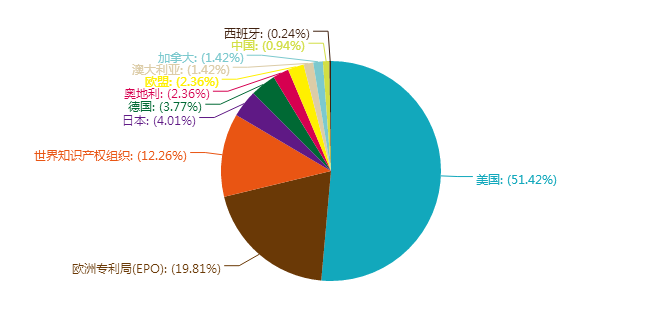
Global Patent Layout of Spectranetics
An analysis of Spectranetics’ patent portfolio reveals that the company not only possesses substantial technical expertise and industry-leading products but also offers technological synergies that complement Philips’ strengths. It is therefore unsurprising that Spectranetics has become a favored acquisition target for Philips. With Spectranetics now under its umbrella, Philips is well-positioned to accelerate the integration of upstream and downstream resources within the interventional imaging ecosystem, thereby further solidifying its leading advantage in the healthcare sector.
Here, we also take this opportunity to discuss the intellectual property issues that medical technology companies should pay attention to in mergers and acquisitions:
1. Assess whether the target company's technology is complementary to one's own
In today’s environment, where the financial and time costs of technological innovation continue to rise, it is unwise to start from scratch by independently entering a new technical field. Therefore, when acquiring target companies, it is essential to evaluate their patent portfolios in advance to identify their core R&D directions and resource advantages, assessing whether their technologies can address the acquirer’s weaknesses or align with the company’s future strategic layout. Furthermore, a substantial reserve of valuable patents can save the time costs associated with filing new patents, facilitating safe and rapid entry into the target market.
2. Assessment of Patent Value and Patent Stability
A large quantity of patents does not necessarily indicate high quality. Many patents have not undergone post-grant procedures such as pledge, assignment, licensing, invalidation, or litigation, leading to certain issues regarding their value and the stability of their rights. In this context, examining the utilization of patents becomes particularly important. For instance, like Spectranetics Corporation, where the majority of its patents have been pledged, indicating that they have undergone risk assessments by institutions such as trust companies and banks. This suggests that these patents not only have promising market prospects but also possess highly stable rights. If some patents remain valid despite invalidation requests, it demonstrates that these patents not only effectively target competitors' vulnerabilities but also maintain robust defensibility in rights protection battles, thereby holding greater value.
3. Mitigating Regional Market Risks
Patent rights are territorial in nature; if a patent is not granted in a designated country, it cannot be protected there. However, due to factors such as the cost and duration of international applications, many small and medium-sized enterprises (SMEs) only seek domestic protection during product development, with limited overseas patent layout. For instance, Spectranetics currently has only four patent applications in China. When acquiring a target company, if it is discovered that core technologies and patents deemed critical have not been secured in the company’s target markets, immediate action should be taken to file for protection. This prevents intellectual property gaps from hindering joint sales or bundled offerings of both parties’ products.
Certainly, there are numerous intellectual property (IP) issues involved in mergers and acquisitions (M&A) by medical technology companies. This is a complex systematic project that requires the company’s IP team to conduct comprehensive considerations in light of the enterprise’s development direction and strategic layout. Only in this way can the acquiring company fully leverage the target company’s intellectual property assets during the acquisition, thereby empowering the enterprise to achieve more ambitious long-term goals.