

How a Brilliant Idea Led to the Demise of Pact, the US Mobile Health Startup
Pact, a U.S. mobile health company that originated as a Harvard student startup, began with a brilliant idea and once secured endorsements from prominent angel investors. However, despite five years of operations, the company failed to achieve any significant breakthroughs. Pact recently notified users that it would cease operations after the end of August. Over the past five years, the mobile health market has undergone substantial changes, leaving Pact with no choice but to shut down. While there may be many reasons for its failure, from one perspective, Pact appears to have been constrained by its own “good idea.”
Starting with a Good Idea
In the past, many people believed that entrepreneurship began with a good idea. People would chat in cafes, engage in lively brainstorming sessions, and countless ideas would emerge. Pact was likely one of them, but it must be acknowledged that Pact stood out as particularly innovative.
Most people exhibit significant inertia toward fitness: they have good intentions but struggle to follow through—a pattern that seems to apply to virtually all of life’s pursuits. The founders of Pact came up with an idea: have users place bets on their self-set fitness or dietary goals. You must put up real money as a deposit; if you fail to meet your goal, you must accept defeat and forfeit the funds.
These goals are specific, short-term, and easy to achieve, encouraging steady progress over time. Users typically place small bets, such as $5 on completing 30 minutes of exercise per week. If the goal is achieved as planned, you not only get your deposit back but also receive a certain reward.
Pact’s founders believe that accountability is a powerful tool for pursuing health, leveraging the psychological tendency of individuals to work harder to overcome inertia in order to avoid tangible financial losses, thereby achieving more effective behavioral incentives.
The counterintuitive concept of earning money while improving your own health quickly attracted Pact’s first batch of users. The Pact app was officially launched in early 2012, facilitating over 5 million fitness activities in its first year of operation. With a user goal achievement rate as high as 92%, the results seemed to align well with the original vision.
By late 2013, Pact, having shown initial success, attracted investment from the renowned venture capital firm Khosla Ventures. With significant expertise in the healthcare sector, Khosla Ventures is one of the most active investors in the digital health space. Other co-investors included Max Levchin, co-founder of PayPal. In total, Pact secured $1.5 million in angel funding.
Good Ideas Are Not a Competitive Advantage
Because startups often begin with an idea that founders believe to be unique, this idea frequently becomes their distinguishing mark from other companies in the same field, leading them to mistakenly assume that this singular concept constitutes their core competitiveness. Such a misconception can prove to be a grave error.
Ideas themselves are not patentable; you cannot use them to keep competitors at bay, as they are easily replicated. The more understandable and feasible an idea is, the easier it is to copy. You can use it as a stepping stone, but not as a moat.
This is particularly true for Pact. Pact’s product concept appears simple, clear, and easy to implement, with a direct link to payments, but in reality, it is quite thin. Beyond requiring users to put up a deposit to create pressure, the Pact app itself lacks real-time health management features. However, fitness and wellness involve many components beyond just user behavioral incentives, and even when focusing on such incentives, requiring a deposit is not the only approach. From start to finish, Pact has seemed more like a plugin, unable to support broader strategic ambitions. Indeed, Pact has been integrated as a plugin into mobile health applications such as MyFitnessPal and Fitbit.
Around 2012, competition in the mobile health market was just getting underway. MyFitnessPal did not complete its Series A financing until 2013. At that time, the market was far from saturated; users had only recently been exposed to such health apps, and there was still considerable room to tap into latent demand. A wave of mobile applications subsequently entered the market, developed by wearable device manufacturers, well-known sports and fitness brands, or major chain gym operators. All of these players sought various ways to provide more services to users, thereby extending their value propositions and building larger user ecosystems.
These apps have only two core objectives: expanding their user base and enhancing user stickiness. To this end, many applications have gradually become more thoughtful and comprehensive in terms of functionality; nearly every app incorporates gamified strategies for user incentives, which are substantially similar across the board. For these larger-scale apps, replicating the deposit-based incentive model is as simple as developing a new plugin. For them, this is merely one option among many bells and whistles. In contrast, Pact relies solely on this single tactic, making its approach appear increasingly thin by comparison.
A Good Idea Is Not Necessarily a Profitable Business Model
We can see that Pact seems to focus all its actions on the deposit incentive mechanism, but this alone cannot create a profitable business model with growth potential.
Due to the lack of substantive functionality, Pact cannot adopt a tiered subscription pricing model like other health applications. However, given Pact’s product features, users are required to pay an initial deposit, thereby generating a certain level of cash flow for the company. By retaining a portion of the deposits forfeited by non-compliant users after deducting reward payouts, Pact can still recognize some funds as revenue. This may be a key reason why Pact managed to sustain operations for over three years after 2014 without securing additional rounds of financing.
We can make a preliminary calculation of the viability of this profit model. Based on available information, Pact users pay a $5 deposit for each goal. Upon completion, they not only get their $5 deposit back but also receive a reward of approximately 30–50 cents. The reported goal completion rate among Pact users is 92%. This means that out of 100 users, the 8 who fail forfeit a total of $40, which is then distributed among the 92 successful users. On average, this amounts to roughly 43 cents per person. If Pact retains a portion, say $1, the remaining amount would yield a reward of approximately 35 cents per user for the 92 successful participants. This 35-cent figure falls squarely within the stated reward range. Logically, it is plausible that Pact generates revenue by retaining 20% of the deposits from failed goals.
If this is Pact’s revenue model, we can roughly estimate its annual revenue. According to recent statements by Pact’s founder, users have completed 40 million health activities on the platform over the past five years. Assuming a gradual growth in user base, let us posit that 20 million health activities were completed in the most recent year. Pact’s annual revenue can then be estimated as follows: 20 million × (1 − 92%) × $1 = $1.6 million per year.
With such a revenue scale, after deducting various costs, the company could likely only sustain a small team of a few people. This is clearly far from sufficient for Harvard graduates with lofty ambitions and major angel investors like Khosla Ventures.
How to Expand Revenue Potential: Pact’s Persistent Focus on the Deposit Incentive StrategyAfter securing angel funding, the original name “Gympact” was abandoned in favor of “Pact,” reflecting the addition of behavioral goals related to healthy eating alongside its core deposit incentive model. Furthermore, we have observed an increase in deposit amounts. While early reports cited a weekly commitment of $5, current examples show penalty deposits set at $20–$30 per day, although the default remains at $5. Assuming completion rates remain constant, higher deposit levels naturally lead to a greater total volume of forfeited funds from non-compliance. However, this approach ultimately depends on user willingness; deposit amounts cannot be raised indefinitely, meaning this strategy alone cannot sustain long-term growth.
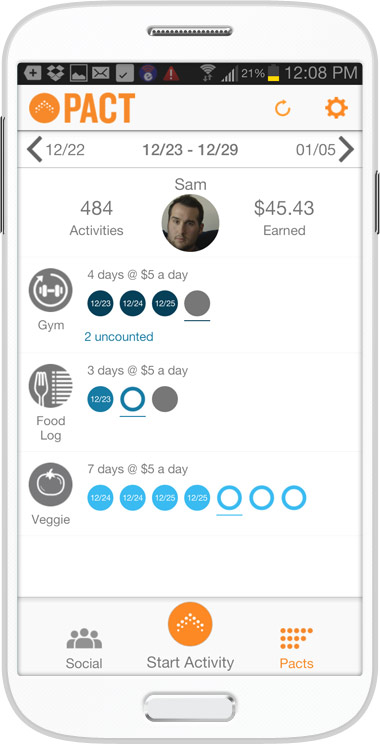
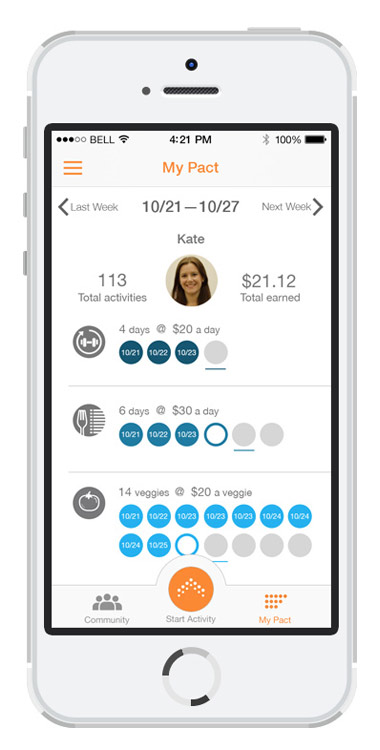
Illustration of the Pact Official Website App Interface
The primary pathway to increasing revenue—expanding the user base—has not been effectively realized. Given that Pact achieved 5 million service engagements in its first year of operation, yet reported a cumulative total of only 40 million over five years (with official website data suggesting an actual figure of approximately 22.6 million, as shown in the figure below), it is evident that user growth has been remarkably limited over this five-year period.
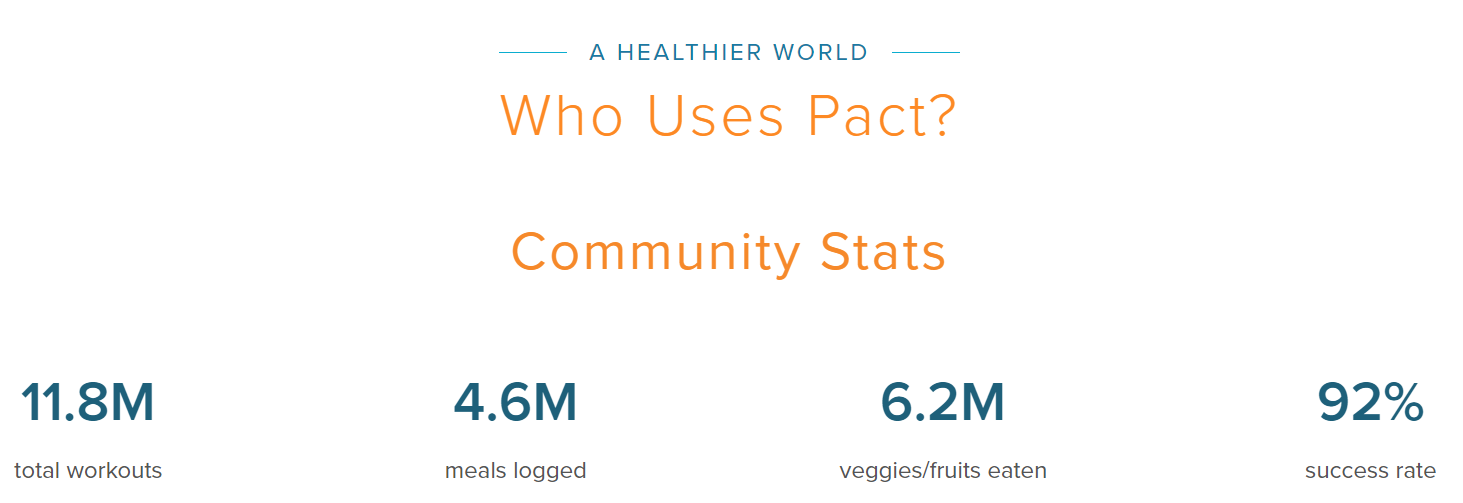
Pact Health Activity Execution Volume Statistics (Official Website Screenshot)
We do not have access to Pact’s active user data, but we can make a rough estimate. Assuming each user completes one health goal per week, an annual volume of 20 million transactions implies approximately 380,000 active users. During the years Pact remained committed to its deposit-based incentive model, other health management apps saw significant growth. By 2016, MyFitnessPal had amassed 165 million users, and by 2017, Fitbit’s active wearable device users had risen to 23.2 million. Evidence suggests that while the deposit-based incentive model is a sound idea and does work, it appears neither essential nor widely adopted; only a small segment of users is willing to engage with this approach, which is insufficient to support broader revenue expectations.
Overly Clever Ideas May Harbor Logical Risks
Once a unique idea takes root in your mind, it tends to reinforce itself, becoming impossible to shake off. The more unconventional the idea, the more likely you are to become carried away by your own ingenuity. Generally speaking, unconventionality implies a lack of validation; in entrepreneurship, such quirky notions are highly likely to violate fundamental business logic at some stage. Yet, because you are so enamored with your own clever and whimsical solution, you subconsciously choose to ignore potential pitfalls that defy logical reasoning, making you unwilling to overturn the idea.
Pact’s business model embodies a problematic logic, simply put: deriving one’s own happiness from others’ suffering. If Pact’s revenue model operates as we suspect—where lower goal-achievement rates lead to higher revenues for Pact—then the company’s commercial objectives would be fundamentally misaligned with users’ value-driven goals. This conflict would undermine Pact’s incentive to help users achieve their targets. Even if Pact’s revenue structure differs from our assumption, the rewards received by users who meet their goals are funded by the forfeited deposits of those who fail. Logically, this creates an expectation among users that more people should fail, thereby increasing their own potential rewards.
In short, Pact seems to have been tripped up by its own clever idea. A good idea can help you get started, but it cannot carry you all the way. In fact, during the early years of mobile app development, many ingenious yet overly simplistic apps emerged; some gradually matured and expanded their offerings, while others stagnated. Compared with other critical capabilities—such as business acumen, technical expertise, and resource integration—a mere flash-of-inspiration “good idea” may truly be insignificant.