

Medbanks Expands Real-World Evidence Platform in Oncology with $500M Tencent-Backed Investment
“China's Only Institution Focused on Real-World Clinical Oncology” On the official website of Medbanks Network Technology, these words are particularly prominent.
In June 2016, after securing tens of millions of US dollars in Series B financing led by Tencent, Medbanks Network Technology rapidly expanded its team, surging from 200 to 500 employees.
On one hand, the company has invested substantial funds into research projects on RWE (Real-World Evidence in clinical oncology). On the other hand, nearly 500 personnel, including front-end staff, Clinical Research Coordinators (CRCs), monitors, and data management professionals, are involved in the project.
Currently, Medbanks Network’s “Pai Data” platform has accumulated hundreds of thousands of patient records through collaborations with hospitals and departments, with data sourced from nearly 500 partner hospitals across China.
Driven by curiosity about RWE (real-world evidence in clinical oncology), VCBeat (WeChat official account: vcbeat) conducted an exclusive interview with Li Dayong, Chief Operating Officer of Medbanks Network Technology.

Li Dayong, Chief Operating Officer of Medbanks Network
RWE: Medbanks Network’s “Next Big Star”
Real-World Study (hereinafter referred to as RWS) originated from pragmatic clinical trials and falls within the scope of pharmacoepidemiology.
RWS refers to the non-randomized selection of treatment interventions based on patients’ actual clinical conditions and preferences, conducted with a larger sample size that covers a broader, representative population. It involves long-term evaluation with an emphasis on clinically meaningful outcomes, aiming to further assess the external validity and safety of the interventions.
Currently, RWS has garnered significant attention across many medical fields, with some disciplines having established relatively comprehensive observational cohorts, registries, and managed care databases.
RWE(Real-World Clinical Oncology), is a new practical project developed by Medbanks Network Technology based on RWS.
Historically, the most critical evidence for clinicians’ use of medications in treating a specific disease has been derived from RCTs (randomized controlled trials).Although randomized controlled trials (RCTs) are scientifically rigorous, they still face certain challenges. For instance, the clinical trial results of many drugs after Phase III trials often differ significantly from their real-world effectiveness in patients. While Phase III clinical trials yield strict results with a very high level of evidence, their restrictive inclusion criteria make it difficult for the findings to fully reflect real-world conditions.
Therefore, an increasing number of enterprises are seeking to leverage Real-World Evidence (RWE) to address the limitations of Randomized Controlled Trials (RCTs), thereby establishing a complementary relationship between the two.
Li Dayong stated, “Since real-world evidence (RWE) requires large sample sizes, traditional experimental methods have been difficult to implement. Medbanks Network Technology has built its own expert network and ‘Pai Data’ platform, establishing two core competitive advantages.”
Conducting retrospective studies in hospitals requires extracting data from the Hospital Information System (HIS) and electronic medical records, followed by excluding and screening for a specific patient cohort according to experimental criteria—a process that is relatively slow.
For departments collaborating with Medbanks Network Technology, since data from their HIS, LIS, PACS, and other systems are already housed in the “Pai Shuju” platform, clinicians and department heads can rapidly access data for real-world evidence (RWE) studies directly through this platform.
Medbanks Network’s expert network primarily comprises clinical experts from multinational pharmaceutical companies and hospitals, a significant proportion of whom are users of the Medbanks data platform. The network currently includes over 2,000 members.
Currently,Medbanks Network RWE primarily includes six categories of services:
Medical Services:Establish dedicated medical support teams tailored to different tumor types to collaborate with investigators in defining research directions, clarifying research questions, determining study designs, and developing research protocols.
Data Services:Establish a targeted research database based on the research questions and protocol, with dedicated research assistants responsible for data collection and management.
Statistical Services:Participated in study design during the research and discussion phase; conducted individualized statistical analyses of the collected data tailored to different research questions, thereby supporting the dissemination and publication of the results.
Research Management Services:Provide support services, including clinical research coordinators, clinical research monitors, and project managers, based on investigators’ needs to ensure the smooth implementation of research projects.
Representative Studies:Medbanks and experts jointly launched the CLAP study (planned enrollment of 5,000+).
Collaboration with Enterprises:Multiple real-world studies in the fields of lung cancer, colorectal cancer, and others.
RWE Can Reduce Drug Approval Time
According to Li Dayong: “In the United States, RWE is primarily used by pharmaceutical companies for post-marketing studies.”
After a drug is launched on the market, pharmaceutical companies need to monitor its efficacy and safety, including assessing the impact of price reductions on physicians’ treatment regimens.
When designing clinical protocols, the medical affairs departments of pharmaceutical companies adopt the standards for Phase III clinical trials required for drug approval. Phase III clinical trials involve numerous data collection points, whereas real-world evidence (RWE) studies generally entail minimal intervention.
“Many industry insiders are unaware of the differences between the two. Therefore, Medbanks Network Technology has been engaging in ongoing communications with certain medical institutions and pharmaceutical companies to help them understand what real-world evidence (RWE) truly entails.”Li Dayong said。
The United States and the United Kingdom have begun to use RWE to approve drug indications.
“For instance, a certain class of drugs may already have one approved indication but seeks to add another. However, this new indication targets a rare disease, making clinical trials extremely challenging. Since the drug has been on the market for some time and its safety profile is well-established, leveraging real-world evidence (RWE) to support regulatory approval for this new indication can significantly save time.”Li Dayong told VCBeat。
Data Warehouse: Meeting the Diverse Needs of Hospitals
Medbanks’ primary clients are hospitals and their respective departments. Given that a significant portion of its team comes from the medical and pharmaceutical industries and interacts with physicians on a daily basis, Medbanks has an in-depth understanding of physicians’ needs.
Li Dayong stated, “The ‘Pai Zhuanjia’ data platform developed by Medbanks Network Technology aligns closely with physicians’ needs in terms of technology, functionality, and specific application scenarios, thereby minimizing their learning curve.”
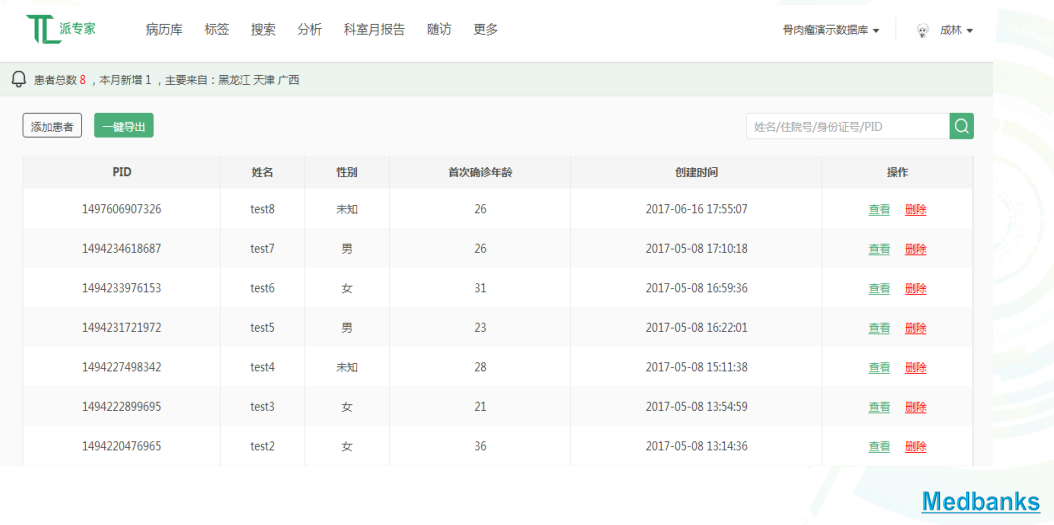
Medbanks Expert Data Platform
Due to the varying demands across different hospitals, many big data companies face the challenge of balancing diverse requirements. After a period of practical operation, Medbanks Network Technology discovered that commonalities in underlying technology can address this issue.
For instance, even within the same disease category such as lung cancer, different physicians have varying requirements for data platforms. Medbanks Network Technology has established a standardized data dictionary at the infrastructure level, from which a data warehouse is derived. Regardless of which physician accesses the information, all queries are based on this data warehouse, with the presented content tailored to specific needs.
For AI and Big Data Companies, the Future Competition Will Be About Application Scenarios
“The primary users of the data are clinicians. Therefore, the most critical aspect of big data products is their close integration with clinicians’ workflows.“said Li Dayong.
Many clinical decision support solutions are built upon knowledge bases that require extensive literature resources; however, the literature within these systems is often several years old and lacks timely updates, resulting in significant information lag in clinical practice.
On the other hand, there is the issue of data openness. Currently, hospital-level data remains relatively inaccessible. However, AI systems often require substantial data inflow and outflow to facilitate algorithm updates.Therefore, in addition to policy support, the integration of big data companies with EMR (Electronic Medical Record) companies is also key to development.
Li Dayong stated: “In the future, the true competition between artificial intelligence and big data companies will not be about the volume of data or algorithms, but rather application scenarios. Data and algorithms must be built upon core application scenarios.”
Taking a specific type of tumor as an example, patients often require regular follow-up after surgery, with some even needing invasive diagnostic procedures.Through artificial intelligence algorithms, it is possible to predict the likelihood of tumor recurrence and associated risks.
However, whether AI analyzes data from high-risk or low-risk populations when predicting patient recurrence risk represents two distinct scenarios that affect the accuracy of AI algorithms and their conclusions, underscoring the importance of context.
There Is No Bubble in AI Healthcare
“Whether a technology bubble exists hinges on whether the technology can be truly implemented in the current market environment.”According to Li Dayong’s assessment, the potential for AI in the healthcare industry is immense.
VR and AI differ fundamentally. The VR bubble stems largely from the immaturity of both technology and the market, making it difficult to implement practical applications, whether in gaming or other scenarios.
The application scenarios for medical AI are relatively clear. Beyond medical imaging, some ophthalmic hospitals in Guangdong and Shanghai have already begun integrating AI into clinicians’ daily practice—a capability far beyond the reach of VR.
Amid the development trends of AI and big data, Medbanks Network Technology’s forward-looking layout in real-world evidence (RWE) may enable the company to break through first in future market competition.