

WeDoctor and Yilin Network Launch China's First Internet-Based Oncology Medical Consortium to Enhance Cancer Care at Grassroots Hospitals
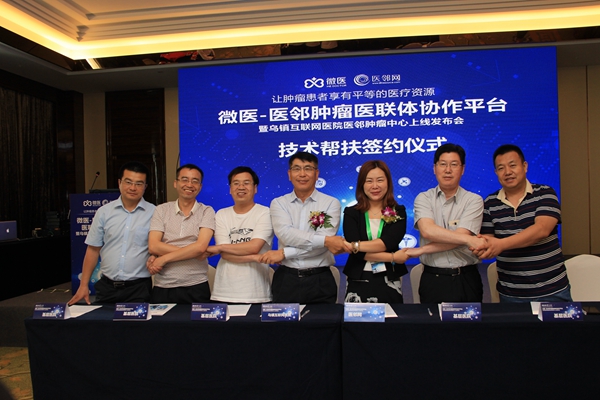
On July 8, 2017, the WeDoctor–Yilin Oncology Medical Consortium Collaboration Platform and the Wuzhen Internet Hospital Yilin Oncology Center were launched in Shanghai. This is the first internet-based specialized medical consortium platform in China established around the oncology discipline. Six municipal and county-level hospitals from four provinces, including Shaanxi and Jiangsu, announced their participation in the medical consortium as the first batch of members.
On that day, coinciding with the “Academic Symposium on New Advances in Clinical Oncology—Best of ASCO (BOA) Event in China,” jointly organized by the Chinese Society of Clinical Oncology (CSCO) and the American Society of Clinical Oncology (ASCO) in Shanghai, the Tumor Medical Consortium Collaboration Platform was officially launched at the conference.
Currently, China is facing a severe situation in cancer prevention and control. According to the latest "2017 Report on Urban Cancer Data in China" released by the National Cancer Center, the incidence and mortality rates of cancer in China continue to rise, making it the leading cause of disease-related deaths. Approximately 10,000 people are diagnosed with cancer nationwide every day, equivalent to one person being diagnosed with cancer every seven minutes on average.
However, due to the scarcity and uneven distribution of medical resources in China, many patients fail to receive timely and effective diagnosis and treatment, leading to delays in their condition. To integrate regional medical resources, promote the downward flow of high-quality medical resources, and enhance the capacity of primary healthcare services, the National Health and Family Planning Commission issued a document at the beginning of this year proposing the advancement of tiered diagnosis and treatment through Medical Consortiums. Regarding the organizational models of Medical Consortiums, models such as Specialist Alliances have been proposed.
To ensure equitable access to medical resources for cancer patients, deepen healthcare system reform, implement the development of medical consortiums and tiered diagnosis and treatment, facilitate the decentralization of high-quality medical resources, and promote the overall advancement of the discipline, WeDoctor has partnered with Yilin.com to jointly establish the “WeDoctor-Yilin Oncology Medical Consortium Collaboration Platform and Wuzhen Internet Hospital Yilin Oncology Center.”
In his address, Professor Wu Yilong of Guangdong Provincial People’s Hospital pointed out that high-quality oncology medical resources should be extended to the county level and below, with the Internet serving as an excellent platform. As a new initiative, the Oncology Medical Consortium calls for CSCO members to reach out and join forces in this effort, working together to ensure that the general public has access to more equitable and convenient medical services.
“The national medical consortium policy has given us greater hope. The emergence of specialty-focused medical consortia provides an opportunity for experts and scholars like ourselves to leverage our academic leadership, offering effective technical guidance to primary care physicians through online and offline exchanges, thereby better serving patients,” said Professor Qin Shukui, Chairman of the CSCO Foundation and affiliated with the 81st Hospital of the Chinese People's Liberation Army, at the launch ceremony.
In 2017, China comprehensively launched pilot programs for the construction of medical consortia in various forms. How to fully leverage the role of medical consortia, particularly specialized medical consortia, and improve the accessibility of high-quality oncology medical resources has become a new challenge for health authorities across the country. Since the launch of the medical consortium initiative in April 2016, innovative models such as the “Internet + Medical Consortium” represented by WeDoctor have actively explored and implemented practices, drawing widespread attention from the healthcare industry.
According to VCBeat (WeChat ID: vcbeat), following its establishment, the WeDoctor–Yilin Oncology Medical Consortium Collaboration Platform will join the Wuzhen Internet Hospital Platform—the largest telemedicine collaboration network in China—as its 13th specialty remote consultation center. Leveraging WeDoctor’s RMB 300 million investment in building a medical consortium system comprising seven subsystems—remote diagnosis and treatment, remote consultation, remote referral, remote training, cloud-based electronic medical records, cloud-based laboratory and imaging services, and payment and settlement—and supplemented by Yilin Network’s extensive and in-depth collaborations with thousands of authoritative expert mentors both domestically and internationally, the Oncology Medical Consortium Collaboration Platform will integrate renowned experts and key physicians at the upper end to form an authoritative think tank in the field of oncology. At the grassroots level, it will connect with primary care physicians and patients, providing services such as online consultations, multidisciplinary consultations, and patient education. This initiative aims to fully amplify the value of oncology experts, promote the downward flow of high-quality medical resources, and enhance the capacity for cancer prevention and control at the primary care level.
On the launch day, Luonan County Hospital in Shangluo City, Shaanxi Province; the First People’s Hospital of Nankang District in Ganzhou City, Jiangxi Province; the Fourth People’s Hospital of Shaanxi Province; Shaanxi Tongchuan Hospital of Integrated Traditional Chinese and Western Medicine; Suqian Cancer Hospital; and Chengdu Aerospace Hospital jointly joined the WeDoctor–Yilin Oncology Medical Consortium and signed a strategic cooperation agreement for technical assistance.
He Chao, Senior Vice President of WeDoctor, pointed out that by leveraging its three core capabilities—systems, traffic, and operations—WeDoctor integrates online and offline medical resources and establishes a remote consultation mechanism. It “transfuses” expertise into the Medical Consortium platform through top-tier specialist teams, while also building platforms for remote training and education to facilitate essential sharing of medical capabilities and technical collaboration. To date, WeDoctor has established 12 specialty-specific remote consultation centers, represented by the Pancreatic Cancer Diagnosis and Treatment Center and the Colorectal Cancer Multidisciplinary Team (MDT) Remote Consultation Center, and has successfully pioneered an internet-based specialty medical consortium model, exemplified by the National Otorhinolaryngology Medical Consortium.
At the recently held China Innovation Conference, WeDoctor announced the completion of its WeDoctor Health Insurance System, which integrates specialty care, primary care, and insurance. As a key component of this system, WeDoctor has co-established internet hospitals with central hospitals in 19 provinces and municipalities, set up 12 specialty teleconsultation centers led by academicians, and built a “hospital without walls” through collaboration with the leading disciplines of key hospitals nationwide.
As healthcare reform continues to deepen, the WeDoctor–Yilin Oncology Medical Consortium Collaboration Platform will further strengthen specialized capabilities within the WeDoctor ecosystem. Driven by internet and artificial intelligence technologies, the platform will facilitate the “grouped decentralization” of high-quality medical resources through remote consultations, two-way referrals, and expert collaboration, thereby enhancing primary healthcare service capacity and ensuring that more oncology patients receive timely and effective treatment.