

Landing Med Secures CFDA Approval and Deploys Over 300 AI Diagnostic Systems, Serving Millions Ahead of Competitors
“Landing’s fully automated digital (telemedicine) case analyzer has obtained CFDA and European CE certifications, with FDA approval expected within 2017.. LANDING has established over 300 laboratories both domestically and internationally, with a monthly capacity of 1.08 million cervical cancer diagnoses. It has currently reached cooperation intentions with partners in Southeast Asia, the United States, and Europe. In addition, LANDING’s cervical cancer screening vehicles have entered the market, and its third-party pathology testing centers are being steadily advanced.”
At the “2017 Overseas Chinese Entrepreneurship and Development Conference,” Dr. Sun Xiaorong, founder of Landin High-Tech, shared some of their current achievements with VCBeat.
For current medical AI, obtaining certification from the China Food and Drug Administration (CFDA) is an extremely challenging feat. To provide a clearer understanding of Landin’s certified products, our reporter visited Landin’s company headquarters and photographed their certification documents for your reference.
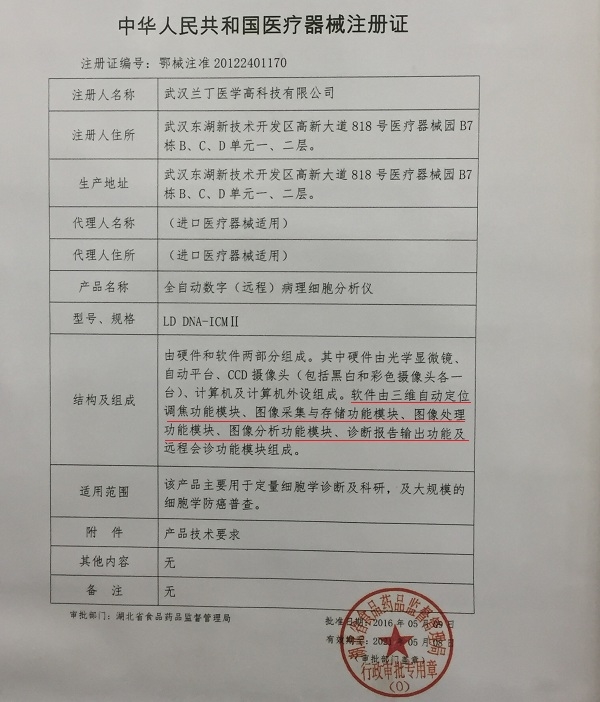
We can see that this certification clearly states it consists of two parts: hardware and software, among whichThe hardware component consists of an optical microscope, an automated stage, a CCD camera, a computer, and computer peripherals.The software component consists of a 3D automatic positioning and autofocus module, an image acquisition and storage module, an image processing module, an image analysis module, a diagnostic report output module, and a remote consultation module.。
What is the status of Landin High-Tech’s products, and why have they gained recognition from the government, hospitals, and users? VCBeat sought answers by examining Landin High-Tech and the cervical cancer screening industry.
Cervical Cancer: High Prevalence, Low Screening Coverage, and Substantial Government Subsidies
According to data from the World Health Organization (WHO), there are 500,000 new cases of cervical cancer each year, with 250,000 deaths. Developing countries are disproportionately affected by this disease, accounting for 200,000 deaths annually, which represents 80% of global cervical cancer mortality.
In China,According to data released by the Chinese Ministry of Health, there are over 130,000 new cases of cervical cancer annually in China, accounting for 28% of the global total., with approximately 30,000 deaths. There is also a trend toward younger patients. Moreover, many rural families have been driven into poverty by the disease. A study published in The Lancet in November 2011 confirmed this, further revealing that the incidence of cervical cancer in China has been rising year by year.
Cervical cancer is curable with effective early screening. To this end, since 2009, the Chinese central government has established a special fund for major public health services, allocating approximately RMB 400 million annually to provide free cervical cancer screening for 10 million women.In China, there are 360 million women aged 30–65 who require cervical cancer screening.。
According to Wang Linhong, Director of the National Center for Chronic and Non-communicable Disease Prevention and Control at the Chinese Center for Disease Control and Prevention, as introduced at the "2017 Overseas Chinese Entrepreneurship and Development Fair,"The overall screening rate in China is 21.4%, with 25% in urban areas and 18% in rural areas.. The coverage rate in developed countries worldwide reaches 80%.
Cytological diagnosis offers advantages such as simplicity and non-invasiveness. It plays a crucial role in the clinical diagnosis of tumors and is the preferred method for cervical cancer screening both domestically and internationally. Cytological diagnosis based on microscopic examination and the expertise of cytopathologists has a history spanning several centuries; however, it is limited by the magnification capabilities of microscopes and the potential for human error in interpretation.
Sun Xiaorong used this analogy: senior pathologists searching for cancer cells under a microscope is akin to picking out a few rotten soybeans from tens of thousands, a time-consuming and labor-intensive process. Moreover, the identification of early-stage cancerous cells can yield inconsistent results depending on the diagnosing physician’s experience, mood, and level of fatigue, leading to highly subjective diagnoses with significant margins of error.
In China, the accuracy rate of consistency between actual conditions and medical records in secondary hospitals is in the twenties (percent). In the United States, the sensitivity of cervical cancer screening over a 60-year period ranges from 42% to 73%, meaning that the highest positive detection rate is approximately 71%.
Dr. Sun Xiaorong returned to China from Canada in 2001. Having spent two decades researching automated microscopy and automated slide-reading systems, she dedicated the subsequent 17 years in China to rigorous validation, ultimately developing an automated, standardized, and intelligent system for cancer cell detection. Leveraging China’s vast sample volume and accumulating data from millions of cases over more than a decade, she successfully developed a fully automated digital (remote) pathology analyzer.
Automated Initial Screening, Manual Quality Control
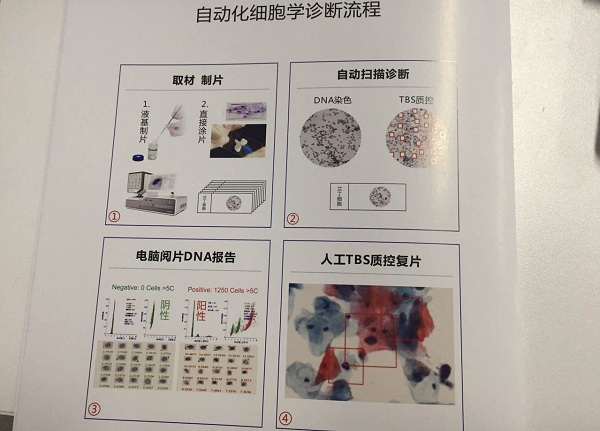
Landing’s intelligent cytology diagnostic workflow is as follows: The first step is to process the collected samples.Specimen Collection and Slide Preparation, which is the same as the traditional approach.
The second step isAutomatic Scanning, the technician places the slide on the device, and the machine automatically reads the cells in the entire area and uploads them to the diagnostic system.
Step 3 isComputer-Aided Automated Image Interpretation, intelligently diagnose the scanned images, automatically count the number of various types of cells, and then provide a preliminary report.
The final step isArtificial TBS Quality Control Slide Review。
These four processes are underpinned by Landing’s mature technologies and business model.
Landing collaborates exclusively with B2B institutions.
First, regarding specimen sourcing, their samples currently come from three sources., one type isPrimary Care UploadFor grassroots medical institutions such as village and township health centers, establishing a dedicated clinical laboratory is clearly inappropriate. However, patients can have specimens collected at these local healthcare facilities. Once information from various villages, townships, and counties is aggregated, the samples are sent to centralized primary-care laboratories. These laboratories then perform slide preparation, scanning, and processing, and upload the resulting image data to the cloud-based diagnostic platform.
The second type isThird-Party Pathology Testing Center, third-party clinical pathology laboratories are all located in major cities. Given the high demand for testing services from numerous medical institutions, specimens are collected directly and transported to these centralized pathology laboratories, where they undergo automated and intelligent diagnostic processing after centralized specimen handling.
The third type isLarge Hospitals, Landing collaborates with hospitals to facilitate rapid patient screening, thereby enhancing hospital efficiency.
On the same day, Dr. Sun Xiaorong’s team also unveiled a device equipped with the “LANDING” robotInternet-based Remote Mobile Medical Vehicle System, together with the cloud platform, provides women with mobile cervical cancer screening services, allowing them to receive high-quality cervical cancer screening at home nearby, just as they would with other e-commerce services.
Overall, the source of customers also determines Landing's business model.Currently, Landin collaborates exclusively with B-side institutions, collecting specimens from medical facilities or undertaking portions of the government’s “Two-Cancer” (breast cancer and cervical cancer) screening programs. On the other hand, Landin sells equipment and consumables to hospitals and provides related services to generate profits, while not currently offering services directly to C-side consumers.。
Landing’s accuracy is approximately five times that of traditional methods.
Automated Scanning Diagnosis and Computer-Aided DNA Report InterpretationAs a technical solution, the fully automated quantitative DNA analysis system for cells identifies cells with altered DNA ploidy by measuring the DNA content within cell nuclei, thereby achieving fully automated scanning, automated diagnosis, and comprehensive quality control.
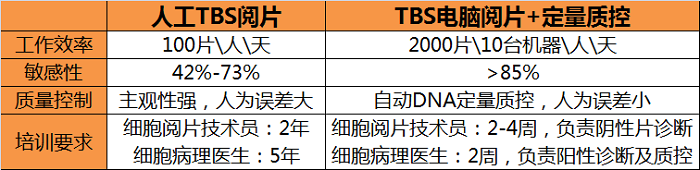
Regarding the system’s accuracy, Sun Xiaorong described it as follows:In a "challenge" against three experts from MD Anderson Cancer Center, the AI system and the experts collectively diagnosed 1,500 cases, with Landing’s accuracy rate exceeding that of the three experts by 12%.。
In addition, Dong Yan, Director and Chief Gynecological Expert at Shanxi Provincial Maternal and Child Health Hospital, also shared a set of data at the forum:
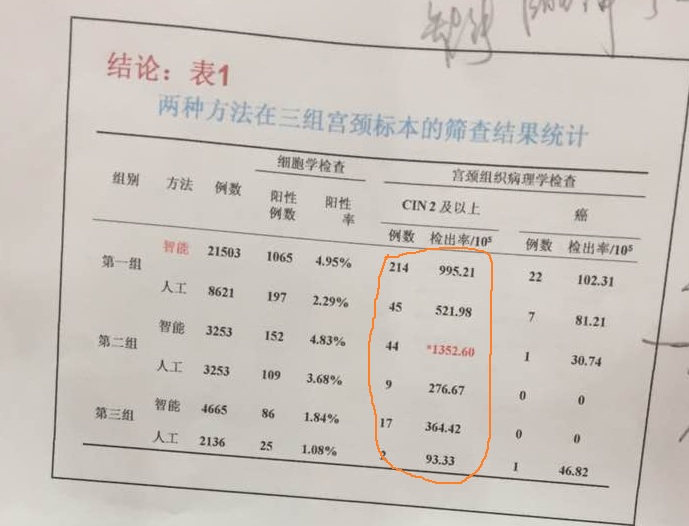
This image was provided by Director Dong Yan. The three sets of comparative data clearly show that,Among tens of thousands of samples, Landing’s accuracy is approximately five times that of traditional methods. Additionally, according to Dong Yan, they have collaborated with Landing for six years and have consistently used automated systems for screening.。
In addition to automated screening and diagnosis, Landing’s other key technology is its Cytopathology Cloud Platform. In 2016, Wuhan Landing completed the development and deployment of this platform, which enables the upload of raw data from terminal scanners to the cloud for automated detection and diagnosis. The diagnostic reports are verified through a three-tier quality control system in the backend before being transmitted back to the respective terminals.
Artificial TBS Quality Control Slide Review Enables Clinical Validity of AI Slide Interpretation
Manual TBS Quality Control Slide Review: After initial screening, the system refers approximately 10% of suspected cases to physicians collaborating with Landing. In accordance with current professional standards and regulations for cytopathologists, a diagnostic report becomes valid only upon the physician’s signature. Therefore, the physician performs a final review and signs the report to validate it.
Although physician involvement is still required, LANDING has already completed 90% of the workload, significantly improving efficiency. The process only requires logging into the system via a mobile phone for work purposes, with no restrictions on location or time.
The income model for doctors on the platform is similar to that of Didi Chuxing, where they compete to accept orders and earn more by working harder.When VCBeat arrived at Landing for an interview, we happened to meet a physician hired as a quality control expert at the company’s front desk. Later, over a meal, she told our reporter that she was about to retire. For someone like her, income was secondary; what mattered most was not having to work on-site and being able to work from home. Having spent most of her career performing cytology tests, she wished to continue contributing after retirement and avoid falling behind the times, which is why she accepted the position.
During the interview, VCBeat observed an interesting phenomenon: DaoTong Investment, an investor in Landin, has specifically assigned a staff member to support Landin’s development—a practice that is rare in post-investment management. According toLin Zhencheng, Vice President of Investment at Daotong Investment and Deputy General Manager of Landing High-Tech, stated that this approach was primarily aimed at helping Landing develop a more robust business model., It would be a great pity if LANDING’s excellent technology could not be widely adopted. Fortunately, LANDING has already identified a development model well-suited to its needs.