

Alibaba Health and Wanliyun Unveil 'Doctor You' AI for Lung Nodule Screening in Medical Imaging Debut
Artificial Intelligence (AI)Is it a capable assistant to humanity, or a “job terminator” that replaces humans? This is a “to be,or not to be” ultimate question. However, before the answer emerges, healthcareAIIt may be the first to transform physicians' clinical practices, ensuring that technological advancements benefit everyone.
VCBeat (WeChat ID: vcbeat), July 11 — This afternoon, Alibaba Health, in collaboration with Wanli Cloud, unveiled its medical AI product “Doctor You.”
At Beijing Wanliyun Medical Imaging Center, the two parties jointly demonstrated a real-world scenario of human-AI collaborative remote diagnosis, where on-site physicians, assisted by medical AI, conducted screening for suspected pulmonary nodules in CT images.
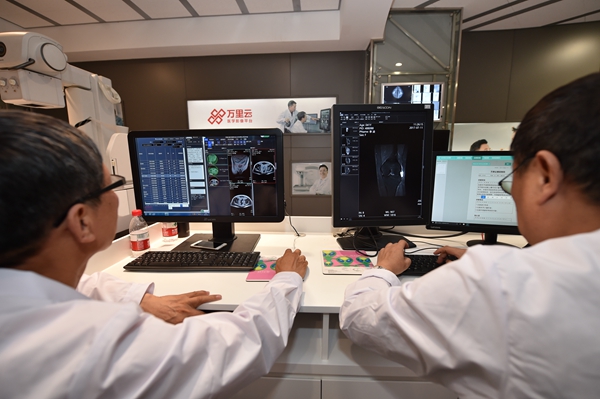
Efficiency: 9,000 CT Images Reviewed in 30 Minutes
According to the official introduction by Alibaba Health, the “Doctor You” AI system officially released to the public includes a clinical medical research and diagnostic platform, a medical auxiliary detection engine, and a physician competency training system. On this occasion, Alibaba Health and Wanli Cloud demonstrated the real-world application scenario of the CT pulmonary nodule intelligent detection engine within the “Doctor You” system in the remote imaging diagnosis workflow.
On-site, an expert panel comprising four senior radiologists from tertiary hospitals, affiliated with the Wanliyun Medical Imaging Center, was present alongside “Doctor You,” which served as a physician assistant. As patient CT images uploaded in real time from primary care hospitals across China were distributed to the Wanliyun imaging platform, “Doctor You” operated at full capacity to perform intelligent detection and recognition of nearly 9,000 CT scans from 30 patients. It flagged suspected nodules identified during the initial screening and provided these findings as auxiliary diagnostic results for review by the four physicians.
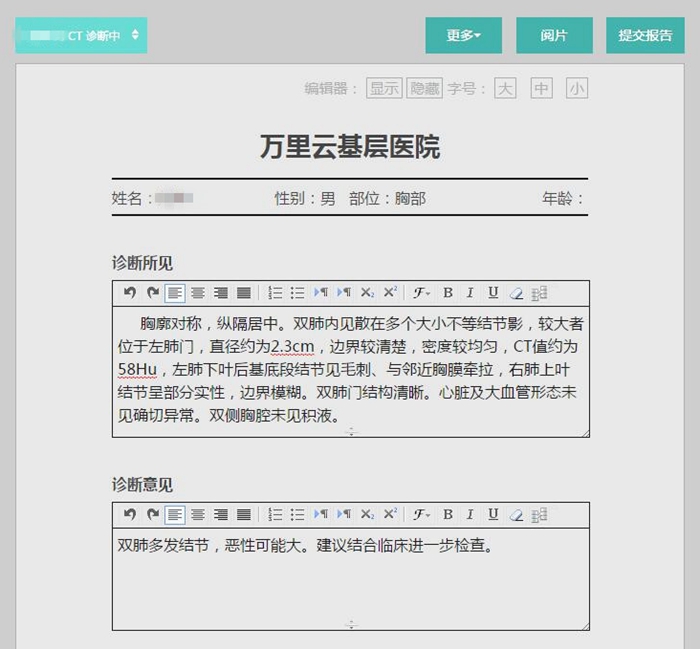
Diagnostic Reports Generated with AI Assistance
After a 30-minute diagnostic session, on-site physicians confirmed and tallied the results, demonstrating that “Doctor You” achieved an accuracy rate of over 90% in correctly identifying pulmonary nodules.
It is understood that if four physicians manually review and diagnose imaging studies for 30 patients via conventional methods, the process is estimated to take 150–180 minutes. In other words, medical AI has reduced the image review time to one-fifth of the original duration.
How Alibaba Health’s Medical AI Was Developed
Why did “Doctor You” choose pulmonary nodule detection as its first medical AI product for practical application?
Li Xiaoqiu, a radiologist at the Wanliyun Imaging Center and chief physician at the Air Force General Hospital, told reporters that pulmonary nodules are a manifestation of early-stage lung cancer. Early detection and treatment of lung cancer can significantly improve patients' quality of life and survival rates; therefore, screening for pulmonary nodules is extremely important.
However, pulmonary nodules are often easily missed during visual inspection of images. Radiologists typically spend a significant amount of time on manual detection of pulmonary nodules, resulting in an extremely heavy clinical workload.
“A tertiary hospital receives approximately 200 patients for pulmonary nodule screening on an average day, with each patient generating around 200–300 CT images during the examination process. Radiologists are required to interpret at least 40,000 images daily,” said Li Xiaoqiu.
Fan Yi, a senior architect at Alibaba Health, stated that the “Doctor You” intelligent CT pulmonary nodule detection engine was jointly developed by Alibaba Health’s algorithm engine team and Alibaba’s Institute of Data Science and Technologies (iDST) visual computing team. By integrating medical knowledge with artificial intelligence technology, the system automatically identifies and flags suspicious nodules, thereby improving physicians’ work efficiency and reducing rates of misdiagnosis and missed diagnosis. “In high-intensity work environments, doctors are susceptible to fatigue and even emotional influences; delegating this task to artificial intelligence can help alleviate their workload.”
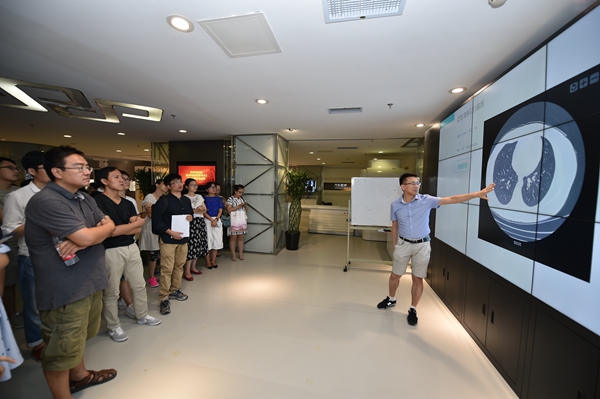
Fan Yi Explains the Principles of Medical AI and Pulmonary Nodule Detection
“‘Doctor You’ will soon be deployed in multiple medical institutions across China, serving as the best assistant to physicians,” revealed Ke Yan, Vice President of Alibaba Health. Over the past year, leveraging big data technology, “Doctor You” has performed continuous, 24/7 deep learning analysis of medical images for a wide variety of disease conditions.
Currently, Alibaba Health’s CT pulmonary nodule detection engine has reached a world-class level in both performance and cloud service capabilities. “However, medical AI is an emerging field, and we hope to afford it greater patience and room for growth. Our expectation is that within ten years, medical AI will help physicians handle half of their workload,” said Ke Yan.
Exploring More Application Scenarios for Medical AI
Meanwhile, as China’s largest medical imaging platform, Wanli Cloud will become the first remote imaging diagnosis platform to integrate artificial intelligence (AI) into practical clinical applications. According to Huang Jiaxiang, CEO of Wanli Cloud, the platform currently provides remote consultation services to more than 1,600 primary-care hospitals across over 20 provinces and municipalities in China. The company plans to onboard more than 2,500 hospitals this year, with radiologists practicing at multiple sites through the center interpreting images for over 4,000 patients daily.
Leveraging this advantage, the Wanli Cloud Medical Imaging Platform will continue to expand the breadth of its collaboration with Alibaba Health AI in the next phase, progressively integrating “Doctor You”’s intelligent detection engines for breast ultrasound, electrocardiograms (ECG), X-rays, and more. “We aim to build our medical imaging center into China’s most advanced and patient-trusted intelligent remote imaging diagnosis platform,” said Huang Jiaxiang.
According to Alibaba Health staff, in addition to its collaboration with Wanli Cloud, Alibaba Health has partnered with various external institutions, including local governments, hospitals, and research universities, to develop intelligent diagnostic engines for 20 common and frequently occurring diseases. These include conditions such as diabetes, lung cancer prediction, psychological intelligence, and fundus screening. In the future, these engines will serve as assistants to professional physicians, significantly enhancing both the efficiency and quality of medical care.
“Don’t let machines mimic humans; instead, let them do what humans cannot.” On June 29, Jack Ma, Chairman of the Board of Alibaba Group, pointed out at the inaugural World Intelligence Congress that machines should not be made to resemble humans, but rather should be endowed with human-like learning capabilities. Machines should not become rivals to humans; the future lies in collaboration between machines and humans. The application of Alibaba Health’s “Doctor You” medical AI in medical imaging may serve as a new footnote to this philosophy.