

Policy Analysis of Health Medical Big Data: Guangdong, Beijing, and Guizhou Lead Implementation Efforts Amid Five Key Challenges
Since 2015, a series of policies on healthcare big data have been introduced. From initially clarifying its definition to the State Council incorporating the application and development of healthcare big data into the national big data strategic layout, the strategic status of healthcare big data has undergone significant changes within just two years.
On October 25, 2016, the Central Committee of the Communist Party of China and the State Council issued the “Outline of the ‘Healthy China 2030’ Plan.” As the action plan for advancing the construction of Healthy China over the next 15 years, it places particular emphasis on developing the health industry and medical big data, as well as fostering new business models in the application of health and medical big data.
Thus, it is evident that under the guidance and incentives of national policies, big data in health and healthcare is emerging as a new growth pole for the future development of the health and medical industry.
VCBeat (WeChat Official Account: vcbeat) has reviewed the policies related to health and medical big data, and through analysis and summarization, clearly presents an overview of the current policy landscape for health and medical big data.
Through this report, you will learn:
1. Among the 58 policies on big data in health and medical care, the State Council issued the largest number of policies, while Guangdong Province demonstrated the most proactive follow-up;
2. The evolution of policies on big data in health and healthcare is divided into three stages;
3. Seven Major Categories and Five Key Practical Barriers of Health and Medical Big Data
I. Among the 58 policies on big data in health and healthcare, the State Council has issued the most policies, while Guangdong Province has demonstrated the most proactive follow-up.
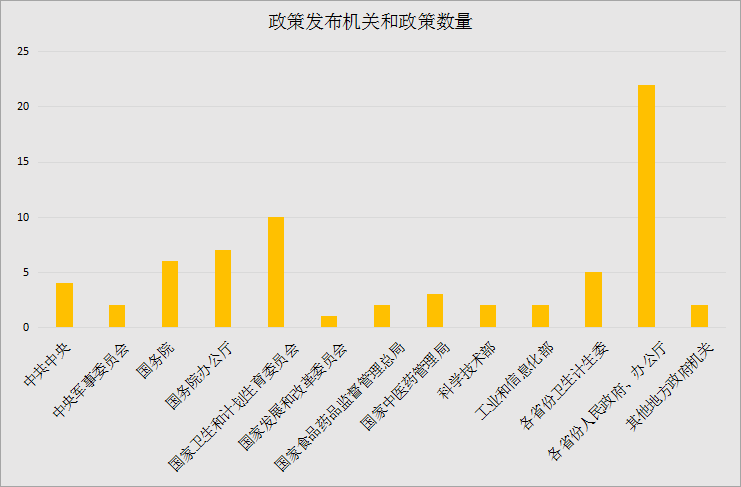
From 2013 to 2015, the state issued a total of 58 policies related to health and medical big data:
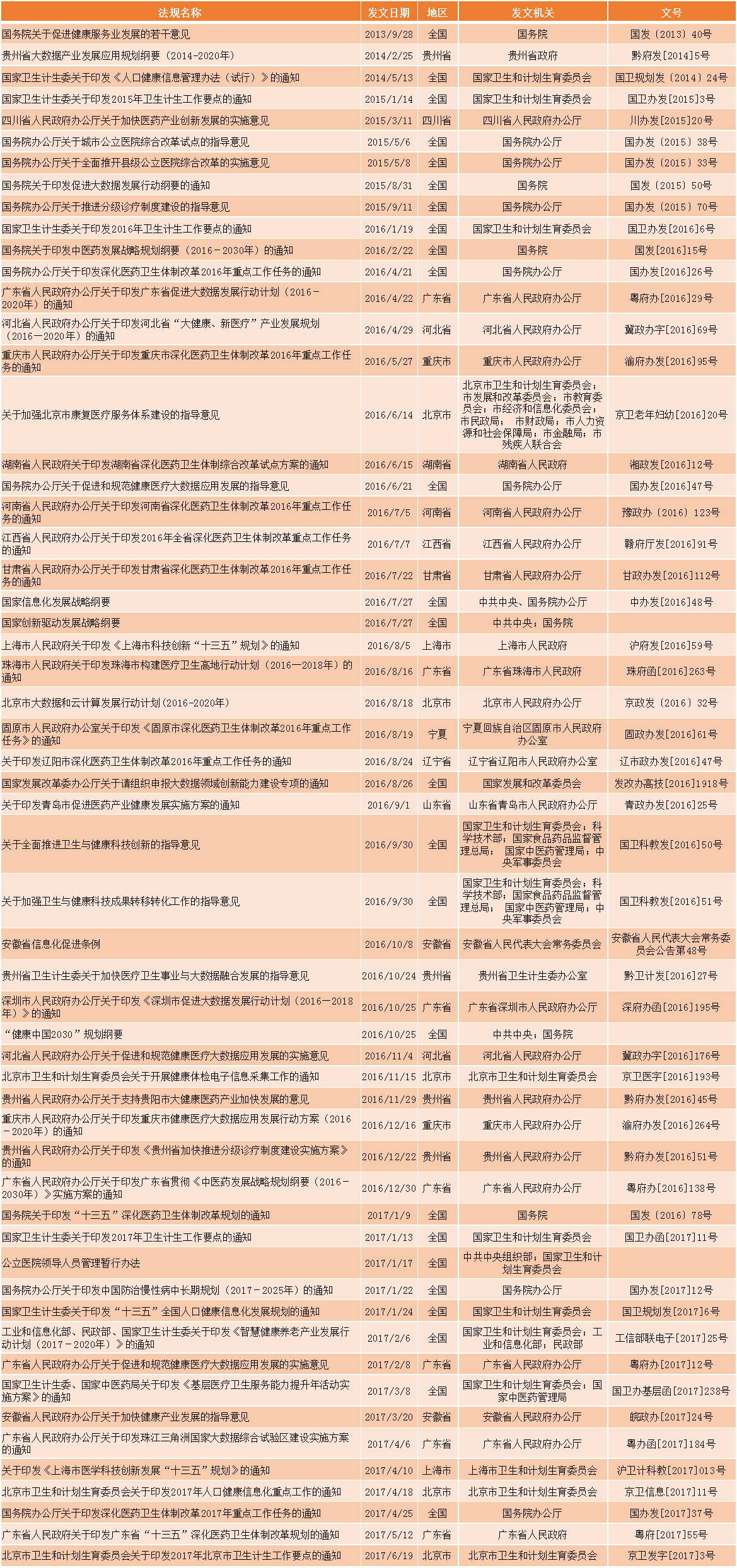
In terms of the year of policy release, 2016 witnessed a surge in policies related to health and medical big data. In that year, the State Council issued what is regarded as the most critical policy for the development of health and medical big data: the “Guiding Opinions of the General Office of the State Council on Promoting and Standardizing the Application and Development of Health and Medical Big Data.” This policy marked the first inclusion of health and medical big data into the national strategic layout for big data.
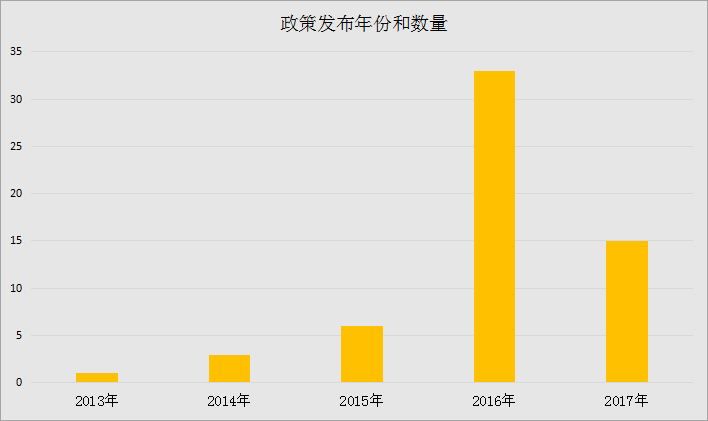
In terms of the provinces where the policies are located, Guangdong Province is the most proactive, having issued the largest number of health and medical big data-related policies, with a total of seven; Beijing Municipality and Guizhou Province follow closely, each with five.
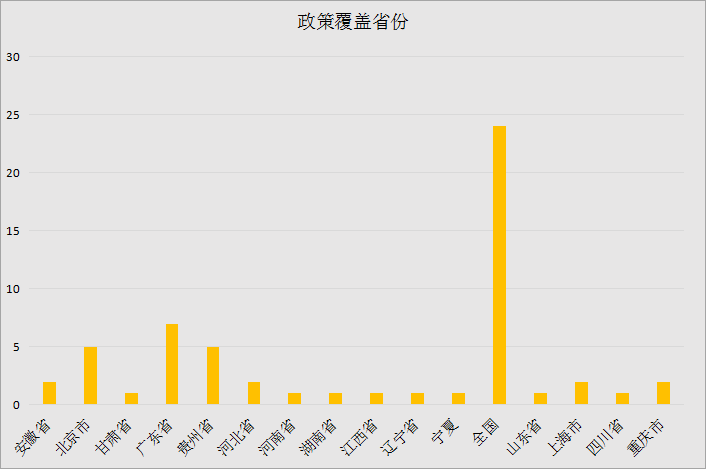
From the perspective of issuing authorities, in addition to the 26 policies issued by provincial governments and their general offices,The State Council and the General Office of the State Council issued 6 and 7 items, respectively, totaling13 Policies;The National Health and Family Planning Commission also has a relatively large number, totalingPublished10 Policies。
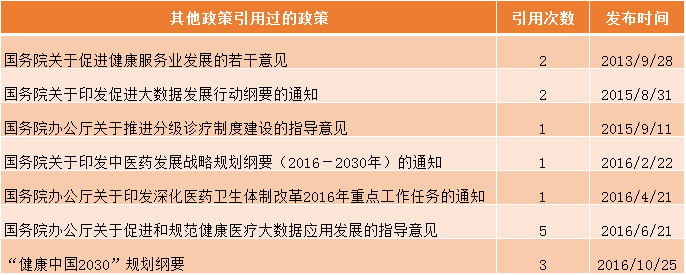
Among these 58 policies, the one most frequently cited directly by other policies is the “Guiding Opinions of the General Office of the State Council on Promoting and Regulating the Application and Development of Health and Medical Big Data,”Citation count reached 5The “Outline of the ‘Healthy China 2030’ Plan” follows, with three citations. This indicates that these two policies are the most core guiding documents for the implementation of health and medical big data across all provinces in China.
II. The Policy Evolution of Big Data in Health and Medical Care is Divided into Three Stages
If categorized by stages, the development of big data in health and healthcare can be roughly divided into three phases:
Key Policies:"Several Opinions of the State Council on Promoting the Development of the Health Service Industry"
Keywords:Hospitals, Health Insurance Information Systems, Telemedicine, and Primary Care Information Systems.
Core Content:Establish data standards for relevant information, strengthen the development of information management systems for hospitals and medical insurance, fully leverage existing information and network infrastructure, and expedite the sharing of information on medical insurance, medical services, and health management. Actively develop online health services, including appointment registration, online consultations, and interactive communication.
Develop telemedicine with a focus on remote imaging diagnosis, remote consultations, remote monitoring and guidance, remote surgical guidance, and remote education for grassroots, remote, and underdeveloped areas.
Support the development and promotion of low-cost digital health devices and information systems tailored to the needs of townships and rural areas. Gradually expand the deployment of digital medical equipment, explore the development of portable health data collection devices, integrate them with the Internet of Things (IoT) and mobile internet, and continuously enhance the level of automated and intelligent health information services.
Key Policies:“Notice of the State Council on Issuing the Outline for Promoting Big Data Development” and “Guiding Opinions of the General Office of the State Council on Advancing the Construction of a Tiered Diagnosis and Treatment System.”
Keywords:Big Data: Well-Defined Electronic Health Records, Electronic Medical Record Databases, and Regional Healthcare Information Platforms.
Core Content:
Big data is a collection of data characterized primarily by large volume, diverse types, rapid access speed, and high application value. It is rapidly evolving into a new generation of information technology and service models that collect, store, and perform associative analysis on massive, dispersed, and multi-format data to discover new knowledge, create new value, and enhance new capabilities.
Establish electronic health record and electronic medical record databases, and build a big data application system for healthcare management and services that covers public health, medical services, health insurance, drug supply, family planning, and comprehensive administrative operations.
Explore services such as appointment scheduling, tiered diagnosis and treatment, telemedicine, sharing of examination and test results, integration of prevention and treatment, integration of medical care and elderly care, and health consultations, to optimize the formation of standardized, shared, and mutually trusted diagnostic and treatment processes.
Build a unified big data platform for social assistance, social welfare, and social security that extends from urban to rural areas. Strengthen data integration and information sharing with relevant departments to support the application of big data in labor employment and social security fund supervision, monitoring of medical service behaviors by medical insurance, labor security inspection, internal control audits, as well as tracking and evaluating the formulation and implementation effectiveness of human resources and social security-related policies.
Accelerate the development of national health information infrastructure, establish regional healthcare information platforms, enable continuous documentation of electronic health records and electronic medical records, and facilitate information sharing among healthcare institutions of different levels and categories to ensure seamless referral communication.
Enhance the capacity for telemedicine services, leverage information technology to facilitate the vertical flow of medical resources, improve the accessibility of high-quality medical resources and the overall efficiency of healthcare services. Encourage secondary and tertiary hospitals to provide remote consultation, remote pathological diagnosis, remote imaging diagnosis, remote electrocardiogram (ECG) diagnosis, and remote training to primary healthcare institutions. Encourage regions with appropriate conditions to explore effective models of “primary-level examination and upper-level diagnosis.”
Promote the sharing of medical consultation information across regions and institutions. Develop internet-based healthcare services, and fully leverage information technologies such as the internet and big data in the implementation of tiered diagnosis and treatment.
Key Policies:“Notice of the State Council on Issuing the Outline of the Strategic Plan for the Development of Traditional Chinese Medicine (2016–2030)”, “Notice of the General Office of the State Council on Issuing the Key Tasks for Deepening the Reform of the Medical and Health Care System in 2016”, “Guiding Opinions of the General Office of the State Council on Promoting and Regulating the Application and Development of Health and Medical Big Data”, and “Outline of the ‘Healthy China 2030’ Plan”.
Strategic Direction:Incorporate the development of big data applications in health and healthcare into the national big data strategic layout.
Regulations: Establish and improve regulatory frameworks for the open access to and protection of health and medical big data, strengthen the development of standards and security systems, reinforce responsibilities for security management, properly balance the relationship between application development and security assurance, enhance technical support capabilities for security, and effectively protect personal privacy and information security.
Development Goals:
By the end of 2017, achieve interconnectivity among the national and provincial population health information platforms and the national drug centralized procurement platform, basically forming a pattern of cross-departmental sharing and utilization of health and medical data resources.
By 2020, a national tiered open-application platform for healthcare and medical information will be established, achieving cross-departmental and cross-regional sharing of foundational data resources such as population, legal entity, and spatial geographic data; significant progress will be made in the integrated application of data across healthcare, pharmaceuticals, health insurance, and other related fields.
Coordinate regional layout and leverage existing resources to establish 100 regional clinical medical data demonstration centers, basically achieving standardized electronic health records and fully functional health cards for urban and rural residents. Continuously improve policies, regulations, security protection, and application standard systems related to healthcare big data; essentially establish a development model for healthcare big data applications suited to national conditions; and initially form an industrial system for healthcare big data.
Key Tasks:
① Strengthen the foundation for the application of health and medical big data
Keywords:Population Health Information Platform, Sharing and Open Access of Health and Medical Big Data Resources.
② Comprehensively deepen the application of health and medical big data
Keywords:Resident Health Status Monitoring, Clinical and Research Big Data, Public Health Big Data.
③ Standardize and promote “Internet + Health and Medical” services
Keywords:Electronic Health Records (EHR) for Residents, Integrated Platform for Healthcare Services, Mutual Recognition and Sharing of Laboratory and Diagnostic Test Results, Tiered Diagnosis and Treatment Information System, Digital Intelligent Healthcare Devices, Cloud-Based Platform for Healthcare Education and Training.
④ Strengthen the construction of a safeguard system for health and medical big data
Keywords:Regulatory and Standard System Development, Guidelines for Big Data Application Practices, Unified Data Standards, Health and Medical Data Security Assurance, National Talent Development Plan for Health and Medical Informatics.
III. Seven Major Categories and Five Key Practical Barriers of Health and Medical Big Data
1. There are seven major categories of big data in health and healthcare
Based on the policies issued by the state over the years, China’s health and medical big data currently consists primarily of the following seven categories:
① Population health information (data generated by electronic health records for residents, wearable devices, smart health electronic products, mobile health and medical applications, etc.);
② Public health big data (multi-source monitoring data on environmental hygiene, drinking water, health hazard factors, port medical vector organisms, and nuclear, biological, and chemical agents; multi-source surveillance data on infectious diseases and occupational diseases);
③ Electronic medical record and electronic prescription data;
④ Clinical medical data;
⑤ Biomedical big data (medical big data such as genomics and proteomics);
⑥ Drug R&D data (including big data on traditional Chinese medicine);
⑦ Medical Insurance Data.
If categorized by the application directions of various types of data, they can be divided into the following four categories:
①Tiered Diagnosis and Treatment:Population health information, electronic medical records, and electronic prescription data;
②Medical Payment:Medical insurance data;
③Scientific Research, Precision Medicine:Clinical medical data, biomedical big data, drug R&D data, and traditional Chinese medicine (TCM) big data;
④Public Health Security:Public Health Big Data.
2. Five Major Practical Obstacles Facing Health and Medical Big Data
Although the state encourages and supports the development of big data in health and healthcare at the macro-policy level, there are still many practical difficulties and obstacles to be overcome and broken down in terms of policy implementation and specific operations, mainly including the following:5 o'clock:
① The legal framework in the field of big data for health and medical care urgently needs improvement, with insufficient safeguards for security and privacy;
② Proliferation of digital silos within hospitals creates barriers to data sharing and interoperability;
③ Data standardization issues;
④ Shortage of professionals in health and medical big data;
⑤ It is difficult for the company to establish a viable business model.
Big health and medical data represents the future direction for informatization enterprises. To achieve sustainable development, companies must address the issue of payers and determine how to establish a viable profit model.
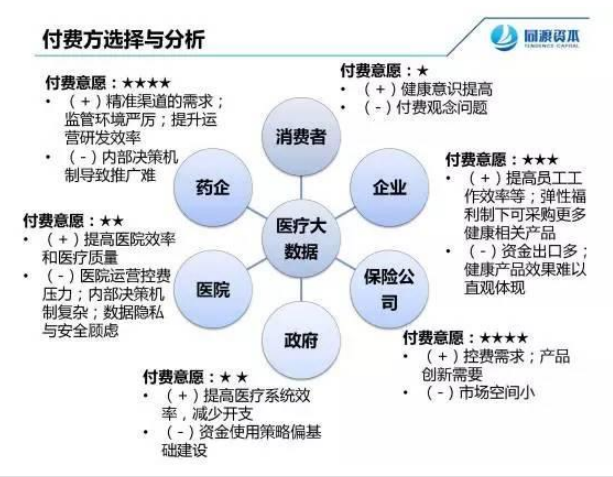
As indicated in the analysis report by Tongdu Capital, the primary payers for healthcare big data currently fall into six categories: consumers, enterprises, insurance companies, governments, hospitals, and pharmaceutical companies (including medical device manufacturers).
In the short term, insurance companies and pharmaceutical firms demonstrate the strongest willingness to pay, with representative enterprises already beginning to explore big data applications. While demand from hospitals, governments, and enterprises remains evident, their approach is currently relatively conservative. Consumers are still more inclined to pay for tangible products, showing limited willingness to pay for services such as online preliminary consultations, let alone big data solutions.
3. Five Major Solutions Proposed by the Health and Medical Big Data Policy
From the “Guiding Opinions of the General Office of the State Council on Promoting and Standardizing the Application and Development of Health and Medical Big Data” (hereinafter referred to as the “Opinions”), we can identify approaches to addressing issues in the development of health and medical big data:
① Regarding legal, regulatory, and privacy security issues:
The “Opinions” point out that laws and regulations governing the application and development of health and medical big data should be formulated and improved, standardized management of resident health information services strengthened, authority for information use clearly defined, and the legitimate rights and interests of all relevant parties effectively protected.
Improve the support service system for data openness and sharing, and establish a management framework based on “tiered authorization, categorized application, and consistency of rights and responsibilities.” Standardize access criteria in the field of health and medical big data applications, establish integrity and exit mechanisms for big data applications, and strictly regulate the development, mining, and application of big data.
Accelerate the development of a health and medical data security system, establish a data security management accountability system, and formulate rules for identification coding, scientific classification, risk stratification, and security review.
Formulate a security plan for population health information, strengthen national and regional engineering and technical capabilities in population health informatics, emphasize content security and technological security, and ensure that national critical information infrastructure and core systems are independently controlled, stable, and secure.
② Addressing data sharing issues:
The “Opinions” point out that it is necessary to encourage various medical and health institutions to promote the collection and storage of big data in health and healthcare, strengthen application support and operational and maintenance technical safeguards, and open up channels for sharing data resources.
③ Addressing the issue of data standardization for health big data:
The “Opinions” point out that unified standards should be established for disease diagnosis coding, clinical medical terminology, examination and testing specifications, drug application coding, information data interfaces, and transmission protocols, so as to promote the standardization of health and medical big data products and service processes.
④ Addressing the shortage of talent in health and medical big data:
The “Opinions” point out that support should be given to establishing a cloud-based platform for health and medical education and training, with the National Open University of Health and Medicine as its foundation and the China Health and Medical Education MOOC Alliance as its support.
Encourage the development of MOOC-based training materials for health and medical care, explore new internet-based teaching models and methods, organize high-quality faculty to promote the open sharing of online medical education resources and applications such as online interaction, remote training, remote surgical demonstrations, and learning outcome assessment, facilitate lifelong education for medical personnel, and enhance the service capacity of primary healthcare institutions.
⑤ Addressing issues related to corporate business models:
The “Opinions” point out that government support policies should be studied and formulated to provide necessary support for the development and application of health and medical big data in areas such as fiscal and taxation, investment, and innovation. The public-private partnership (PPP) model should be promoted and applied to encourage and guide social capital to participate in infrastructure construction, application development, and operational services related to health and medical big data.
Encourage the government to collaborate with enterprises, public institutions, and social organizations, and explore approaches such as government procurement and social crowdsourcing to integrate governmental and societal applications in the field of health and medical big data.
Fully leverage the role of established investment funds, stimulate the enthusiasm of social and private capital to participate, encourage innovative and diversified investment mechanisms, improve risk prevention and regulatory systems, and support the development of health and medical big data applications.
References:
“Big Data Entrepreneurship in Healthcare: What Opportunities and Challenges Remain?” — Tongdu Capital
"Policy and Legal Issues in the Field of Health and Medical Big Data" —— Zhu Min | Zhang Chi