

Alibaba Cloud AI ET Claims Top Spot in LUNA16 Lung Nodule Detection Challenge, Leading Chinese Teams Dominate Global Rankings
Latest news on July 14: A Chinese company has broken the world record in LUNA16, the internationally authoritative lung nodule detection competition. Alibaba Cloud ET claimed the world championship with an average recall rate of 89.7%. This technology was developed by Alibaba’s iDST Visual Computing Team and has been integrated into the Alibaba Cloud ET Medical Brain.
VCBeat visited the official LUNA16 website and found that the second, third, and fourth places were taken by Hangzhou Jianpei Technology, a team from Peking University, and Imagia, respectively. The platform announced the results for the top 15 contestants in total. The reporter further examined the top eight participants and did not identify any other domestic medical AI startups. It remains unclear whether these companies did not participate or simply failed to rank.
In addition, the results from other teams are from May and June, with some even dating back to 2016; therefore, the developments in recent months remain unclear.
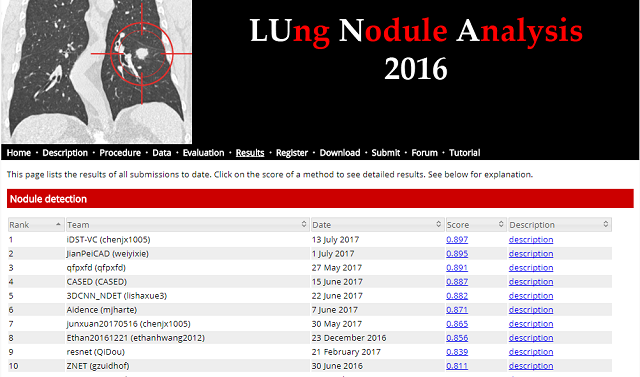
Current Latest LUNA16 Official Website Ranking
The competition required participants to analyze 888 lung CT samples to identify pulmonary nodules. The dataset contained a total of 1,186 pulmonary nodules, with over 75% being small nodules less than 10 mm in diameter. Ultimately, ET achieved an average recall rate of 89.7% for detected pulmonary nodules across seven different false positive rates, surpassing the second-place competitor by 0.2%.
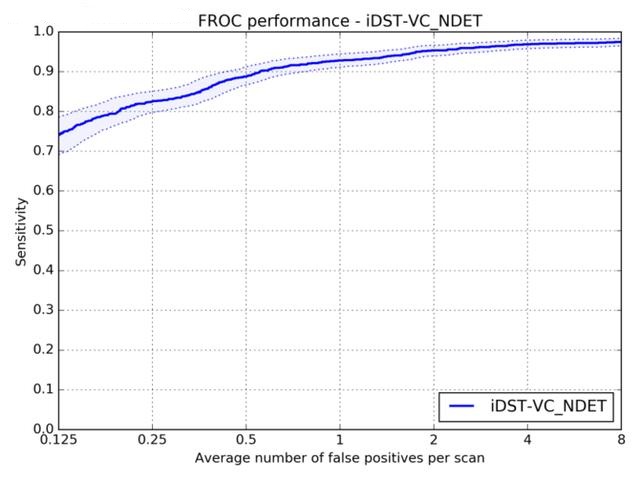
FROC Curve
Recall refers to the proportion of nodules successfully detected in the sample data. The figure above shows the recall of ET at different numbers of false positives.
During the competition, Alibaba Cloud’s ET Medical Brain overcame a series of challenges: the nodules exhibited complex modalities, and early-stage nodules were small (less than 10 mm), making them typically difficult for traditional machine learning algorithms and deep learning networks designed for natural images to handle effectively.
Hua Xiansheng, head of the Visual Computing Team at Alibaba iDST, introduced that, unlike the commonly used two-stage detection methods, they innovatively adopted a single-stage approach that requires no manual intervention throughout the process. The machine automatically reads patients’ CT sequences and directly outputs the detected pulmonary nodules.
In terms of model architecture design, ET adopts a multi-channel, heterogeneous 3D convolution fusion algorithm tailored to the characteristics of CT slices. This approach effectively leverages the complementarity of multiple heterogeneous models to process and detect pulmonary nodule CT sequences with varying morphologies, thereby enhancing sensitivity to pulmonary nodules of different scales. Meanwhile, the integration of a network with deconvolutional structures and a multi-task learning training strategy further improves detection accuracy.
Hua Xiansheng is an internationally renowned authority in the fields of visual recognition and search. He has been elected as an IEEE Fellow and an ACM Distinguished Scientist.
Data released by the National Cancer Center indicate that lung cancer ranks first in both incidence and mortality among all malignant tumors. Chest CT radiological imaging is an effective method for early screening of lung cancer. However, due to the large volume of CT scan images (a single CT scan typically generates more than 200 images), prolonged diagnostic time, heavy workload, and susceptibility to fatigue, human error is inevitable. Artificial intelligence has emerged as a new alternative.
Currently, this technology has been integrated into Alibaba Cloud’s ET Medical Brain. The ET Medical Brain serves as a physician assistant in fields such as precision medicine, medical imaging, drug efficacy mining, new drug development, health management, and wearable devices, and has achieved breakthroughs in lung cancer, cervical cancer, and thyroid cancer.
The continuous breakthroughs in visual computing are part of Alibaba’s “NASA” initiative. Not long ago, the team broke the world record on KITTI, the globally authoritative benchmark platform for machine vision algorithms, raising the accuracy of vehicle detection to 90.46%. This technology was subsequently integrated into the ET City Brain.
Detailed Competition Results:https://luna16.grand-challenge.org/results/
The information in this article is sourced from IT168 Enterprise and other internet websites, compiled by VCBeat.