

2017 Depression Innovation Enterprise Report: Six Innovation Types Enhancing Diagnosis and Treatment from Service and Technology Perspectives
On April 1, 2003, superstar Leslie Cheung committed suicide by jumping from a building due to depression;
On October 31, 2009, young singer Chen Lin committed suicide by jumping from a building due to depression;
On August 11, 2014, comedian Robin Williams died by suicide via hanging due to depression;
On September 16, 2016, reality TV star Qiao Renliang died by suicide through hanging due to depression;
On July 21, 2017, Chester Bennington, the lead vocalist of the rock band Linkin Park, died by suicide via hanging due to depression...
Depression, a disease affecting the normal lives of more than 300 million patients. However, most ordinary people fail to recognize its severe hazards. According to the "2017 Survey Report on Depression Among Chinese Internet Users," Chinese citizens have very limited understanding of depression; even among highly educated individuals with a master’s degree or higher, only one in ten possesses a thorough understanding of the condition. One objective of this report is to systematically review information related to the prevalence, etiology, and treatment modalities of depression, thereby enhancing public understanding of the disorder.
In recent years, the emergence of new technologies such as mobile internet, artificial intelligence, and wearable devices has given rise to innovative, non-traditional approaches across various stages of depression diagnosis and treatment. For instance, artificial intelligence calculates an individual’s risk of depression by analyzing facial expressions and verbal communication; digital health companies leverage big data to precisely match patients with appropriate antidepressant medications; and pharmaceutical giants like Pfizer have partnered with internet companies to launch depression management apps, among other initiatives. Another objective of this report is to elucidate how these new technologies are facilitating the diagnosis and treatment of depression, while also providing an overview of the key enterprises involved in this space.
Core Sections of This Report:
Part I: Current Status of Depression
Part II Key Policies Related to Depression
Part III: Landscape of Innovative Enterprises in Depression
Part IV: Case Studies of Innovative Enterprises in Depression
Part V: Summary and Outlook
This article excerpts the first three sections of the report. To read the full text, scan the QR code at the end of the article to become a VCBeat member and access the complete report, gaining deeper insights into the current industry landscape and development trends in the field of depression.
Part I: Current Status of Depression
1. Prevalence of Depression
1.1. The global patient population has reached 322 million, with 54.28 million patients in China
According to the “Report on Depression and Other Mental Disorders” released by the World Health Organization in February 2017, the global number of people with depression has reached 322 million, accounting for approximately 4.4% of the world’s total population. Among them, the number of people with depression in China is conservatively estimated to exceed 54.82 million, representing 4.2% of China’s total population.
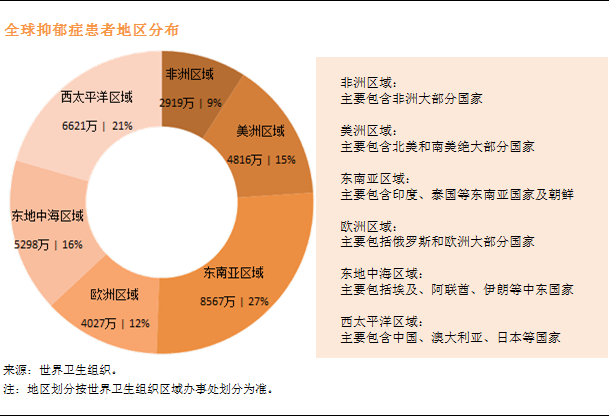
Nearly half of the global population with depression resides in Southeast Asia and the Western Pacific region. This is partly due to the large population base in these two regions, and partly because the fast-paced social environments in rapidly developing countries such as China, India, and Thailand are closely linked to the incidence of depression.
1.2. Depression has become the leading cause of suicide among patients
Globally, approximately 800,000 patients die by suicide due to depression each year, with one person dying every 40 seconds on average. Seventy percent of patients with depression have attempted suicide, and their suicide rate is 36 times that of the general population.
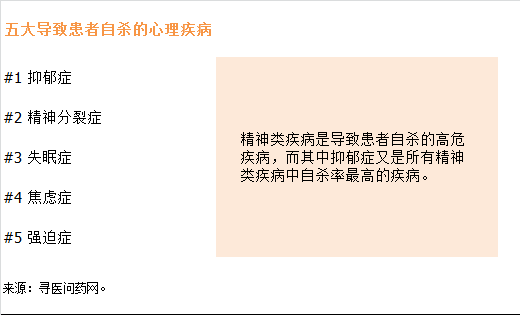
In addition, according to a report by Beijing Youth Daily, statistics indicate that at least 130,000 people die by suicide in China each year, with 40% of those individuals suffering from depression at the time of their suicide.
1.3. The incidence of depression in women is 1.5 times that in men
Globally, the incidence rate of depression in women is higher than that in men. The average global incidence rate of depression is 5.1% for women and 3.6% for men.
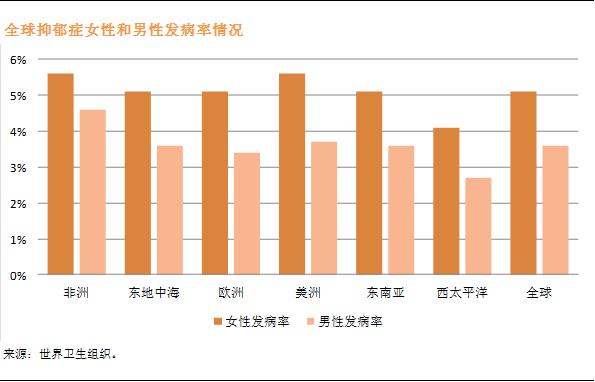
The survey indicates that the gender disparity in depression incidence is primarily attributable to the following three factors:
a. Hormone levels in females are more prone to fluctuation than those in males, with such fluctuations being particularly pronounced during the peripartum period;
b. Women are more emotionally sensitive and, compared to men, are more susceptible to external influences, making them prone to negative emotions that can trigger depression;
c. Influenced by traditional culture, some men did not confide in others or seek medical attention at healthcare institutions after the onset of symptoms, resulting in statistical underreporting.
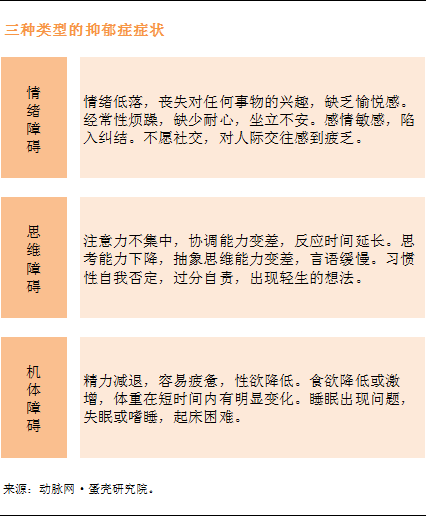
Depression, also known as melancholia, is a psychological and physiological disorder primarily characterized by persistent low mood (defined as lasting at least two weeks per international standards) that is disproportionate to the patient’s environmental circumstances.
3. Etiology of Depression
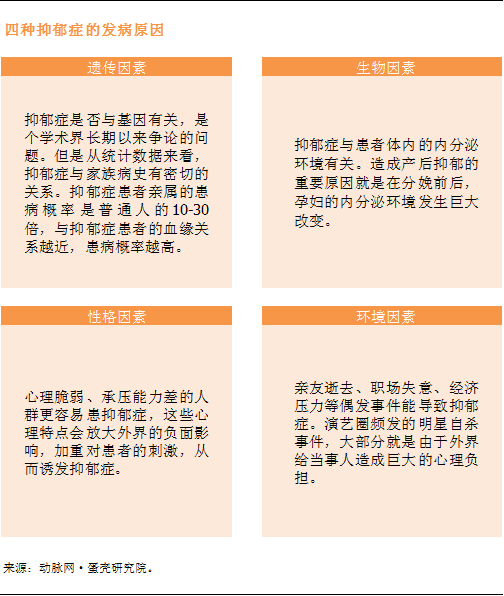
The pathogenesis of depression is complex, with multiple hypotheses proposed in the medical field. Among these, four widely accepted theories are genetic factors, biological factors, personality factors, and environmental factors.
4. Diagnosis and Treatment of Depression
4.1. The diagnosis of depression is primarily based on clinical observation by physicians.
Currently, there are no specific diagnostic tests for depression. Diagnosis is typically made by psychiatrists based on the patient’s medical history, clinical features, and physical examination. The internationally recognized diagnostic criteria include ICD-10 (International Classification of Diseases, 10th Revision) and DSM-IV (Diagnostic and Statistical Manual of Mental Disorders, Fourth Edition); China currently adopts ICD-10. Physicians observe patients’ clinical symptoms in accordance with these diagnostic criteria to arrive at a diagnostic conclusion.
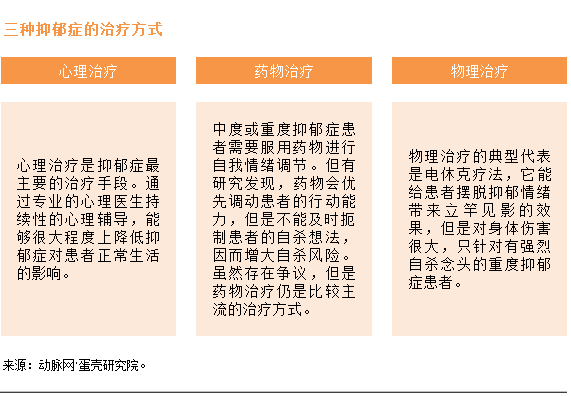
4.2. Treatment of depression is divided into psychotherapy, pharmacotherapy, and physical therapy
Part II: Key Policies Related to Depression
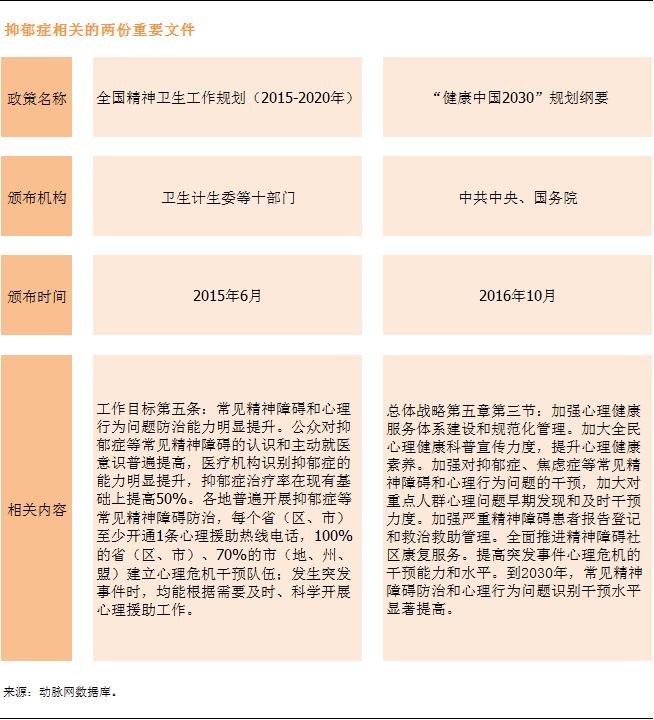
National Key Policies Released to Boost the Diagnosis and Treatment of Depression in China
Currently, China has no specific policies dedicated to depression. However, depression was highlighted as a key focus in the diagnosis and treatment of mental disorders in two major policy documents: the National Mental Health Work Plan (2015–2020), issued in June 2015, and the Outline of the “Healthy China 2030” Plan, released in October 2016.
Part III: Landscape of Innovative Enterprises in Depression
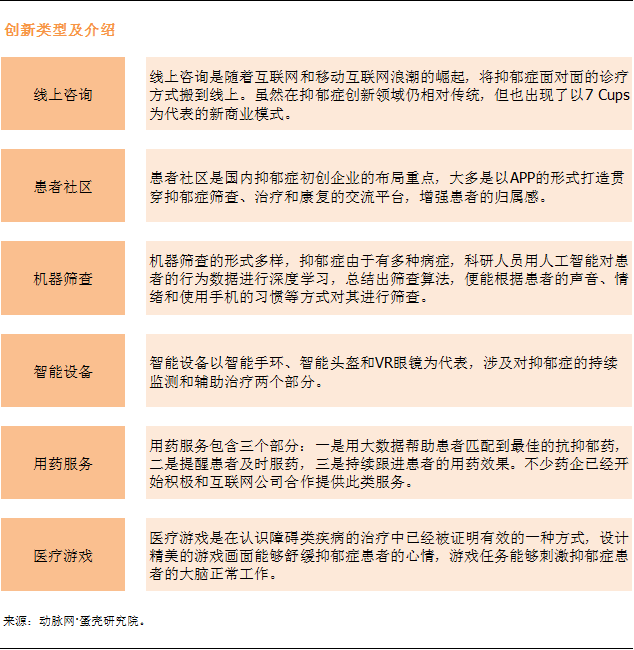
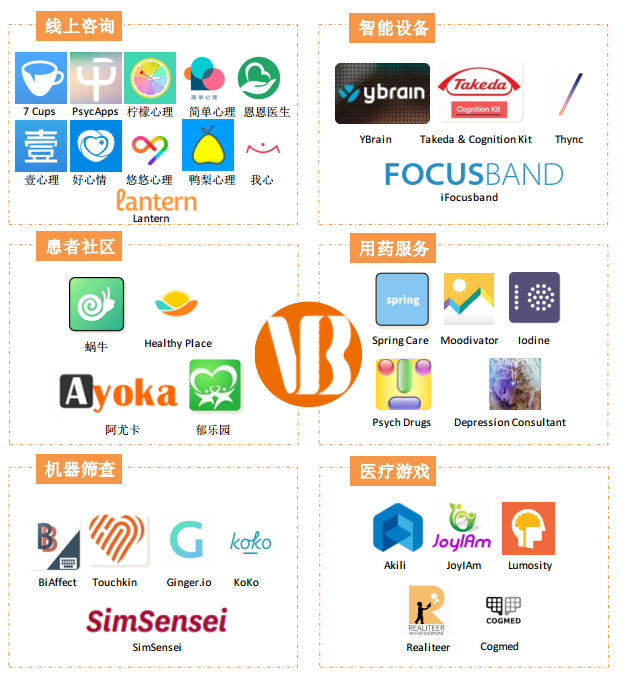
Domestic enterprises focus on service innovation, while overseas enterprises prioritize technological innovation.
Innovative enterprises in the field of depression can be broadly categorized into service innovation and technological innovation. Service innovation primarily encompasses online psychological counseling and novel patient communities, while technological innovation mainly involves leveraging emerging technologies—such as deep learning, natural language processing, and wearable devices—to empower both patients and physicians during the screening and treatment phases of depression.
Global Landscape of Innovative Companies in Depression
Part IV: Case Studies of Innovative Enterprises in Depression
Case 1: Spring Care
Case 2: Snail
Case 3 Akili
Case 4 Ybrain
Case 5: Touchkin
Case 6: Ayuka
Case 7 Takeda & Cognition Kit
Case 8: 7 Cups
Case 9: Yu Leyuan
Case 10 Iodine
Case 11: BiAffect
Case 12 Simsensei
For details, please read the full report.
Part V: Summary and Outlook
For details, please read the full report.
Scan the QR code below to becomeVCBeat Official Member, you can obtainFull Version of "2017Report on Innovative Enterprises in the Field of Depression》Understood.A deeper look at the current industrial landscape and development trends in the depression sector, offering a “sober reflection” on future innovative advancements.Furthermore, over the coming year, you will enjoy unrestricted access to the completeIndustry Trend Report, stay abreast of the latest global investment and financing information, with access to a comprehensiveMedical Enterprise Database, and alsoMassive Resource Matching。

Scan the QR code to become a VCBeat member,
Beta Version Trial Price: ¥365/year.