

AI-Powered Diabetic Retinopathy Screening Targets a Nearly $10 Billion Market: Nine Startups Address Five Key Industry Pain Points
Diabetic retinopathy, abbreviated as "DR," is a common retinal vascular disorder and the leading cause of blindness among patients with diabetes. China has the largest population of individuals with type 2 diabetes globally. As the number of diabetic patients continues to rise, both the prevalence and blindness rate associated with diabetic retinopathy have been increasing year by year, making it the foremost cause of blindness in the general population.
Evidence-based medical studies have demonstrated that hyperglycemia, hypertension, and hyperlipidemia are significant risk factors for the development of diabetic retinopathy.
Because diabetic retinopathy often presents no clinical symptoms in its early stages, and once symptoms appear, the condition is already relatively severe, making it easy to miss the optimal window for treatment. Therefore, the therapeutic efficacy for diabetic retinopathy depends on the timeliness of intervention. However, due to a shortage of ophthalmologists and low public awareness in China, the current screening rate for diabetic retinopathy remains below 10%.
Since 2016, artificial intelligence has experienced explosive growth in the healthcare sector, with its capabilities in radiology imaging, pathology imaging, intelligent speech recognition, and text entry surpassing those of most physicians. Particularly in the field of medical imaging, leveraging the advantages of AI algorithms and computational power, certain AI-based imaging products have achieved accuracy rates exceeding 95%.
Meanwhile, some startups have applied AI to the screening of diabetic retinopathy and achieved certain results. VCBeat has compiled a list of nine such companies to examine how they are attempting to address diabetes screening challenges and assist in the management of patients with diabetes.
27 Million Patients with Diabetic Retinopathy, 70% Not Receiving Standardized Treatment
Data released by the General Office of the National Health and Family Planning Commission in March 2017 illustrated the current status of diabetic retinopathy in China, using metrics such as prevalence, incidence, and patient conditions:
Prevalence: Currently, the prevalence of diabetic retinopathy among individuals with diabetes in China ranges from 24.7% to 37.5%, with proliferative diabetic retinopathy accounting for 3.3% to 7.4%. The longer the disease duration, the higher the prevalence and the more severe the condition. The prevalence rates of diabetic macular edema (DME) and clinically significant macular edema (CSME) in the diabetic population are 5.2% (3.1%–7.9%) and 3.5% (1.9%–6.0%), respectively.
Incidence Rate:
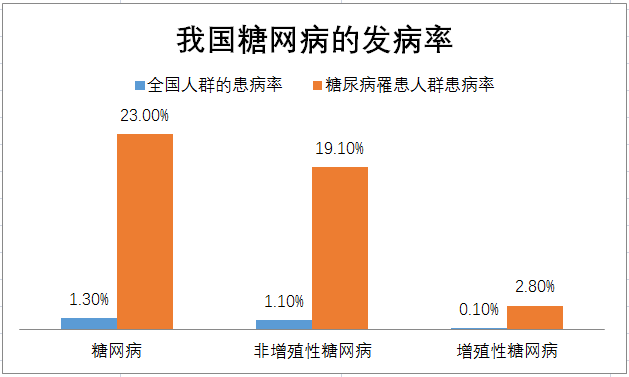
Epidemiological surveys across various regions in China have shown that the prevalence of diabetic macular edema and clinically significant macular edema among individuals with diabetes is 5.2% (3.1%–7.9%) and 3.5% (1.9%–6.0%), respectively.
Patient Status in Diabetic RetinopathyAccording to statistics from the International Diabetes Federation, as of 2015, there were approximately 110 million diabetes patients in China. Assuming two screenings per person per year at a cost of 50 yuan per screening and an 80% penetration rate, the market size would reach RMB 8.8 billion, approaching RMB 10 billion. Based on this, it is estimated that there are about 27 million patients with diabetic retinopathy in China. Currently, 87% of diabetes patients seek medical attention at county-level or lower healthcare institutions; however, basic diagnostic and treatment measures as well as appropriate technologies for diabetic retinopathy are mostly available only at tertiary healthcare institutions, while primary healthcare institutions lack such capabilities.
Epidemiological Findings on Diabetic Retinopathy:More than 50% of patients with diabetes are not informed of the need for regular fundus examinations. Nearly 70% of patients with diabetes do not receive standardized ophthalmic treatment, and approximately 90% of cases of diabetic retinopathy with indications for laser therapy remain untreated. Among patients who should undergo laser therapy, only 20% receive standardized laser treatment.。
There is a huge number of patients, but China has very few ophthalmologists. According to statistics from the National Health and Family Planning Commission, there are currently only 32,000 ophthalmologists in China, among whom approximately 800–1,000 specialize in fundus disease services and research. This represents a severe shortage of ophthalmologists relative to the more than 100 million diabetic patients.
In terms of treatment costs, as public health awareness rises and the frequency of diabetes screening increases, more patients with diabetes will receive effective treatment. Consequently, the diabetes care market holds substantial growth potential.
According to the IDF report, in 2015, 11.6% of global healthcare expenditure was spent on diabetes treatment, amounting to approximately USD 673–1,197 billion.
Direct medical expenditures attributable to diabetes in China account for 13% of the nation’s total healthcare spending, amounting to RMB 173.4 billion. This is primarily because patients with diabetes utilize healthcare services at three to four times the rate of non-diabetic individuals, resulting in higher frequencies of both hospitalizations and outpatient visits. Additionally, middle-aged and older populations have accumulated a certain level of wealth, affording them greater payment capacity.
Based on this calculation, the average annual expenditure per diabetic patient on diabetes management is under RMB 10,000; therefore, spending a few dozen yuan on a screening test does not constitute a significant financial burden.
Top 5 Industry Pain Points in Diabetic Retinopathy Screening
Diabetic retinopathy screening has not been widely implemented, partly due to the shortage of physicians and the large patient population, and partly due to certain practical challenges.
1、The large and rapidly growing patient population with diabetic retinopathy has far outpaced the adoption rate of fundus imaging equipment.. However, due to the high cost of fundus imaging equipment, large-scale procurement is not feasible for underdeveloped regions.
2. With growing public awareness of diabetic retinopathy screening and national policy support, the demand for fundus image interpretation is increasing.The current number of physicians is insufficient to handle this workload., leading to physician burnout and an increase in misdiagnoses and missed diagnoses. Furthermore, experienced physicians are reluctant to devote themselves exclusively to image interpretation; they desire more time for research to generate new findings. This exacerbates the shortage of physicians.
3、Slow and Variable Training of Physicians in Fundus Image Interpretation. This also leads to discrepancies in image interpretation among different physicians, resulting in a lack of quantitative information in diagnostic outcomes.
4. Data management and analysis for fundus image interpretation are highly challenging. Currently, data is merely archived in a simple manner, but the substantial workload required for data organization makes it difficult to reuse the interpreted imaging data.
5. Patients with diabetes often face mobility challenges due to advanced age or systemic multi-organ complications, and they frequently reside far from medical institutions within their region that have adequate capacity for ophthalmic services, while also enduring prolonged waiting and examination times at these facilities.
9 Companies Leveraging AI for Diabetes Screening
These pain points are primarily caused by an imbalance between the supply and demand of medical services. As image recognition is a specialty of artificial intelligence (AI), leveraging AI for preliminary screening will significantly improve the current state of diabetic retinopathy screening. To this end, VCBeat has compiled a list of nine companies currently using AI for diabetic retinopathy screening (this list may not be exhaustive; if other companies are involved in this business, please contact VCBeat).
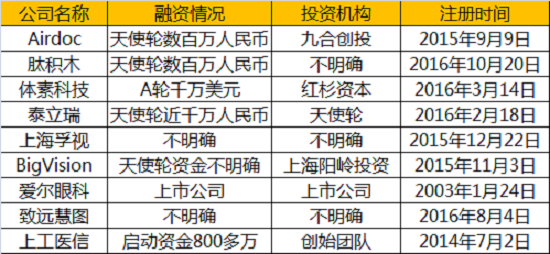
Apart from Aier Eye Hospital, the other eight are all startups.Three of them were registered in 2015, and four in 2016; all are still young companies. Among these nine startups, financing information is available online for five: four at the angel round and one at Series A.
Among these companies, ShangGong YiXin, Peptide Blocks, Shanghai Fushi, BigVision, and Zhiyuan Huitu are all focused on the field of ophthalmology. The businesses of Tisu Technology, Taili Rui, and Airdoc are more extensive, involving other imaging products.。
In the clinical trial phase,The Process of Using Artificial Intelligence for Diabetic Retinopathy Screening Is as Follows: Patients use mobile phones, handheld fundus cameras, and professional fundus equipment to capture fundus photographs, which are then uploaded to the system or cloud platform. After entering their medical history (which may also be entered by a physician), the system automatically provides auxiliary reference recommendations.
Refer patients requiring further in-depth examination and treatment to physicians for re-evaluation; provide health guidance recommendations to patients with no diabetic retinopathy or mild cases that do not require further in-depth examination and treatment.
According to Bai Wenjie, CEO of Peptide Blocks, the company’s AI technology can complete lesion marking on a single fundus image in 13–15 seconds, compared to the 3–5 minutes required by physicians. This represents an approximately 20-fold increase in speed while maintaining accuracy.
Professor Wei Ruili from Shanghai Changzheng Hospital commented on Airdoc as follows: “With the Airdoc DR system, we can extend the expertise of our specialist physicians and our diagnostic capabilities across China. In other words, images captured by mobile phones or professional medical devices in any location can be transmitted to the cloud for auxiliary analysis to obtain accurate recommendations, enabling patients to receive early prevention and supportive analytical advice at any time.”
Artificial intelligence not only enables rapid and highly accurate identification of diabetic retinopathy, but also significantly optimizes screening processes, streamlines patient care pathways, and saves physicians’ time. In the future, AI will empower primary care hospitals to better screen for diabetic retinopathy, ensuring that patients requiring treatment receive timely intervention, thereby substantially reducing overall societal healthcare costs.
Leveraging AI for Diabetic Retinopathy Screening Will Bolster Diabetes Management in China
A previous article highlighted the view that AI-powered diabetic retinopathy screening will bolster diabetes management in China.
Compared with blood glucose management, diabetic retinopathy screening is more effective in helping primary care institutions gradually establish a chronic disease management system and enhance their chronic disease management capabilities. The National Health and Family Planning Commission’s tiered diagnosis and treatment service plan clearly states that ocular conditions require referral, while strict control of blood glucose, blood pressure, and blood lipids, along with regular patient follow-up and education, must be implemented at the primary care level.
Thus, after patient screening, even if they receive ophthalmic treatment at a tertiary hospital, they must ultimately return to primary care settings. “Render unto Caesar what is Caesar’s, and unto God what is God’s.” Effectively implementing screening, monitoring, follow-up, patient education, and pharmacological management constitutes the core of the primary care-based chronic disease management system.
Screening for diabetic retinopathy is merely the beginning, an entry point. When primary care providers are willing to initiate patient management, I believe many pharmaceutical companies will make substantial investments in training our physicians and providing various tools to assist in patient management.
Challenges and Opportunities in AI-Based Diabetic Retinopathy Screening
Ophthalmic Equipment Needs Advancement: Currently, professional ophthalmic equipment is expensive and complex to operate. It requires trained personnel for operation, but such equipment is not conducive to large-scale screening. In response, handheld fundus cameras and smartphone-based improved fundus cameras have emerged in the market.
Although handheld devices are simple to operate, industry experts state that approximately 30% of the images captured by domestically produced handheld devices are invalid, necessitating a second capture. The image quality of imported handheld fundus cameras is superior to that of domestic devices.
If large-scale screening for diabetic retinopathy is conducted,Handheld fundus cameras are essential devices; a technological shortfall in this area will somewhat hinder the widespread adoption of AI-based fundus screening technology. However, according to VCBeat, many companies are currently collaborating to improve these devices.。
A comprehensive standard database needs to be established.: Enterprises or hospitals collect a certain volume of imaging data comprising fundus photographs of varying quality. Under government leadership, a panel of experts is engaged to annotate these images and establish graded classifications. These images are then input into the AI-assisted diagnostic and screening systems developed by various startups. The accuracy of these systems is meaningfully evaluated by comparing their outputs with the expert annotations.
This is no easy task. Annotating hundreds of thousands of data points requires funding exceeding tens of millions of RMB, with each image requiring annotation by 5–7 experts, representing a substantial workload. How to implement this in practice will require multi-party discussions among the government, enterprises, and hospitals.
Comprehensive Ophthalmology Services: Zhang Dalei of Airdoc has pointed out that current medical AI applications are primarily focused on outpatient and inpatient care. However, given the multitude of stages within healthcare services, AI has significant potential to play a greater role in other areas, such as postoperative tracking and follow-up, as well as monitoring drug efficacy feedback. By rapidly analyzing massive datasets and generating corresponding models, AI can assist physicians in more effectively tracking disease progression and managing treatment follow-ups.
Recently, we have increasingly observed AI companies collaborating with local Health and Family Planning Commissions to launch screening programs for diabetic retinopathy. These initiatives are funded by medical insurance and implemented by the enterprises. Although still in the pilot phase, we believe that with policy improvements and equipment upgrades, artificial intelligence will undoubtedly facilitate diabetic retinopathy screening, diabetes management, and the implementation of tiered diagnosis and treatment.
Reference: Notice of the General Office of the National Health and Family Planning Commission on Issuing the Technical Scheme for Graded Diagnosis and Treatment Services for Diabetic Retinopathy