

Medical AI Is Not Hype—It Will Become an Indispensable Tool for Physicians, Though Patience Is Required
Recently, an article titled “Is Watson a Joke?” has been circulating on WeChat Moments. The gist of the article is that in the aftermath of the AI hype, Watson terminated its collaboration with MD Anderson Cancer Center and failed to generate substantial revenue for IBM. Some people consider Watson a joke, arguing that it will not solve healthcare problems as advertised, and even suggesting that medical AI may be overhyped.
However, as a media outlet that closely monitors medical AI on a daily basis, we believe such views are somewhat exaggerated. After all, the rigorous nature of healthcare and the current level of market education dictate that medical AI is inevitably a long-term endeavor.
Speaking with facts and data, Watson is truly helping doctors and patients.
It is reported that the termination of the collaboration between Watson and MD Anderson was not due to Watson, but rather to MD Anderson, as evidenced by the settlement amount paid by MD Anderson.In fact, since March 2016, when MD Anderson replaced its legacy in-house electronic medical record system, ClinicStation, with the Epic EHR system, the transition led to a significant decline in physician and hospital operational efficiency, resulting in an annual loss of $260 million and prompting the announcement of 900 job cuts in January 2017.
Furthermore, due to incompatibility with the new EHR system, the original Watson platform could not seamlessly integrate with the new infrastructure, resulting in an inability to continuously access hospital data. This significantly impacted Watson’s capacity for continuous learning, ultimately leading to the termination of the partnership.
In addition, VCBeat conducted a survey in March 2017 on the implementation status of Watson for Oncology. The results showed that Watson for Oncology had been deployed in seven countries worldwide—namely, China, the United States, South Korea, Thailand, Singapore, India, and the Netherlands—where it had officially entered the commercialization phase and was providing services to patients. In terms of covered conditions, Watson’s oncology treatment recommendations currently encompass breast cancer, lung cancer, rectal cancer, colon cancer, gastric cancer, cervical cancer, and ovarian cancer, with plans to expand coverage to 8–12 cancer types by the end of 2017.
As of March 25, Watson for Oncology had served more than 20,000 patients worldwide. In the months since, there has been growth in the number of countries, hospitals, and patients served.
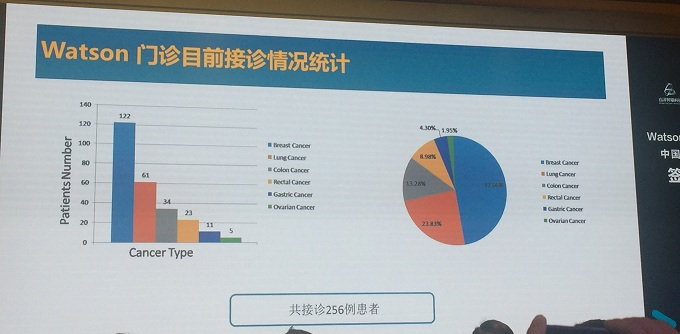
The above figure isAccording to clinical data provided by Zhang Xiaochun, Vice President of the Affiliated Hospital of Qingdao University and Dean of its Cancer Hospital, Watson for Oncology, since its introduction to the hospital on April 27, 2017, served a total of 256 patients in less than two months. The cases included 122 with breast cancer, 61 with lung cancer, 34 with colon cancer, 23 with rectal cancer, 11 with gastric cancer, and 5 with ovarian cancer.。
Li Na, Deputy Director of the Oncology Department at the First Hospital of Hebei Medical University, also revealed to VCBeat that Watson for Oncology has provided services to more than 100 patients in the month since its introduction to the hospital.
Norman Sharpless, M.D., Director of the University of North Carolina Lineberger Comprehensive Cancer Center, stated, “It is extremely challenging to identify precise and appropriate medications for patients with advanced cancer. This requires complex analysis of diverse big data sources, integrating emerging clinical trial information with personalized genomic sequencing. This is precisely where IBM Watson excels.”
According to Fu Gang, Chairman of Baiyang Pharmaceutical Group, the collaboration on Watson for Oncology, which was agreed upon by both parties three months ago, is progressing steadily. The system has currently been deployed in 11 hospitals and is expected to cover 150 tertiary general hospitals by the end of the year.
None of these hospitals have declared issues with Watson products or terminated their collaborations. Reporters have bypassed IBM to engage in direct conversations with physicians. Although Watson for Oncology requires improvement and expansion in terms of localization and disease spectrum coverage, the service currently provided offers substantial assistance, particularly by offering theoretical support for clinical decision-making and helping physicians monitor drug dosages and side effects.
The Current Challenges of Medical AI Stem from the Inherent Rigor of Medicine
Some argue that Watson’s progress has slowed in recent years, primarily due to the high cost and scarcity of medical data. This challenge was indeed prevalent during the early stages of medical AI development. For many years, medical data were not standardized, organized, or properly archived. Although individual countries and major hospitals possess vast amounts of data, these datasets remain unformatted and disorganized, rendering them effectively unusable.
However, as awareness of medical AI deepens and greater emphasis is placed on high-quality data, startups focused on medical data processing have gradually emerged. The capital market also recognizes data as the “oil” of the future and advocates for increased investment in such companies. In February 2016, IBM planned to acquire the healthcare data company Truven Health Analytics for $2.6 billion. In China, specialized medical data companies such as Senyi Intelligence, Yiming Technology, and Yidu Cloud have all secured financing.
On the other hand, while data is valuable, unorganized and unanalyzed data stored in hospitals amounts to a collection of ineffective information. Hospitals have research needs and are willing to collaborate with enterprises to unlock the value of data, thereby better serving patients. Consequently, most medical AI startups in China engage in collaborative R&D with hospitals to develop medical AI products.
In this way, hospitals achieve new research accomplishments, and enterprises do not need to spend huge amounts on data, creating a true win-win situation. Therefore, although data is important for medical startups, it is currently not the biggest bottleneck in the development of medical AI companies.
Currently, most companies have completed the preliminary research and development of their products, with some reaching the diagnostic proficiency level of associate chief physicians or even higher. However, these products have not been rapidly deployed in clinical practice. The primary reason is the inherent rigor of the medical field, which requires extensive clinical data validation to gain recognition—a process that takes time. As is well known, medical AI has only emerged in recent years.
Moreover, public awareness of medical AI largely began in 2016. Over the course of a year, although understanding among stakeholders such as the government, hospitals, physicians, and patients has increased, comprehension remains insufficient due to the complexity of medical AI. Beyond industry-specific knowledge, most people’s perception of artificial intelligence is still primarily shaped by its portrayal in science fiction films.
During the interview process, reporters learned that some physicians using AI products even consider telemedicine, healthcare informatization, and internet-based healthcare to be part of medical artificial intelligence. These phenomena indicate that market education is also a challenge currently facing the industry.
Medical AI is a “slow-burn” endeavor; those seeking quick profits should step aside.
Although aided by the internet and AI, healthcare remains a slow-moving industry. Unlike internet companies such as Didi Chuxing, which can emerge suddenly, scale rapidly, and quickly permeate daily life, healthcare products require several years even for preclinical trials alone. Given that lives are at stake, one should not apply an internet-centric mindset to AI in healthcare.
Recently, IBM’s revenue has declined and its stock price has dropped, prompting analysts to question when Watson will generate market value. Subsequently, some media outlets began publishing negative reports on Watson and other medical AI projects, dismissing them as hype with no investment value.
Medical AI as an emerging industry,It encompasses both the emerging field of artificial intelligence and the traditional, rigorously regulated healthcare industry. Neither innovative technology nor healthcare is a pathway to quick profits; technological expertise requires accumulation, and medical applications demand rigorous validation—both of which necessitate time.. Although many current investors have not achieved substantial returns, the performance of medical products has gained industry recognition, and their achievements are evident to all:
People are expected to be able to diagnose skin cancer via mobile phones, with an accuracy rate exceeding 91%;
AI Outperforms Doctors in Early Diagnosis of Autism in Children;
Google Uses Deep Learning to Assist Pathologists in Detecting Cancer, with an Accuracy Rate of 89%;
Third Military Medical University Uses AI to Identify Blood Types Within 30 Seconds, Achieving Over 99.9% Accuracy...
The benefits of medical AI will materialize in the future, as it is still in its growth stage; therefore, expecting to make quick profits from medical AI is clearly unrealistic. Much like the pharmaceutical industry, which requires billions of dollars in investment and decades of research and development to ultimately produce a blockbuster drug like Humira, with annual sales reaching tens of billions of dollars...