A Decade of Transformation: Macroeconomic Insights and Product Landscape of China's Pharmaceutical Industry (2008–2017)
2008–2017: Marked by the launch of China’s new healthcare reform, the Chinese pharmaceutical industry underwent a decade of development with distinct characteristics. Unprecedented changes occurred across policy, economic, social, and technological dimensions. In essence, the past decade witnessed the demise of traditional models and the emergence of a new ecosystem.
2008–2017: A Decade of the CHS Conference. The 2017 CHS Conference will be held in Boao from August 16 to 21. As the new session of the CHS Conference approaches, the data team at Sinohealth Information has reviewed the developments of the past decade from three perspectives—macroeconomic trends, the overall pharmaceutical industry landscape, and transformations in the retail sector—comparing conditions before and after this period. By identifying patterns through data analysis and using these insights to forecast future trends, the report provides a multi-dimensional analysis of the pharmaceutical industry’s evolution over the past ten years. As a media partner of the CHS Conference, VCBeat (WeChat ID: vcbeat) has promptly released this data report.
A Decade of Macroeconomic Growth: GDP Doubles, Industrial Scale Triples
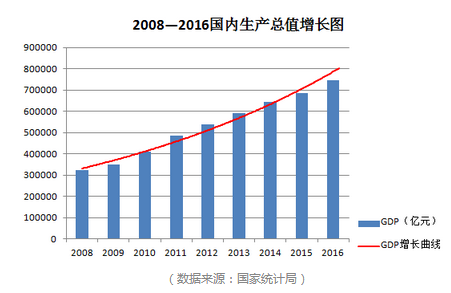
From 2008 to 2016, China's gross domestic product (GDP) grew from RMB 31.95 trillion to RMB 74.41 trillion, while per capita GDP increased from RMB 24,121 to RMB 53,817. In terms of growth rate, it declined from 9.7% in 2008 to 6.7% in 2016, with a projected figure of 6.5% for 2017, marking the onset of an L-shaped inflection point.
In contrast, the total output value of China’s pharmaceutical industry above designated size showed a steady growth trend, increasing from RMB 748.192 billion in 2008 to RMB 2,963.586 billion, representing a threefold increase over ten years. However, the growth rate declined from 24.76% in 2008 to 10.06% in 2016.
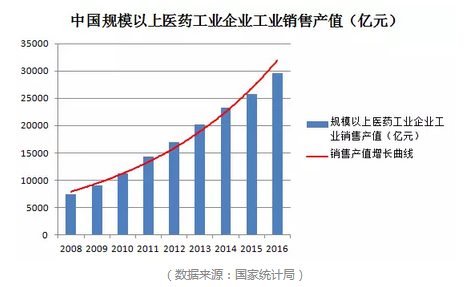
In 2016, the pharmaceutical industry's value-added accounted for 3.3% of the total industrial value-added, an increase of 0.3 percentage points from the previous year, further expanding its contribution to industrial economic growth.
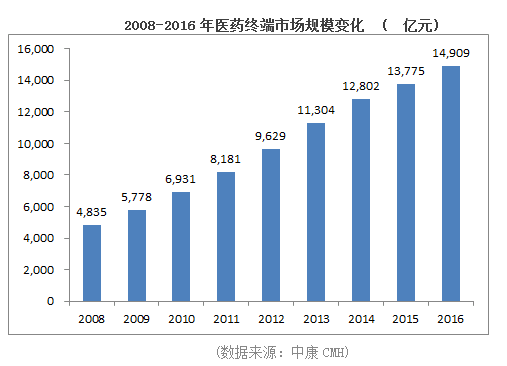
In the pharmaceutical terminal sector, data from Zhongkang CMH shows that from 2008 to 2016, the national drug market size grew from RMB 483.5 billion to RMB 1.4909 trillion, with the pharmaceutical terminal drug market size officially surpassing the one-trillion-yuan mark in 2013.
A Decade of National Income: Disposable Income Doubles, with a Gradual Rise in the Share of Healthcare and Pharmaceuticals
Parameters such as changes in disposable income and shifts in consumption structure are also key indicators for assessing a country’s overall consumption level, profoundly influencing the development of consumer sectors, including the pharmaceutical and health industries.
Disposable Income:
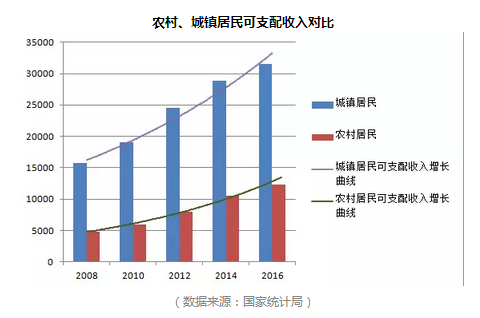
Ten years ago, the gap in disposable income between rural and urban residents was significant, at 4,761 yuan and 15,781 yuan, respectively.
In 2016, the income of rural residents increased to RMB 12,363, while that of urban residents reached RMB 31,554, representing 2.6 times and 2 times the levels of 10 years earlier, respectively.
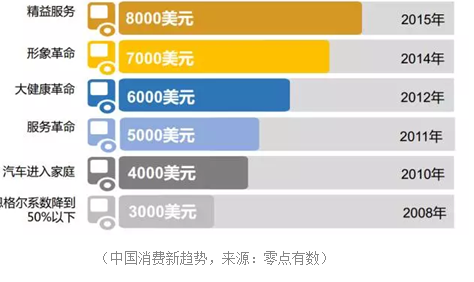
It is worth noting that in 2008, China's per capita GDP surpassed US$3,000 for the first time, reaching US$3,315, marking the onset of a pronounced trend toward upgrading household consumption structures. Correspondingly, consumer and service-oriented industries exhibited significant upward momentum. By 2015, as per capita GDP exceeded US$8,000, consumption entered the “lean service” stage.
Healthcare Expenditure:
In 2008, urban residents' expenditure on healthcare was 786.2 yuan, while that of rural residents was 246.0 yuan, accounting for 7.0% and 6.72% of their total consumption expenditure, respectively.
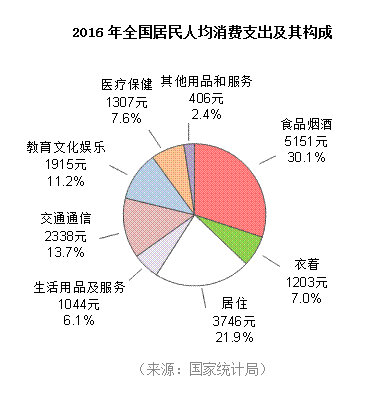
By 2016, the median household healthcare expenditure had reached RMB 1,307, accounting for 7.6% of total consumer spending.
A Decade of the Healthcare Service System: Health Insurance Coverage Doubles, Rapid Growth in Medical Infrastructure
The foundational system of medical services and support is the core of sustainable development in the pharmaceutical and healthcare industry.
From a longitudinal perspective, the security system:
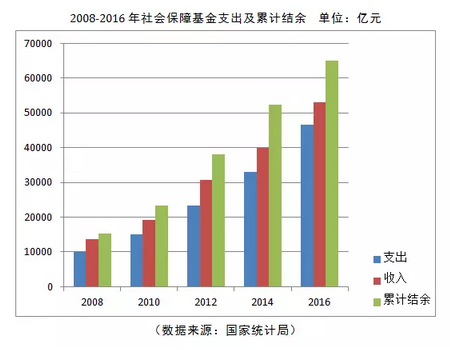
According to data from the National Bureau of Statistics, in 2008, the number of people enrolled in urban basic medical insurance reached 316.98 million. New Rural Cooperative Medical Scheme (NRCMS) was implemented in 2,729 counties (cities, districts), with a participation rate of 91.5%. By 2016, the number of people enrolled in urban basic medical insurance had increased to 748.39 million, representing a 1.3-fold increase in coverage compared to 2008.
In addition to expanding the coverage of basic safeguards, the “Opinions of the General Office of the State Council on the Comprehensive Implementation of Critical Illness Insurance for Urban and Rural Residents” was officially issued in 2015. It required that by the end of 2015, critical illness insurance should cover all participants in the Basic Medical Insurance for Urban Residents and the New Rural Cooperative Medical Scheme (hereinafter collectively referred to as the Basic Medical Insurance for Urban and Rural Residents), thereby effectively alleviating the medical expense burden for patients with critical illnesses. By 2017, a relatively well-developed critical illness insurance system had been established, closely coordinated with medical assistance and other systems to jointly provide a safety-net protection function, effectively prevent catastrophic household medical expenditures, and significantly improve the equity of medical security for urban and rural residents.
On Healthcare Service Infrastructure:
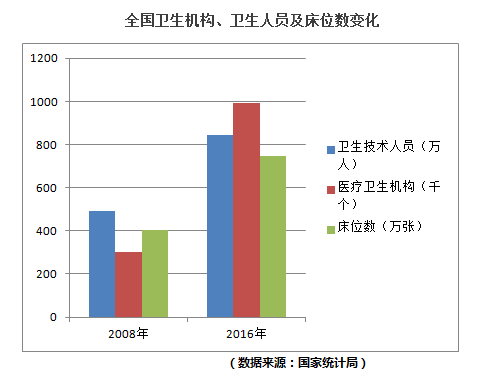
In 2008, there were 300,000 healthcare institutions, 4.92 million health technical personnel, and 4.03 million hospital beds nationwide in China. By 2016, the number of healthcare institutions had increased to 993,000, health technical personnel had grown to 8.44 million, and the number of hospital beds had risen to 7.47 million.
The data show that the number of healthcare institutions has more than doubled, while the increase in technical personnel is less than twofold, and the number of hospital beds has risen by 1.8 times. However, despite the continuous improvement of the healthcare service system, medical service professionals, especially physicians, remain in short supply.
A Decade of Population Development: The Population Aged 65 and Above Reaches 230 Million, with Aging Profoundly Impacting Industries
Changes in population size and structure are among the internal drivers of socioeconomic dynamics. This is particularly evident in the pharmaceutical and health industries. Among various demographic indicators, data on the aging population holds core reference value. Internationally, it is commonly accepted that a country or region is considered an aging society when individuals aged 60 and above account for 10% of the total population, or those aged 65 and above account for 7%.
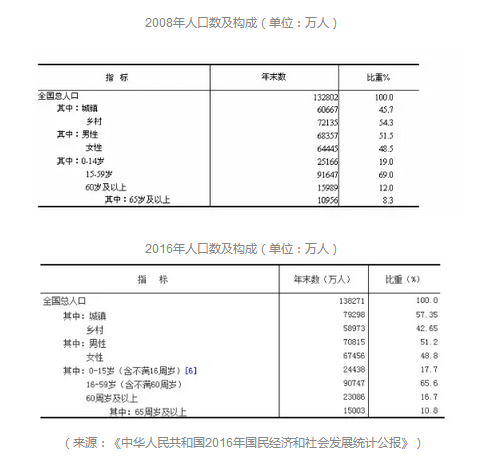
In 2008, the total population of China at year-end was 1.32802 billion, with individuals aged 60 and above accounting for 12% and those aged 65 and above comprising 8.3%, indicating that the country had entered an aging society. By 2016, the total population had reached 1.38271 billion, with the proportion of people aged 60 and above rising significantly to 16.7%, and those aged 65 and above accounting for 10.8%.
As population aging accelerates, the proportion of deaths among urban and rural residents attributable to three major diseases—malignant tumors, heart disease, and cerebrovascular disease—has continued to rise. According to the Health Statistical Yearbook, their combined share was 66.39% in 2008 and increased to 69.05% by 2015. This trend underscores the unprecedented pressure on China’s prevention and control efforts for chronic diseases, predominantly malignant tumors and cardiocerebrovascular disorders. Chronic diseases now account for as much as 70% of the overall disease burden, leading to a substantial increase in total healthcare expenditure in China:
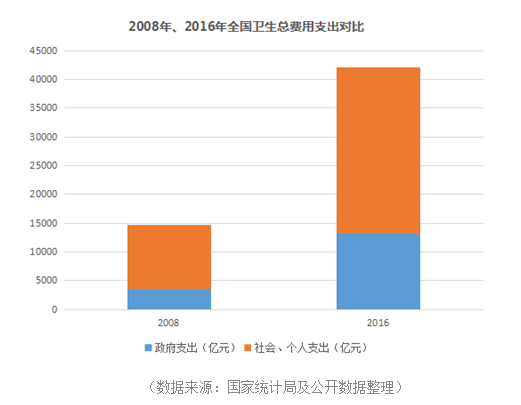
In 2008, China’s total health expenditure reached RMB 1,453.54 billion, of which government spending accounted for RMB 359.394 billion. In 2016, total expenditure rose to RMB 4,214.5 billion, with government spending amounting to RMB 1,315.4 billion. It can be seen that China’s total health expenditure in 2016 was 2.9 times that of 2008, while government spending on health was 3.6 times the 2008 level.
A Decade of Urbanization: The Urbanization Rate Reaches 57.35%, and the Consumption Structure Upgrades
The level of urbanization is one of the core parameters of socio-economic development; the rise in the urbanization rate has transformed consumption patterns and fueled the rapid growth of the pharmaceutical industry.
In 2008, China’s urbanization rate was 45.7%, rising to 57.35% by 2016. In fact, the urban population first surpassed the rural population in 2011. At the end of that year, the rural population stood at 656.56 million, while the urban population had reached 697.09 million.
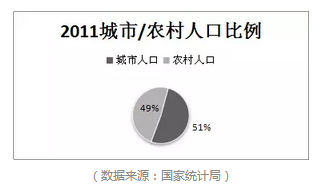
During the process in which the urban population surpassed the rural population, natural growth of the local population was only a secondary factor; large-scale migration accompanying urbanization was the core reason for this trend.
Therefore, when compiling statistics on the population size and composition for 2016, the National Bureau of Statistics specifically noted that the nationwide population with separate household registration and actual residence totaled 292 million, including 245 million floating migrants.
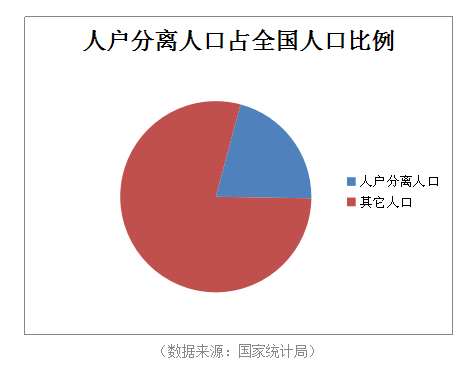
The population of nearly 300 million people living apart from their registered households is unprecedented not only in Chinese history but also in world history. This situation signifies a substantial gap in the urban healthcare services market and implies an urgent need to transform service delivery models, requiring us to directly address and resolve the issue of allocating medical and pharmaceutical resources.
Meanwhile, urbanization transforms farmers into urban residents, accompanied by shifts in consumption patterns and an expansion in consumption scale. The "Analysis Report on the Development Path and Investment Strategic Planning of China's New-Type Urbanization (2013–2017)" shows that migrant workers who have lived in the same city for one year have an average expenditure of 1,761 yuan. If they reside in the city for more than five years, their average expenditure rises to 2,609 yuan. Furthermore, as urbanization advances, service levels in sectors such as culture, tourism, leisure, domestic services, and beauty care will continuously improve. The proportion of enjoyment-oriented consumption will steadily increase, thereby gradually achieving an upgrade in the consumption structure.
A Decade of Shifts in Consumer Channels: The Rapid Rise of E-Commerce and the Emerging Promise of Pharmaceutical E-Commerce
Driven by the growth in disposable income, the diversification and upgrading of consumption are reflected in channel transformation. In particular, with the rapid development of internet technology, the share of e-commerce channels in the consumer sector has been increasing year by year.
According to data from the National Bureau of Statistics, in 2016, the total retail sales of consumer goods amounted to RMB 33.2316 trillion, representing a real growth of 9.6%. Among this, online retail sales reached RMB 5.1556 trillion, a year-on-year increase of 26.2%, accounting for 15.5% of the total retail sales of consumer goods.
In 2008, the e-commerce market size was approximately RMB 130 billion, already in a phase of explosive high-speed growth, with a year-on-year surge of 150% compared to 2007. It can be said that over the past decade, the scale of online retail has grown nearly 40-fold, marking a golden decade of rapid development for e-commerce.
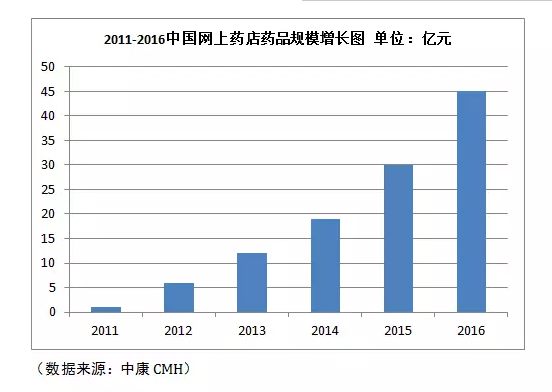
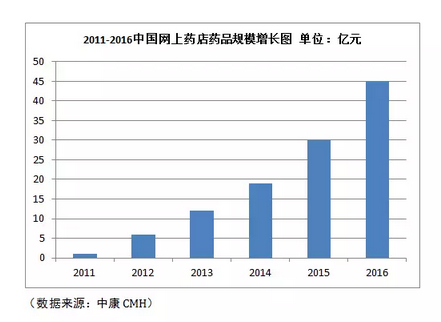
In the pharmaceutical and health industry, the noticeable shift in data can be attributed to the official launch of Tmall’s Pharmacy Channel in 2012. According to data from Sinopharm CMH, the share of e-commerce in drug consumption gradually increased from a negligible level to approximately 3% by 2016.