

China's State Council Releases 'Next-Generation Artificial Intelligence Development Plan': Key Implications for the HealthTech Sector
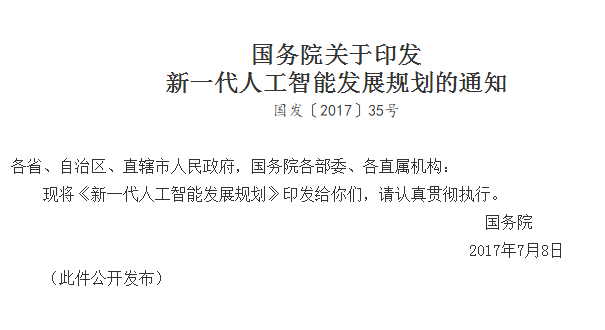
On July 20, the State Council released the “Development Plan for New-Generation Artificial Intelligence.” The national guidelines long anticipated by industry professionals have finally been issued—and by the State Council, no less. VCBeat (WeChat ID: vcbeat) has summarized the four major sections of the document related to general health for your reference.
Establish a Preliminary AI Legal, Ethical, and Policy Framework by 2025
Document in the plannedThree-Step Strategic PlanThe second step in points out,By 2025, the country will have initially established a legal and regulatory framework, ethical norms, and policy system for artificial intelligence, thereby developing capabilities for AI safety assessment and control. The third step outlines that by 2030, a more comprehensive legal and regulatory framework, ethical norms, and policy system for artificial intelligence will be established.
This information holds profound significance for the field of medical artificial intelligence, which remains a legal “blank slate.” As an emerging industry, medical AI cannot follow the same approval processes as traditional medical devices. Even if submissions are made, regulators will exercise greater caution given the rigorous nature of healthcare.
However, artificial intelligence is a rapidly evolving industry, with some products undergoing iterative updates every 3 to 7 days. By the time we submitted the first-generation product for regulatory approval, it had already undergone dozens of iterations within a year, while the certification was still pending.
In response to this situation, the U.S. FDA formally established a new department in May 2017 dedicated to the review of digital health and AI technologies. This department comprises 13 software engineers and developers, as well as experts in AI technology and cloud computing.
The department’s mandate is to establish regulations and standards for the FDA, initiating the review of the growing influx of AI products and healthcare devices, instruments, or medical software with machine learning capabilities entering the FDA. They will redefine the regulatory and approval pathways for intelligent medical robots and medical devices featuring machine learning capabilities.
Furthermore, as the foundation of medical artificial intelligence, medical big data currently lacks a comprehensive legal framework for regulation. There are no clear legal guidelines regarding data ownership, usage rights, privacy standards for medical data, data security, liability norms, or whether the law can accommodate non-malicious errors arising from innovation.
While the absence of legal regulations has contributed to the current prosperity of medical artificial intelligence (AI), the lack of rules can hinder orderly progress, and such unchecked development may not be beneficial in the long run. If preliminary legal frameworks had been established by 2025, although this might have triggered industry reshuffling, it would have fostered more robust and sustainable growth in medical AI.
Establish a foundational theoretical framework and a system of key generic technologies for next-generation artificial intelligence
The “Development Plan for New-Generation Artificial Intelligence” points out that the country will strengthen deployments in areas such as frontier fundamental theories, key generic technologies, foundational platforms, and talent pools to increase the source supply of AI innovation. With algorithms at the core and data and hardware as the foundation, and with a focus on enhancing capabilities in perceptual recognition, knowledge computing, cognitive reasoning, motion execution, and human–computer interaction, China aims to establish an open, compatible, stable, and mature technological system.
Simultaneously establish and deploy artificial intelligence innovation platforms to strengthen the foundational support for AI research, development, and application.. The open-source software and hardware infrastructure platform for artificial intelligence will focus on building a unified computing framework that supports AI paradigms such as knowledge reasoning, probabilistic statistics, and deep learning, thereby fostering an ecosystem that promotes synergy among AI software, hardware, and intelligent cloud services.
If the technological and foundational layers of artificial intelligence can achieve rapid development, medical AI products will evolve and advance at an even faster pace.
Accelerate the Cultivation and Aggregation of High-End Artificial Intelligence Talent
In terms of talent development, the New Generation Artificial Intelligence Development Plan outlines three key points:
Cultivating High-Level AI Innovation Talent and Teams. Emphasize the cultivation of interdisciplinary talent, with a focus on developing vertically integrated professionals who bridge artificial intelligence theory, methodologies, technologies, products, and applications, as well as horizontally interdisciplinary professionals proficient in “AI+” economics, society, management, standards, law, and related fields.
Strengthen the Recruitment of High-End Artificial Intelligence Talent. Coordinate the use of existing talent programs and strengthen efforts to attract outstanding professionals in the field of artificial intelligence, particularly talented young individuals. Improve policies related to corporate human capital cost accounting to incentivize enterprises and research institutions to recruit AI talent.
Development of the Artificial Intelligence Discipline. Improve the disciplinary layout in the field of artificial intelligence, establish AI majors, promote the development of first-level disciplines in artificial intelligence, expedite the establishment of schools of artificial intelligence at pilot institutions, and increase the enrollment quotas for master’s and doctoral programs in AI-related disciplines.
Encourage universities and colleges to expand the curriculum of artificial intelligence (AI) majors on existing foundations, establish a new model for cultivating interdisciplinary talents in “AI + X,” and emphasize the integration of AI education with disciplines such as mathematics, computer science, physics, biology, psychology, sociology, and law.
VCBeat once conducted a statistical analysis,46 CTOs or Chief Scientists from medical AI startups, 25 of whom have overseas study experience, accounting for 54%.. The implementation of this policy will favorably improve the current shortage of artificial intelligence talent in China.
Develop Convenient and Efficient Intelligent Services
In terms of artificial intelligence applications, the "New Generation Artificial Intelligence Development Plan" mentions two points:
Smart HealthcarePromote the application of new AI-driven therapeutic models and methods, and establish a rapid and precise intelligent healthcare system. Explore the development of smart hospitals, create human-machine collaborative surgical robots and intelligent diagnostic and treatment assistants, develop flexible, wearable, and biocompatible physiological monitoring systems, and formulate human-machine collaborative clinical intelligent diagnosis and treatment protocols to achieve intelligent image recognition, pathological classification, and intelligent multidisciplinary consultations.
Conduct large-scale research on genomics identification, proteomics, and metabolomics, as well as new drug development, based on artificial intelligence, to promote the intelligentization of pharmaceutical regulation. Strengthen intelligent monitoring and prevention and control of epidemics.
The “Development Plan for the New Generation of Artificial Intelligence” explicitly outlines the development of surgical robots, human-machine collaborative clinical intelligent diagnosis and treatment solutions, intelligent medical image recognition, pathological subtyping, and intelligent multidisciplinary consultations. This serves as a positive signal for most domestic medical AI startups in China, such as Infervision, Yitu Technology, VoxelCloud, and Deepcare.
However, there are few domestic companies involved in fields such as genomic identification, proteomics, metabolomics, and new drug development, so the market is still full of opportunities.
Smart Health and Elderly CareStrengthen population-based intelligent health management, achieve breakthroughs in key technologies such as big data analytics for health and the Internet of Things (IoT), develop wearable devices for health management and smart home-based health testing and monitoring equipment, and promote a transformation in health management from spot-check monitoring to continuous monitoring, and from short-process management to long-process management.
Develop smart elderly care communities and institutions, and establish a secure and convenient intelligent infrastructure system for aged care. Enhance the intelligence of products for the elderly and improve the age-friendliness of smart devices by developing smart home care equipment such as audio-visual aids and physical assistance devices, thereby expanding living and activity spaces for older adults. Develop mobile social networking and service platforms tailored to the elderly, along with emotional companionship assistants, to enhance their quality of life.
From this information, it is evident that artificial intelligence encompasses a broad scope, including the Internet of Things (IoT), big data analytics in healthcare, and smart hardware.。
Extending this approach to other industries, the three-step strategic plan mentions:
By 2020, the scale of the core artificial intelligence industry exceeded RMB 150 billion, driving the scale of related industries to surpass RMB 1 trillion.
By 2025, the scale of the core artificial intelligence industry will exceed RMB 400 billion, driving the scale of related industries to surpass RMB 5 trillion.
By 2030, the scale of the core artificial intelligence industry will exceed RMB 1 trillion, driving the scale of related industries to surpass RMB 10 trillion.This goal is achievable (China's 2017 GDP was RMB 74.4127 trillion).。
To ensure effective implementation, the “Development Plan for New-Generation Artificial Intelligence” also puts forward recommendations from four aspects: organizational leadership, implementation safeguards, pilot demonstrations, and public opinion guidance. It is hoped that the “Development Plan for New-Generation Artificial Intelligence,” issued by the State Council, will be implemented as planned to promote the healthy and rapid development of the artificial intelligence industry.Full text link: http://www.gov.cn/zhengce/content/2017-07/20/content_5211996.htm