

Private Hospitals in China: Building Brand through Hardware, Talent, Management, and Marketing
At the Hospital Development Conference hosted by DXY a few days ago, when asked for her views on the rapid growth of China’s private healthcare sector, United Family Healthcare founder Li Bijing said, “I am very afraid.”
She stated that healthcare is inherently a “slow investment.” If hot money floods into private healthcare in pursuit of short-term returns, it will inevitably disrupt the ecosystem of the private healthcare sector, a trend that warrants vigilance.
In recent years, the private healthcare sector has maintained sustained high growth, with significant increases in the number of new entrants, healthcare institutions, and patient visits. Meanwhile, private healthcare providers are striving to shed labels such as “exorbitant profits” and “over-treatment,” making brand building a key focus of their development. With favorable policies and the reshaping of industry value, the private healthcare sector is at a critical juncture for transformation and upgrading.
Private Healthcare DevelopmentFour Stages of Development
Industry insiders have divided the development of private healthcare into four stages: the nascent stage before 1985, the classified management stage from 1985 to 2000, the rapid growth stage from 2000 to 2009, and the policy-driven acceleration stage since 2009.
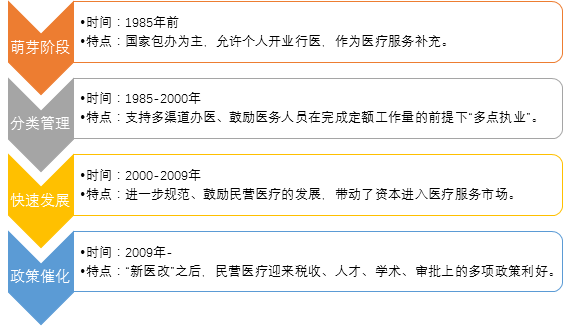
Prior to 1985, healthcare provision was predominantly state-run, although private practice was permitted as a supplement to medical services. Subsequently, the central government explicitly endorsed the development of diverse economic models, marking the formal emergence of private medical institutions on the historical stage.
In April 1985, the State Council issued the “Notice on Forwarding the Ministry of Health’s ‘Report on Several Policy Issues Concerning the Reform of Health Work,’” which introduced the concept of classified management of health institutions and provided comprehensive support for the development of private medical institutions. Related policies included supporting multi-channel healthcare provision, encouraging medical personnel to engage in “multi-site practice” after fulfilling their assigned workload quotas, permitting qualified entities and healthcare professionals to provide paid part-time services, and allowing compensated work beyond standard duties.
Since the turn of the new century, the government has further standardized and encouraged the development of private healthcare, making the promotion of private medical services a key component of healthcare industry development. This has attracted capital into the healthcare services market, with investments spanning specialized medical disciplines, high-end healthcare, and health management.
Key policies during this period included the "Guiding Opinions on the Reform of the Urban Medical and Health System" and the "Opinions on Accelerating the Development of Private Medical Institutions." The main contents were as follows: First, from the perspective of ownership, it clarified the definition, scope, and investment entities of private hospitals, and established a new classification management system for medical institutions, dividing them into for-profit and non-profit categories. Second, it allowed for-profit medical institutions to operate with the aim of obtaining investment returns, in accordance with the principles of "liberalizing medical service prices, operating autonomously in accordance with the law, and paying taxes in accordance with regulations." Third, it specified different fiscal, taxation, and other policies and management models for for-profit and non-profit medical institutions, and further relaxed policy restrictions on social participation in the healthcare sector, actively encouraging the establishment of medical institutions by social forces.
In 2009, the “New Healthcare Reform” was officially launched. The State Council issued the Opinions on Deepening the Reform of the Medical and Health Care System, which called for accelerating the formation of a diversified landscape in healthcare provision and encouraging private capital to establish non-profit hospitals. This set the fundamental tone for the development of private healthcare under the new circumstances, namely that private and public healthcare operate within the same developmental framework.
In terms of specific implementation, the policy explicitly emphasizes leveraging market mechanisms, encouraging and guiding social capital to develop the healthcare sector, and establishing a medical service delivery system characterized by diversified investment entities and varied investment models. This approach aims to mobilize societal enthusiasm, foster orderly competition, enhance operational efficiency, and improve the quality and level of healthcare services, thereby meeting the multi-tiered and diverse healthcare needs of the public.
In December 2010, the General Office of the State Council issued the “Opinions on Further Encouraging and Guiding Social Capital to Establish Medical Institutions.” These opinions broadened market access for social capital in establishing medical institutions, including measures such as encouraging and supporting social capital to establish various types of medical institutions; giving priority to social capital when adjusting and allocating new healthcare resources; encouraging social capital to participate in the restructuring of public hospitals; permitting foreign capital to establish medical institutions; and streamlining administration and delegating authority.
Meanwhile, further improve the professional environment for medical institutions established by social capital, including implementing tax and pricing policies for non-public medical institutions, incorporating eligible non-public medical institutions into the medical insurance system, optimizing the employment environment for non-public medical institutions, enhancing the external academic environment for non-public medical institutions, supporting the allocation of large-scale equipment to non-public medical institutions, and encouraging government procurement of services provided by non-public medical institutions.
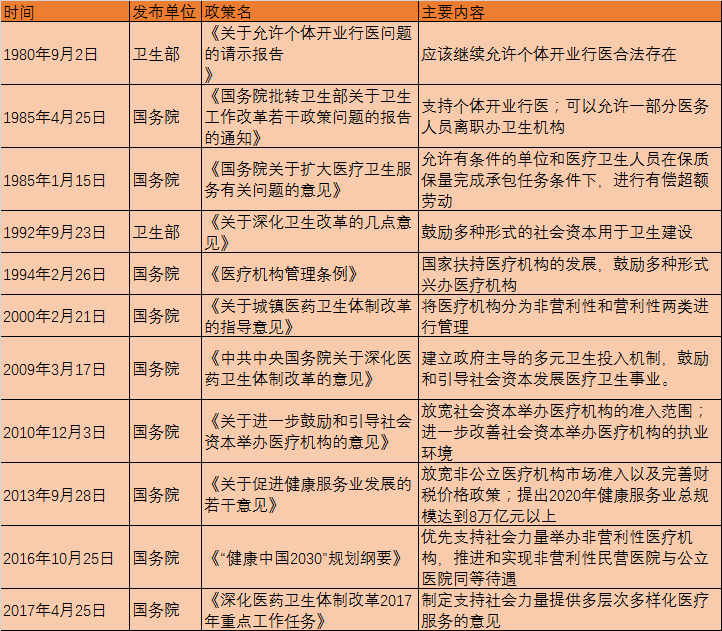
Overview of Policies Related to Private Healthcare in Previous Years
Severe Imbalance Between the Total Number of Private Medical Institutions and Their Patient Visit Volume
Given its large population, China’s healthcare services market offers substantial growth potential and has been continuously expanding, driven by sustained economic improvement, demographic structural adjustments, urbanization, and the ongoing refinement of the medical insurance system. According to statistics from the National Health and Family Planning Commission, China’s total health expenditure in 2015 was approximately RMB 4 trillion, accounting for 5.99% of the country’s gross domestic product (GDP). This figure remains significantly lower than the average level of around 8% observed in developed countries, indicating considerable room for further development in the healthcare services market.
In October 2013, the General Office of the State Council issued the “Several Opinions on Promoting the Development of the Health Service Industry,” explicitly setting a target for the total scale of the health service industry to reach RMB 8 trillion by 2020. Within this framework, medical services will become a key area of development, and private healthcare providers will also benefit from the dividends brought about by the expansion of the industry’s scale.
However, amidst the overall positive trend, it is essential to clearly understand the current reality of private healthcare development and identify its shortcomings and deficiencies. Here, we focus on several key sets of data:
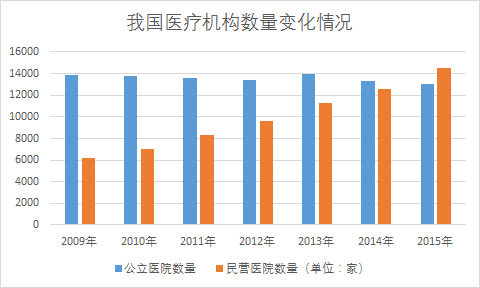
Data Source: Statistical Information Center of the National Health and Family Planning Commission
As shown in the chart above, following the “New Healthcare Reform,” the number of medical institutions across China has continued to increase. Among these, public hospitals have exhibited a slight downward trend, while the number of private medical institutions has doubled, with a compound annual growth rate exceeding 19%. The number of private medical institutions surpassed 10,000 in 2013 and exceeded that of public hospitals in 2015.
However, in terms of the number of patients treated and discharges, private medical institutions still lag significantly behind public ones.
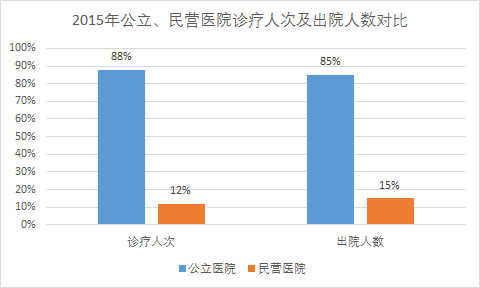
Data Source: Statistical Information Center of the National Health and Family Planning Commission
According to statistical data from the National Health and Family Planning Commission, the total number of patient visits at medical and health institutions across China reached 7.7 billion in 2015, an increase of 100 million (or 1.3%) compared with the previous year. Among these, public hospitals accounted for 2.71 billion visits, representing 88.0% of all hospital visits, while private hospitals recorded 370 million visits, accounting for 12.0%. In terms of discharges, the distribution remained proportionally consistent, with private hospitals contributing only 15% of the total number of discharged patients.
This indicates that the numerical advantage of private hospitals has not yet been fully leveraged, as patients remain more inclined to seek care within the public healthcare system. What, then, are the underlying reasons? By enumerating all factors influencing residents’ healthcare-seeking behavior, we can identify which specific category or categories of factors drive their choices.
First is convenience. Patients generally prioritize proximity when seeking medical care. Given the current regional coverage of private medical institutions, private healthcare may not be at a disadvantage under the principle of convenient access. Second is price. When both sectors are covered by medical insurance, public medical institutions do not hold a price advantage over private ones. However, the currently low rate of medical insurance coverage among private hospitals may become one of the influencing factors.
Another factor is the quality of medical services, which is determined by the caliber of healthcare professionals and their service attitude. In terms of talent structure, public hospitals possess comprehensive systems for recruiting and training personnel, enabling them to secure high-quality medical talent at the source. In contrast, private medical institutions primarily rely on headhunters, resulting in different channels for talent acquisition. Regarding service attitude, public hospitals serve a large patient volume, leading to shorter consultation times per patient, whereas private hospitals offer more ample consultation time and demonstrate a stronger service orientation.
Last but not least is the public credibility of hospitals. During the period of unregulated expansion in the past, numerous negative incidents involving private healthcare providers have eroded public confidence in private hospitals. This situation may improve as policies become more comprehensive and market competition becomes increasingly standardized.
Brand Is a Reflection of a Hospital's Comprehensive Strength
The lack of private healthcare brands has also drawn attention from industry insiders. At the Hospital Development Conference recently hosted by DXY, many private healthcare practitioners addressed this issue. In addition to the cautious stance on the rapid growth of private healthcare expressed by Li Bijing, founder of United Family Healthcare, as mentioned at the beginning, other panelists also focused on how to address the problem.
For instance, Liu Zhigang, General Manager of Xiamen Chang Gung Hospital, stated that during his five-year tenure at the hospital, he has gained profound insights into the differences between private and public hospitals. He noted that the greatest brand advantage of public hospitals stems from their “state-owned” status, which entitles them to policy support, fiscal subsidies, and assistance in addressing talent shortages—three critical resources that private hospitals largely lack in building their brands.
However, private hospitals are not entirely without opportunities. In terms of operational systems, private hospitals possess more flexible organizational mechanisms and more refined management regulations compared to public hospitals, which constitute the vital force driving their development.
Taking Chang Gung Memorial Hospital as an example, the hospital was founded in 1976 by Wang Yung-ching and Wang Yung-tsai, the brothers who chair the Formosa Plastics Group. From its inception, the hospital adopted corporate management principles, designing a comprehensive performance evaluation model. It also emphasized liberating doctors and medical staff from non-clinical burdens, adhering to the principle that “professionals should focus on their professional duties.” By establishing a robust logistical support system, the hospital freed physicians from routine administrative tasks, allowing them to dedicate more time to delivering and optimizing patient care services.
Liu Zhigang stated that a popular saying at Chang Gung Memorial Hospital is, “A hospital’s brand is built by the public voting with their feet.” When people trust you and choose to seek medical care at your hospital, you have successfully established your brand. Chang Gung Memorial Hospital operates seven campuses, with more than 10,000 inpatient beds and over 8 million outpatient visits annually.
Formosa Plastics Group jointly invested with Xiamen Haicang Company in 2005 to build Xiamen Chang Gung Hospital, with a planned land area of 700,000 square meters and a total floor area of 1.4 million square meters. In May 2008, Xiamen Chang Gung Hospital officially opened, featuring 32 clinical departments and 2,000 beds, with physicians either transferred from the Chang Gung system or recruited locally. Through its efforts, Xiamen Chang Gung Hospital gradually achieved a development status equivalent to that of local public hospitals, including designation as a provider for basic medical insurance and work-related injury insurance, thereby becoming a successful hallmark of private healthcare.
Liu Zhigang stated that the experience of Xiamen Chang Gung Hospital encompasses several aspects, such as a people-oriented philosophy in hospital management, the “separation of medical practice and administration” model, and the establishment of specialized operational assistants and administrative support for medical services.
Certainly, the foundation of brand building for private hospitals lies in talent. Xiamen Chang Gung Hospital has made breakthroughs in this area by becoming a residency training base, enabling it to cultivate talent internally from the residency training stage onward. Furthermore, Xiamen Chang Gung Hospital offers competitive salaries to its medical staff: attending physicians earn a monthly pre-tax salary of approximately RMB 30,000; associate senior physicians earn over RMB 50,000; and full senior physicians earn over RMB 70,000.
Hu Yanbin, Deputy Secretary of the Party Committee and Vice President of Guangdong Provincial Hospital of Traditional Chinese Medicine, also stated at the conference that building a hospital brand should involve three key elements. The first is the ability to solve problems and provide effective treatment, which reflects professional competence. The second is a people-oriented approach, offering high-quality services based on problem-solving, with a strong service mindset. The third is reputation, which serves as a comprehensive indicator, reflecting public acceptance of the hospital’s diagnosis, treatment, and service systems, thereby becoming an accumulated asset.
During the post-conference interview session, United Family Healthcare founder Beth Dunlop once again addressed the development philosophy of private hospitals. She stated that, as a corporate entity, a private hospital should first clarify its original mission and maintain a clear understanding of its core activities; only then should it focus on brand communication and increasing the reach of its services.
Li Bijing also revealed that United Family Healthcare is adopting a management export model (with brand licensing), which involves partnering with well-positioned hospitals in second-tier cities to assume 100% management responsibility and build branded hospitals based on United Family Healthcare’s expertise.
Li Bijing stated that United Family Healthcare’s first hospital opened in 1997, followed by its second in 2005. To date, it has established a comprehensive healthcare system comprising Beijing United Family Hospital, a rehabilitation hospital, clinics, and dental practices, with coverage across multiple regions in China. Over the past two decades, United Family Healthcare expanded at a modest pace; however, having accumulated extensive expertise in establishing and managing hospitals, the organization is poised to undertake more significant initiatives in hospital brand development.
How Private Hospitals Can Build Their Brand
Zhu Hengpeng, Deputy Director of the Institute of Economics at the Chinese Academy of Social Sciences and Director of the Center for Public Policy Research, also noted at the DXY Hospital Development Conference that the key to healthcare system reform lies in the development of private healthcare; if private healthcare thrives, the direction of healthcare system reform will be correct.
He also highlighted the development of private healthcare in Suqian, Jiangsu Province. He noted that after years of “healthcare reform,” Suqian has seen significant growth in its private healthcare sector, which has delivered medical resources above the regional average without relying on fiscal subsidies, while providing residents with more cost-effective medical services compared to public hospitals.
He believes that following the relaxation of policies, robust competition has emerged both among private healthcare providers and between private and public institutions. This competitive environment has not only ensured service quality but also enhanced the reputation and credibility of the private healthcare sector. As a result, local residents no longer treat the ownership status of hospitals as an exclusive criterion when making healthcare choices.
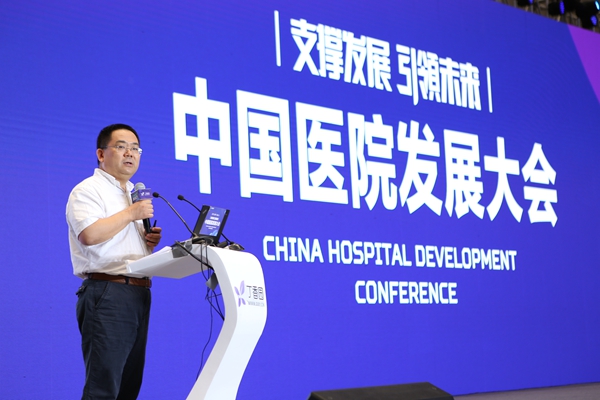
Zhu Hengpeng Delivers Presentation on “Challenges Facing Hospital Presidents in the New Era” at the China Hospital Development Conference
However, Zhu Hengpeng also maintains a cautious stance toward competition in the private healthcare sector. He argues that, within the framework of “healthcare reform,” government authorities should define the red lines for competition rather than impose detailed implementation rules that restrict exploration by private healthcare providers.
Zhu Hengpeng stated to media outlets, including VCBeat, that private healthcare has both the willingness and the capacity to become a significant component of medical services. Areas where some public medical institutions underperform can be addressed through the private healthcare system, and the development of private healthcare will yield benefits for all stakeholders.
An executive dean who moved from a public healthcare institution to a private hospital told VCBeat that while private medical institutions are indeed making conscious efforts to build their brands, they often overdo it by equating marketing with branding. They pour substantial funds into market promotion, but these costs ultimately get passed on to patients. If the quality of medical care and service fails to keep pace, such strategies can easily backfire, resulting in losses outweighing the gains.
Therefore, the hospital’s brand-building strategy follows a dual approach: medical knowledge popularization combined with free clinical services. The former leverages online dissemination, whereby physicians regularly create high-quality content on well-known diseases or pathological knowledge for distribution across all digital platforms. The latter is grounded in offline engagement, targeting residents within a 3–5 kilometer radius of the hospital. By fostering familiarity and building goodwill among these local communities, the hospital can effectively attract a steady stream of patients.
Overall, brand building in the private healthcare sector requires focused efforts across four key areas: infrastructure, talent, management, and marketing. Infrastructure encompasses the hospital’s main facilities, diagnostic and treatment equipment, and medical instruments. In terms of talent, organizations must be able to “attract and retain” skilled professionals by establishing competitive compensation packages and improving performance evaluation mechanisms. Management should adopt a “refined management” approach to fully mobilize employee engagement, eliminate redundancy, and strictly control costs to achieve value accumulation. Marketing involves strategic planning for the hospital’s overall positioning, as well as reputation-based marketing initiatives.
Building a brand in the private healthcare sector is a long-term and continuous process. Policies such as lowering the entry barriers for social capital to establish medical institutions, allowing physicians to practice at multiple locations, forming private healthcare alliances, and encouraging tiered diagnosis and treatment have laid a solid policy foundation for brand development in the private healthcare industry.
Industry insiders believe that the future development of private healthcare will diverge from that of public healthcare. Private providers can either adopt a mass-market approach or offer high-end, specialized services, thereby building their own brands through service quality and reputation.