

Duchang Information's Yuan Yongfu: Leveraging EHR Empowerment Framework to Lay the Foundation for Healthcare Big Data
With the implementation of national policies on health and medical big data, electronic medical records (EMRs), as one of the foundational databases, have been rising in prominence within hospital information systems. Addressing the development challenges of EMRs in the context of health and medical big data, VCBeat (WeChat Official Account: vcbeat) conducted exclusive interviews with experts from several of China’s most representative EMR companies.
Nanjing Duchang Information Technology Co., Ltd. is an emerging technology-driven software development enterprise. Although the company is young, its team members are seasoned experts who have long been engaged in the electronic medical record (EMR) industry. The team not only possesses a profound understanding of the dynamics governing the EMR sector but also masters core technologies that are difficult to substitute.
Duchang Information's current flagship products areDCWriter Electronic Medical Record Editor Software, is an emerging product in the electronic medical record (EMR) market. After years of development, DCWriter has been adopted by domesticNearly 200Healthcare IT Software VendorsProcurement and use. Available in ChinaApproximately 1/4 of Medical Institutions(including secondary and tertiary hospitals and primary healthcare institutions) are currently operating products such as DCWriter.
To gain insight into Duchang Information’s progress in electronic medical records (EMR) and healthcare big data, VCBeat conducted an exclusive interview with Yuan Yongfu, CTO of Nanjing Duchang Information Technology Co., Ltd. The following highlights are from the VCBeat interview:

Yuan Yongfu, Founder and Chief Technology Officer of Nanjing Duchang Information Technology Co., Ltd.
2008 Microsoft MVP in C# (the highest honor in the Microsoft technical community)
Mastering C# Programming was published by the Publishing House of Electronics Industry in 2011.
In 2013, Publishing House of Electronics Industry published *From Graduate to Programmer: Developing Commercial Software with C#*.
Specialization, Research Orientation, and Integration: The Three Major Demands of Hospitals for Electronic Medical Record Systems
At present, hospitals have three main requirements for electronic medical record (EMR) systems:Specialization, Research-Orientation, and Integration。
In the past, hospital electronic medical records (EMRs) relied on a unified, institution-wide EMR system, akin to a "one-size-fits-all" approach. As the adoption of EMRs within hospitals has become increasingly widespread and in-depth, various departments have developed specific operational requirements, namely, specialty-specific needs.
The implementation of the national tiered diagnosis and treatment system has led to an increasing number of complex and rare cases being referred to tertiary hospitals, while minor and chronic conditions have become less frequent. This shift has enhanced the research-oriented nature of large hospitals and prompted a corresponding adjustment in physicians’ priorities. Scientific research has thus become one of the key responsibilities for doctors in tertiary hospitals. Physicians are also increasingly considering how to improve therapeutic outcomes and enhance patients’ quality of life. Consequently, electronic medical recordsResearch-oriented capabilities have become the second-largest demand.
Integration is the third major requirement, which simply refers to the interconnectivity of data. Even in large tertiary hospitals, achieving full interoperability among various systems remains a challenge.
With the national promotion of health and medical big data, the integration of hospital data has become one of the core drivers of development.Although the business processes of various hospital departments are highly diverse, their business data exhibit significant similarity.
Duchang Information highly abstracts the operational data from various hospital departments to design a medical business data document object model. Building on this foundation, it has developed a core business system architecture. Based on this core, specific business description data models are generated for different departments, which, when combined with business processes, ultimately formSpecialized Electronic Medical Record Empowerment Framework。
Partners of Duchang Information,Specialty-Specific Electronic Medical Record Empowerment Framework Enables Rapid Development of Specialty EMR Software。
Just as the reinforced concrete structure composed of beams, columns, and load-bearing walls supports an entire building, various electronic medical record (EMR) products are akin to different types of structures—such as parking garages, shopping malls, hotels, and residential buildings—constructed according to the EMR empowerment framework.
Hospital research demands involve extensive data processing. The required data must possess both breadth and depth."Data depth refers to the vast, long-term accumulated data generated by inpatient and outpatient services, as well as various medical equipment, within hospitals."The breadth of data means that it includes not only inpatient and outpatient data from a single campus or hospital, but also from other hospitals.
Patient care often involves a long-term treatment process, which cannot be fully captured by data from a single hospitalization.Only when data possesses both breadth and depth can the research-oriented application of electronic medical records become possible.
To address the needs for specialization, research orientation, and integration in hospitals, Duchang Information’s approach is as follows:
1. Medical record data and business data structures are open and transparent.Only when data is open and transparent can it be cited and analyzed.
2. Underlying architecture and shared pipelines.As the electronic medical record (EMR) enablement framework operates across different hospitals or software systems, data interoperability between these systems becomes significantly easier due to their adoption of a common underlying framework.
Within a unified framework, Duchang Information has established numerous data-sharing pipelines to facilitate the rapid transmission and sharing of diverse data types. This technical capability ensures both the breadth and depth of data collection, thereby supporting the research-oriented application of electronic medical records (EMRs).
Differences Between the EMR Enablement Framework and Full-Featured Software
The primary distinction between the Electronic Medical Record (EMR) Empowerment Framework and an EMR system is that, functioning as software middleware, the framework is not a standalone application and therefore cannot operate independently. It must be embedded within an EMR system to deliver its intended value. In contrast, an EMR system is a comprehensive suite that can be installed, operated, and utilized independently.
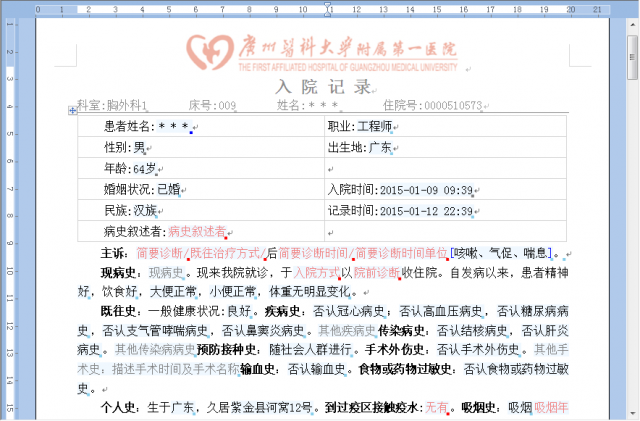
The EMR Enablement Framework is the most core component within an Electronic Medical Record (EMR) system, analogous to the relationship between a mobile phone and its CPU.Partners of Duchang Information, much like mobile phone manufacturers, procure CPUs from Duchang Information and integrate them into the internal components of phones, ultimately resulting in a complete smartphone.
The strategic core of Duchang Information is empowerment, which encompasses three aspects:
1. Empower hospitals with the capability to independently develop hospital information systems;
2. Empower hospitals with the capability to rapidly respond to the needs of clinical departments;
3. Promote the development of medical informatization construction.
Guided by the strategic philosophy of empowerment, Duchang Information has determined its product selection in niche markets, namely, the electronic medical record (EMR) editor. Compared with standalone EMR products, it offers the following advantages:
1. Customer requirements for the electronic medical record (EMR) editor are relatively stable, with few changes in requirements.
2. The technical complexity of electronic medical record (EMR) editors is substantial, with few companies in China capable of developing them.
3. Electronic medical record editors are easily productized and are nearly universal across hospitals.
Duchang Information provides two versions of its electronic medical record (EMR) editor control: a desktop version and a browser/server (B/S) version, also known as the cloud-based multi-platform edition. The interoperability requirements of certain hospitals can be met through the cloud-based version.
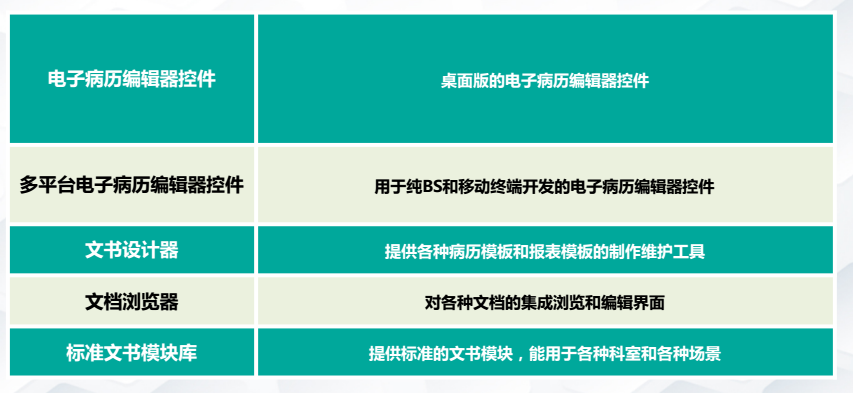
The parseability and standardization of electronic medical record data form the foundation for the development of big data in health and healthcare.
Data within hospital internal systems primarily consists of data generated by electronic medical record (EMR) systems. However, when data from various hospitals are integrated outside the hospital setting, they form a Personal Health Record (PHR). Both processes—extracting data from within hospitals and consolidating it externally—are based on interoperability.
In this regard, Duchang Information’s electronic medical record (EMR) editor file format offers two major advantages:
First, it is interpretable; second, it is standardized.
Duchang Information’s open file format allows third-party companies to parse it directly through application software, without relying on Duchang Information’s software products. Thanks to this convenience, regional healthcare information systems built by IT companies can achieve high-speed data analysis, upload, download, and integration. As a result, IT companies can easily upgrade electronic medical records into personal health records.
In terms of standardization, since electronic medical record (EMR) files adopted by different hospitals follow a consistent format, concatenating data in the same format becomes straightforward. This lays a solid foundation for the interoperability of EMRs and the formation of big data in healthcare.
Empowering the Foundation: Liberating IT Companies and Hospital Information Departments
For many health IT companies, developing their own electronic medical record (EMR) editor controls is not cost-effective. Take a development team in Beijing as an example: high labor costs would bring the two-year development expense to nearly RMB 10 million, and the subsequent product maintenance costs would drive the total expenditure even higher.
Therefore, for project-oriented companies, the primary focus is on project development and software delivery, rather than the research and development of underlying technologies. In contrast, as a technology-driven enterprise, Duchang Information regards its underlying technologies as its core competitive advantage.
Duchang Information’s electronic medical record (EMR) editor, built on a comprehensive feature set and backed by ongoing technical support from its team, significantly shortens the software development and implementation timelines for healthcare IT companies.
Building on its collaboration with IT firms, Duchang Information has also begun working directly with hospital information departments to help them develop simpler and more efficient electronic medical record (EMR) products.
In the past, IT companies that entered hospitals through the bidding model exerted significant control over hospital informatization construction. Due to cost considerations, these companies often prioritized the use of off-the-shelf products and minimized customized development.
However, for hospitals, the cost of medical software comprises two aspects: oneFirst is procurement cost, second is overallPossessCost.
Procurement cost refers to the winning bid price, while total cost of ownership (TCO) encompasses labor costs incurred by hospitals during software utilization, such as training and usage costs for physicians and nurses.
Therefore, from the hospital's perspective, the total cost of ownership (TCO) of the software should be reduced.
On the one hand, hospitals desire highly customized software solutions; on the other hand, healthcare IT vendors strive to minimize customization. This divergence gives rise to a supply-demand conflict.
For this very reason, an increasing number of Grade A tertiary hospitals are seeking to establish their own teams to develop software that best meets their specific needs.
However, hospital IT departments often have only five or six staff members. This understaffing makes it extremely difficult for them to develop software products in-house.
Duchang Information leverages its empowerment framework to help hospital IT departments overcome software development challenges, minimizing the barriers to developing electronic medical record (EMR) products.As the software was developed in-house, it aligns closely with the daily workflows of healthcare professionals, resulting in minimal resistance and enabling doctors to quickly master its operation. Consequently, the hospital’s software operational costs are significantly reduced.
Enhancing the Data Value of Electronic Medical Records to Empower Healthcare Big Data
The value of medical record data stems from two fundamental elements: first, the data must be parsable and open; second, the data must be authentic. Both are indispensable.
The authenticity of data hinges critically on the reliability, simplicity, and practicality of the software. Data within electronic medical record (EMR) systems are ultimately generated by physicians during clinical practice. If the software interface is cumbersome, clinicians are prone to fatigue during data entry, which significantly compromises the veracity of the recorded information.
Duchang Information’s electronic medical record (EMR) control component demonstrates meticulous attention to user experience. It offers a comprehensive suite of features, including structured data entry, audit trail retention, quick-assist input, and full keyboard operation. Through these refined functional details, the component enhances the human-centric design of partner systems, enabling physicians to enter data both efficiently and accurately, thereby improving the overall accuracy of medical data.
Another point is the openness and interpretability of data.
The document format of Duchang Information’s electronic medical record (EMR) editor is transparent and open. The generated EMR documents are in pure XML format, enabling third-party institutions to easily parse the data.
It is precisely because Duchang Information has enabled its partners to ensure data authenticity and openness that big data analytics in healthcare now rests on a solid foundation.
Currently, there are nearly 200 software companies nationwide providing Douchang Information services. Approximately one-quarter of healthcare institutions (including secondary and tertiary hospitals as well as primary care facilities) are currently operating products such as the Douchang Information Electronic Medical Record (EMR) Editor Control.
Special Series on Electronic Medical Records and Healthcare Big Data: