

Nurse Multi-Site Practice Takes Root in China, Awakening the Dormant Home Nursing Market
Not long ago, the Beijing Municipal Health and Family Planning Commission issued the “Notice on Implementing Regional Registration for Nurses” (hereinafter referred to as the “Notice”), announcing that registered nurses in Beijing would be permitted to engage in multi-site practice starting August 1. Well before this date took effect, rumors had already been rife within the industry. Across the entire nursing sector, companies providing home-visit nursing services are arguably the group most significantly impacted by the policy, aside from public hospitals and nurses themselves.
Can Beijing’s new policy completely resolve the series of challenges and widespread skepticism previously raised by the industry regarding nurses’ multi-site practice? Can multi-site practice for nurses truly be implemented effectively? What impact will it have on the nursing sector, and even on enterprises?
In this regard,VCBeat (WeChat ID: vcbeat)A reporter interviewed three industry insiders with a series of questions:Zhang Xueli, Founder and CEO of HuLianWang; Li Mingzhu, Founder and CEO of V-Hu Daojia; and Xie Qi, Vice President of YiHu Daojia,We hope to learn from them about the advantages and disadvantages of implementing multi-site practice for nurses.
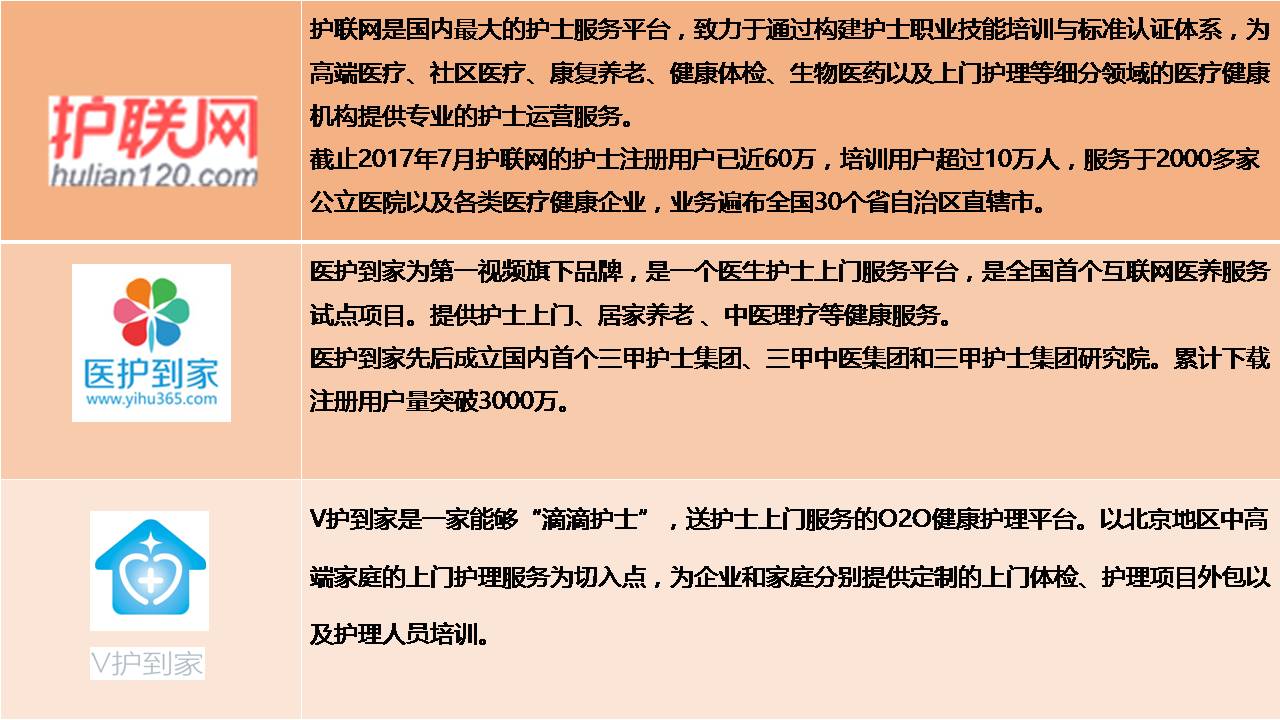
Company Profiles of Three Enterprises
In recent years, with socioeconomic development and the advancement of the healthcare sector, public demand for health and nursing services has become increasingly multi-layered and diversified. The connotation and scope of nursing services are gradually evolving, leading to growing demand for primary health care, health management, geriatric nursing, chronic disease management, palliative care, and transitional care for patients following discharge from acute care settings.
The rapid development of health service sectors, such as the integration of medical and elderly care, social capital investment in healthcare, and “Internet Plus Nursing,” has further expanded the scope of nursing services, which are gradually extending from institutions to communities and households.Meanwhile,The Construction of a Tiered Diagnosis and Treatment Medical Service System Poses New Requirements for Primary Care Nursing Service Capacity.

The State Council, the National Health and Family Planning Commission, and Beijing Municipality have issued a number of policies in recent years,Encourage and guide the development of health service industries such as private healthcare, integrated medical and elderly care, and home-based nursing.All relevant medical institutions have conscientiously implemented policies and actively explored new approaches, thereby meeting some of the public’s health needs.
Against this backdrop, the policy promoting multi-site practice for nurses was officially implemented on August 1. The notice stipulates that, effective August 1, the “Practice Location” field in the Nurse Practicing Certificate for nurses registering their practice in Beijing shall be recorded as “Beijing.”This regulation also means that nurses are no longer restricted to a single practice institution, making “part-time work” a legal and compliant practice.
There is a significant gap between the current community health service institution-led primary care nursing model and the public’s growing demand for nursing services.The prevailing view is that nurses in primary care institutions suffer from low incomes and limited staffing quotas. However, the reality is that, apart from nurses in top-tier tertiary hospitals (Grade 3, Class A), those even in ordinary secondary and tertiary hospitals do not have an easy life.
In addition to the shortage of nursing staff, nurses within the public healthcare system do not enjoy the same opportunities as physicians to conduct research and see more patients for higher income. Career advancement for nurses is limited to roles such as head nurse or administrative positions, resulting in a narrow career path. Furthermore, the most prominent and distinctive aspect of nursing work is night shifts. As nurses reach their thirties and forties and encounter career bottlenecks, many consider “breaking out” to pursue multi-site practice.
When discussing nurses in primary care institutions, Zhang Xueli provided an example to the reporter: “Many community nurses have a professional responsibility and obligation to conduct home visits. However, since each home visit yields only a 10-yuan compensation, many nurses at primary care facilities would rather sit in their offices waiting for their shifts to end.” In her view, “This results in very low utilization efficiency of resources and leads to inadequate services at primary healthcare institutions.” Low income further exacerbates staff shortages, which reflects the current state of nursing practice in primary care settings.
Jie Qi, however, believes that there is currently a shortage of nurses in tertiary hospitals, with 80%-90% of nurses’ work confined to hospital settings, and a high turnover rate. “For hospital administrators, nurse attrition is a major headache, as training a qualified nurse requires considerable effort and dedication.”
Nurses’ workplaces are confined solely to hospitals. In Li Mingzhu’s view, such work settings are narrow. “Nurses already work within hospitals, their salaries are not high, and they have many responsibilities.” These simple, everyday words capture the general public’s conventional perception of nurses.
In summary, “high work intensity,” “low income,” and “limited career advancement” are currently the three most common labels attached to nurses. It is precisely these three factors that have led to the generally high turnover rate among nurses.
Currently, the professional situation for nurses is less than ideal, with high turnover rates exacerbating staff shortages. Can this situation be alleviated after the implementation of multi-site practice? From the perspective of companies in the nursing industry, what does multi-site practice for nurses mean? How will they respond to the implementation of this policy?
Zhang Xueli believes that “this is a favorable policy that can address nurses’ concerns and will have a significant promotional effect,”Nurse multi-site practice is akin to the “sharing economy,” placing nurses into a “resource pool” for rational allocation and improving resource utilization efficiency.
In its notice, the Beijing Municipal Health and Family Planning Commission explicitly encouraged nurses from secondary and tertiary hospitals to practice in primary healthcare institutions, integrated medical and elderly care facilities, and privately run medical institutions. This initiative aims to provide scarce nursing services—such as transitional care, long-term care, and home-based care—to discharged patients, individuals with chronic diseases, and the elderly, thereby promoting hierarchical diagnosis and treatment, the integration of medical and elderly care, and the development of privately run healthcare.
In secondary and tertiary hospitals, nurses are often seen bustling about; however, in reality, not every department’s nursing staff operates at such an intense, non-stop pace. Consequently, how nurses allocate their free time becomes a key factor in enabling multi-site practice, raising the question of whether nurses would be willing to use their spare time to take on part-time roles at other medical institutions.
Currently, the Huliwang platform has nearly 600,000 registered nurses and has provided professional training to over 100,000 nurses. Huliwang is implementing skill tagging and certification initiatives to broaden career pathways for nurses. Zhang Xueli stated, “In recent years, Huliwang has served as a platform offering comprehensive career development services for nurses. We aim to help nurses in China enhance their skills, increase their income, and elevate their professional status, thereby fostering greater passion for their profession among nurses and earning broader social respect through their professional value.”
Regarding the significance of nurses practicing at multiple sites, Zhang Xueli believes that its social significance outweighs its personal significance. In essence, multi-site practice by nurses is conducive to promoting tiered diagnosis and treatment, the integration of medical care with elderly care, and the development of privately run healthcare institutions.
In her view, multi-site practice will help tap into the existing pool of nursing resources for rational allocation, providing scarce nursing services such as transitional care, long-term care, and home-based care to discharged patients, those with chronic diseases, and the elderly. This will promote initiatives including tiered diagnosis and treatment, integration of medical and elderly care, and privately run healthcare institutions. For instance, transitional care enables discharged patients to receive continuous health care during their recovery period, thereby facilitating rehabilitation, reducing the need for readmission due to condition deterioration, and increasing healthcare service costs.
Throughout the implementation of multi-site practice for nurses, concerns regarding patient safety and nurses' professional competencies have remained focal points of external apprehension and attention.In the previous home care market, caregivers dominated the landscape. Many of them received only basic training and lacked medical qualifications, a situation that was particularly evident in the field of elderly home-based care.
Unlike on-site services, home-based services require nurses to personally assume responsibility for both safety and professionalism. While multi-site practice enables nurses to enhance their professional value and income, it also introduces associated risks.
In response to this issue, nurse certification and skills training become particularly important after the formal implementation of multi-site practice. “Previously, companies involved in providing home-based nursing services were essentially operating in a ‘gray area,’ relying on the principle that ‘what is not prohibited by law is permitted.’ If there is no standardized screening and certification process for nurses, the future occupational risks associated with multi-site practice will be significant.”
Zhang Xueli told reporters, “To prepare, we have signed cooperation agreements with leading companies in various niche sectors related to nursing demand. On one hand, we analyze the job skills required for positions where nurses can practice at multiple sites; on the other hand, we train and match nurses whose skill profiles align with these job requirements.” It is reported that HuLianWang has partnered with Taikang Community and Aimujia to explore integrated models of medical and elderly care. In addition, in the area of tiered diagnosis and treatment, first-tier primary healthcare groups such as Ping An Wanjia and Xinkang Medical are also partners of HuLianWang.
To provide better safeguards for expanding nurses’ career development, Hulianwang has also established in-depth collaborations with United Family Healthcare and Fresenius Medical Care, and joined forces with WuXi AppTec and China CRC Home in the field of clinical research to jointly chart a path for nurses’ professional growth.
So, for home-visit nursing companies that are most directly affected by the policy, what is the significance of nurses’ multi-site practice?
Among companies offering in-home nursing services, V Hu Daojia has chosen to enter the market directly through corporate channels, establishing connections with middle-aged and young employees within these enterprises. After building trust with this primary paying demographic, it introduces direct care services for the actual care recipients.
Li Mingzhu stated, “This policy was actually expected.” The policy allowing nurses to practice at multiple sites will have a significant impact. In his view, it is a policy where “the benefits outweigh the drawbacks.”
Previously, services provided by companies offering home-visit nursing were largely in a “gray area,” with such services not widely recognized. “Before the policy was introduced, people speculated that it would be released; now that it has officially been implemented, it is likely to further boost confidence across the industry and enhance its overall professional standards,” said Li Mingzhu.
Furthermore, in his view, allowing nurses to practice at multiple sites unleashes their productivity, drives the development of the nursing market and reforms in public hospitals, and promotes the growth of China’s insurance industry.
In his conversation with Li Mingzhu, he repeatedly emphasized to reporters that the impact of policies on corporate development and their resulting outcomes are invariably slow to materialize, representing a continuous, gradual change.“Step by step”—the term he used to describe the impact of this policy on the nursing industry,“I have always believed that the implementation of multi-site practice for nurses is a long-term endeavor. It is not the case that we can immediately observe corporate transformation and development following the introduction of today’s policies. The entire policy framework aims to reshape the market, including facilitating capital inflow from investors and enhancing recognition of home-based nursing services.”
He believes that the greatest significance of the policy’s introduction lies in enabling industry enterprises to see a clearer direction for the future. “For us, it comes down to one thing: strengthening nurse management and enhancing our own service capabilities. Doing our job well is more important than anything else.”
Given China’s complex healthcare landscape and distinctive characteristics, with regard to the factors impeding policy implementation,Primarily, the administrative resistance faced by nurses in hospital administration.Li Mingzhu stated, “Chinese hospitals have their own unique characteristics in healthcare delivery. Nurses and physicians operate within certain constraints, as they are subject to administrative oversight within their respective institutions. From this perspective, if policies are to be effectively implemented, public hospitals will likely present administrative resistance to nursing practice changes. Therefore, I believe that full implementation will not occur rapidly.”
Such resistance is primarily found in public hospitals, which operate under strict administrative management systems. It remains to be seen whether nurses will have the courage to break free from the constraints of the “bianzhi” (state-approved staffing quota) system, and whether their professional title evaluations—closely tied to compensation—will be affected by the implementation of multi-site practice.
When it came to administrative resistance, Li Mingzhu summed it up in one sentence: “This will be quite challenging.”
As a nurse home-visit enterprise that operates both an online platform and offline service stations, Hushi Daojia is directly and significantly impacted by the policy on multi-site practice for nurses.
In Xie Qi’s view,Beijing’s move to open up regional registration for nurses is a “groundbreaking initiative” and also a market-oriented action.Nurses are the core productive force in the nursing industry. For these out-of-hospital enterprises, the inclusion of nurses will elevate the overall professional standards of the nursing sector.
According to the Beijing Municipal Health and Family Planning Commission’s interpretation of the policy, one ultimate goal of allowing nurses to practice at multiple sites is to address the shortage and uneven distribution of nursing resources. The Commission also pointed out that promoting multi-site practice for nurses facilitates talent mobility, accelerates the decentralization of high-quality nursing resources to grassroots levels, rapidly enhances the capacity of primary care nursing services in both quantity and quality, increases the supply of grassroots nursing services, and better meets the public’s health needs.
In this sense, the primary beneficiaries appear to be primary healthcare institutions and nurses working at the grassroots level.SolutionQi believes that, unlike the earlier rumors in Guangdong, Beijing’s recent release of the “Notice on Implementing Regional Registration for Nurses” is essentially aimed at advancing Beijing’s healthcare reform policies.In terms of the intensity with which it drives healthcare reform in Beijing, the significance of this newly released policy is entirely different from that of Guangdong Province two years ago. This series of measures is actually centered on healthcare reform, with the aim of channeling resources down to the grassroots level.
The promotion of multi-site practice for nurses will foster deeper collaboration between home-based medical and nursing services, community health service centers, and hospitals at all levels, thereby exploring the “last mile” of post-treatment home care.
Xie Qi told reporters, “We hope that once the policy is fully implemented, it will establish a favorable framework to facilitate our collaboration with tertiary hospitals in providing post-discharge nursing care, as well as with community health service centers in delivering home-based nursing and home hospital bed services. Previously, there was no guiding document issued to promote cooperation between ‘Nurse-to-Home’ services and healthcare institutions at all levels.”
Whether from the perspective of nurses themselves or that of the overall market and public hospitals, the thorough implementation of newly issued policies has always been a primary concern for the industry. After all, there are precedents where policies were announced but not effectively enforced (“all wind, no rain”). Policy implementation faces resistance, and the market must address numerous challenges, such as standardizing and regulating the processes for nurses’ multi-site practice, as well as resolving related safety supervision issues.
From Xie Qi’s perspective, the reported shortage of hospital nurses is largely attributable to hospital administrators,Although promoting multi-site practice for nurses in Beijing may encroach upon the vested interests of many hospitals, it holds significant importance for addressing the distribution of medical resources in the Beijing area as part of broader healthcare reforms.. With regard to risk issues, follow-up regulations and standards will certainly be introduced after the policy is launched,“Related service institutions involved in nurses’ multi-site practice will not face significant risks if they adhere to the standards and guidelines issued by the government.”
Conclusion
In any case, the policy has been firmly implemented. The multi-site practice for nurses is another policy targeting healthcare professionals, following the introduction of multi-site practice for physicians. In fact, the gradual advancement of various policies reflects the improving overall healthcare environment in China. The successful implementation of multi-site practice for nurses depends on both the nurses themselves and industry guidance.
In summary, behind the promulgation of any policy lies the governing body’s determination and hope for change. In a rapidly evolving market, multi-site practice for nurses is a crucial component in ensuring home-based care for families. With policy support and the efforts made by enterprises at the center of the industry chain, the entire nursing sector will move toward a sustainable and positive trajectory.