

IBM and University of Alberta Achieve 74% Accuracy in Schizophrenia Prediction Using Machine Learning
Recently, IBM scientists and the University of Alberta’s Edmonton campus in Canada released new data in *Schizophrenia*, a partner journal of *Nature*.Demonstrating that AI and machine learning algorithms can help predict schizophrenia cases with 74% accuracy.
This retrospective analysis also indicates that, based on the correlations observed between activities in different brain regions, the technique can predict the severity of specific symptoms in patients with schizophrenia with high accuracy.This groundbreaking study can also help scientists identify more reliable and objective neuroimaging biomarkers for predicting schizophrenia and its severity.
Schizophrenia is a chronic, debilitating neuropsychiatric disorder that affects 7 to 8 individuals per 1,000.Patients with schizophrenia may experience hallucinations, delusions, or thought disorders, as well as cognitive impairments such as difficulty concentrating and physical deficits such as motor disturbances.
Dr. Serdar Dursun, Professor of Psychiatry and Neuroscience at the University of Alberta, stated: “This unique and innovative multidisciplinary approach has deepened our understanding of the neurobiological underpinnings of schizophrenia and can help improve the treatment and management of the disorder.”
“We have identified numerous significant abnormal connections in the brain, which future studies can further explore. Moreover, AI-generated models bring us one step closer to discovering objective neuroimaging-based patterns that can serve as diagnostic and prognostic indicators for schizophrenia.”
In the paper, researchers analyzed de-identified functional magnetic resonance imaging (fMRI) data from the open dataset of the Function Biomedical Informatics Research Network (fBIRN),The dataset includes patients with schizophrenia and schizoaffective disorder, as well as healthy control subjects.。
fMRI measures brain activity by detecting changes in blood flow within specific brain regions. Specifically, the fBIRN dataset reflects studies conducted on brain networks at varying levels of clarity, based on data collected while research participants performed a standard auditory test.By examining scan images from 95 participants, researchers used machine learning techniques to develop a schizophrenia model for identifying the connections in the brain most closely associated with the disease.
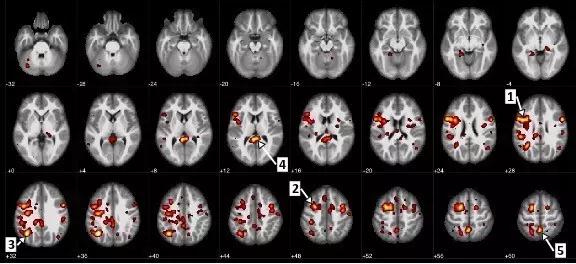
As can be seen from the figure above, several brain regions exhibit statistically significant differences between patients with schizophrenia and those without the disorder. For instance, Arrow 1 indicates the precentral gyrus, and Arrow 5 points to the precuneus, which is involved in processing visual information.
Research findings from IBM and the University of Alberta indicate that machine learning algorithms, by leveraging activity correlations between different brain regions, can distinguish patients with schizophrenia from experimental control groups with 74% accuracy, even on more challenging neuroimaging data collected from multiple sites (different machines, across diverse subject populations, etc.).
Furthermore, studies have shown thatFunctional network connectivity can also help determine the severity of various symptoms exhibited by patients, including psychomotor retardation, bizarre behavior, formal thought disorder, as well as alogia (poverty of speech) and avolition.
By predicting the severity levels of symptoms, more quantifiable and measurement-based characteristics of schizophrenia can be obtained. This allows for determining the condition within a spectrum, rather than relying solely on a binary label (diagnosed or not diagnosed).This objective, data-driven approach to severity grading can ultimately help clinicians tailor treatment plans for patients.
Ajay Royyuru, Vice President of Healthcare and Life Sciences at IBM Research, stated: “The ultimate goal of this research is to identify and develop objective, data-driven metrics for characterizing mental states and to apply them in psychiatry and neurological disorders.“We also aim to provide new insights into how AI and machine learning can be used to analyze mental illnesses and neurological disorders, helping psychiatrists evaluate and treat patients.”
The National Institute of Mental Health (NIMH) Research Domain Criteria (RDoC) initiative underscores the importance of objective measurements in psychiatry. Often referred to as “Computational Psychiatry,” this field aims to leverage modern technologies and data-driven approaches to enhance evidence-based clinical decision-making in psychiatry, which has traditionally relied on subjective assessment methods.
As part of this ongoing collaboration, researchers will continue to investigate brain regions and connections that are significantly associated with schizophrenia. We will strive to further refine these algorithms, perform machine learning analyses on larger datasets, and explore ways to extend these techniques to other psychiatric disorders, such as depression and post-traumatic stress disorder (PTSD).