

Empowering Primary Healthcare: AI-Driven Clinical Decision Support Systems for Grassroots Doctors
By Che Feilun, General Manager of Shenzhen Kehengli Computer Software Co., Ltd.
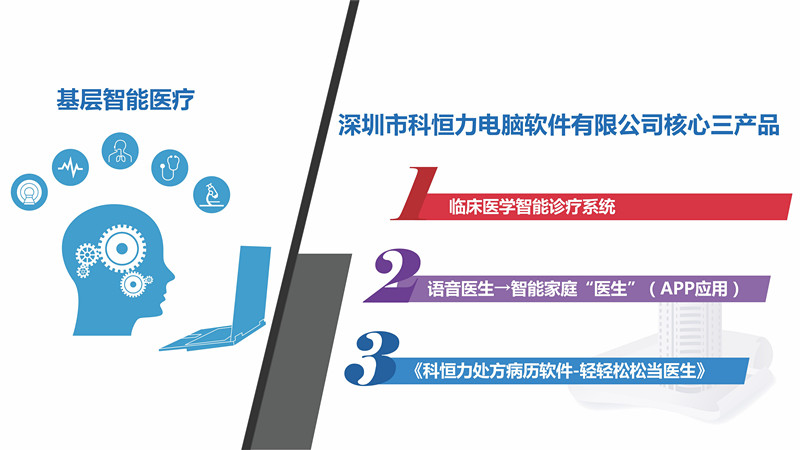
Artificial Intelligence—The term has a history of nearly six decades, during which it has made gratifying progress along a rugged and uneven path.
In 2016, AlphaGo defeated Lee Sedol, one of the world’s top Go players; in 2017, it again triumphed over Ke Jie, who was ranked number one in the world by Go rating points. Extensive coverage by major news media fueled a global surge of interest in artificial intelligence.
# How Hot Is Artificial Intelligence?It can be said that companies failing to mention “artificial intelligence” may no longer be regarded as technology firms.
However, it is also important to recognize that all current artificial intelligence technologies, no matter how advanced, still fall under the category of weak AI. For instance, Google has spent billions of dollars attempting to develop a computer capable of reading images and text intended for six-year-old children and understanding the meaning of those words, but such a system has yet to be realized.
Therefore, the current stage is that of weak artificial intelligence, wherein human brain intelligence has been continuously mimicked, but consciousness has never been surpassed. The so-called intelligent diagnosis and treatment does not simulate the doctor’s entire brain, but rather simulates the diagnostic and therapeutic process, which is indeed achievable.
Why is artificial intelligence now focusing on application scenarios? Because discussing AI in isolation, without concrete product implementation and usage to meet user needs, amounts to building castles in the air—possessing superior computational power alone is insufficient if there is no substantial user adoption. Therefore, AI startup ventures must integrate with industry applications: leveraging precise data resources and algorithms on one hand, while designing business models tailored to specific application scenarios on the other.
So, what is intelligent diagnosis and treatment in the medical field? It refers to the application of artificial intelligence technologies to medical diagnosis and treatment, enabling computers to “learn” from the clinical experience of medical experts and knowledge contained in medical literature, simulate doctors’ diagnostic thinking and reasoning processes, and thereby provide reliable diagnostic and therapeutic plans.
This sounds promising, but what exactly are the intelligent diagnosis and treatment scenarios in the healthcare sector?
Ideal Application Area for Intelligent Diagnosis and Treatment: Primary Care
Currently, the country is promoting tiered diagnosis and treatment, with initial consultations at primary care facilities serving as a crucial foundation for this system. To implement tiered diagnosis and treatment effectively, primary healthcare institutions must fulfill their roles as “gatekeepers” and “health managers.” The tiered diagnosis and treatment system will be truly and universally implemented only when primary care is strengthened.
It is evident that the greatest market opportunity for intelligent diagnosis and treatment lies at the primary care level, by assisting primary care physicians in their clinical practice. Here, “primary care” refers to healthcare settings with relatively limited service capabilities, such as community health centers or village clinics equipped only with the “traditional three basic diagnostic tools” (stethoscope, blood pressure cuff, and thermometer) and simple biochemical analyzers; it does not include township health centers, which are relatively better equipped. Renowned experts and professors at tertiary Grade A hospitals possess advanced specialized skills and access to sophisticated medical equipment; therefore, their demand for AI-assisted diagnosis is not strong, making it merely a nice-to-have addition rather than a necessity.
Given the insufficient capabilities of primary healthcare professionals, who are nonetheless required to manage a large volume of patients with common, frequently occurring, and chronic diseases, there is an even greater need for tools that can enhance their diagnostic and treatment standards and efficiency. Although the promotion and widespread adoption of intelligent diagnostic and therapeutic systems in primary care may constitute a disruptive innovation, these technological advancements help decentralize diagnostic and treatment capabilities that previously required specialists. This enables primary care physicians to provide preliminary diagnosis and treatment to patients, even in the absence of high-end medical equipment.
Currently, the most common and efficiently operating medical AI solutions on the market primarily fall into two subfields: natural language processing (NLP)-based auxiliary diagnostic systems and medical imaging recognition-based auxiliary diagnostic systems. However, it is essential to recognize that the true implementation of intelligent diagnosis and treatment empowered by AI at the primary care level should not focus on medical imaging recognition, but rather explore NLP-based auxiliary diagnostic and therapeutic approaches.
Because medical image recognition is particularly suited for secondary and tertiary hospitals, where it analyzes imaging films in a single, highly standardized domain, it is fundamentally unsuitable for primary care physicians—especially the million rural doctors—who lack advanced equipment yet are expected to possess comprehensive clinical skills. Therefore, the true niche for implementing AI-enabled clinical decision support at the grassroots level should not be medical image recognition; rather, intelligent diagnostic and therapeutic tools serve as the most accessible entry point for enhancing primary care capabilities. By strengthening primary healthcare services through such intelligent systems, the implementation of first-contact care at the grassroots level can be realized, thereby genuinely advancing the tiered diagnosis and treatment system.
Intelligent Diagnosis and Treatment System: Making It Easy to Be a Doctor
Artificial intelligence possesses the capability to simulate the diagnostic and therapeutic reasoning processes of physicians, while surpassing humans in memory capacity, computational speed, and precision. AI-powered intelligent diagnosis and treatment systems can provide physicians with practical, real-time decision support, thereby enhancing the professional capabilities of less experienced healthcare providers. This is particularly beneficial for primary care physicians, as these systems assist in clinical diagnosis and treatment, effectively serving as an “extension of memory” and a “physician’s assistant.”
For example, consulting textbooks versus using an intelligent clinical decision support system: referring to textbooks may undermine patient confidence (leading them to perceive the physician’s clinical competence as low), whereas utilizing an intelligent clinical decision support system (requiring a computer terminal) conveys a sense of sophistication and high-level diagnostic capability. When encountering unfamiliar or ambiguous cases, remain composed in front of the patient and avoid casually stating “I don’t know,” which could erode their trust. At a minimum, you should be able to identify the relevant medical specialty and physiological system involved, as well as determine which routine diagnostic tests are appropriate. By leveraging the rapid search capabilities and intelligent diagnostic features of computer-based systems, you can gain a relatively accurate and comprehensive understanding of the diagnosis and treatment plan, enabling you to proceed with care. This approach yields results several times more effective than rote memorization through strenuous effort.
In an era marked by a shortage of high-quality medical resources, addressing the common challenges faced in primary healthcare requires uncovering “incremental value” within the existing supply-and-demand landscape and developing solutions that enhance efficiency. For medical entrepreneurs, the key challenge lies in rapidly replicating the knowledge and clinical expertise of top-tier medical specialists to design and create an “Intelligent Clinical Diagnosis and Treatment System” that simulates expert diagnostic reasoning.
The AI-powered clinical diagnosis and treatment system described herein offers assistance to three categories of physicians: First, for physicians capable of accurately diagnosing and treating diseases, the system facilitates rapid disease screening and triage without fatigue, thereby enhancing work efficiency. Second, for physicians who are not yet able to make precise diagnoses, the system provides auxiliary diagnostic support and alerts to prevent misdiagnosis and missed diagnoses, thus elevating their professional competence. Third, in the context of traditional medical education, where physician training cycles are lengthy, the intelligent diagnosis and treatment system enables primary care physicians—particularly the million rural doctors—to become qualified general practitioners within 2–5 years, rather than the conventional 5–10 years.
Top-Tier Diagnosis and Treatment: Physician Clinical Expertise + Intelligent Diagnostic Systems
Human Intelligence + Artificial Intelligence = A New Height of Human-Machine Integration. In the stage of weak artificial intelligence, humans and computers each have their own advantages; therefore, the optimal model for the current development of intelligent diagnosis and treatment should be human-machine integration. By combining human intelligence with intelligent diagnostic and therapeutic systems, massive amounts of medical data can be processed efficiently, enabling the rapid identification of patterns and regularities, thereby achieving more satisfactory diagnostic and treatment outcomes.
Wang Xiaochuan stated, “There are approximately 70,000 to 80,000 human diseases, whereas a physician may specialize in only dozens. Machines, however, can continuously review medical literature to identify patterns. By leveraging machine-assisted diagnostic systems, physicians can enhance their diagnostic capabilities to reach top-tier proficiency.”
Regarding diagnosis, if specific symptom-disease relationships are not stored, computational analysis cannot be performed. Inputting incorrect data, such as incomplete medical histories, imprecise laboratory results, and flawed diagnostic models, will lead to incorrect outputs.
Furthermore, even with the development of robust automated diagnostic programs, medical practice must remain under physician supervision. This is because emerging clinical challenges and the nuances of doctor-patient interactions require professional oversight for proper investigation and resolution. The greater value of physicians lies in interpreting and explaining diagnostic results, as well as providing professional endorsement. Intelligent diagnostic and treatment systems, meanwhile, offer timely guidance and support to primary care physicians. Replacing physicians with intelligent systems for independent diagnosis and treatment is currently inconsistent with medical ethics. However, leveraging these systems to assist and guide physicians will undoubtedly enhance the diagnostic and therapeutic capabilities and efficiency of primary care providers, bringing them to the standard of general practitioners, thereby reducing rates of misdiagnosis and missed diagnoses.
The renowned physician Osler once famously stated, “Medicine is a science of uncertainty and an art of probability.” If we aim to endow computers with human-like cognitive abilities, fuzzy logic and its cybernetics serve as powerful tools to achieve this leap. The Intelligent Clinical Diagnosis and Treatment System is predicated on fuzzy judgment, employing fuzzy linguistic rules to deduce approximately correct fuzzy conclusions. Physicians then apply logical, imaginative, and intuitive thinking to evaluate and select among these conclusions (Human Intelligence + Artificial Intelligence = A New Height of Human-Machine Integration). The mission of the Intelligent Clinical Diagnosis and Treatment System is to facilitate human-machine collaboration, helping physicians acquire necessary knowledge and experience, inspiring rather than replacing their clinical reasoning, and enabling primary care physicians to readily become competent general practitioners.
Intelligent Diagnosis and Treatment System: A Tool for Cost Reduction and Efficiency Enhancement. The intelligent diagnosis and treatment system empowers primary healthcare, equipping grassroots physicians with “expert-level diagnostic and treatment capabilities,” enabling everyone to access top-tier medical services, and encouraging appropriate patients to return to primary care settings for treatment.
The Imperative of AI-Driven Diagnosis and Treatment at the Primary Care Level
With the advancement of technology and social progress, artificial intelligence (AI) technologies are inevitably permeating various industries, bringing about transformative changes in societal production and lifestyles. In the field of medical diagnosis and treatment, however, there is still no intelligent diagnostic and therapeutic system fully tailored to the needs of primary care physicians. As we enter the 21st century, we face greater opportunities and challenges, making the development of intelligent diagnostic and therapeutic solutions for primary care imperative (thus giving rise to the new generation of intelligent clinical diagnostic and therapeutic systems).
★Background Analysis
1. In March 2015, the General Office of the State Council issued the “Implementation Opinions on Further Strengthening the Development of the Village Doctor Workforce,” deploying measures to further enhance the development of village doctors and effectively solidify the foundation of the rural healthcare service network.
2. In September 2015, the General Office of the State Council issued the “Guiding Opinions on Advancing the Construction of a Tiered Diagnosis and Treatment System,” deploying measures to accelerate the establishment of such a system, foster a scientific and orderly pattern of medical care-seeking, improve the health status of the population, and further safeguard and enhance people’s livelihoods.
3. Development Plan for New-Generation Artificial Intelligence
The “Development Plan for New-Generation Artificial Intelligence” was issued by the State Council on July 8, 2017, as Document No. 35 (2017) of the State Council. The Plan sets forth the guiding principles, strategic objectives, key tasks, and safeguard measures for the development of China’s new-generation artificial intelligence toward 2030, and deploys efforts to build China’s first-mover advantages in AI development, accelerating the construction of an innovative country and a world leader in science and technology.
4. In primary healthcare institutions: there are 35,000 community health service centers (stations), 37,000 township health centers, 638,000 village clinics, and 205,000 clinics (medical rooms). Village doctors are allocated at a standard of no fewer than one per 1,000 service population.
5. Few companies have entered the intelligent diagnosis and treatment market targeting primary care physicians. “Many ‘Internet + Healthcare’ initiatives focus on the patient market; in fact, it may be worthwhile to consider developing apps, knowledge bases, and other tools for physicians to help primary care medical personnel enhance their service capabilities,” stated Jiao Yahui.
The final sentence of this article: Precision medicine is not necessarily precise (Hu Dayi: Can medicine be precise? Macroscopically NO, microscopically Maybe), nor does it necessarily benefit the general public. However, an intelligent clinical diagnosis and treatment system tailored specifically for primary care physicians can serve the majority of doctors, thereby benefiting the general public.
Stay tuned for the next article: How to Implement Intelligent Diagnosis and Treatment at the Primary Care Level