

Who Will Become the 'Wolf Warrior' of China's Online Paid Consultation Market?
Recently, Wolf Warrior 2, written, directed by and starring Wu Jing, has surpassed 3.4 billion yuan at the box office, breaking multiple Chinese-language box office records and creating a miracle in Chinese film history.
Wu Jing has not only achieved enviable box-office results but also successfully cultivated a tough-guy image among audiences both domestically and internationally, becoming China’s foremost representative of the tough-guy archetype.
During the filming of *Wolf Warrior 2*, Wu Jing pioneered a film genre from scratch. This craftsmanship and pioneering spirit are equally worthy of emulation by companies offering online paid medical consultations.
According to the report “Consumption Upgrade: The Dawn of the Era of Online Paid Medical Consultations” released by Caixin, which details the value of Dingxiang Doctor, will it become the “Wolf Warrior” of China’s online medical consultation sector?
Tracing the origins of online medical consultations, it is an import that has been widely adopted abroad but has faced significant challenges in China.
Since online medical consultations are a “new species,” the three most critical factors for developing a paid online consultation service are policy, physicians, and patients. Online consultation platforms must possess appropriate medical qualifications; otherwise, they can only be classified as providing advisory services that offer recommendations to patients.
In terms of policy, incentives for physicians were introduced in September 2009, when the former Ministry of Health issued the “Notice on Issues Concerning Multi-Site Practice by Physicians,” launching pilot programs in selected regions. The notice stated that the reasonable mobility of medical personnel would be steadily promoted to facilitate vertical and horizontal exchanges of talent among different medical institutions, and that multi-site practice by registered physicians would be explored and studied. This initiative was regarded as truly legitimizing physicians’ “moonlighting.” Notably, the notice explicitly stipulated that “physicians should, in principle, practice within the same province, autonomous region, or municipality directly under the Central Government, with no more than three practice locations.” Subsequently, on November 5, 2011, the former Ministry of Health issued another notice to expand the scope of the multi-site practice pilot programs, encouraging medical personnel to practice in grassroots and rural areas.
The multi-site practice of physicians has greatly promoted the development of online consultation platforms, as more doctors are willing to leverage their fragmented time to address users’ health-related questions.
Encouragement for enterprises to develop internet-based healthcare services emerged in July 2015, when the General Office of the State Council officially issued the Guiding Opinions on Actively Promoting the “Internet Plus” Action. This document provided clarification on “Internet Plus Healthcare,” setting forth the development goal of achieving richer internet applications in the health and medical sector, more diversified public services, and continuously optimized allocation of social service resources by 2018.
On the other hand, on March 19, 2017, the Yinchuan Municipal People's Government of Ningxia launched the "Signing Ceremony for the Yinchuan Internet Healthcare Industry Project," with 15 internet hospitals formally entering Yinchuan as the second batch of internet healthcare enterprises. These included Chunyu Doctor, Haodafu, and DXY Doctor.
Once the compliance challenges on the policy and physician sides are resolved, sustained customer acquisition from the patient side will require both a cultivation period and continuous promotional efforts.
Customer acquisition channels can be divided into online and offline. Online methods attract patients through content and direct them to the platform; they also include various forms of hard advertising on major websites or platforms. Offline methods primarily involve ground promotion, events, and similar activities.
In other words, when all online consultation services start from the same baseline, those who can acquire more customers may find it easier to stand out. It is akin to movies released simultaneously; the ones with larger audiences tend to achieve higher box office revenues.
Take Dingxiang Doctor as an example. Its online consultation service was launched relatively late; planning for its precursor, a pilot product named “Ask the Doctor,” only began in April 2016. From the outset, it was determined to offer only paid online consultation services.
“Although Dingxiang Doctor entered the market relatively late, this does not mean there are no opportunities. I believe that only by ‘planning carefully before acting’ can we break through the fierce competition,” said Chu Yang, Vice President of DXY and Head of Dingxiang Doctor.
Meanwhile, DXY Doctor is also a key strategic initiative in DXY’s consumer-facing business, deeply addressing user needs for health education, online consultations, medication lookup, and healthcare provider recommendations, thereby delivering one-stop medical services to users.
On the physician side, DXY Doctor leveraged Dingxiang Yuan’s existing base of 2 million real-name verified physicians, carefully selecting 800 contracted physicians to join the platform and introducing a peer-review mechanism. Following subsequent expansion, the total number of consulting physicians on the DXY Doctor platform currently stands at approximately 20,000.
With access to high-quality physicians, DXY Doctor has also lowered patients’ expectations for immediate responses through its functional design, adopting an asynchronous communication model. After patients upload text and images and submit their consultation requests, DXY Doctor allows a generous 24-hour window for physicians to respond, deliberately avoiding the real-time chat interaction model. Furthermore, DXY Doctor has developed referral and consultation-declination features, which have received positive feedback from physicians regarding this interactive experience and functional design.
Regarding the advantages in patient acquisition through traffic, Chu Yang stated, “Using content as an entry point for patient traffic may be another one of our strengths.”
It is reported that in 2016, DXY Doctor produced 26.22 million words of original editorial content. The total number of views on WeChat across its new media matrix reached 1 billion for the year. Its Zhihu institutional account, launched in 2016, amassed 630,000 followers in less than three months. The follower count on its WeChat Official Account exceeded 20 million. These assets have become DXY Doctor’s exclusive, organic channels for acquiring patient traffic.
With patient acquisition traffic comes patients. On the patient side, data from the Dingxiang Doctor platform indicates that the majority of patient consultations concern chronic diseases such as diabetes and hypertension.
Furthermore, DXY cultivates physicians’ personal brands through its “Doctor Broadcaster” initiative, thereby integrating secondary traffic streams. In other words, as physicians become online influencers, they attract a larger patient base. These physicians engage with patients in a more personable manner, providing emotional support and offering reasoned medical advice. This leads to higher patient satisfaction with medical services, and through word-of-mouth referrals, creates a virtuous cycle for patient acquisition.
Amid the current reality where patient acquisition is becoming increasingly expensive and difficult, DXY’s new media matrix of medical science popularization content has emerged as a unique lever for attracting patient traffic, offering a level of precise matching that various marketing approaches cannot rival. Furthermore, its cost is extremely low; high-quality medical educational content authored by reputable physicians naturally fosters patient trust.
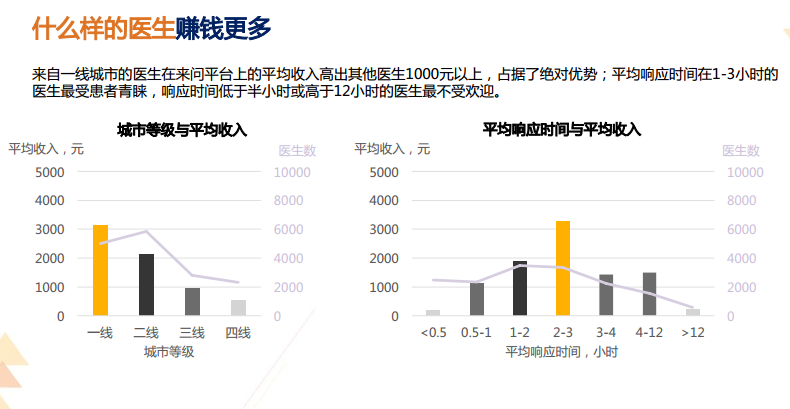
In the first quarter of 2017, on the DXY Doctor platform, which had implemented online paid consultations for approximately one year, more than 70 physicians earned an average monthly income of over RMB 5,000 from answering patient inquiries, with some physicians achieving monthly incomes exceeding RMB 10,000. According to statistical data from the DXY Doctor platform, these physicians were primarily based in first-tier cities, as shown in the figure below:
In Chu Yang’s view, “Our true competitor at this stage is actually ourselves. The most critical tasks are to refine our products and cultivate user habits. Since the penetration rate of online medical consultations in the Chinese market is still below 20%, the real revolution is yet to come.”
Under the prevailing trend of consumption upgrading, the transformation and upgrading of consumption structures are driving growth in related industries. In this process, consumption in sectors such as education, entertainment, culture, transportation, telecommunications, healthcare, housing, and tourism is growing most rapidly, with particularly swift growth in consumption linked to the IT, automotive, and real estate industries.
Furthermore, paid access to high-quality content is gradually gaining traction and increasingly favored by users. Preceded by platforms such as FenDa and Dedao, and followed by Himalaya FM and Zhihu Live, even Douban—long known for its niche positioning and appeal to literary-minded youth—has launched its own paid product, Douban Time.
According to media reports, since its establishment, Luoji Siwei’s revenue and profit figures are as follows: In 2015, 2016, and the first quarter of 2017, revenues were RMB 159 million, RMB 289 million, and RMB 151 million, respectively; net profits were RMB 18.6 million, RMB 44.62 million, and RMB 38.05 million, corresponding to net profit margins of 11.7%, 15.5%, and 25.2%, respectively.
Meanwhile, Teladoc, a U.S.-listed company specializing in online consultations, primarily provides patients with 24/7 medical advisory services via telephone, video, and other channels—i.e., telemedicine. On the Teladoc platform, users cannot freely choose their physicians; instead, doctors are assigned to users by Teladoc.
According to Teladoc’s Q4 2016 financial report, the number of Teladoc members surged to 17.5 million, a year-on-year increase of 43%. The fourth quarter saw a total of 310,467 visits, representing a 68% increase compared to the fourth quarter of 2015. In 2016, there were a total of 952,081 visits, a year-on-year increase of 65%. Meanwhile, full-year revenue grew by 59%, reaching $123 million for the full year of 2016.
Although the national conditions in the United States and China differ, the development trajectory of Teladoc in the U.S. can serve as a reference for domestic online consultation companies. By combining this with China’s actual circumstances, these companies can explore an online consultation path suited to local development. Leveraging its advantages in user traffic and physician resources, will Dingxiang Doctor become the “Wolf Warrior” of China’s paid online consultation market? Only time will tell.