

Auris Surgical Robotics Secures $280 Million Series D Funding to Advance Robotic Platform for Early-Stage Lung Cancer Diagnosis and Treatment
VCBeat (WeChat ID: vcbeat) has learned that surgical robotics company Auris Surgical Robotics recently completed a $280 million Series D financing round, led by Coatue Management, with participation from Highland Capital Partners, Lux Capital, Mithril Capital Management, and others. To date, its total funding has reached $513 million.

Auris Surgical Robotics Historical Financing Data
The Company’s Founder Is Surprisingly the “Father of the Da Vinci Surgical Robot”
Auris, founded in 2007 and headquartered in San Carlos, California, was established by Frederic Moll, co-founder of Intuitive Surgical, the manufacturer of the renowned da Vinci surgical robot. In fact, Auris is the fourth surgical robotics company founded by Frederic Moll.
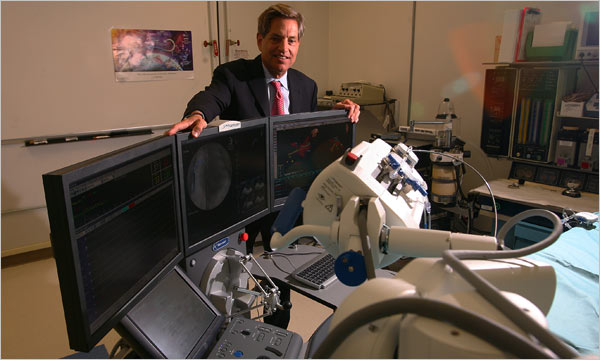
Dr. Frederic Moll, CEO of Auris
Moll previously founded three companies, including Intuitive Surgical, a publicly traded company established 22 years ago that also develops robotic surgical systems and currently has a market capitalization of nearly $35 billion. Another company, Hansen Medical, specialized in developing tools for catheter manipulation; it was founded by Moll in 2002 and went public in 2006. However, Hansen’s market influence was far less than that of Intuitive, and last summer, the company was acquired by Auris for $80 million. The third company was Origin Medsystems, a medical device firm. It later became an operating subsidiary of Guidant and was acquired by Eli Lilly in 1992.
Among these four companies, Auris is a healthcare technology company dedicated to improving medical interventions. The company is developing targeted minimally invasive treatment methods to enhance the precision of each procedure. The Auris platform integrates robotics, micro-instruments, sensing, and data science, with the aim of improving patients’ clinical outcomes. The primary objective of the newly secured funding is to support research into minimally invasive treatments for lung cancer.
Specializing in Early Diagnosis and Targeted Therapy for Lung Cancer
It is reported that there are 1 billion smokers worldwide, causing 6 million deaths annually. The vast majority of these deaths are attributed to lung cancer, rather than prostate, breast, or colorectal cancer. The high fatality rate of lung cancer stems from delayed diagnosis and ineffective treatment. Most patients are diagnosed at an advanced stage, by which time the cancer has already metastasized to other parts of the body.
Furthermore, many current surgical treatments are invasive and carry certain risks. Therefore, precise diagnosis and minimally invasive treatment are of paramount importance. Auris proposes ““Our surgical robot will change this status quo. With our technology, doctors will be able to access early-stage lung cancer without incisions, enabling accurate diagnosis and targeted treatment.”
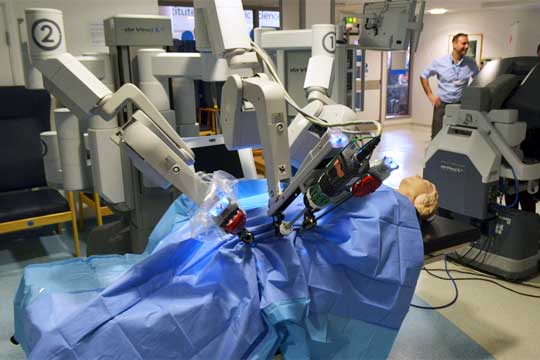
Auris's ARES Endoscopic Robot
In 2016, Auris Health’s ARES (Auris Robotic Endoscopy System) also received FDA approval. It is an endoscopic system designed for the treatment of pulmonary diseases. By eliminating the need for large incisions or general anesthesia, ARES simplifies endoscopic procedures, thereby benefiting frail patients who cannot tolerate the trauma associated with conventional surgery. Consequently, Auris has selected lung cancer as the initial therapeutic target for ARES. The company is expected to launch the ARES device on the market in the coming months.
Why did Auris attract this substantial $280 million investment? The primary reason likely lies in Intuitive’s remarkable achievements. As the most commercially successful surgical robotics company, Intuitive reported total revenues of $2.7 billion last year. Its flagship product, the Da Vinci Surgical System, received FDA clearance in 2000 and enables surgeons to perform minimally invasive procedures through small incisions in the chest, including lung cancer surgeries. Compared with traditional techniques that require large incisions and mechanical rib spreaders, this approach represents a significant advancement, helping to reduce surgical complications.
Specifically, the da Vinci system is a minimally invasive endoscopic surgical robot. It inserts two (or more) robotic arms into the patient’s body. The surgeon observes the lesion via images transmitted by an endoscope mounted on the tip of one robotic arm, and then relays precise manual movements through a haptic interface to miniature surgical instruments attached to the tip of another robotic arm. As a result, procedures for small lesions require only minimal incisions in the patient’s skin, thereby helping to reduce trauma to the patient. For more information about the da Vinci surgical robot,See previous reports by VCBeat.。
VCBeat has learned that Auris is currently developing flexible robots for the treatment of throat, lung, and gastrointestinal diseases.