

How Leading Pharmacy IT Firms Are Strategizing for the Next 3–5 Years Amid a Red Ocean Market
“Everyone is now talking about new retail in the pharmaceutical industry. The difference between the old and new models lies in the fact that the traditional retail system centers on ‘products’ and ‘places,’ whereas new retail centers on ‘people.’ By leveraging various information technology tools and data analytics, new retail aims to better serve individuals. This is what new retail is all about.”
“For retail pharmacies at different stages of development, their needs for informatization vary. The role of IT service providers is to accurately identify these needs and deliver tailored solutions, often understanding the pharmacies’ requirements better than they do themselves.”
The aforementioned remarks were made by Yang Jun, Co-founder of Haidian Software, and Qin Gang, General Manager of Qianfang Baiji Co., Ltd. As leading enterprises in the pharmaceutical informatization industry, they have designed various informational tools and products tailored to the needs of pharmacies, helping them enhance management and marketing efforts.
Pharmaceutical IT companies represented by Haidian and Qianfang Baiji have played an irreplaceable role in the evolution of the pharmaceutical retail market. Under the new market environment, they are also undergoing significant transformations. VCBeat (WeChat ID: vcbeat) has reviewed the current state of China’s pharmaceutical IT industry and conducted interviews with several representative enterprises to examine, from a media perspective, the development paths of pharmaceutical distribution and retail IT companies amid emerging technologies and trends.
From Standardization to Diversification: The Evolving Demands of Pharmacies
Qin Gang told VCBeat that Qianfang Baiji entered the pharmaceutical informatization market in 2001. Originally, Qianfang Baiji was the pharmaceutical products division of Renwoxing Software Co., Ltd., one of the earliest domestic providers of management software for small and medium-sized enterprises (SMEs). With 16 years of development history to date, Qianfang Baiji has established an independent company this year to continue delving deeply into the informatization needs of the pharmaceutical sector.
Having been immersed in the industry for over a decade, Qin Gang has personally witnessed the evolution of pharmaceutical informatization. As drivers shifted from business needs and enterprise scale to policy and regulatory compliance, pharmacies’ demands for information technology tools have continued to evolve.
“The primary driving force remains internal business management within enterprises; when there is a need for internal management, corresponding tools are sought for implementation. Policy-level factors, such as the establishment of traceability systems required by Good Supply Practice (GSP), have also played a facilitating role, with many health IT companies directly benefiting from the implementation of the new GSP.” Qin Gang believes that the informatization needs of pharmacies are endogenous, while also being influenced by changes in the external environment.
Qin Gang categorized the internal needs of pharmacies into three tiers, primarily based on the scale of development of pharmaceutical retail chains. The first tier comprises enterprises in the survival stage, characterized by small scale and relatively simple business operations. Their internal management is extensive rather than intensive, necessitating information technology tools to standardize operations. The second tier includes enterprises in the growth stage, which have achieved a certain scale and are experiencing rapid growth in both store count and performance. These companies require IT solutions that strengthen process supervision and control to prevent operational errors. The third tier consists of large enterprises with numerous chain stores, where internal communication is often lacking. They need tools for refined internal management and process configuration to ensure efficient execution and operation.
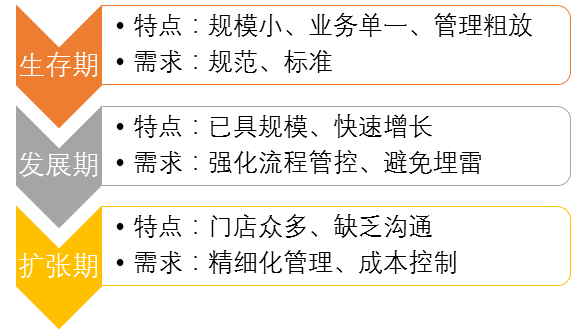
Differences in Information Technology Needs of Pharmaceutical Retail Enterprises at Different Stages of Development
“Of course, with the advancement of informatization and changes in the competitive landscape of the industry, enterprises require more than just internal management solutions. They also need capabilities such as online e-commerce, membership management, and mobile-based management,” said Qin Gang. He further noted that while pharmaceutical companies of different sizes share similar needs for informatization, there is also a demand for personalized customization, requiring tailored development by IT solution providers.
Management at a county-level pharmacy chain in Chongqing told VCBeat that their primary criteria for IT investments are whether the solutions can meet daily operational needs, offer cost-effectiveness, and provide strong scalability to accommodate system iterations and business expansion. As a leading pharmaceutical enterprise with dozens of stores within its county, this company is representative of the broader pharmaceutical retail industry. Qianfang Baiji primarily serves such small and medium-sized enterprises.
Correspondingly, the development of such small and medium-sized enterprises (SMEs) has also provided greater opportunities for growth to healthcare IT companies. First, in terms of industry scale, according to the Blue Book on the Pharmaceutical Market recently released by Southern Medical Institute, the terminal pharmaceutical market in China reached approximately RMB 1.5 trillion in 2016, representing a year-on-year increase of 8.3%. Meanwhile, the market size of the secondary terminal—namely, retail pharmacies—exceeded RMB 330 billion, with a growth rate surpassing that of the overall pharmaceutical terminal market during the same period.
As the market pie continues to expand, the corporate structure of the pharmaceutical retail sector is also undergoing changes. According to the statistical bulletin issued by the China Food and Drug Administration (CFDA), from 2012 to the end of November 2016, the total number of pharmacies increased by 20,000, reaching 446,000. Among these, chain pharmacies increased by 70,000, while independent pharmacies decreased by 50,000, demonstrating a trend characterized by “the retreat of independent pharmacies and the advance of chain pharmacies.”
These developments have created significant opportunities for pharmaceutical IT enterprises. Whether it is the expansion of operational scale or the increasing complexity of management, corresponding information technology tools are essential to provide support and assurance. Pharmaceutical IT companies have thus shared in the dividends brought about by the transformation of China’s pharmaceutical retail market.
Players in the Red Ocean Market
Haidian Software, founded in 2004, is primarily engaged in the research and development, sales, and implementation of information systems for the pharmaceutical distribution industry. The company was listed on the National Equities Exchange and Quotations (NEEQ) in 2014 and was among the first batch of enterprises to enter the Innovation Tier after the NEEQ introduced its tiered management system last year. In 2016, it achieved an annual revenue of RMB 77.318 million and a net profit of RMB 14.1 million, with approximately 500 employees. Regarded as a first-tier enterprise in the pharmaceutical informatization sector, co-founder Yang Jun believes that while the industry still holds growth potential, the market has become a “red ocean,” necessitating a focus on uncovering new demands from pharmaceutical retail enterprises.
From the perspective of market size, relevant research reports indicate that the overall scale of China’s enterprise-level information software market is approximately RMB 20 billion. Specifically, within the vertical sector of pharmaceutical informatics, the market size is unlikely to exceed RMB 2 billion.
“This is inherently a ‘niche’ market with high saturation and intense competition. If companies focus solely on the existing market, prioritizing the maintenance and expansion of their market share, their growth potential will be very limited,” said Yang Jun. He noted that after more than a decade of development, the basic services and functionalities offered by various pharmaceutical informatics providers have become largely homogeneous and highly substitutable. Haidian Software recognized this issue three years ago and adopted a strategy of continuously expanding its product line to drive incremental market growth.
Wang Ti, Vice President of Operations at Lanxin Health, introduced to VCBeat that the business operations of pharmaceutical informatics companies can be broadly categorized into four types: first, Enterprise Resource Planning (ERP); second, Customer Relationship Management (CRM); third, mobile tools for operational processes; and fourth, online transaction platforms. These business segments may overlap, and each has its representative enterprises.
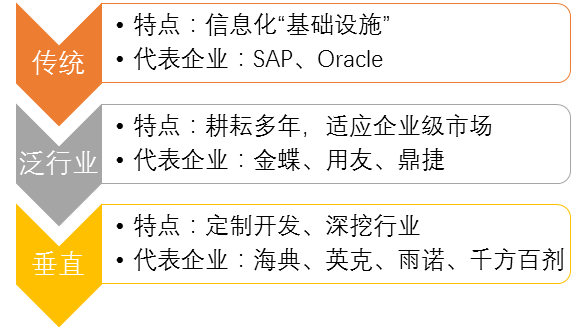
Players in the pharmaceutical informatization sector can be broadly categorized into three tiers. The first tier comprises traditional ERP vendors, such as SAP and Oracle. The second tier consists of domestic service providers specializing in the development and implementation of enterprise management software, including Kingdee, Yonyou, and Digiwin. The third tier includes enterprises dedicated specifically to pharmaceutical informatization, such as Haidian, Inker, Yunuo Information, Qianfang Baiji, Lanxinkang, and Wandianzhang. Some of these companies offer customized development and implementation based on ERP systems, while others focus primarily on single services, such as membership management or chronic disease management.
Qin Gang stated that there are two key terms in the pharmaceutical informatics industry: “red ocean” and “replacement.” “The current market is saturated, as virtually all pharmacies that need to implement information systems have already done so. Leading enterprises, or those in the first tier, command a very high market share, accounting for more than 60%, while the remaining market is fragmented among smaller players. In the future, the market share of these leading enterprises is likely to increase further, ultimately resulting in a monopolistic competition landscape, as seen across all industries, to maintain sector vitality.”
So, in this red ocean market, where do the competitive advantages of vertical enterprises lie? Haidian’s strategy is to provide “one-stop services.” Yang Jun introduced that Haidian has developed a series of products integrated with ERP systems, such as solutions connecting industrial enterprises with pharmacies, an internal communication tool for enterprises called “Pharmacy Assistant” (Yaodian Xiaomi), and products for member management and marketing like “Pharmacy Plus” (Yaodian Jia). Meanwhile, Haidian aims to position itself as a “connector” for pharmacy informatization applications, linking a range of tools specifically designed to provide informational services to pharmacies, such as chronic disease management, electronic prescriptions, and remote consultations. These tools are integrated into pharmacies through Haidian, which can also provide data aggregation and analytics services to both pharmacies and developers.
“The digitalization services for pharmacies have a ceiling. Before hitting that ceiling, it is essential to identify where future growth will come from. Digitalization is a tool that can fulfill the needs of pharmacies; however, merely following their demands step by step is insufficient. To stay competitive in this saturated market, IT companies must anticipate and help pharmacies clarify needs that even they themselves have not yet clearly defined.” Yang Jun believes that when developing information systems, it is crucial to make forward-looking assessments of pharmacy needs.
What Are the Future Development Trends of Pharmaceutical Informatics?
In the interview, Yang Jun also mentioned the concept of “new retail in pharmaceuticals.” He stated that since the emergence of the new retail concept, practitioners in the pharmaceutical retail sector have been contemplating how to implement it. In his view, traditional pharmaceutical retail was centered on “products” and “places,” whereas new retail in pharmaceuticals is people-centric, leveraging various informational tools and data analytics to better serve individuals—this is what defines new retail.
He cited the example of Haidian, which developed a product to assist chain pharmacies with member management. By integrating with WeChat Official Accounts, users can achieve online-to-offline connectivity. Through this system, personalized promotional pages and discount coupon packs can be delivered to each individual user.
“Previously, our marketing and membership management efforts were largely one-way, lacking interaction. With our new products, we aim to foster engagement between store staff and members. Additionally, we are migrating certain offline marketing activities to online channels. For instance, traditional direct mail (DM) flyers had low conversion rates; however, by leveraging personalized, user-specific online strategies, we can significantly improve conversion. We provide tailored recommendations based on specific medical conditions and age groups, ensuring a highly personalized and precise approach.”
The future trend will undoubtedly be “one-stop services.” When the basic services provided by enterprises are largely similar, the true competitiveness of IT companies—or any enterprise serving pharmacies—will lie in their ability to fully uncover pharmacy needs, help refine those needs, and even anticipate them one step ahead, thereby growing together with the pharmacies.
“Competition in informatization hinges on two key factors: one is the capability to deliver services, and the other is the speed of response. The capability to deliver services reflects a vendor’s R&D strength, enabling continuous innovation and the provision of products that meet user needs; response speed refers to the ability to provide rapid feedback when issues arise, as well as the capacity for quick iteration in response to new requirements,” said Qin Gang.
When broken down, the competitive factors for healthcare IT companies are concentrated in several areas: technology, talent, products, services, and resources.
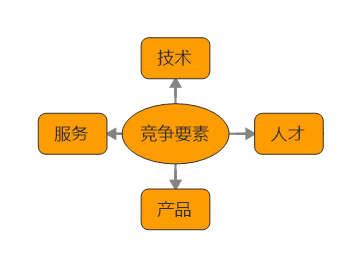
Competitive Factors in the Pharmaceutical Informatics Industry
From a technological perspective, after years of development, active enterprises in the pharmaceutical informatization industry show little disparity in their reserves of foundational technologies and have established robust solutions. However, new focal points have emerged in the current technological landscape, such as cloud computing, SaaS, mobile applications, big data, and artificial intelligence. These technologies may become new catalysts for growth in informatization products, reshaping the technological ecosystem of the pharmaceutical informatization industry. Amidst these changes, large companies leverage their early investment in new technologies, while small companies benefit from their agile strategic deployment, resulting in balanced competitiveness. This suggests that small companies may ultimately be the primary beneficiaries of technological advancements.
In terms of talent, building a robust talent pipeline is critically important. Pharmaceutical informatics is a multidisciplinary industry that integrates medical and pharmaceutical expertise with information technology (IT), imposing exceptionally high demands on professional competencies. Since its emergence in the early 2000s, the sector has evolved into a highly competitive “red ocean.” Consequently, its appeal to top-tier talent has been waning. In this context, greater emphasis must be placed on talent development and pipeline construction to ensure a well-balanced talent structure and cultivate a team of experienced, multidisciplinary professionals.
In terms of products, transforming technological advantages into marketable offerings requires a certain development process and must align with customer needs and industry regulatory requirements. Currently, the primary revenue-generating products in the pharmaceutical informatics industry remain traditional ERP systems. Value-added services built around these systems, such as e-commerce, O2O (online-to-offline), and employee management solutions, have not yet formed a substantial market. In the future, however, this suite of value-added service products may become a significant source of revenue for the pharmaceutical informatics industry.
Other factors, such as services and resources, can also help pharmaceutical IT companies build competitive barriers for future competition. However, it is worth noting that the current customer base of the pharmaceutical IT industry is relatively fragmented, with “heavyweight” clients accounting for a small share of revenue. As the pharmaceutical distribution and retail sector continues to consolidate and scale up, pharmaceutical IT firms should prioritize securing large enterprise clients to gain a first-mover advantage in the market.
In the interview, Yang Jun also highlighted a particularly interesting detail: he noted that business owners in the pharmaceutical industry demonstrate a strong commitment to learning. Each year, various forums and academic seminars are held within the sector, attracting substantial participation and fostering enthusiastic discussions.
In fact, the “eagerness to learn” among pharmaceutical professionals is closely tied to the inherent characteristics of the pharmaceutical industry. From policy-driven initiatives such as the separation of prescribing and dispensing, the outflow of prescriptions from hospitals, and the rise of internet-based healthcare, to consumer spending upgrades and heightened health insurance awareness, as well as technological advancements like e-commerce and mobile integration, the pharmaceutical retail sector is undergoing significant transformation. Information technology tools and solutions have effectively “safeguarded” pharmaceutical retailers in navigating these changes, and this synergy is expected to become even stronger in the future.
Special thanks to Yang Xiao, General Manager of Zhixiang Network, and Wang Ti, Vice President of Operations at Lanxinkang, for their support in the planning of this topic.