

SoYoung 2017 Medical Aesthetics Industry White Paper: Disrupting Traditional Consumer Decision-Making and Reducing Clinic Customer Acquisition Costs by 90%
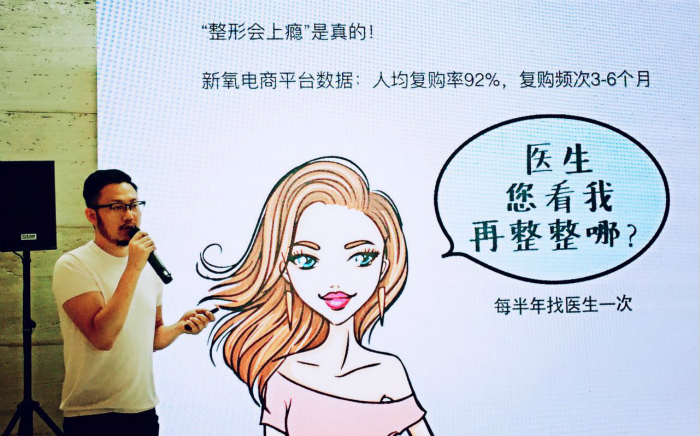
Jin Xing, Founder and CEO of So-Young, Interprets the "So-Young 2017 Medical Aesthetics Industry White Paper"
“Get a New Oxygen boost, transform safely.” It has become commonplace for consumers to use the New Oxygen app to review plastic surgery diaries written by other users, verify the credentials of doctors and hospitals, place online orders, and purchase insurance; meanwhile, medical aesthetic institutions leverage the Medical Aesthetics app for customer acquisition, reputation building, and brand establishment.
On August 8, the medical aesthetics app SoYoung released the “SoYoung 2017 Medical Aesthetics Industry White Paper,” marking its third consecutive year of publishing industry reports.
The “SoYoung 2017 Medical Aesthetics Industry White Paper” drew on online survey data from a sample of 200,000 SoYoung users, extracted 300,000 order records from SoYoung’s backend systems, and conducted comparative analyses across a three-year timeframe. Offline, it included field visits and surveys of 100 medical aesthetics institutions, while also reviewing and citing public data from third-party organizations such as Zero2IPO Research, Deloitte, and Analysys.
China’s medical aesthetics market has become the third largest in the world, after the United States and Brazil. After a decade of rapid expansion, the market size continues to grow at an annual rate of 40%, with a very high degree of marketization.
Each year, a large number of new consumers flood into this market. New and existing consumers differ significantly in their consumption concepts, habits, decision-making processes, and even disposable income. From the “radio generation” born in the 1970s, to the “television generation” born in the 1980s, and then to the “internet generation” born in the 1990s, the sources through which people obtain information have continually evolved.
According to the New Oxygen White Paper, 53 out of every 100 medical aesthetics consumers in China are born in the 1990s. Accustomed to using the internet and given that medical aesthetics purchases involve significant decision-making, reviewing ratings and reputation on online social platforms has become a crucial step in their consumption process.
Medical aesthetic institutions, as part of the offline service industry, must also adapt to changing environments. Older institutions will eventually be phased out, while a new generation will gradually emerge and grow, creating an ongoing cycle of survival of the fittest.
1. Two Major Drivers of Medical Aesthetics: Rejuvenation and Minimally Invasive Procedures
The New Oxygen White Paper points out that in 2015, China’s medical aesthetics consumption was mainly driven by the professional needs of celebrities and internet influencers. However, by 2017, consumer awareness had awakened, with more people opting for medical aesthetic procedures simply for self-gratification, as medical aesthetics became integrated into public life. A steady influx of young consumers has joined the ranks of medical aesthetics users, serving as the primary driving force behind market growth.
From a global perspective on aesthetic enhancement trends, Chinese consumers typically begin undergoing cosmetic procedures at the age of 20, whereas their counterparts in Europe and the United States generally start after the age of 30. The average age of Chinese consumers is thus ten years younger than that of Western consumers. This age disparity leads to differing demands: Chinese consumers primarily pursue aesthetic enhancement, with the prevailing ideal centered on well-defined facial features, fair skin, and slenderness; in contrast, Western consumers mainly focus on anti-aging, with the core ideals being breast and buttock augmentation and wrinkle reduction.
Not only is the number of people undergoing medical aesthetic procedures increasing, but the range of treatments each individual is willing to accept is also expanding. In recent years, the popularization trend in medical aesthetics has been “from external to internal, and from top to bottom”—that is, shifting from double eyelid surgery, eyebrow tattooing, skin treatments, and rhinoplasty to dermal fillers, intimate care, and dental aesthetics, as well as transitioning from facial procedures to those targeting the chest, legs, shoulders, waist, and buttocks. This year, transaction volumes for intimate care and dental aesthetic services on the So-Young app have seen a significant increase.
Moreover, China’s vast territory and diverse regional environments have given rise to distinct consumption patterns. For instance, residents of Beijing are most inclined to post cosmetic surgery diaries and travel to South Korea for procedures; one-quarter of the complaint calls received by So-Young originate from Shanghai; Guangdong accounts for one-eighth of the nation’s hyaluronic acid consumption; and Chongqing performs one-sixth of China’s breast augmentation and intimate aesthetic procedures.
“Overall, non-surgical cosmetic procedures account for the largest share of orders on the So-Young platform, reaching 70%. In fact, the non-surgical aesthetics market sees new trending treatments emerge annually, such as skin boosters, Thermage, and Theralift, with relatively rapid iteration. The proportion of non-surgical procedures is expected to rise rapidly in the coming years. As technology advances, many treatments that previously required surgery can now be performed without incisions or operative intervention,” stated Jin Xing, Founder and CEO of So-Young.
It is foreseeable that although minimally invasive procedures dominate the New Oxygen platform, consumers typically start with these less invasive options. As their confidence in the safety of medical aesthetics grows, they gradually transition to surgical procedures, leading to a corresponding increase in both order volume and transaction value for surgical treatments.
2. 3.2 million plastic surgery diaries effectively connect institutions, doctors, and consumers
New Oxygen was founded in 2013, a window period for the establishment of medical aesthetics platforms. Prior to this, Baidu served as the primary online channel for users to access information. To identify reputable institutions and physicians, users faced prolonged and imprecise decision-making processes.
On the So-Young app, 3.2 million consumer-written cosmetic surgery diaries have been accumulated, covering the vast majority of hospitals and doctors in China and tagging all major accredited institutions and physicians.
New Oxygen stipulates that only consumers themselves have the right to modify or delete their plastic surgery diaries; neither the platform nor medical institutions may interfere. This provides consumers with a dedicated space to document and search for information on aesthetic medicine consumption. The platform serves as a connector between consumers, doctors, and medical institutions.
“The more plastic surgery diaries and institutional sales data New Oxygen accumulates, along with extensive user feedback, the more precisely it can curate products and services,” said Jin Xing.
With the abundance of information, effectively matching content to ensure a positive user experience is particularly important. SoYoung’s product lists and plastic surgery diary feeds both leverage “personalized recommendation” algorithm technology, an advanced approach similar to that used by Toutiao.
According to New Oxygen, when the algorithm was tested with 20% of its users, the user open rate doubled. “As the volume of information grows, our push notifications become more precise, which is one of the key reasons for the high engagement levels on our app,” said Jin Xing.
3. The New Oxygen App integrates with the National Health and Family Planning Commission to ensure accredited institutions and licensed practitioners.
In 2017, the SoYoung app was integrated with the National Health and Family Planning Commission’s physician qualification verification system, enabling one-click access to physician information. Meanwhile, SoYoung conducted rigorous reviews of the Medical Practice Licenses of onboarding physicians to ensure that only legally licensed practitioners could join the platform.
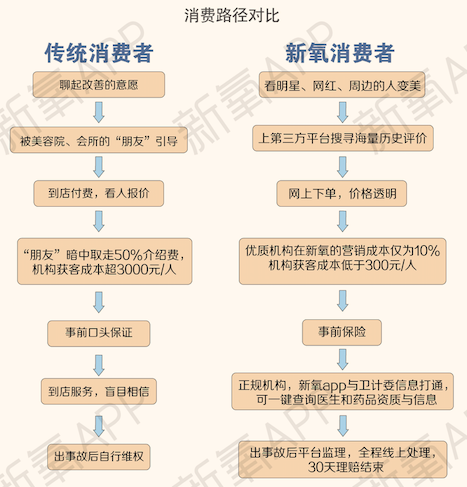
Consumer Pathway Comparison
If consumers have questions about a physician’s qualifications, they can simply open the SoYoung app on their mobile phone, tap “Me,” select “Physician Search,” and enter the physician’s name and medical institution to instantly view the physician’s registration information recorded by the National Health and Family Planning Commission.
Furthermore, the New Oxygen app supports online verification for all pharmaceutical products. Before using a medication, consumers can open the “Medication Verification” feature under the “My” section of the New Oxygen app to activate the QR code scanner. By scanning the QR code on the medication packaging, users can instantly access relevant product information.
Regarding institutions, So-Young strictly reviews the "Medical Institution Practice License," "Business License," and "Medical Advertisement Review Proof" of participating institutions. In terms of quality control, So-Young has launched the "Strict Selection Program," establishing five layers of security guarantees: 100% authentic products, 100% on-site inspections, Oxygen Guard, Flash Refund, and Advance Compensation.
Currently, the New Oxygen app has deployed business development personnel across 216 cities in China to strictly verify the qualifications of hospitals and physicians, thereby instilling greater confidence in consumers.
4. SoYoung Reduces Customer Acquisition Costs for Offline Institutions by 90%
Competition among offline medical aesthetics institutions has become fiercely intense, with tens of thousands of clinics of varying sizes operating across China. How to stand out from the crowd and reduce customer acquisition costs is the most pressing challenge for every plastic surgery clinic.
Whether bidding on comprehensive search engines or acquiring customers through offline channel agents, the marketing cost for institutions generally stands at 50%, with an average customer acquisition cost exceeding RMB 3,000 per person. This means that for each customer visiting the clinic, if the revenue generated is less than RMB 3,000, the institution incurs a loss.
“Among companies listed on the NEEQ, medical aesthetics institutions generally have profit margins of around 10%, which means that the average spending per customer must exceed RMB 30,000 before these institutions begin to turn a profit. This has historically led to issues such as opaque pricing and exorbitant bills in the medical aesthetics sector,” said Jin Xing.
Medical aesthetic apps inherently possess the DNA of transparency and disintermediation. On So-Young, the marketing cost for high-quality institutions is only 10%, with a per-customer acquisition cost below RMB 300. This figure is primarily calculated based on initial orders, excluding repeat purchases, which will further reduce the customer acquisition cost.
New Oxygen eliminates the high costs associated with intermediate sales channels for users. Its core strategy is to reduce customer acquisition costs for institutions through content and word-of-mouth marketing, thereby driving down consumer prices.
According to the New Oxygen White Paper, the market price of injectables has dropped by more than 70% over the past three years. This is primarily due to three factors: first, the significant price disparity between domestic and foreign pharmaceuticals left considerable room for correction; second, increased consumer transparency has prevented institutions from engaging in discriminatory pricing; and third, under current pricing mechanisms, institutions have adopted injectables as loss-leader services to attract customers.
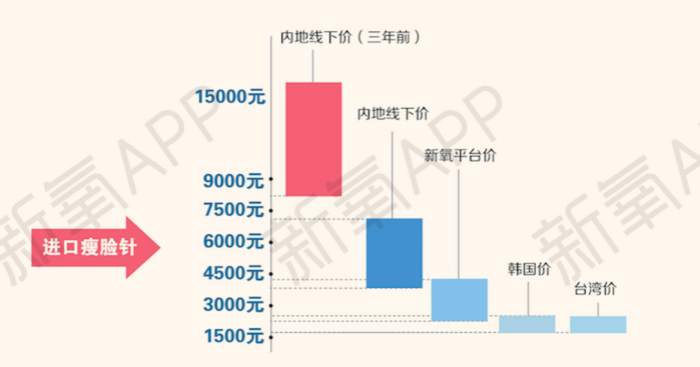
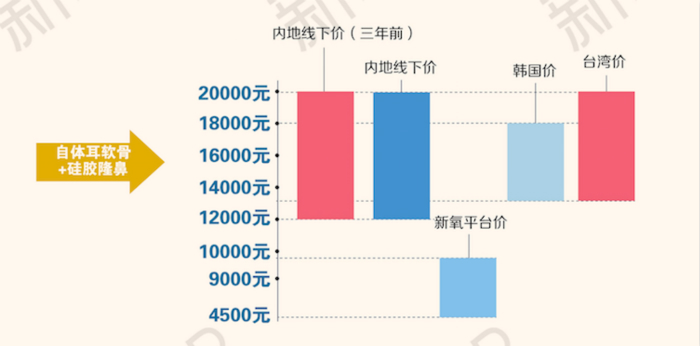
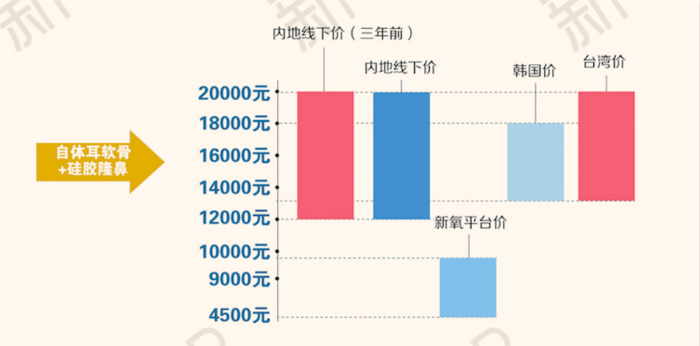
Comparison of Consumer Prices for Three Typical Procedures Across Different Channels
Unlike the steady decline in prices for injectable treatments, surgical procedure prices at offline institutions have not followed suit, even though such procedures on NewSoYoung are priced at half—or even less than half—of what offline institutions charge.
There are several reasons for this. First, physicians’ incomes are rising. Second, channel agent prices have been climbing steadily, driving up marketing costs. Third, unlike injection-based procedures, which serve as low-priced customer acquisition tools, surgical procedures are the primary profit source for institutions. This indicates that, for these institutions, if they do not change their development trajectory, there is no further room for price reductions, and they are struggling at the subsistence level.
The SoYoung platform uses plastic surgery diaries to encourage institutions to focus more on consumer satisfaction while also driving down prices. This is primarily because it reduces customer acquisition costs for these institutions from over RMB 3,000 per person to under RMB 300 per person, thereby correcting the distorted ratio between service delivery and marketing expenditure. At some key partner institutions, customers referred by SoYoung account for 60%–70% of their total patient volume.
5. SoYoung Establishes a Fair-Competition Medical Aesthetics Platform
In 2016, So-Young announced that it had achieved annual profitability. “For So-Young, the core revenue model remains based on commission fees and advertising charges. However, there is also room for innovation in the fee structure, such as developing differentiated value-added service packages tailored to merchants,” said Jin Xing.
New Oxygen’s pricing model is not based on a fixed daily rate for ad placements, but rather on a dynamic matching system. Under this dynamic matching model, the advertising cost for the same ad placement varies among hospitals; for instance, a hospital with higher online user ratings and reviews will pay a lower price.
For a new institution with low user ratings and limited cumulative sales, securing the same ad placement may cost three to five times more than what others pay. This disrupts traditional advertising models.
“Through this approach, we are in fact encouraging institutions that diligently manage their operations on the app and have an excellent reputation; even small- and medium-sized clinics can receive strong recommendations,” said Jin Xing.
"Given the vast number of institutions registered on the app, it is essential to adopt a fair approach. 'Many large chain hospitals, with their substantial financial resources, may leverage traditional advertising models to buy out all premium placement slots. This would cause significant harm to small and medium-sized clinics with strong reputations and high sales volumes, as well as to physicians’ personal brands.'"
In terms of expanding its network of hospitals and physicians, the market is gradually undergoing certain changes. In addition to continuous growth in numbers, So-Young has begun to deeply engage in the operations of offline institutions, helping these partnered entities build their brands, refine appropriate pricing, marketing, and management strategies, empower clinics, and establish a safe environment for consumers seeking aesthetic enhancements.
Rather than superficial metrics, Venus places greater emphasis on in-store visit volume—that is, the incremental value that the platform actually generates for offline medical aesthetic institutions.
“When we help offline medical institutions reduce their sales costs from 50–70% to 10%, it also encourages them to reinvest the savings into medical services themselves, ultimately boosting customer repurchase rates.” Jin Xing believes, “This is the correct value orientation for a company.”
Regarding SoYoung’s future development, Jin Xing stated that in addition to aiming for a larger market share in the medical aesthetics app sector, SoYoung intends to connect upstream and downstream segments of the industry, while also ensuring precise strategic positioning. “We are still an internet company, and our strength lies in breaking down information asymmetry. Therefore, we will intensify our efforts to facilitate the flow of information across the upstream and downstream industrial chains. One of SoYoung’s ‘modest goals’ is to help 100 million people achieve beauty safely.”