

EDDA Health Tech Advances as a Pioneer in AI-Powered Precision Surgery with IQQA Platform Adopted by Over 120 Hospitals Globally
“Currently, more than 120 hospital departments both domestically and internationally are utilizing the IQQA Precision Surgical Platform. With the exception of the IQQA-Guide 3D Image Intraoperative Navigation System, which has recently entered the National Special Approval Procedure for Innovative Medical Devices and is currently applying for CFDA approval (though it has already received U.S. FDA clearance), all our other products have obtained both CFDA and FDA certifications. Therefore, all these hospital departments use our products through procurement, with no free users. To date, the global number of clinical cases using the IQQA-3D System has exceeded 35,000, covering major diseases involving thoracic and abdominal soft tissue organs such as the liver, biliary and pancreatic systems, lungs, and kidneys.”
Dr. Zeng Xiaolan, Executive Vice President of EDDA Technology, provided this update on their project progress in an interview with VCBeat (WeChat ID: vcbeat).
While other medical AI companies are still engaged in laboratory research and development or conducting clinical trials, EDDA Technology has already completed the R&D, clinical trials, device certification, and pricing exploration for its three categories of medical AI products: detection, diagnosis, and treatment assistance. The company has also initiated commercial expansion, with over 120 hospital departments having paid for EDDA Technology’s medical AI product services.
It can be said that EDDA Technology, to some extent, represents what many medical imaging AI companies will look like in the future.
An AI Expert Team Dedicated to Assisting Physicians in Cancer Diagnosis and Treatment
Dr. Qian Jianzhong, founder of EDDA Technology, is a Fellow of the American Institute for Medical and Biological Engineering (AIMBE) and holds over 100 patented inventions in the fields of computer vision and intelligent medical diagnostic imaging analysis. His career in imaging began at the Institute of Remote Sensing Applications, Chinese Academy of Sciences.
After joining the field of medical imaging, Dr. Jianzhong Qian worked at Siemens’ Global Research and Development Headquarters, where he led the development of innovative solutions in response to market demand trends. His efforts resulted in multiple flagship products that became market leaders, including the first CT-based early lung cancer detection product to receive FDA 510(k) clearance. For these achievements, he was honored with the “Siemens Global Inventor of the Year Award.”
His entrepreneurial journey traces back to an academic conference he attended in Shanghai a decade ago. Through exchanges with university presidents and officials from the Ministry of Health, he recognized that the integration of medicine and engineering in China was remarkably low at the time, even as the total number of lung and liver cancer patients had reached millions.
Academician Jianzhong Qian founded EDDA Technology, Inc., where he serves as Chairman and President. He is dedicated to pioneering a new generation of AI-powered medical imaging diagnosis and analysis systems with independent intellectual property rights. Together with a core team of experts boasting extensive experience in intelligent medical imaging, he has developed the IQQA AI-Enabling Platform, which assists physicians in the diagnosis and treatment of cancer.
Dr. Xiaolan Zeng, a co-founder of EDDA Technology, holds a Ph.D. in Medical Imaging from Yale University. While at R2 Technology in Silicon Valley (later acquired by the publicly traded company Hologic), she led the upgrade of the core algorithm for the first FDA-approved breast cancer detection product with the largest market share, as well as the research and development of the core algorithm for a lung cancer detection product that received FDA PMA approval. She currently serves as Executive Vice President of EDDA Technology.
EDDA Technologies’ product portfolio includes the IQQA AI+QMR core technology and product service suite, as well as the IQQA Cloud Platform, covering the entire cycle of diagnosis and treatment management. These solutions are effectively applied to the early detection and diagnosis of various cancers (particularly tumors of the liver, gallbladder, pancreas, spleen, stomach, lungs, and kidneys), preoperative precise simulation and planning, three-dimensional comprehensive quantitative intraoperative navigation, intraoperative imaging monitoring, postoperative quantitative assessment, and follow-up. Through these products, EDDA Technologies provides physicians and patients with comprehensive technical services spanning screening, diagnosis, and treatment.
AI-Powered Solutions for the Entire Patient Journey: Screening, Diagnosis, and Treatment
The application of artificial intelligence in detection and diagnosis is well known; unlike most companies,EDDA’s IQQA-enabled platform can assist physicians in detection, diagnosis, and treatment.Moreover, the platform covers a range of conditions, including liver diseases, pulmonary diseases, urological disorders, and pancreatic diseases. Taking lung cancer as an example, let us examine how EDDA Technology addresses the three key stages of lung cancer management: screening, diagnosis, and treatment.
For instance, the imaging expert team led by Professor Yan Fuhua of Ruijin Hospital, Shanghai Jiao Tong University School of Medicine, is collaborating with EDDA Technology to leverage the IQQA empowerment platform, which is centered on artificial intelligence. This partnership provides comprehensive, multi-level integrated imaging application solutions in areas such as early detection of lung cancer, preoperative three-dimensional precise quantitative assessment, optimization of surgical plans, intraoperative robot-assisted biopsy and tumor ablation navigation, and postoperative precise pathological examination.
EDDA Technology’s IQQA-3D Lung System (for CT, low-dose CT, and contrast-enhanced CT) is built upon computer learning and analysis of millions of medical imaging big data records. By applying IQQA’s artificial intelligence technologies for automatic vessel suppression and enhanced visualization, it provides physicians with an effective tool for early detection and diagnostic analysis of lung cancer, thereby improving the detection rate of small pulmonary nodules.
The system focuses particularly on small pulmonary nodules that are prone to being missed by manual review, especially ground-glass opacities (GGOs) and mixed-density GGOs. Recently, the system was evaluated on over 50,000 CT images (with a mean long-axis diameter of 5.07 mm for solid small nodules, 6.89 mm for GGOs, and 12.81 mm for mixed-density GGOs; GGOs and mixed-density GGOs accounted for more than 60% of all small nodules), achieving a detection rate of up to 95%.
How to Differentiate Between Benign and Malignant Pulmonary Nodules and Confirm Early-Stage Lung Cancer? In addition to providing quantitative tumor tracking, quantitative analysis of morphology and CT values, and analysis of the spatial relationship between tumors and arteries/veins to assist physicians in assessing tumor benignity or malignancy, the IQQA platform...The most direct diagnostic tool is the IQQA-Guide, a fully quantitative, real-time navigation robot for precise biopsy puncture. It samples pathology with millimeter-level precision and achieves a first-pass success rate of over 77%, thereby effectively assisting physicians in accurately characterizing pulmonary nodules.。
By leveraging the IQQA empowerment platform, precise preoperative assessment, surgical planning, and simulation can be performed at the level of pulmonary bronchial segments. Intraoperatively, comprehensive three-dimensional quantitative real-time navigation is provided throughout the procedure, offering multidisciplinary team (MDT) precision surgery with comprehensive, accurate, and intuitive support.
Full-Process Quantitative Interventional Ablation Navigation: The IQQA-Guide Navigation Robot, centered on the “IQQA® Personalized 3D Fully Quantified Organ Electronic Map” (eOrgan Map), integrates real-time interactive quantitative imaging technology into minimally invasive interventional navigation.
During surgery, the IQQA-Guide navigation robot provides real-time, continuous localization of surgical instruments. Based on comprehensive, patient-specific parameters for soft-tissue organs and tumors—including needle entry points, angles, depths, trajectories, and ablation zones—it robustly supports physicians in performing various minimally invasive interventional procedures for thoracic and abdominal tumors, such as radiofrequency ablation, microwave ablation, and cryoablation.。
In particular, IQQA-Guide 3D intraoperative image navigation has obtained U.S. FDA medical device clearance and, in August 2017,7Day,Approved by the China Food and Drug Administration (CFDA) for inclusion in the Special Approval Procedure for Innovative Medical Devices. (Other products, such as IQQA-3D and IQQA-chest, have obtained Class II medical device certifications from both the CFDA and the FDA, while IQQA-Guide is approved as a Class III medical device.))
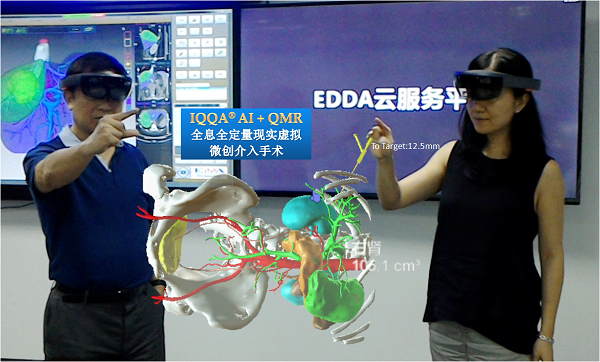
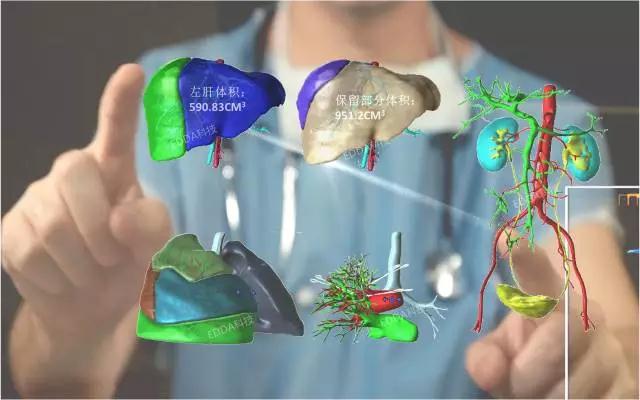
Its core highlight is intelligencePersonalized, Comprehensive, Interactive. EDDA’s proprietary AI+QMR holographic fully quantitative reality-virtuality system enables immersive, gesture- and voice-controlled manipulation of personalized 3D anatomical models of human organs, as well as various tissues and lesions, from multiple angles, aligning with actual clinical needs;More importantly, it enables real-time interactive quantitative analysis of three-dimensional volumes, distances, angles, and vessel diameters, thereby facilitating comprehensive preoperative quantitative 3D precision assessment, virtual surgical simulation, and surgical risk evaluation.。
Leveraging Artificial Intelligence to Assist in Clinical Teaching
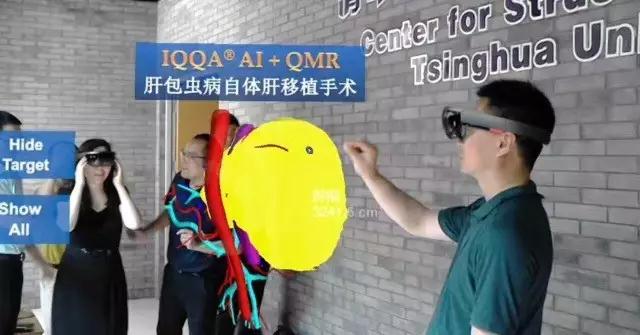
Zeng Xiaolan told VCBeat that, in addition to applying its products to screening, diagnosis, and treatment, EDDA Technology has also applied artificial intelligence technologies to assist clinical teaching. Through collaboration with EDDA Technology, Tsinghua University has jointly established the “Smart Reality-Virtual Clinical Teaching Center.”
Physicians can access specialized facilities,In the augmented reality virtual space, users can directly observe the anatomical details of patients' real human structures from all angles. Through gesture and voice commands, they can perform real-time 3D geometric analysis of organs and lesions, precisely measuring parameters such as the location, volume, diameters, and distances of target structures. Additionally, the system supports virtual dissection, simulated surgical resection, surgical planning, and surgical risk assessment.。
Professor Dong Jiahong, Dean of the School of Clinical Medicine at Tsinghua University, stated: “Medicine has entered an era characterized by precision medicine, artificial intelligence, and virtual reality; medical education must also leverage the integration of cutting-edge technologies to enhance teaching effectiveness and efficiency.”
In the past, medical education relied primarily on lectures using human cadaver specimens, textbooks, illustrations, and video or slide presentations. Today, we have entered the era of “Artificial Intelligence + Fully Quantitative Extended Reality.”
Through artificial intelligence, reality can be virtually reconstructed in a holographic and quantitative manner. In this virtual space, physicians and medical students can directly visualize the detailed anatomical structures of the human body, with physicians performing procedures and providing explanations. This new model transcends the limitations of time and space, significantly enhancing the quality and efficiency of medical education.
Commercially implemented
Currently, most medical AI companies are still in the product development phase. The more advanced ones are undergoing certification by the China Food and Drug Administration (CFDA) or have just obtained CFDA certification, but they still lack significant commercialization capabilities. In contrast, EDDA Technology has been exploring commercial pathways for many years and has accumulated its own expertise.
As the founding team comes from a background integrating medicine and engineering, they deeply understand the critical importance of clinical practice to medical technologies and devices. Consequently, they have engaged extensively in clinical settings, successfully obtained multiple international certifications—including approval from China’s CFDA and the U.S. FDA—and brought their products to market.
During its deep engagement in clinical practice, EDDA Technology established connections with many Grade 3A hospitals in China. After the product was launched and obtained regulatory approval,Their products have been procured by more than 120 hospital departments both in China and abroad, a scenario that stands in stark contrast to the prevailing situation in most parts of China.
These users include nine of the top 10 and 23 of the top 30 Class A tertiary hospitals in China.. For example, Peking Union Medical College Hospital, West China Hospital of Sichuan University, PLA General Hospital (301 Hospital), Ruijin Hospital in Shanghai, Zhongshan Hospital in Shanghai, the First Affiliated Hospital of Sun Yat-sen University, Tongji Hospital in Wuhan, Mayo Clinic in the United States, Massachusetts General Hospital, and UCSF Medical Center.
At present, EDDA Technology has further advanced its commercial strategy. By integrating new technologies that have been approved by the China Food and Drug Administration (CFDA) and validated for safety, efficacy, and maturity through extensive clinical use into its IQQA Intelligent Cloud, the company has established a Real-Virtual Precision Cloud Service Center alongside its traditional equipment sales. Through providing technical services to hospitals, physicians, and medical consortia, EDDA aims to extend the benefits of precision diagnosis and treatment to a broader population and facilitate the implementation of tiered diagnosis and treatment through high-tech solutions.
The gradual implementation of billing items for precision surgical planning across various regions, along with the government’s new policies on filing requirements for fees in special-needs medical services, have provided favorable conditions for the development of these pioneering efforts.
In addition, EDDA Technology also collaborates with enterprises to charge fees from B-side clients. Given EDDA Technology’s globally leading performance in pulmonary nodule detection,Phillips has established a multi-million-dollar business partnership with EDDA, leveraging the capabilities of IQQA-Chest to enhance the market competitiveness of Philips DR equipment.
Shimadzu Corporation and EDDA Technology Establish Multi-Million-Dollar Business Collaboration for the IQQA-Chest Tomo System Used in Tomosynthesis Imaging, to enhance the competitiveness of Shimadzu imaging equipment in lung cancer screening applications; this product has received approval from Japan's PMDA.
EDDA Technology is also strengthening its collaboration with intelligent surgical robotics companies. While current surgical robots feature precise and flexible robotic arms, they still lack a “brain” and an “intelligent eye” capable of interpreting the surgical scene, identifying surgical targets, and quantifying their spatial relationships with surrounding anatomical structures.
The IQQA platform, powered by artificial intelligence and computer vision as its core engine, provides surgical robots with precisely such a “brain” and an interconnected “panoramic, quantitative,透视慧眼 (insightful eye).”
Medical AI Is Not the Future, but the Present
Starting from November 2016,VCBeat has gathered information from or interviewed nearly 50 medical AI companies. Among medical imaging AI firms, EDDA Technology stands out as one of the companies with the most comprehensive product portfolio, the widest range of clinical applications, the most complete set of certifications, and the most successful commercial exploration.。
We all perceive medical AI as a novel development that has only emerged in the past two years; however, EDDA Technology has been engaged in this field for over a decade. It is possible that the algorithms they initially employed differed from the deep learning techniques used today.
However, Qian Jianzhong told VCBeat that they have also been keeping pace with technological trends and would try out new algorithms as they emerge. AdditionallyThe application of artificial intelligence in precision diagnosis and treatment cannot be supported by a single algorithm or technology alone; rather, it requires an enabling platform centered on multi-dimensional intelligent technologies., and engage in deep clinical practice. Only in this way can medical AI truly cease to be a future prospect and become a product we can use today.
Although EDDA Technology has achieved deep penetration in specialized fields, it remains relatively unknown to the general consumer market. With the rising prominence of artificial intelligence and the accelerated market adoption of IQQA’s AI-enabled platforms and products, the time is now ripe for broader recognition.
In terms of financing and investment, EDDA Technology has received funding from investors such as Morningside Venture Capital and SoftBank. To accelerate the market penetration of its products, EDDA Technology is also seeking strategic partners...