

How Intelligent Diagnosis Systems Are Being Deployed in Primary Healthcare: A Case Study of Shenzhen Kehengli's Clinical AI Platform
By Che Feilun, General Manager of Shenzhen Kehengli Computer Software Co., Ltd.
In the field of medical artificial intelligence, numerous companies provide related services, ranging from tech giants like BAT to many startups and small enterprises. However, there are very few practical applications actually implemented in primary healthcare settings. Moreover, these so-called implementations merely claim certain accuracy rates without generating any sales volume. To some extent, this reflects the insufficient innovation capability of many companies in the primary healthcare sector.
What Is the Key to Winning in the Deployment of Intelligent Clinical Diagnosis and Treatment at the Primary Care Level? This article analyzes solutions primarily from two perspectives: the three critical factors determining the success or failure of intelligent healthcare at the primary care level, and the principles for the successful implementation of intelligent clinical diagnosis and treatment systems in primary care settings.
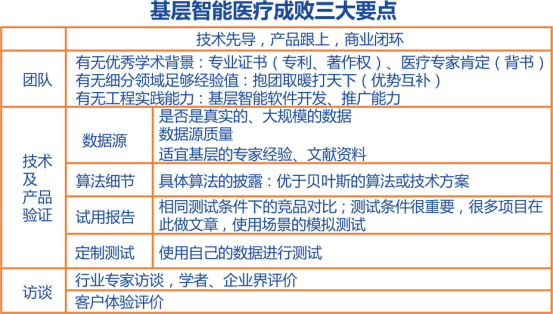
(This figure is adapted from Liu Weiwei of Galaxy Interactive’s guide on how investors can conduct technical validation for AI projects.)
Core Competitiveness of the Team
An excellent team should consist of individuals who share a common goal and mutual trust. Through efficient organizational division of labor and professional collaboration during project implementation, each member’s expertise is fully leveraged, enabling complementary strengths (combining AI proficiency with knowledge of primary healthcare) to achieve shared objectives in a rational manner. While operational models can be replicated and personnel can be selected, the soft power of a shared vision is the most difficult element to duplicate for any team. Nevertheless, effective teamwork unlocks endless possibilities.
Furthermore, understanding when and how to shift the company’s focus from product to revenue is also critical to successfully building a sales team: establishing a high-quality, high-execution, scalable, replicable, and measurable sales process; cultivating the right brand image; integrating resources; and jointly building an ecosystem.
Disruptive innovation typically originates from small startups. The success of these startups stems from their willingness to pursue opportunities that large corporations deem unworthy. Although large companies possess advantages in human, material, and financial resources, and may even define market directions—such as Google’s release of the “Knowledge Graph,” which represents strategic layout in the foundational and technological layers of artificial intelligence—they often hesitate when faced with innovative projects that could potentially undermine their existing profitability, leaving them in a dilemma. As large corporations continue to strengthen their positions in the foundational and technological layers, which have high technical barriers, small startups should concentrate on the application layer, focusing on vertical scenarios. By leveraging unique insights into medical technology, they can create superior, differentiated products and refine implementation strategies, thereby fostering a thriving and widespread ecosystem. For instance, Kangfuzi’s diagnostic accuracy, based on the same algorithm, is slightly higher than that of Baidu Medical Brain.
Zhou Hongyi believes that as a young entrepreneur, even if your venture is small and niche today, it doesn’t matter. As long as it delivers value to users, you must persevere—until the day fortune finally turns in your favor.
Obtaining and applying professional certifications for intelligent diagnostic and treatment systems (such as patents and copyrights) enables the company to leverage its independent intellectual property rights, positively impacting market expansion and promotion of these systems. This fosters a mechanism for continuous innovation and maintains technological leadership. After establishing an intelligent diagnostic and treatment system, startups can also engage industry experts to assist with validation, leveraging their professional reputation to endorse the brand and thereby earn user trust.
Technology and Product Validation
The quality of medical data is paramount. The presence of substantial redundant data, if not properly managed, can readily lead to data contamination. Professor Zhang Qin from Tsinghua University emphasizes that more medical data is not necessarily better; what matters is high data quality.Data sources for intelligent diagnostic and treatment systems at the primary care level mainly include authoritative domestic and international medical textbooks, professional monographs, academic papers, Baidu Baike, drug package inserts, clinical guidelines, clinical pathways, and expert experience. However, it must be clearly recognized that medical data derived from advanced high-end instrumentation, surgical techniques, and expensive novel specialty drugs are unsuitable for primary healthcare settings. Instead, data sources such as expert experience and literature appropriate for primary care constitute the required inputs for intelligent diagnostic and treatment systems at this level (knowledge bases can be established and validated under the guidance of industry experts).
Currently, the most effective underlying core technology for natural language-based computer-aided diagnosis on the market is a knowledge graph based on Bayesian networks. By mapping symptom descriptions onto the knowledge graph, this approach intelligently performs probabilistic reasoning, computation, and diagnosis to address the inherent uncertainty in medical conditions. However, due to the substantial engineering effort and complexity involved in constructing knowledge graphs, as well as the intrinsic uncertainties of medicine, the development of computer-aided diagnosis systems has been relatively slow. Consequently, Baidu Medical Brain (which collaborated with 580.com to launch “Meile Yi”) has faced significant challenges; it has not yet been adopted for clinical use or achieved commercialization.
Zhang Yaqin believes: “Currently, all machine learning is becoming increasingly complex. Big data, large parameters, and massive computation have essentially achieved virtually unlimited computational power. However, if we look at nature, it is remarkably simple; quantum physics, chemistry, and biology are based on the most fundamental principles of the natural world. Yet, to realize artificial intelligence, highly complex models are required for precise application. Therefore, a future trend will undoubtedly be simpler learning. Machines may be able to make decisions through deep learning without requiring massive amounts of data, and algorithms will also become simpler.”
Innovation should build upon the strengths of predecessors to push core technologies to their pinnacle. The new generation of intelligent clinical diagnosis and treatment systems innovatively provides a comprehensive simulation of the physician’s diagnostic and therapeutic workflow. It employs visualized flowcharts from diagnostics—offering clarity and immediate comprehensibility—combined with a “slot-matching” diagnostic model. By incorporating the diagnostic reasoning patterns of primary care physicians and applying fuzzy logic rules, the system enables physicians to leverage logical, intuitive, and inspirational thinking to match and select options, thereby forming hypothetical diagnoses. These hypotheses are then verified and confirmed through diagnostic criteria and differential diagnosis. (See the next article for a detailed breakdown.)
Anyone with experience in software or hardware testing understands a fundamental principle: any test conclusion drawn without specifying the test conditions is meaningless (practice is the sole criterion for testing truth). Therefore, before public release, intelligent diagnostic and treatment systems should undergo formal studies in primary care settings. Algorithms form the foundation of these systems; new algorithms are emerging in abundance, offering diverse pathways to success. As algorithmic barriers continue to diminish and even give way to open-source models, the successful deployment of an intelligent diagnostic and treatment system in primary care settings hinges on a rigorous differentiation of test conditions, content, and methods (see below for the principles for successful implementation of intelligent diagnostic and treatment systems in primary care settings).
Interviews, Dissemination
As the old saying goes, “Good wine needs no bush,” meaning that if the wine is well-brewed, its aroma will attract connoisseurs even from deep within a narrow alley. However, times have changed. In today’s information-saturated society, where product homogenization is severe, we cannot passively wait for an occasional passerby to discover our quality and then rely on the slow process of word-of-mouth promotion. Instead, we must proactively bring our fine wine within effective olfactory range.
Once startups embrace the vision of “letting the aroma of their wine travel farther,” they must then confront the challenge of communication. In fact, the highest form of communication is the interview—revealing charisma through simplicity and substance through conciseness. Grassroots innovators are shaping the world; sincere case stories and enlightening entrepreneurial insights are bringing a vibrant springtime to the internet. How can we leverage interviews and communication to promote grassroots intelligent diagnostic and treatment projects?
First, it is advisable to solicit opinions and recommendations from experts, scholars, and industry practitioners, as they represent professionalism and authority. Interviews should be conducted with both proponents and skeptics within these groups regarding the chosen direction. Furthermore, maintaining ongoing communication and collaboration with experts in AI and primary healthcare is essential. Through comprehensive information exchange, diverse insights can be gathered to leverage strengths and mitigate weaknesses, thereby developing professional, reliable, and trustworthy intelligent diagnostic and treatment solutions for primary care settings.
Furthermore, while we should respect experts, we must not blindly follow them. Mao Zedong once said, “From the masses, to the masses.” In developing grassroots intelligent diagnosis and treatment projects, small startups creating such systems should adhere to the principle of “from grassroots physicians, to grassroots physicians” when defining their concepts and implementation standards.
Experiential marketing is a novel approach that has gradually permeated every corner of the sales market. For intelligent diagnosis and treatment projects to succeed, they must start from the very first point of contact with primary care physicians. While laypeople may only see the surface, experts understand the underlying mechanics; ultimately, word-of-mouth referrals from primary care physicians are paramount. As the saying goes, “Gold and silver trophies are not as valuable as the endorsement of primary care physicians.” Therefore, startups should prioritize communication and interviews with primary care physicians to uncover their intrinsic needs, evaluating their products and services from the perspective of the physicians’ user experience. By grounding experiential services in the authentic feedback of primary care physicians and establishing successful regional model markets, these initiatives can spark a prairie fire, achieving widespread adoption.
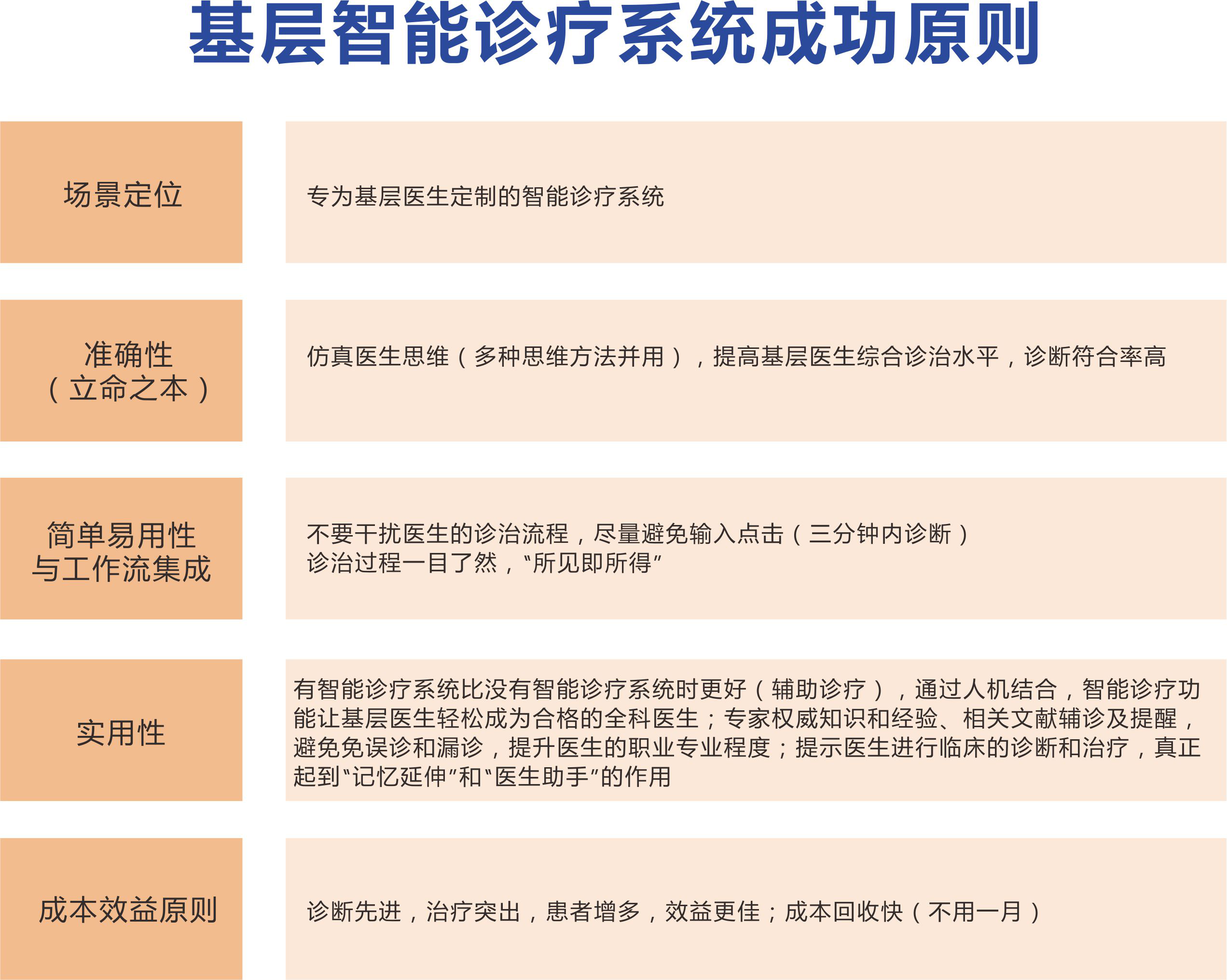
Scenario Positioning: An Intelligent Diagnostic and Treatment System Customized for Primary Care Physicians
Fu Sheng, CEO of Cheetah Mobile, believes that the breakthrough point for artificial intelligence lies in the integration of technology and products. Startups can focus on applications in niche scenarios, develop specialized solutions, and directly address industry pain points. Startups should continuously innovate from the periphery, pursuing innovation in areas overlooked or disregarded by tech giants, thereby expanding the boundaries of innovation and growing into a value center—adopting a strategy akin to “encircling the cities from the countryside.”
The state’s emphasis on tiered diagnosis and treatment, primary-care physicians, and general practitioners, coupled with government support policies for small and medium-sized high-tech enterprises, has made it feasible for small teams to develop high-performance intelligent diagnosis and treatment systems for primary care, thereby accelerating the development of this industry. Since 2015, several companies have emerged that focus exclusively on providing services to primary healthcare institutions and physicians, including Baidu Medical Brain, Huimei Technology, and Shenzhen Evidence-Based Medicine.
Intelligent diagnostic and treatment systems are only meaningful if they vertically address challenges in primary healthcare. Technology must be embedded into products to enable more primary care physicians to perceive its value. If technology remains lofty and fails to achieve widespread adoption among primary care physicians, the invested technical efforts will ultimately amount to a bubble. Ma Huateng stated, “Computing power and big data are replicable, but markets and talent are not; this is a core point.”
Positioning of the Intelligent Clinical Diagnosis and Treatment System: An intelligent medical tool tailored for primary care physicians. Market Positioning: China’s first AI-powered “king” of general clinical diagnosis and treatment. Why is positioning important? As the old saying goes, “If the choice is wrong, all effort is wasted.” Another Chinese proverb states, “Men fear choosing the wrong profession, while women fear marrying the wrong man,” both underscoring the critical importance of positioning.
Vast grassroots clinical market: With 638,000 village clinics, and assuming a relatively low price of RMB 2,000 per unit for AI-powered clinical diagnostic systems, the market size reaches RMB 1.276 billion. This figure does not yet include markets such as township health centers, community health service centers, clinics (medical rooms), medical students, pharmacies, or subsequent commercial expansions across the ecosystem.
Accuracy Is the Foundation of Grassroots Intelligent Diagnosis and Treatment Systems
Simulating Clinical Reasoning (Integrating Multiple Cognitive Approaches) to Enhance the Comprehensive Diagnostic and Therapeutic Capabilities of Primary Care Physicians, Achieving High Diagnostic Concordance: Intelligent Clinical Decision Support Systems Must Be Medically Sound. The knowledge base and clinical workflows of such systems must be derived from the expertise, diagnostic and treatment experience, and unique, practical medical insights of both medical specialists and primary care physicians. It is essential to rigorously integrate medical knowledge with reliable technological methods, carefully curate data, and precisely define the analytical tasks. Furthermore, maintaining a sense of reverence for the medical profession is crucial to developing intelligent clinical decision support systems that are both reliable and clinically usable.
Misdiagnosis in clinical practice is a trigger for the tense doctor-patient relationship in China. The rate of misdiagnosis by doctors remains relatively high today. Although no relevant authorities have released authoritative statistics on clinical misdiagnosis rates, there is a consensus within China’s healthcare industry that the rate is approximately 30%. Many specialists also make misdiagnoses, and due to the insufficient level of education and training for general practitioners, their misdiagnosis rate is even higher.
If the misdiagnosis rate among primary care physicians lacking access to medical equipment is 35%, and an AI-assisted diagnostic system combining human expertise with machine intelligence can reduce this rate to below 25% (while significantly lowering the rate of missed diagnoses), this demonstrates that the system is an accurate intelligent diagnostic platform.
To achieve the goal of reducing misdiagnosis and missed diagnosis rates, the optimal approach for an intelligent clinical diagnosis and treatment system is to simulate physician reasoning by integrating multiple cognitive methods used in clinical practice, including comprehensive thinking, procedural deduction, pattern recognition, hypothetical-deductive reasoning, direct diagnosis, exclusionary diagnosis, and differential diagnosis.
Ease of Use and Workflow Integration
"Do not interfere with the doctor's diagnosis and treatment process. Try to avoid input clicks (diagnosis within three minutes), making the diagnosis and treatment process clear at a glance, 'what you see is what you get'."
Any superior user experience must cater to the inherent human tendency toward convenience. An intelligent diagnostic and treatment system designed for usability should be developed from the perspective of primary care physicians, focusing on how to seamlessly integrate it into their existing workflows. This approach aims to help them rapidly address clinical diagnosis and treatment challenges while reducing rates of misdiagnosis and missed diagnosis. Intelligent diagnostic systems are not developed solely for technological advancement; rather, they are intended to align with physicians’ current workflows to solve practical clinical problems. It is crucial to achieve effective clinical problem-solving without imposing additional burdens on primary care physicians.
Designers of intelligent diagnostic and treatment systems should possess expertise in both AI and primary healthcare, with a deep understanding of the psychology of human-computer interaction, medical logic, and clinical knowledge. An ideal intelligent diagnostic and treatment system should keep technology in the background, offering users a simple application interface that minimizes excessive clicking. The system’s display should be clear at a glance, enabling the entire diagnostic and treatment process to be completed with just a few mouse clicks. The panoramic flowchart-style diagnosis provides immediate clarity, embodying the principle of “what you see is what you get.”
Kangfuzi and Baidu Medical Brain exhibit deficiencies in this regard. They require excessive human-computer interaction (involving numerous selections and judgments regarding medical history, symptoms, and signs), which can be overwhelming to complete in a single diagnostic workflow. Furthermore, users often have to click through many ambiguous items, leading to an increased risk of misdiagnosis. While this approach aligns more closely with patient self-diagnosis and inquiry processes, it is ill-suited for the workflow of busy primary care physicians. The clinical reasoning process for primary care providers should be concise and efficient; specifically, human-computer interaction time during the diagnosis of common and frequently occurring diseases should be completed within one minute, requiring no text input and minimal clicking.
Practicality: Intelligent diagnostic and treatment systems outperform scenarios without such systems (assisted diagnosis and treatment)
Through human-AI collaboration, intelligent diagnostic and treatment capabilities enable primary care physicians to easily become qualified general practitioners. Expert authoritative knowledge and experience, along with literature-assisted diagnosis and alerts, help avoid misdiagnosis and missed diagnoses, thereby enhancing physicians' professional expertise. By providing clinical diagnostic and therapeutic guidance, the system truly serves as an "extension of memory" and a "physician's assistant."
Intelligent diagnostic and treatment systems should not only inform physicians of a patient’s diagnosis but also explain the rationale behind it. Furthermore, they should guide primary care physicians in determining the most valuable next steps for examination and treatment when using such intelligent systems.
Dr. Zhang Qin of the Chinese Association for Artificial Intelligence stated, “Although artificial intelligence is currently very popular, we hope that people will apply necessary critical thinking to its true value during this surge, rather than blindly worshipping it.”
Over the decades-long history of medical artificial intelligence, no software has truly been implemented in clinical practice. Pragmatists adhere to the adage, “It doesn’t matter whether a cat is black or white, as long as it catches mice.” Decades into China’s reform and opening-up, ordinary citizens who have benefited from these policies still fondly recall and firmly uphold this “Cat Theory.” In the context of medical AI, this saying can be adapted to: “Simple intelligent diagnostic and treatment systems, complex intelligent diagnostic and treatment systems—whichever is smart and effective is the good system.”
In other words, regardless of how an intelligent diagnosis and treatment system implements its diagnostic and therapeutic functions, as long as these functions perform similarly to or better than the processes and outcomes observed in professional clinical settings, it can be said that this system possesses artificial intelligence capabilities within that domain. From a practical standpoint: An intelligent diagnosis and treatment system is a tool-based solution designed to address the diagnostic and therapeutic challenges faced by primary care physicians while maximizing benefits.
Cost-effectiveness: break-even within one month
Intelligent diagnostic and treatment systems should be readily accessible: physicians ought to be able to use them conveniently and at a reasonable cost. Even the most advanced intelligent diagnostic and treatment systems are of little value if primary care physicians cannot afford them. The application of such systems should be as effortless as using a telephone or mobile phone.
Intelligent diagnosis and treatment systems are merely tools that leverage artificial intelligence technology to enter the healthcare sector, built upon a software foundation. The marginal cost (and even the price) of software approaches zero; therefore, the actual pricing of intelligent diagnosis and treatment systems should not be excessively high, particularly at the primary care level. It is unrealistic to expect primary healthcare institutions to spend tens of thousands or even over one hundred thousand yuan to purchase such a system.
If we remain solely at the technical level, intelligent diagnosis and treatment at the primary care level will struggle to succeed in the current stage; physicians will not pay for algorithms and technology alone. You must integrate all links, dive deep into problem-solving, and carefully design and establish every component—from front-end data acquisition and processing to application systems, the experience of primary care physicians, and even the overall business model. The development of intelligent diagnosis and treatment in primary care should be driven by industry applications, rooted in market demand, aimed at addressing pain points in primary healthcare, inspiring primary care physicians, and turning visions into reality. Intelligent diagnostic and therapeutic solutions can provide much-needed support to primary care settings that lack technology, talent, and equipment.
Stay tuned for the next article: Intelligent Diagnosis and Treatment at the Primary Care Level—Intelligent Clinical Diagnosis and Treatment Systems