

China's First Expert Consensus on Self-Management Prescriptions for Type 2 Diabetes (2017 Edition) Finalized; AI-Powered Prescription Systems Set for Widespread Hospital Adoption
Author: Huang Xiaoling
Research data indicate that China has become the country with the largest number of diabetes patients worldwide, with one in ten adults affected by the disease. Moreover, both awareness and control rates remain low. As a chronic condition that is currently incurable, diabetes requires patients to engage in self-management through medication, dietary adjustments, physical activity, and other measures. However, most patients lack adequate knowledge about diabetes and exhibit poor self-management capabilities. Therefore, professional self-management education and ongoing support provided by healthcare professionals are particularly crucial for individuals with diabetes.
However, the current state and effectiveness of education and support for patients with diabetes are far from ideal. On one hand, healthcare resources are limited; patients with diabetes spend an average of only three minutes per visit with their physicians and just six hours per year in clinical settings, leaving the remainder of the time for self-management. On the other hand, diabetes education is plagued by numerous issues, including monotonous content overly reliant on textbook knowledge, high variability among educators, lack of systematic assessment and follow-up, a disconnect between education and behavioral change, and a failure to address patient needs.
ChinaFirst Issue"China"Expert Consensus on Self-Management Prescriptions for Type 2 Diabetes (2017 Edition)" Finalized
To address this long-standing and widespread issue, guide healthcare professionals in the more standardized and scientific application of clinical guidelines, select appropriate timing based on individualized needs, quantify self-management content, goals, and expected outcomes, and collaboratively develop implementation plans and determine follow-up schedules with patients—all with the ultimate goal of improving patients’ quality of life—the experts of the Education and Management Group of the Chinese Diabetes Society have compiled this document."Expert Consensus on Self-Management Prescriptions for Type 2 Diabetes in China (2017 Edition)"(hereinafter referred to as the Consensus) provides a detailed exposition on multiple aspects of self-management education prescriptions, including their definition, theoretical basis, content, formats and implementation processes, timing of application, and clinical value, so as to guide healthcare professionals in patient education and enhance the standardization and effectiveness of educational management.
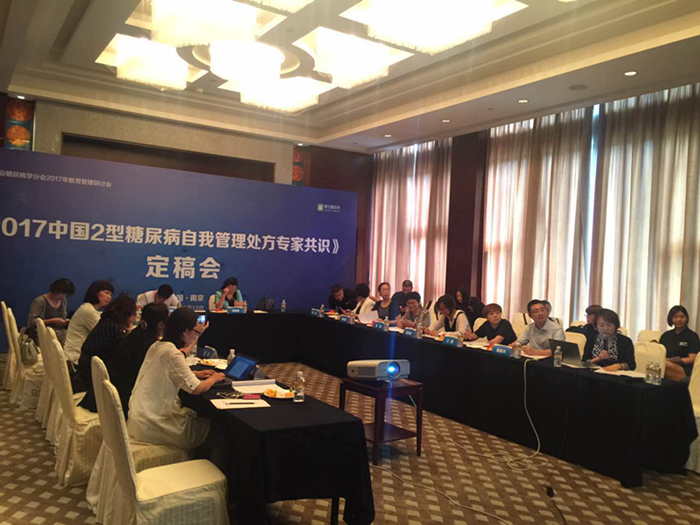
《ChinaExpert Consensus on Self-Management Prescriptions for Type 2 Diabetes》((2017 Edition)Final Review Meeting Venue
On the afternoon of August 13, the finalization meeting for the “Expert Consensus on Self-Management Prescriptions for Type 2 Diabetes in China (2017 Edition)” was held at the Purple Mountain Resort in Nanjing. Under the chairmanship of Professor Guo Xiaohui, experts from the Education and Management Group of the Chinese Diabetes Society of the Chinese Medical Association conducted a final review and finalized the consensus. It is reported that the group’s experts held multiple collective discussions to ensure the practicality and scientific rigor of the consensus content. The finalized consensus will be released within the year and promoted for application in major hospitals across China.
Diabetes Education and Management Should Leverage Intelligent Prescription Systems
“Expert Consensus on Self-Management Prescriptions for Type 2 Diabetes in China” (2017 Edition) is the first expert consensus in the field of diabetes focused on patient education and support.It is worth noting that the Consensus (2017 Edition) proposes that diabetes patient education in the new era should keep pace with the times and align with China’s national conditions, fully leveraging the power of internet and Internet of Things (IoT) technologies to enhance the efficiency and effectiveness of education management. This holds significant importance for the development of diabetes education management in China. The Consensus (2017 Edition) points out that with the advancement of IoT and internet technologies, intelligent remote education service models are gradually being applied to the education and management of patients with diabetes, and foreign research cases have also confirmed the effectiveness of this service model.
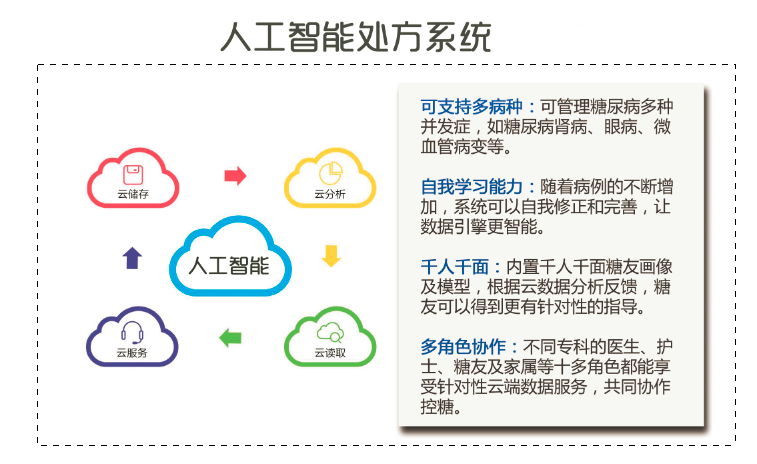
Currently, several intelligent prescription systems for diabetes management have emerged in the market, with some already implemented in multiple hospitals across China. For example,"Smart Management System Launched by Take Control of Diabetes",The system adheres to domestic guidelines and consensus in the field of diabetes, integrating six behavioral change theoretical models., Chinese authoritative institutions have gained recognition and joined to enable multiple functions: storing patient health information, rapidly assisting in the analysis of patients’ self-management behavioral issues through artificial intelligence technology, intelligently generating personalized diabetes self-management plans, coordinating with remote diabetes education and follow-up assessments, and intelligently optimizing self-management prescriptions after assessment, thereby providing patients with continuous support for diabetes self-management.
In 2016, clinical studies conducted in collaboration with institutions such as the Chinese Center for Disease Control and Prevention confirmed that the Zhangkong Diabetes Intelligent Management System helps improve adherence among diabetes patients to blood glucose monitoring, effective exercise, and regular medication intake, resulting in significant improvements in blood glucose control.
Experts believe that in the near future, powered by big data and cloud platforms, intelligent prescription systems will not only automatically connect with smart hardware (such as smart glucose meters) but also integrate with personal health record systems. This integration will establish a regional disease management cloud platform, enabling closed-loop management across online and offline settings as well as within and outside hospitals. Consequently, this will enhance service efficiency, extend the service radius, expand patient coverage, and maximize the benefits of diabetes education and management.