

Chunyu International Breaks Through Homogenization in Overseas Medical Services with Integrated Online-Offline Channels and Remote Healthcare Innovation
Recently, Analysys International released the report "Special Research on the Overseas Medical Market 2017." The report points out that the overseas medical market is still in an exploratory phase. The continuous expansion of the user base has attracted a large number of vendors and investors, leading to intense competition in patient acquisition channels and serious homogenization of services.
Two Years After Major Internet Companies Entered the Overseas Healthcare Market, a VCBeat (WeChat ID: vcbeat) Reporter Interviewed Chunyu International President Xiong Juan to Discuss the Current State of the Overseas Healthcare Market and Chunyu International’s Breakthroughs in Channel Competition.
Channel Breakthrough and Expansion Become Bottlenecks for Overseas Medical Products
“International Travel Health Services” and “Medical Tourism” have been included in the Notice of the State Council on Issuing the 13th Five-Year Plan for Health and Healthcare. The establishment of access qualifications for participants in the overseas medical market, coupled with continuously strengthened market supervision and ongoing policy improvements, has provided new momentum for the development of the overseas medical market.
According to statistics from Analysys, the proportion of private hospitals in China rose from around 30% to 50% between 2010 and 2015, while the number of outbound travelers increased from 57 million to 117 million during the same period. Data from the China National Tourism Administration shows that among overseas medical service providers—including Hong Kong, Thailand, South Korea, Japan, and the United States—Hong Kong led significantly in 2015, serving 45.84 million patients. The concurrent development of the private healthcare sector and the tourism industry has jointly promoted the growth of overseas medical services.
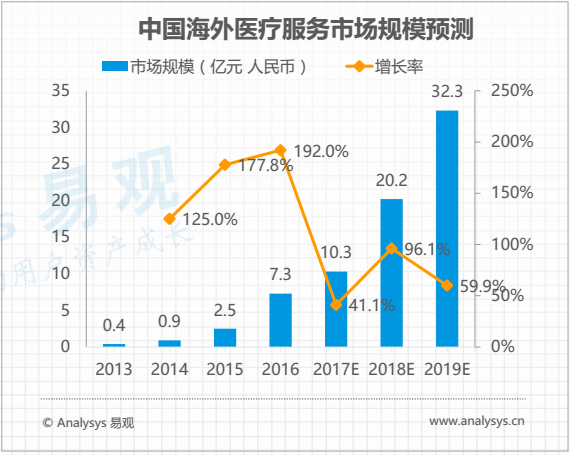
As outbound travel habits become increasingly established among the public, overseas medical services are gaining broader market acceptance. According to the “2017 Analysis of Overseas Medical Market Shift” released by Analysys Think Tank, the overseas medical market size reached RMB 730 million by 2016, with an annual growth rate as high as 177.8%. The market size is expected to exceed RMB 1 billion in 2017 and maintain sustained rapid growth over the next three to five years.
Currently, in China’s cross-border healthcare market on the internet, service providers mainly fall into three categories: traditional cross-border healthcare institutions, Chinese offices of overseas cross-border healthcare providers, and internet-based cross-border healthcare institutions. As the middle class and nouveau riche population continues to expand, the healthcare industry is undergoing upgrades that emphasize globalization, enhanced patient experience, and personalization. However, according to statistics from VCBeat, half of cross-border healthcare institutions offer only a single type of service.
Furthermore, as the economic development and consumption levels in second- and third-tier cities rise, a significant unmet demand has emerged for overseas medical services.
According to the “Top 10 Chinese Cities by Number of Grade-A Tertiary Hospitals in 2017” released by the National Health and Family Planning Commission, China’s high-quality medical resources are predominantly concentrated in first-tier cities. However, data from the “2017 Distribution of High-Consumption Populations by City Tier in China” shows that individuals with high consumption levels in second- and third-tier cities account for more than 40% of the national total, indicating substantial growth potential among this user base. The imbalance between high consumption levels and scarce medical resources in second- and third-tier cities suggests that, going forward, the primary market for overseas medical services will shift from first-tier cities to second- and third-tier cities.
The continuous expansion of the user base has attracted a large number of manufacturers and investors, leading to intense competition in patient acquisition channels and severe service homogenization. Consequently, the traditional approach of positioning service providers solely based on their online or offline presence may no longer be applicable.
According to an Analysys report, the overseas medical market is highly specialized, with relatively abundant high-quality upstream resources. Consequently, breakthroughs and expansion in distribution channels have become a bottleneck for overseas medical products. Relying solely on a single channel may pose significant risks, making the selection of appropriate channels to reach precise target users the industry’s greatest challenge.
Chunyu International Achieves Rapid Growth by Leveraging Offline Channels with High-Net-Worth Individuals
“Channel resources will become a key factor determining the future market landscape.” Chunyu International told VCBeat, “Over the past two years, Chunyu International has firmly secured its position as the online gateway for the industry. It is now time to focus on building offline service scenarios.”
“Fully integrating online and offline services” is the current operational logic of Chunyu International, which has already established partnerships with commercial insurance providers and high-end real estate developers. This represents a pioneering exploration of distribution channels. The International Community Health Management Centers, developed in collaboration with real estate developers by Chunyu International, were established with the support of Cambridge Health Alliance, a renowned U.S. medical chain group. These centers introduce innovative primary care models, U.S.-style general practitioner services, and cutting-edge international health management products. By serving local communities and surrounding high-net-worth individuals, they provide comprehensive, internationally standardized medical management services for chronic disease treatment and health management, along with a range of other high-quality medical services.
In recent years, the demand for overseas medical services has expanded from critical care treatment to health management and chronic disease management. Meanwhile, online customer acquisition costs have continued to rise. To ensure a steady flow of traffic across both online and offline channels, Chunyu International has pioneered health-focused international communities in partnership with real estate developers, bridging advanced foreign primary healthcare concepts with domestic health needs.
In December 2016, Chunyu International partnered with Jinmao and other renowned domestic real estate enterprises to create a new type of internationalized health community, providing high-standard, internationally aligned general practice (family doctor) medical services.
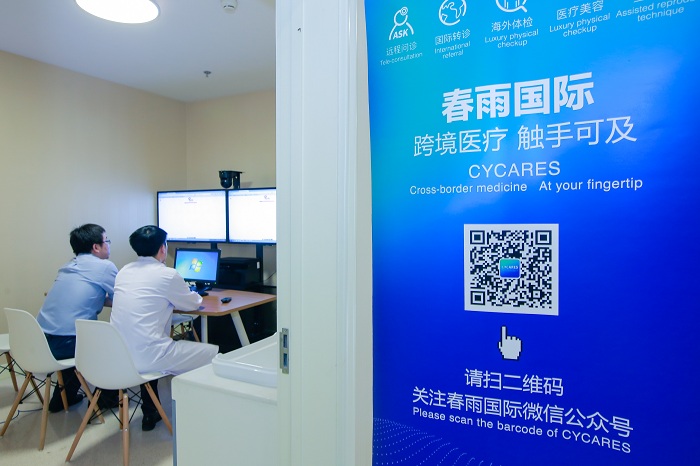
From sending patients abroad for “critical care” to providing online chronic disease management and private physician services within communities. By partnering with real estate developers, Chunyu International has established offline service scenarios that facilitate direct communication with potential customers, thereby addressing the limitations of models that focus solely on either online or offline channels.
For real estate developers, partnering with Chunyu International, the premium brand of Chunyu Doctor, can enhance property value and command a service premium; for Chunyu International, this clearly opens up further front-end channels to high-net-worth individuals.
Currently, Chunyu International Health Community has established partnerships with numerous renowned real estate developers, including China Jinmao, Gemdale Corporation, Sino-Ocean Land, Sansheng Real Estate, SCE Group, Rongsheng Development, CCCC Real Estate, and Yangguang City Group, among others. These collaborations have led to the establishment of offline medical service terminals, with over a thousand property owners already enrolled as members. The Health Community network now spans more than ten provinces, municipalities, and autonomous regions, including Beijing, Chengdu, Fuzhou, Shijiazhuang, and Hangzhou, gradually becoming a core pillar of Chunyu International’s distribution channel.
The overseas medical market has achieved rapid growth by leveraging offline channels that aggregate high-net-worth individuals. Chunyu International’s high-end offline clinics, established in partnership with real estate developers, utilize scenario-based medical services to precisely reach users with high-net-worth healthcare needs, thereby enabling efficient conversion of medical demand and effective expansion of customized products.
Telemedicine Lowers the Barrier to Entry for Users
“Full-chain service” is a novel, proprietary solution of Chunyu International that President Xiong Juan has consistently emphasized: “Critically ill patients have highly detailed requirements for the services provided by manufacturers. For such patients, our service providers are involved throughout the entire process—from initial consultation and mid-stage treatment to post-treatment follow-up—with a high level of engagement.”
With the advancement of remote consultation technologies and Chunyu International’s deepening engagement in community healthcare services, the majority of medical issues will be addressed domestically through collaboration with local physicians, while overseas medical resources will serve as an important supplementary means. Consequently, the proportion of Chunyu International’s business derived from remote consultation services is poised for significant growth.
By capturing tier-2 and tier-3 cities to expand the overseas medical market, pricing remains the primary pain point. Given the significant disparity in healthcare costs between domestic and international settings, Chunyu International has further lowered user access barriers for relatively low-frequency, critical care service providers by launching international telemedicine services.
According to data from Chunyu International, users aged 50 and above accounted for 36% of telemedicine users, compared to 23% among overseas referral users. This indicates a broader user base and channel reach, significantly expanding the scale of the product’s target population.
As the earliest enterprise to launch international telemedicine services, Chunyu International has established partnerships with 50 overseas medical resource institutions, securing a leading position in terms of resource availability. As of June 2017, telemedicine accounted for 82% of Chunyu International’s total business volume.
Post-consultation services represent an upgraded demand for users of overseas medical care. During the period of extensive, unrefined growth in overseas medical services, patients often arrived at foreign hospitals in a scattered and uninformed manner, seeking treatment that typically met only their most basic medical needs. Consequently, they were unable to access post-consultation services comparable to those available to local patients, which clearly had an adverse impact on the quality of care.
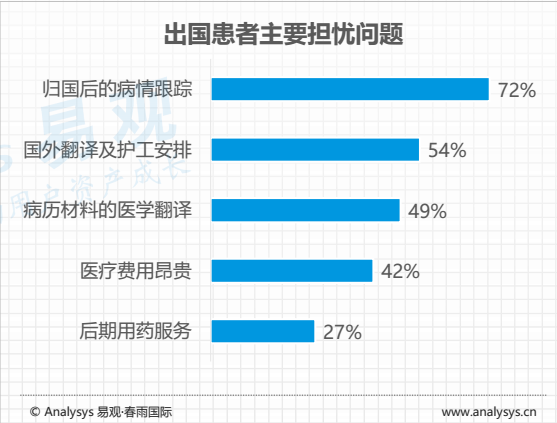
Analysys International’s survey also reveals that among the concerns of patients seeking medical treatment abroad, post-return disease monitoring ranks highest at 72%—yet in practice, few overseas healthcare service providers actually offer such services.
Chunyu International provided VCBeat with a detailed account of its post-consultation services: each step in the patient journey directly impacts the ultimate quality of medical care. The establishment of post-consultation scenarios further strengthens the service chain, ensuring comprehensive patient protection throughout the entire care process. Meanwhile, by enhancing users’ post-consultation experiences, Chunyu International has further differentiated itself from other service providers.