

Insight into Taiwan's Postpartum Care Model: How Dunnan Love Achieves Profitability with Direct-Operated Centers
The total number approaches 400, which represents the entire count of postpartum care centers in Taiwan. Behind these figures lies a large workforce of practitioners in the postpartum care industry, including doctors, nurses, and real estate developers. Purely medical care, meticulously prepared postpartum meals, and standardized operational and management systems are the hallmark features of Taiwan’s postpartum care centers.
Taipei is the hub of postpartum care centers in Taiwan. Dunan Zhenai opened its first postpartum care center on Dunhua South Road in Taipei in 2008, and subsequently established three directly operated branches in Xizhi, New Taipei City, and Taichung. Dunan Zhenai has received the Excellence Award for Postpartum Care Homes, as evaluated by relevant Taiwanese authorities, for two consecutive terms. It is the pioneer that established the nine major service standards for the postpartum care industry and is regarded as the industry “supervisor” in Taiwan.
In 2011, Dunnan Zhenai officially entered the Chinese mainland. In July 2016, it selected Mama.com, a well-known vertical media platform for maternal and infant care, as its strategic partner. To date, it has established five directly operated stores and 34 franchised outlets.
As a postpartum care center in Taiwan, how does Dunan Zhenai manage its operations, and what is its current development status? VCBeat (WeChat ID: vcbeat) interviewed Lin Senyi, General Manager of Dunan Zhenai, and Chen Danping, Marketing Director.
Medical-Grade Standardized Management and Tabletop Postpartum Meals: Two Major Advantages of Taiwanese Postpartum Care Centers
Postpartum care centers in Taiwan are subject to direct regulatory oversight; consequently, they not only adhere to medical-grade standards for care requirements but have also established unified industry standards for facility design, operational models, and staffing. Most postpartum care centers adopt a collective care model, with registered nurses serving as the primary caregivers, and do not employ traditional confinement nannies (yuesao).
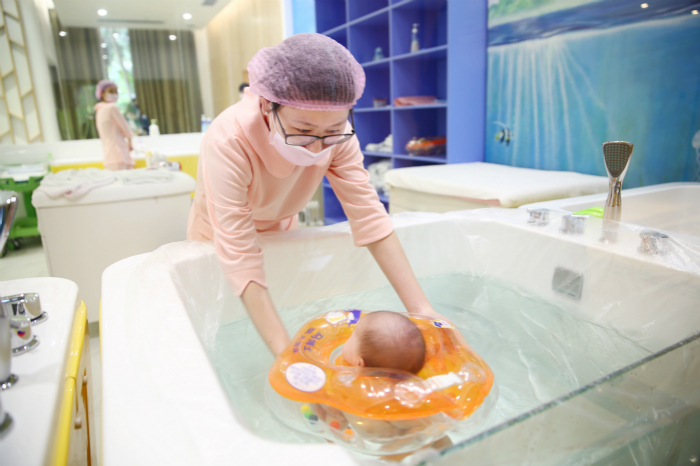
Nursing staff are bathing a newborn.
In contrast to the standardization and uniformity of postpartum care centers in Taiwan, mainland China currently lacks unified standards due to the service-oriented nature of these facilities. As a result, individual centers have not received adequate guidance and have instead developed their own respective standards.
Regarding the differences between postpartum care centers in Taiwan and mainland China, Lin Senyi stated, “In addition to adopting Taiwan’s standardized and professional medical care model, the most significant difference likely lies in the postpartum meals.”
“We particularly emphasize that confinement meals do not achieve their goals simply by using expensive ingredients; rather, they aim to provide optimal nutritional care for both mother and baby—ensuring the mother has an adequate breast milk supply without gaining excess weight. Therefore, the preparation of Dunan Zhen’ai’s confinement meals strictly adheres to the nutritional combinations and caloric requirements set by dietitians, with cooking principles rigorously following standards of low oil, low salt, high protein, and high fiber.”
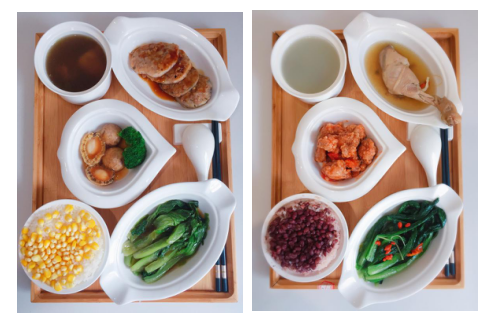
Standard Taiwanese Postpartum Meals
Furthermore, health-preserving herbal meal kits, formulated according to traditional Taiwanese recipes and embodying distinct Taiwanese characteristics, are also an essential component of postpartum confinement meals. These kits primarily utilize mild herbs that replenish qi and nourish blood. Through meticulous formulation, the herbal ingredients are integrated into soups to help mothers recover more rapidly.
Of course, an overly authentic Taiwanese-style postpartum meal plan may also encounter issues of “acclimatization,” such as the preference for wheat-based foods in northern China and the heavy use of salt and spice in northwestern regions. In light of this, Dunan Zhenai makes adjustments to its postpartum meal planning based on local consumers’ taste preferences, aligning the flavor profile more closely with the dietary habits of mothers in each region.
Partner with Mama.com to leverage complementary strengths and implement standardized care protocols
Mama.cn is one of the few maternal and infant vertical media platforms in China with a massive user base, the vast majority of whom are pregnant women and mothers of children under three years old. Many needs within this demographic remain unmet, such as postpartum confinement care, postnatal recovery, newborn education, and mental health support.
Lin Senyi stated, “Mama.cn holds advantages in terms of user base, communication reach, and professional operational resources. Leveraging Mama.cn’s channels will enable more mothers to learn about the medical care strengths of Taiwan’s Dunnan Zhenai Postpartum Care Center at a faster pace. Nevertheless, Dunnan Zhenai continues to operate independently, with only certain investment ties between the two parties.”
In the words of Chen Danping, Marketing Director at Dunnan Zhenai, “At the beginning of 2016, the postpartum care center market was still a blue ocean, but now competition has become extremely fierce. The battleground is no longer about how beautiful the decor is or how novel the concepts are; it has evolved into a contest of resources and capital held by each brand.”
Compared to the small, low-investment community-based husband-and-wife shops with only 8–10 rooms in the past, the postpartum care center industry has entered a stage where higher-dimensional players outcompete lower-dimensional ones. Postpartum care centers with more extensive operational experience at scale, more professional and high-end management talent, and richer resources will gradually replace the fragmented, informal, and purely profit-driven legacy models.
Although postpartum care centers in mainland China are not yet integrated into the medical system and remain essentially part of the service industry, rapid market development will inevitably drive the sector toward greater standardization and higher professional requirements in the future.
“It’s no longer just about pregnant women staying at a postpartum care center for 28 days after childbirth, eating well and sleeping well. In fact, the process involves many services closely related to professional medical care. Dunan Zhen’ai precisely meets such professional needs,” said Chen Danping.
Reporters learned that Dunnan Zhenai has established its own unique standards for physician staffing, professional care, and infection control management, with even the early-stage design of each clinic subject to stringent requirements.
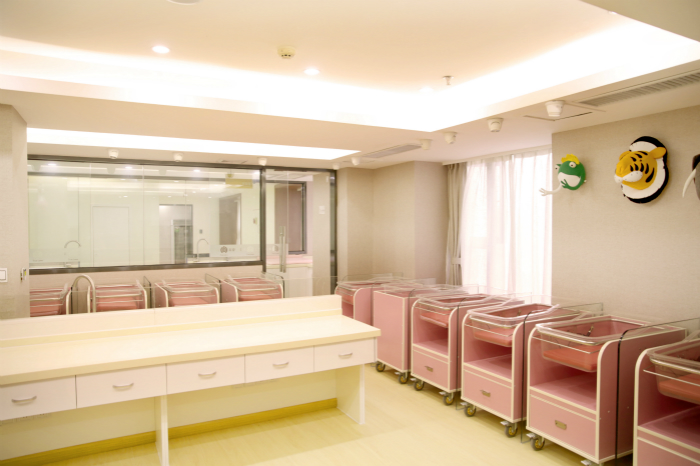
Medical-Grade Nursery
“Whether in maternal care, neonatal care, postpartum meals, or management and operations, each of the four core sectors has its own mature model. ‘By replicating according to standardized protocols, we can ensure a high level of safety, streamline management processes, and facilitate effortless scaling,’ said Chen Danping.”
“At Dunnan Zhenai, the service begins the moment we connect with expectant mothers through marketing channels. ‘Even if a mother does not sign a contract immediately after her visit, we maintain ongoing contact and invite her to attend complimentary prenatal lectures. Clients who sign up typically arrive at our postpartum care center within three to five days after giving birth in the hospital,’ said Lin Senyi.”
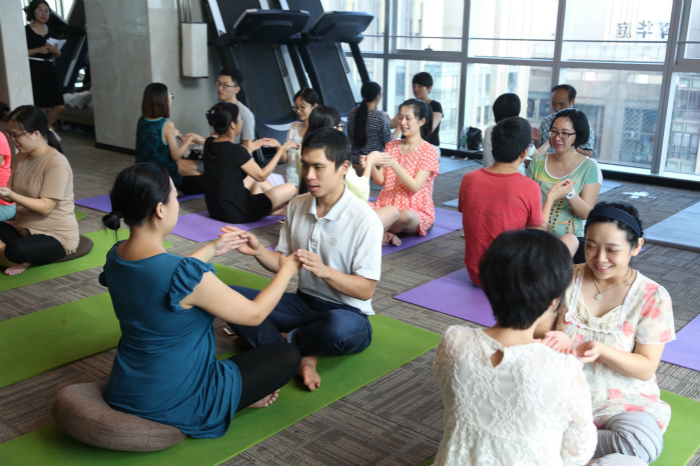
Prenatal Yoga Classes
At Dunnan Zhen'ai Postpartum Care Center, enhanced breast care for mothers is provided during the first three days, including 26 specific assessments. During this period, mothers commonly experience mastitis or difficulties with lactation. As many individuals do not receive adequate breast care while hospitalized, timely breast massage is administered if any issues arise.
"Daily physical assessments are conducted for each mother and baby by professional caregivers, following Taiwanese care standards."
At Dunnan Zhenai, all care providers are nurses. Physicians, such as pediatricians and obstetrician-gynecologists, do not play a core role in the postpartum care center, as their primary responsibilities are diagnosis and round visits. Typically, staffing one to two physicians at a postpartum care center is sufficient to meet operational objectives.
Lin Senyi introduced the service hours and specific offerings of Dunnan Zhenai: “During the first week, we continuously monitor bilirubin levels. In principle, during the initial days, the infant’s bilirubin level is checked every two hours. If the bilirubin level is excessively high, exceeding 15 mg/dL, the infant will be transferred to a hospital. Diapers are changed every two hours. The mother receives a weekly visit from an obstetrician/gynecologist, and the baby receives twice-weekly visits from a pediatrician for round-the-clock medical check-ups. These are all standard SOPs.”
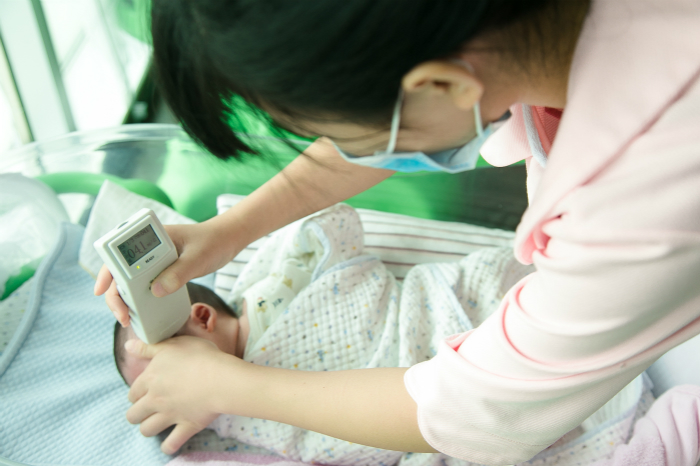
Neonatal Jaundice Screening
Reporters learned that, in conjunction with the "Mommy Classroom," the postpartum care center offers several training sessions each week, such as infant massage and baby swimming.
Dun Nan Zhen Ai has also developed its own proprietary ERP system, with tailored functionalities for investors, mothers, and staff members. This is not merely a consultation management system but also a communication platform that provides mothers with more medical knowledge through the system.
Three Major Pain Points for Profitability: Rent, Marketing, and Renovation Costs
To achieve profitability, every postpartum care center must address the challenges of high rent, high marketing costs, and renovation cost control.
“These three issues are the primary factors directly determining whether a postpartum care center can achieve profitability. Currently, all direct-operated stores of Dunan Zhen’ai are profitable,” disclosed Lin Senyi.
High rent must be matched with high customer unit price and high sales volume; however, if one enters an overly competitive market, profitability becomes challenging. Low rent and low pricing can also yield profits, but the timing of market entry is crucial.
Regarding pricing standards, Lin Senyi believes that it is necessary to consider not only the content and cost of services but also market competition; pricing must absolutely take market factors into account.
In terms of marketing, Dunnan Zhenai primarily leverages Baidu, new media platforms, and maternal-infant media outlets such as Mama.cn.
“Most Dunan Zhen’ai Postpartum Care Centers operate in a hotel-style model, leasing entire floors of hotels, while some—particularly the directly operated centers—are housed in standalone buildings. ‘In essence, we do not adhere rigidly to either the hotel or standalone model; instead, we adapt to local conditions and, in principle, adopt whichever approach best serves mothers.’”
Currently, Dunan Zhenai has not adopted a fully uniform interior design style. While it maintains a consistent Visual Identity (VI) system, the store’s decor is being adjusted to align with local consumer preferences, “as there are significant regional differences between northern and southern China. Consumers in the north tend to prefer upscale and luxurious styles, whereas minimalist and fresh aesthetics are more popular in the south.”
Company-owned and franchise models; company-owned stores have already achieved profitability.
Dun Nan Zhen Ai operates through two models: company-owned stores and franchised stores. Franchising further encompasses three mainstream approaches: brand franchising, entrusted management, and technical franchising.
“Community-based standalone stores often deliver subpar performance in operations, nursing care, and postpartum meals, while also lacking long-term, stable teams and possessing very limited resources. Public maternity hospitals, on the other hand, have scarce resources and generally lack a service-oriented mindset. Currently, Dunan Zhenai’s ideal model remains a chain system that consistently provides medical-grade care.” Lin Sen has set the tone for the future development of confinement centers.
After selecting franchisees, Dunan Zhenai will assign dedicated store supervisors, operations supervisors, nursing supervisors, and marketing promotion supervisors to assist franchisees with evaluation, preparation, and operations. This is primarily reflected in the following specific guidelines:
1. Operational Goal Planning: including market size research, competitor analysis, and market positioning definition;
Second, hardware architecture establishment. This includes spatial planning, hard decoration, engineering acceptance, and recommendations for the procurement of software and hardware;
Third, operational guidance and training programs. This includes establishing operational metrics, training for nursing, customer service, and housekeeping staff, guidance on postpartum meal preparation, and daily operational coaching;
Fourth, operational coaching after the opening, and even during the first quarter after the launch, supervisors will be dispatched to provide guidance.
Regarding the criteria for selecting franchisees, Chen Danping stated, “Whether it’s hospital resources, caregiving resources, channel resources, local media resources, property resources, or capital, all of these are viable options. Investors in the postpartum care center industry are becoming increasingly strong in terms of capabilities.”
In terms of operations, Dunnan Zhenai adopts an asset-light strategy while leveraging a franchising model to strengthen its brand and revenue. It maintains consistent service standards across both franchisee-owned and company-operated stores, enabling rapid expansion in scale and influence.
Dunnan Zhenai is headquartered in Guangzhou. It currently operates a significant number of directly-managed stores in the Pearl River Delta region, with an aspirational vision to expand its franchise network across China.