

Bowei Software: Revolutionizing Healthcare Data Integration with Proprietary Heterogeneous Data Capture Technology


Liang Wei, Chairman of Bowei Software
“Domestically, we may be the only company that can directly interface with hospitals without requiring cooperation from other software vendors,”Hundreds of Information Systemscompanies that scrape data in China,” Liang Wei, Chairman of Bowei Software, told VCBeat.
In 2009, Liang Wei graduated with a master’s degree from Peking University and founded Bowei Software. Given his academic background in image processing, Liang chose medical imaging as the entry point for his entrepreneurial venture. Initially, Bowei Software focused on traditional two-dimensional image processing; later, the company developed3D Organ Analysis System for Medical Imaging and PACS Products。
This product has not only obtained CFDA certification but also achieved a leading position among domestic imaging companies in terms of technology. It breaks through many limitations of traditional two-dimensional imaging diagnosis, improving the diagnostic accuracy for medical personnel and providing support for the development of diagnostic and treatment technologies in multiple departments such as cardiology and gastroenterology.
With this product, Bowei Software quickly accelerated its growth and successfully listed on the New Third Board in 2016.
After achieving notable success in the field of medical imaging, Bowei Software began to focus its efforts on hospital big data platforms. However, deploying a big data platform within a hospital is by no means an easy task. “Basically, every hospital has two or three software systems, each backed by a different company. We need to negotiate with each one individually to secure their cooperation and have them open up their data interfaces,” Liang Wei told VCBeat.
Obviously, this is a highly inefficient matter.
Software companies that enterprises can reach either charge exorbitant prices or provide passive cooperation, repeatedly delaying progress. Although hospitals offer support, it is difficult to effectively motivate software companies to cooperate proactively due to conflicting interests. Ultimately, the issue lies in the control over data and software.
It was precisely on this basis that Liang Wei keenly identified the pain points and opportunities within the industry. However, translating ideas into reality is no easy feat, especially when it comes to achieving technological breakthroughs. In 2012, Liang Wei made a firm decision, mobilizing more than 50 R&D personnel, including the U.S.-based research team, and dedicating four years to development. Finally, in the second half of 2016, he successfullyBowei 101 Heterogeneous Data Acquisition TechnologyR&D successful.
No vendor cooperation required; directly collect data from various software systems within the hospital.
Bowei’s proprietary heterogeneous data fusion technology enablesDo not modify the original system code,No software vendor involvement requiredunder the circumstances,Directly collect clinical data from various hospital software systems (HIS, EMR, PACS, LIS, etc.)., automatically establishes data associations and outputs a structured database. This not only simplifies coordination, shortens project timelines, and enhances safety, but also boosts the implementation efficiency of data integration and sharing by nearly 100-fold.
This technology offers the following advantages:
Barrier-Free – No support from original manufacturers required; medical data acquisition and integration are simple and seamless.
Low Cost – Minimizes personnel coordination and development costs, effectively reducing project delivery time;
Zero Risk — Non-invasive data collection, no need to open the original database, ensuring the security of the original system;
High Efficiency—Independent of system architecture and code, no need to develop data interfaces; direct data collection.
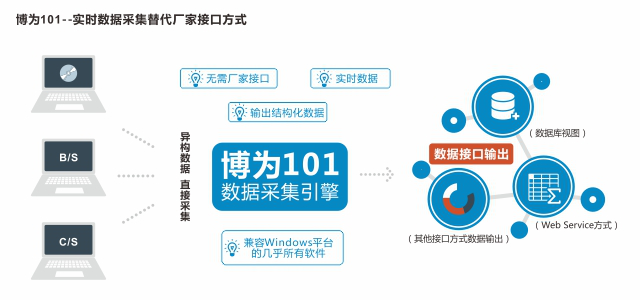
“As long as it is a software system on the Windows platform, Bowei 101 heterogeneous data acquisition technology can extract the data without requiring cooperation from software vendors, demonstrating strong compatibility. Bowei 101 heterogeneous data acquisition technology can convert the collected data into any required format, such as the internationally recognized standard data format,” Liang Wei told VCBeat.
Thanks to the unique advantages of Bowei 101’s heterogeneous data acquisition technology, it was rapidly deployed and put into use in more than ten hospitals. Notably, Yizhang County in Hunan Province leveraged this technology to establish interoperability of information among 30 hospitals within the county in just two months, directly facilitating the establishment and implementation of a regional remote consultation platform.
The big data integration platform of Yizhang County has been embedded into the county’s private health network. By analyzing patient diagnoses and medication usage across hospitals over specified periods, the Health Bureau can accurately quantify metrics such as the incidence of high-prevalence diseases, common conditions, emerging diseases, and the age distribution of patients. This enables the Health Bureau to make timely decisions in response to epidemics and chronic common diseases.
In response, Liang Wei crunched the numbers for VCBeat: “If a hospital needs to extract data from five different health IT software systems, building an integration platform using traditional interface technologies would require paying each software vendor approximately RMB 100,000 in interface fees. In contrast, with Bowei’s 101 heterogeneous data acquisition technology, there are no such interface fees.”
Furthermore, leveraging interface technology requires coordinating with multiple software vendors simultaneously, resulting in an implementation cycle of at least six months, whereas employing Bowei 101 heterogeneous data acquisition technology can complete the task in just two weeks.
It is reported that Bowei Software has established collaborations with over 100 hospitals.
Leveraging Big Data to Control Healthcare Insurance Costs
Bowei 101’s heterogeneous data acquisition technology has an extremely wide range of applications. In addition to the healthcare industry, it is also applied in fields such as insurance, government services, smart cities, and logistics.
Currently, how insurance companies and medical insurance departments can obtain comprehensive and accurate medical information and clinical data during the process of controlling medical insurance costs, establish a scientific and reasonable review mechanism for medical insurance payments, and control their own costs has become an important issue that needs to be urgently addressed.
Bowei Software’s 101 heterogeneous data acquisition technology eliminates the need for interface integration. By capturing low-level data exchanges and network packets from software systems, it directly collects application data, outputs structured data, and stores it in designated server databases, serving as a “powerful tool” for building real-time, accurate, and comprehensive medical big data platforms.
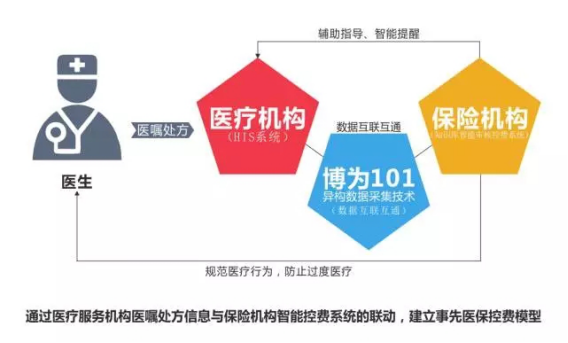
1. Achieve intelligent alerting for medical order and prescription review through data connectivity.By leveraging Bowei 101’s heterogeneous data acquisition technology, hospital HIS order and prescription data are integrated with insurance companies’ or medical insurance departments’ order and prescription audit systems or knowledge-based intelligent cost-control audit systems. This enables real-time interaction between physicians’ orders and prescriptions and the medical insurance cost-control system, providing auxiliary guidance and intelligent alerts for medication and prescribing practices. This approach not only appropriately guides clinicians’ medical behavior but also effectively achieves cost-containment objectives.
2. Establish a comprehensive clinical data review system for medical insurance reimbursement to prevent insurance fraud.Health insurance reimbursement primarily relies on the review of physicians' prescriptions and payment records. Some fraudsters engage in insurance fraud by forging prescriptions and fee receipts, taking advantage of the low difficulty and cost of such falsification. However, the National Healthcare Security Administration and commercial insurers lack the capability to detect these fraudulent activities with precision, resulting in losses to the health insurance fund.
By leveraging Bowei 101’s heterogeneous data acquisition technology, all clinical data from healthcare institutions—including CT scans, ultrasounds, X-rays, blood tests, and laboratory examinations—are incorporated into the scope of review and imported into the medical insurance audit system. This increases the difficulty and cost of insurance fraud, thereby reducing or even eliminating such fraudulent activities.
3. Big data from third-party institutions plugs loopholes in medical insurance expense audits, leaving no room for fraudulent activities to go undetected.For example, during the medical insurance audit process by collecting industrial and commercial data, the National Audit Office found that a hospital registered with only 50 beds had 90 patients hospitalized simultaneously. Further verification revealed fraudulent activities, which is a typical case of combating fraud based on big data.
In the realm of medical insurance expense auditing, data from third-party institutions with a higher risk of fraud can be incorporated for review to identify irregular transactions, followed by penalties imposed on healthcare providers and insured individuals. Although this constitutes post-hoc cost control, the establishment of punitive measures alongside a credit reporting system can prevent the escalation of fraudulent activities and encourage healthcare institutions and insured individuals to regulate their conduct.
Leveraging Historical Data Migration Technology to Facilitate the Upgrade of Chain Pharmacy Systems
In recent years, the business expansion of many chain pharmacies has accelerated. The company’s original GSP (Good Supply Practice) system has severely impacted the work efficiency and user engagement of finance, procurement, and retail operations due to its complex workflows, slow performance, and deficiencies in reporting and statistical functions.
As business expands, enterprises must achieve comprehensive control over information such as terminal pharmacies, drug inventory, and membership through more precise management. Therefore, replacing the existing pharmacy management system with a new one has become inevitable.
However, since all historical data needed to be imported into the new business system, but the legacy system refused to provide table structures or views, pharmacies had no choice but to manually enter the information into the new system, a process that was both time-consuming and labor-intensive.
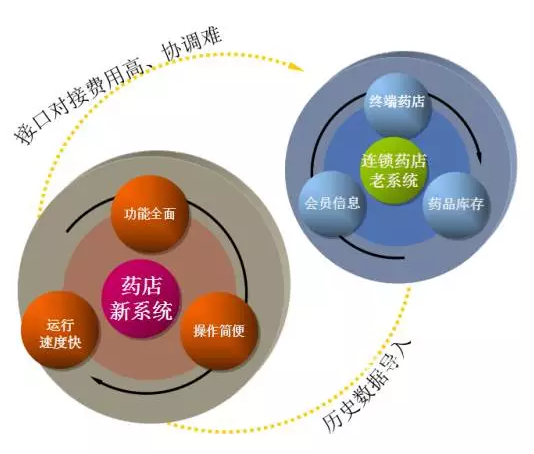
In Liang Wei’s view, the informatization challenges currently faced by chain pharmacies mainly fall into two categories:
1. With the continuous development of IT technology and its deepening application, the pace of software iteration is accelerating.The software system developed many years ago lags significantly behind current state-of-the-art counterparts in terms of processing speed, usability, and business functionality, objectively rendering it incapable of meeting the company’s developmental needs.
2. During the implementation of application software systems, enterprises often find themselves in a passive position of learning and acceptance, as many users lack technical expertise. They typically do not possess the awareness to assist software vendors in identifying usability issues or misalignments with corporate business processes. Over time, the persistent discrepancy between the enterprise software and business operations remains unaddressed, rendering the software increasingly ineffective and of marginal value.
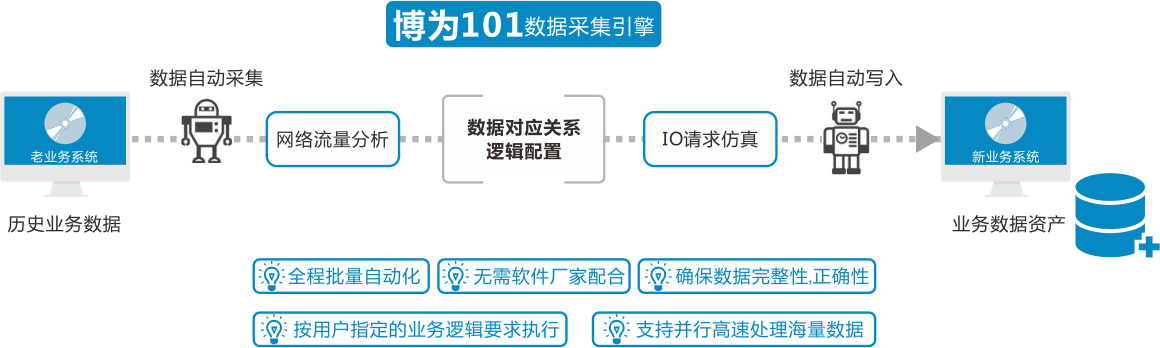
Bowe Software’s historical data migration service leverages Bowe 101 heterogeneous data acquisition technology to automatically collect all data from legacy systems and write it directly into the new system according to business logic, with software robots performing automated operations to replace manual data entry. During implementation, there is no need for interface integration between the new and old systems, which not only saves development costs but also avoids issues such as lack of cooperation or coordination difficulties with software vendors.
“Leveraging Bowei 101’s heterogeneous data acquisition technology has effectively resolved the longstanding challenges associated with migrating historical data during software system transitions,” said Liang Wei.
Medical Big Data: The Time Has Come
# Future Healthcare, Data FirstNew rules and new technologies are driving transformation across industries. The big data storm has already swept through multiple sectors beyond healthcare, bringing about significant changes.
With the rapid expansion of big data in the healthcare sector, it not only addresses existing challenges such as difficult and costly access to medical care, offering viable new approaches for China’s healthcare reform, but also holds significant guiding value for new medical research, including breakthroughs in critical and emergency care, discovery of novel diseases, and control of infectious diseases.
McKinsey predicts that fully leveraging big data in healthcare could generate $300–450 billion in added value; as a country with the world’s largest population and significant gaps in its healthcare market, China stands to realize immeasurable value.
Bower Software is accelerating along this path brimming with opportunities.