

China's AI Talent Pipeline: 15 Universities and Institutes to Graduate Over 2,000 AI Master’s and PhDs in 3–5 Years, with One-Tenth Entering Healthcare
Not long ago, LinkedIn released the “Global AI Talent Report,” which shows that China has more than 50,000 technical professionals in the field of artificial intelligence, ranking seventh globally. India, the United Kingdom, Canada, and Australia rank second through fifth, respectively. The United States, by contrast, boasts more than 850,000 AI talents.
VCBeat (WeChat ID: vcbeat) collected data on AI experts and master’s and doctoral candidates from 11 Chinese universities and four institutes of the Chinese Academy of Sciences (CAS)—namely, the Institute of Computing Technology, the Institute of Acoustics, the Institute of Software, and the Institute of Automation. Among these 15 institutions, data from nine universities and CAS indicate that there are more than 2,300 current master’s and doctoral students specializing in AI.
In the medical field, VCBeat identified 47 CTOs or chief scientists from healthcare AI startups. Among them, 30 had pursued advanced studies abroad or in China’s Hong Kong and Taiwan regions, accounting for 63.8%, while only seven had backgrounds related to medical specialties, representing 14.9%.
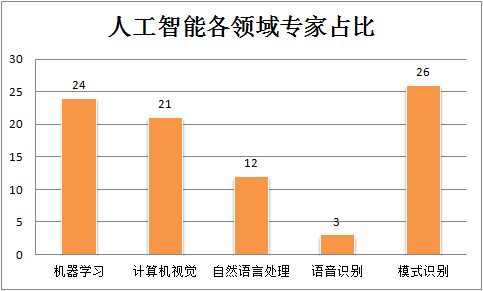
Among the five major research areas—machine learning, computer vision, natural language processing, speech recognition, and pattern recognition—experts in pattern recognition account for the largest proportion at 30%, while those in speech recognition represent only 4%, with most hailing from the Institute of Acoustics of the Chinese Academy of Sciences and Harbin Institute of Technology. Pattern recognition can be simply understood as machine learning; before the emergence of deep learning and modern machine learning, the academic discipline dedicated to artificial intelligence research at universities was known as pattern recognition.
Review of AI Experts from 15 Universities
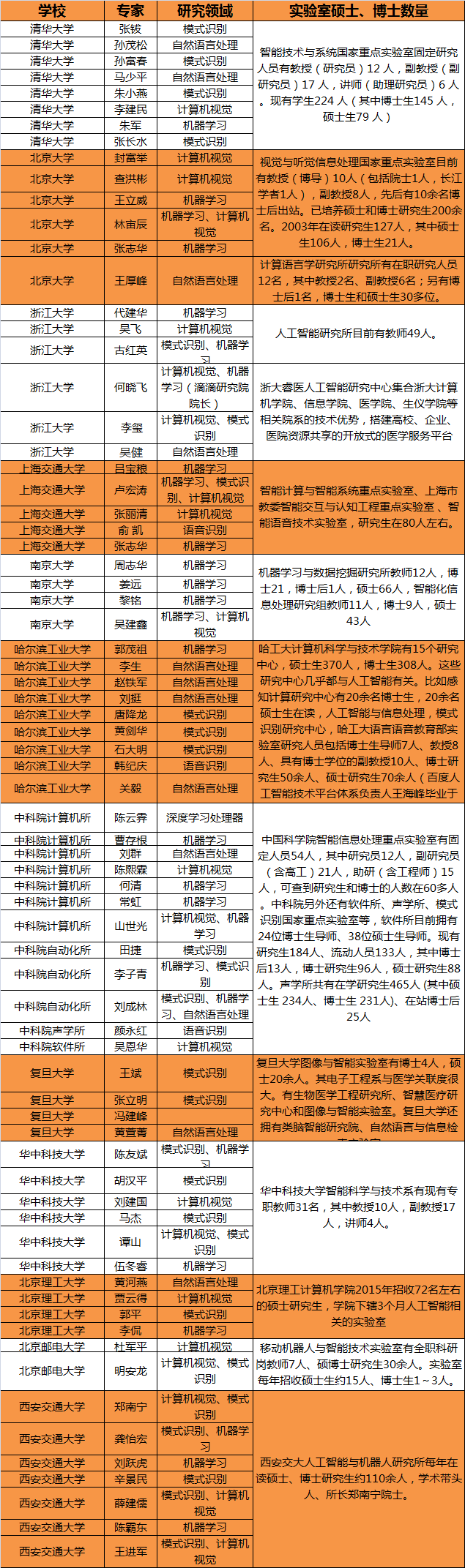
VCBeat has reviewed the research fields of 73 experts from 15 universities and institutes (including the Institute of Computing Technology, the Institute of Acoustics, the Institute of Software, and the Institute of Automation under the Chinese Academy of Sciences), as well as the number of master’s and doctoral students in their laboratories, aiming to estimate the disciplines and approximate volume of AI talent to be produced in China over the next three years. The details are as follows:
Proportion of Experts in Various Fields of Artificial Intelligence
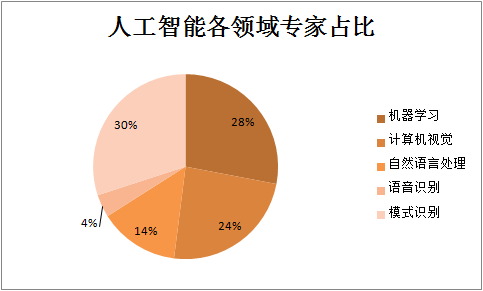
The proportion of experts in speech recognition is relatively low, similar to the proportion of voice entry enterprises among domestic AI healthcare startups. According to VCBeat’s database, there are only three companies engaged in intelligent medical voice entry, accounting for less than 3%. Companies specializing in medical imaging and text analysis represent the largest share.
![_U@J1])EF7HFC~V{_9L`25W.jpg](https://cdn.vcbeat.top/upload/image/02/08/18/59/1503025145449553.jpg)
Proportion of Startups by Sector
Number of AI Talents Pursuing Master's and Doctoral Degrees at Universities
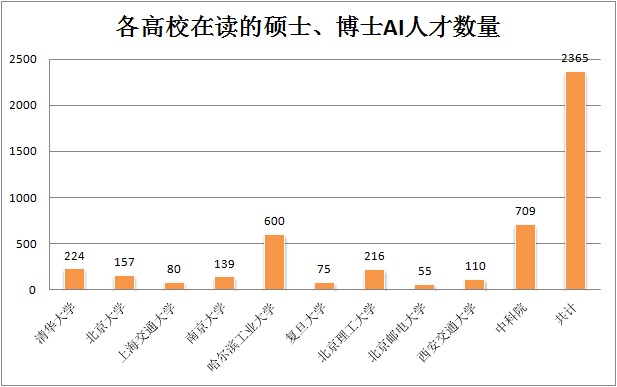
Among the laboratories at various universities, the Chinese Academy of Sciences, Harbin Institute of Technology, and Tsinghua University have the largest number of master’s and doctoral students. However, the total number of master’s and doctoral candidates from these dozen or so institutions exceeds 2,300. In addition to the listed universities, other institutions also possess experts in artificial intelligence and master’s and doctoral talent, such as the University of Science and Technology of China, the University of Electronic Science and Technology of China, Wuhan University, Sun Yat-sen University, Tongji University, and Shanghai University of Finance and Economics; these were not included in the current statistical scope.
Chinese Academy of SciencesIt is one of the institutions in China that produces the largest number of high-end AI talents. The institutes under the Chinese Academy of Sciences (CAS) related to artificial intelligence include the Institute of Computing Technology, the Institute of Software, the Institute of Acoustics, and the Institute of Automation. Among these four institutes, there are 709 currently enrolled master’s and doctoral students specializing in AI. Many renowned domestic AI experts, such as Tian Jie (expert in AI language recognition), Wu Enhua (expert in computer vision), Chang Hong (expert in machine learning), and Liu Chenglin, are conducting industry research at CAS.
Particular mention should be made of the Institute of Acoustics, Chinese Academy of Sciences. Currently, the institute has 465 graduate students (including 234 master’s students and 231 doctoral students) and 25 postdoctoral researchers. It serves as a cradle for intelligent voice technology talent in China, with most high-end professionals in this field hailing from this institution.
In the field of medical artificial intelligence, Chen Jianxin, founder of Big Vision; Che Hao, CTO of Zhongke Huineng; and Liang Jia’en, CTO of Unisound, are all graduates of the Chinese Academy of Sciences, with the latter two hailing from the Institute of Acoustics of the Chinese Academy of Sciences.。
Harbin Institute of TechnologyThe School of Computer Science and Technology has 15 research centers, with 370 master’s students and 308 doctoral students. Although the specific numbers of master’s and doctoral students currently enrolled in artificial intelligence-related majors are not available, most of these research centers are related to artificial intelligence.
For instance, the Center for Perceptual Computing has more than 20 doctoral students and over 20 master’s students currently enrolled.MOE Key Laboratory of Language and Speech, Harbin Institute of TechnologyThe research team comprises 7 doctoral supervisors, 8 professors, 10 associate professors with doctoral degrees, over 50 doctoral candidates, and more than 70 master’s students. This laboratory is the university with the strongest development in the field of intelligent speech, second only to the Institute of Acoustics of the Chinese Academy of Sciences. In addition, there areResearch Center for Artificial Intelligence and Information Processing, Pattern RecognitionWait.
Harbin Institute of Technology (HIT) is home to numerous artificial intelligence experts, such as Liu Ting in the field of natural language processing and Guo Maozu in the field of machine learning. Wang Haifeng, the head of Baidu’s AI technology platform system, is also a graduate of HIT.
According to the data currently collected by VCBeat, no AI talent who graduated from Harbin Institute of Technology has served as a CTO or Chief Scientist in medical AI startups (if you have relevant information, please feel free to contact VCBeat).
Tsinghua UniversityThe State Key Laboratory of Intelligent Technology and Systems has produced numerous distinguished experts. Professor Jia Peifa from the Department of Computer Science and Technology at Tsinghua University currently serves as the Director of the Laboratory, while Professors Wang Jiaxian, Ma Shaoping, and Rong Gang serve as Deputy Directors.
The Laboratory’s Academic Committee comprises 13 renowned experts from China, with Professor Dai Ruwei, an academician of the Chinese Academy of Sciences (CAS), serving as Director, and Professor Zhang Bo and Professor Shi Qingyun, both academicians of the CAS, serving as Deputy Directors. It is no exaggeration to refer to this laboratory as a “national team.”
Currently, the laboratory has 12 permanent researchers holding the titles of Professor (Research Fellow), 17 Associate Professors (Associate Research Fellows), and 6 Lecturers (Assistant Research Fellows). There are currently 145 doctoral students and 79 master’s students, totaling 224 students.
In the field of the medical AI industry,Multiple CTOs are alumni of Tsinghua University, such as Bian Haifeng, CTO of Yizhan Technology, and Ding Dayong of Zhiyuan Huitu (Student of Academician Zhang Bo), Yang Qiong, co-founder of Pai Yi Pai, and others。
Peking UniversityThe State Key Laboratory of Visual and Auditory Information Processing and the Institute of Computational Linguistics are also home to some of the top talents in China’s AI sector. As of 2003, the State Key Laboratory of Visual and Auditory Information Processing had trained more than 200 master’s and doctoral students. Peking University researchers Feng Fuju, Zha Hongbin, Wang Liwei, Lin Zhouchen, Zhang Zhihua, and Wang Houfeng are all well-known artificial intelligence experts in China. The current figure of 127 master’s and doctoral students is based on data from 2003.
Zhejiang UniversityThe Institute of Artificial Intelligence, which holds a leading position in China in the field of image recognition, currently has 49 faculty members. Notably, Zhejiang University’s artificial intelligence program is more oriented toward healthcare, excelling in the cultivation of interdisciplinary talent at the intersection of medicine and engineering.
Furthermore, the WeDoctor-Zhejiang University Ruiyi AI Research Center, jointly established by Zhejiang University and WeDoctor, leverages the technical strengths of relevant departments at Zhejiang University—including the College of Computer Science and Technology, the College of Information Science and Electronic Engineering, the School of Medicine, and the College of Pharmaceutical Sciences—to build an open medical service platform that facilitates resource sharing among universities, enterprises, and hospitals.
Nanjing University has secured a prominent position in China’s AI sector, largely due to Professor Zhou Zhihua, who has personally supervised the graduation of 11 doctoral students and more than 20 master’s students. Currently, Nanjing University hosts two artificial intelligence laboratories. The Institute of Machine Learning and Data Mining comprises 12 faculty members, 21 doctoral students, one postdoctoral researcher, and 66 master’s students. The Intelligent Information Processing Research Group includes 11 faculty members, 9 doctoral students, and 43 master’s students.
Xi’an Jiaotong University has also demonstrated strong performance in the field of artificial intelligence. Its Institute of Artificial Intelligence and Robotics enrolls approximately 110 master’s and doctoral students annually, with Academician Zheng Nanning serving as the academic leader and director.
The Current State of AI Talent at Medical Artificial Intelligence Companies
According to industry insiders who spoke to VCBeat, there is currently a shortage of artificial intelligence (AI) talent, with an even more acute scarcity in the field of medical AI. In his laboratory, he was the only one among his immediate senior and junior cohorts to pursue a career in the healthcare sector—a phenomenon that is relatively common across universities. Only about one in ten AI professionals enter the healthcare industry. In light of this, VCBeat has compiled an overview of the educational backgrounds and majors of Chief Technology Officers (CTOs) and Chief Scientists at healthcare startups.
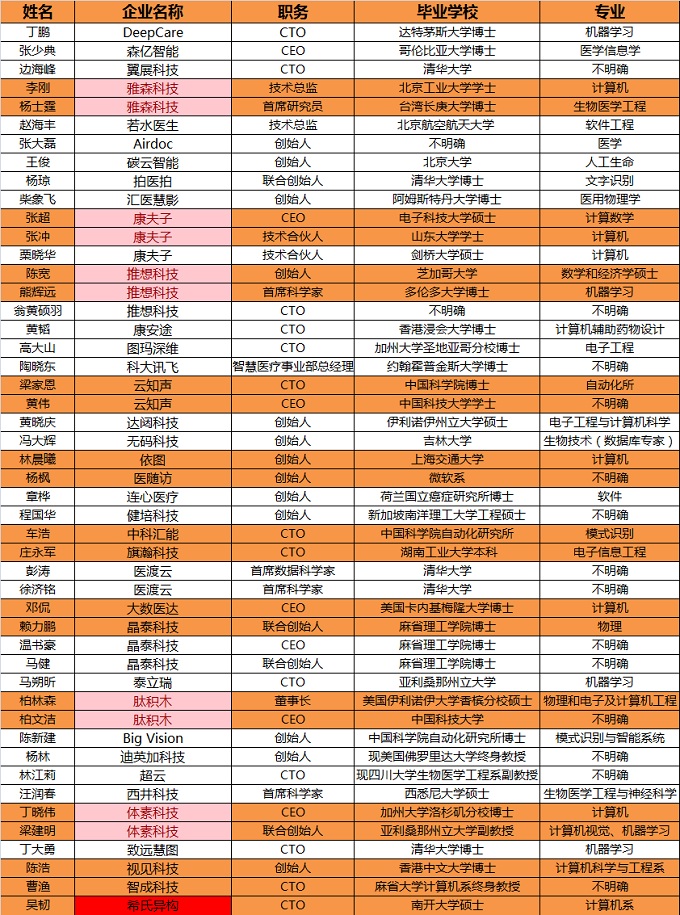
The College Major of the CTO at a Medical AI Startup
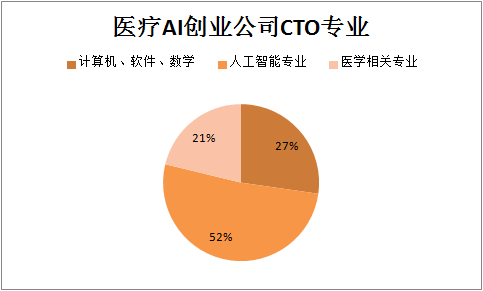
VCBeat compiled a list of 47 CTOs and chief scientists from AI healthcare companies. After excluding 14 individuals with unclear professional backgrounds, the proportion of those with medical-related majors was only 21%, while those specializing in artificial intelligence accounted for 52%.
This indicates that their entry into the healthcare industry was not determined during their academic years; rather, they identified opportunities and established themselves in the medical field during their subsequent professional development.
Furthermore, although the CTOs of AI healthcare companies do not necessarily have a medical background, VCBeat has learned that all medical AI startups hire clinical experts as medical advisors to ensure their products align more closely with clinical applications. Many AI entrepreneurs gradually evolve into “medical experts” through this process.
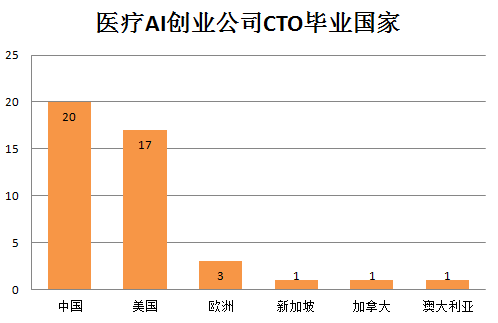
Country of Graduation for the CTO of a Medical AI Startup
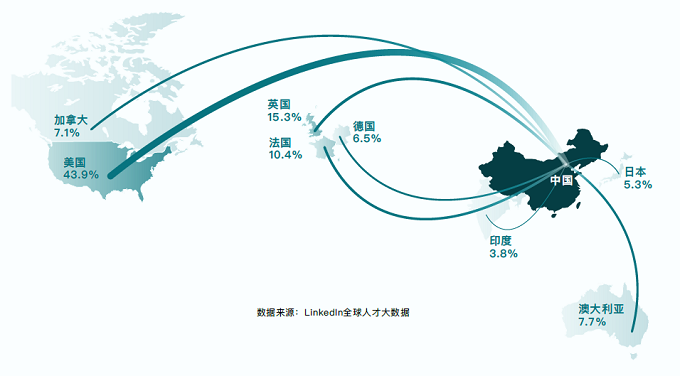
China’s rapid economic development has fueled the desire of overseas talent to return home for career opportunities. According to LinkedIn’s Global Talent Report, 9% of AI professionals in China have prior work experience abroad, while the proportion in the healthcare industry far exceeds this figure.
Based on the data currently available, the largest numbers of CTOs are from the United States and China, with scattered representations in Europe, Canada, Hong Kong (China), Taiwan (China), and other regions. Many CTOs of medical AI companies completed their undergraduate or master’s degrees in China before studying abroad, and subsequently returned to China to launch startups after completing their education.
In the United States, many of them graduated from prestigious institutions such as MIT, Carnegie Mellon University, and Johns Hopkins University. However, statistical data does not indicate that graduates from any specific university are destined to conduct research in the healthcare industry; rather, it depends on individual vision and opportunity.
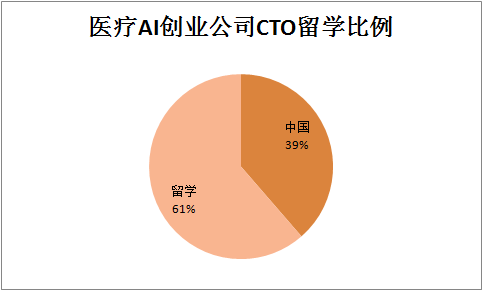
Among these CTOs, 61% have overseas study backgrounds.
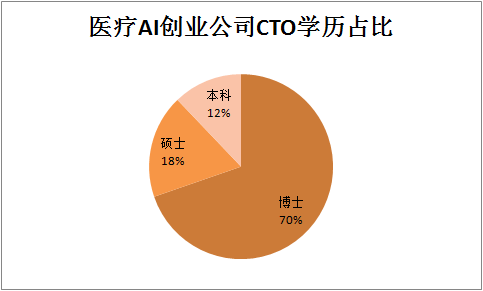
Among these CTOs, 70% hold a doctoral degree, 18% have a master’s degree, and 12% possess a bachelor’s degree. Medical artificial intelligence remains an industry with high technical barriers.
According to the data presented in this report, China’s future AI talent is primarily concentrated in the laboratories of a few key universities. Some of these individuals will pursue advanced studies abroad before returning to China, while others will directly launch startups or join major technology companies. For HR professionals at medical AI firms or companies in other sectors seeking top-tier talent, these institutions represent promising recruitment grounds.
Finally, during the interview, VCBeat also learned that Chinese universities currently place great emphasis on cultivating AI talent, but there is a shortage of professionals trained in the intersection of AI and healthcare. It is precisely this lack of interdisciplinary talent—individuals who possess a deeper understanding of the industry—that makes them highly sought after by enterprises.