

Ali Health and Changzhou Medical Consortium Launch China's First Blockchain Application in Healthcare
You may be familiar with Bitcoin and have heard of the secure and trusted applications of its underlying technology, blockchain, in the financial sector. But are you aware that blockchain can also deliver significant value within healthcare systems?
On August 17, Alibaba Health announced a pilot project with Changzhou City to integrate medical consortiums with blockchain technology: cutting-edge blockchain technology has been applied to the underlying technical architecture of Changzhou’s medical consortium system, enabling secure and controlled data interoperability among certain local medical institutions. This approach addresses the long-standing challenges of “information silos” and data security in healthcare institutions through a low-cost, high-security solution.
“The blockchain pilot program for the Changzhou Medical Consortium is China’s first blockchain application implemented in a healthcare scenario,” said Liu Tie, Head of Blockchain Technology at AliHealth. Leveraging Alibaba Group’s technical expertise in information security, distributed computing, and medical big data, and integrating certain open-source framework technologies, AliHealth has developed a blockchain solution tailored to healthcare settings.
AliHealth’s blockchain technology has found a natural home in Changzhou. In the view of Zhang Ke, Deputy Director of the Health and Family Planning Bureau of Tianning District, Changzhou, this partnership is hardly surprising: Tianning District has long maintained friendly cooperative relations in the field of internet healthcare, and Changzhou is one of the first four national pilot cities designated by the National Health and Family Planning Commission for “Health and Medical Big Data.” “Tianning District is accelerating the development of medical consortia, with a focus on public health management and chronic disease diagnosis and treatment, to establish a tiered diagnosis and treatment system. However, the existing centralized district-level health platform fails to adequately meet the point-to-point interoperability requirements in terms of development costs and response speed,” said Zhang Ke.
Zhang Zhihong is the director of Zhenglu Town Health Center in Changzhou, a community hospital that provides primary healthcare services to a population of 140,000 in Zhenglu Town, with approximately 30,000 patient visits per month. Zhang stated that previously, Tianning District lacked a regional health information platform, requiring the vast amounts of data from each medical institution to be transmitted separately to the municipal medical institution information platform. However, as these medical institutions were not interconnected, many operational needs could not be met. Meanwhile, ensuring the security of personal private health information during circulation and storage has also been a significant challenge for existing platforms.
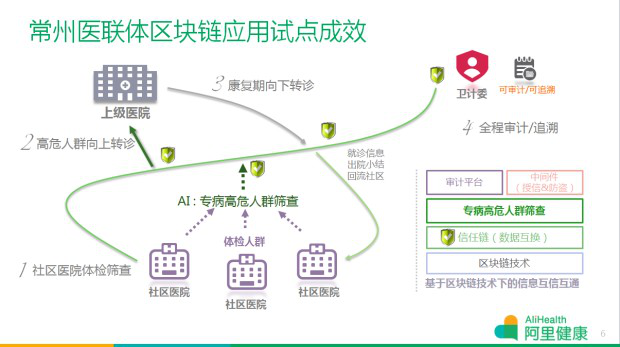
The situation has improved significantly since the adoption of blockchain technology.As illustrated by the healthcare experience under the tiered diagnosis and treatment model: residents undergo physical examinations at nearby community health centers. Blockchain-based analysis of examination reports helps identify individuals at high risk for chronic cardiovascular and cerebrovascular diseases. For approximately 5% of patients requiring referral, community physicians can authorize and transfer medical records to higher-level hospitals via blockchain. Upon authorization, specialists at these hospitals can promptly access the patients’ medical history and examination data, eliminating the need for redundant basic tests. Patients thus benefit from comprehensive, “concierge-style” medical services provided by clinicians across all levels of the medical consortium, enabling early detection and intervention in line with the preventive care principle of “treating disease before it arises.”
“Alibaba Health’s blockchain technology leverages our existing IT equipment and systems to interconnect information, offering low integration costs while enhancing security. With the adoption of blockchain, health centers and district hospitals have transitioned from information silos to seamless interoperability, enabling residents to enjoy greater convenience,” said Zhang Zhihong.
Since the inception of blockchain technology, a growing number of people have come to believe that the healthcare industry, which involves sensitive data such as residents' personal health information scattered across various institutions, is more suited for blockchain application scenarios.
Liu Tie explained that blockchain is a foundational technical architecture for distributed databases, employing technologies such as peer-to-peer (P2P) networking, cryptography, and consensus algorithms to ensure fairness, interoperability, and privacy protection for all nodes participating in data circulation within the blockchain network. In the Changzhou blockchain project, Alibaba Health has established multiple layers of data security barriers. First, data storage and transmission within the blockchain are conducted using encrypted formats; even if intercepted or stolen, the data cannot be decrypted. Second, a digital asset protocol and a data classification system specifically designed for the Changzhou Medical Consortium clearly define access and operational permissions for hospitals at different levels and government regulatory authorities through protocols and certificates. Finally, leveraging the tamper-proof and traceable nature of blockchain technology, auditing bodies can precisely track the entire lifecycle of sensitive medical data, including specific timestamps, the authorizing medical institution, the recipient, and the exact scope of authorization.
“We have recognized the advantages of large-scale blockchain adoption. Although only two or three medical institutions are currently connected, the growing number of participating entities will eventually form a rapidly deployable information network. By integrating Alibaba Health’s blockchain technology, we have achieved genuine interoperability of our business data. Furthermore, features such as encrypted data circulation with authorized access, along with full traceability and auditability, have bolstered the confidence of regulatory authorities,” said Zhang Ke. The technology was first implemented at Wujin Hospital in Changzhou and Zhenglu Town Health Center. Subsequently, under the leadership of the Tianning District Health and Family Planning Commission of Changzhou City, the pilot program will be gradually expanded to cover all tertiary hospitals and primary care facilities within the Tianning District Medical Consortium.
In recent years, the application of blockchain technology has garnered increasing attention across various industries. In 2016, the State Council issued the “13th Five-Year Plan” for National Informatization, which set forth the goal of achieving significant progress in the construction of a “Digital China” by 2020 and elevating China’s informatization capabilities to the forefront internationally. Notably, blockchain technology was included in the Plan for the first time. The Plan also emphasized the need to strengthen innovation, pilot testing, and application of emerging technologies such as blockchain, with the aim of securing leadership in the new generation of information technologies.
With the growing prevalence of blockchain technology, its transformative impact on the healthcare sector has become increasingly evident. It enables the secure and efficient sharing of health data across networks while safeguarding patients’ personal privacy. Early this year, the U.S. Food and Drug Administration (FDA) announced a collaboration with IBM Watson Health to explore the use of blockchain technology for health data sharing, with the ultimate goal of improving public health outcomes.
“It is time to upgrade the underlying technological infrastructure of healthcare. Currently, many cutting-edge technologies have not yet been applied to medical tracking, diagnosis, and treatment. By leveraging blockchain, we can significantly change the current situation where data remains siloed.” Regarding the future applications of blockchain in healthcare scenarios, Zhang Wenjuan, Project Lead for Alibaba Health’s Smart Healthcare Blockchain Initiative, stated that Alibaba Health aims to establish a blockchain network connecting as many healthcare institutions as possible, thereby enabling the secure, convenient, and controllable flow of valuable information within healthcare settings. “We hope that the pilot project in Changzhou will serve as a spark that brings new options to more healthcare institutions, allowing new technologies to empower healthcare.”