

Health Work Aims to Become China's WeWork with Chongqing Launch
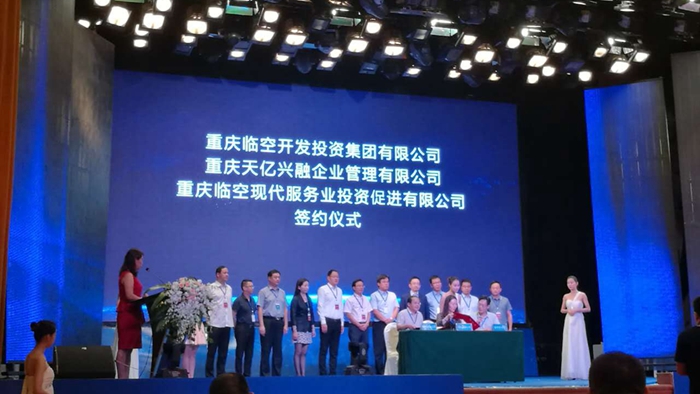
On the morning of August 25, 2017, the “Tianyi-Huarong Strategic Cooperation Launch Conference and Chongqing Health Intelligence Valley Inauguration Ceremony” was grandly held in Chongqing. Health Intelligence Valley announced its establishment in Chongqing, where it will pool global resources to serve innovative startups in Chongqing’s medical industry, drive industrial innovation, and contribute to building a Healthy China through intelligent manufacturing.
At the conference, Zhang Tao, Director of the Medical Management Service Guidance Center under the National Health and Family Planning Commission; Chen Qing, Director of the Incubator Management Division at the Torch High-Tech Industry Development Center of the Ministry of Science and Technology; Ma Chengquan, Deputy District Mayor of Yubei District Government; Yu Rong, Chairman of Meinian Onehealth Healthcare and Tianyi Investment Group; Wang Pinghua, Chairman of Huarong Real Estate; Wang Xiaojun, Vice President of Tianyi Group and General Manager of Health Intelligence Valley; Chen Jinyu, General Manager of Huarong Open Health City; Zhang Wei, Chairman of Chongqing Lin Kong Modern Service Industry Investment Promotion Co., Ltd.; Qu Wei, CEO of Huimei Extreme Medical Care; Zhao Hong, Founder of CN-Healthcare Media; Hui Yunming, President of Meizhao Group; Zhu Liya, President of Meiwei Dental Investment Management Company; Li Jianbo, Founder of Demei Medical; and Li Datao, Founder of VCBeat, among other guests, attended and delivered speeches.
Chongqing Health Intelligence Valley, a flagship healthcare and medical innovation hub in Southwest China jointly developed by Tianyi Group and Huarong Real Estate, covers an area of 28,000 square meters. Located in Building 3 of China Huarong Modern Plaza, it boasts a prime location with access to three intersecting metro lines and proximity to Zhengwu Avenue, attracting a high concentration of top-tier talent and resources. The project aims to create an integrated community healthcare model combining health and culture, filling the gap in Chongqing’s high-end medical market. The first batch of tenant enterprises includes Meinian Onehealth (Meizhao) Checkup, Meiwei Dental, Demei Medical, and VCBeat.
It is the first Health Intelligence Valley in Southwest China and the fifth nationwide. The other four are located in Beijing, Shanghai, and Hangzhou, with one each in Beijing and Hangzhou, and two in Shanghai. In the future, Health Intelligence Valleys will be successively established in Wuhan, Chengdu, Ningbo, Qingdao, and other cities.
What kind of platform is Health Intelligence Valley? Why has it developed so rapidly? What are the distinctive features of these five Health Intelligence Valleys? What are the future plans for Health Intelligence Valley? With these questions in mind, we conducted an exclusive interview with Wang Xiaojun, Vice President of Tianyi Investment Group and General Manager of Health Intelligence Valley.
Established in June 2014, Health Intelligence Valley leverages its affiliation with Tianyi Group and the “Meinian Onehealth” medical service platform. Managed by Shanghai Tianyi Hongfang Enterprise Management Co., Ltd., which is responsible for investment promotion, operations, and management, the project aims to create China’s first health service industrial park.
“As a park focused on the ‘big health’ industry, ‘we mainly incubate two types of enterprises: one is medical device companies related to physical examinations; the other is companies involved in health management. It can be said that since its establishment, Health Intelligence Valley has made precise positioning.’” Wang Xiaojun said.
For resident enterprises, Health Intelligence Valley focuses on the upstream and downstream segments of the health industry chain, prioritizing advanced technologies and services. Technology-driven enterprises include those in fields such as genetic testing and artificial intelligence; healthcare service-driven enterprises encompass high-end medical examination centers, health and medical media outlets, dental care providers, and medical aesthetics companies.
Taking Shanghai Health Intelligence Valley as an example, it has attracted enterprises driven by medical services, such as the headquarters of Meinian Onehealth Healthcare, Siemens’ only joint venture center in China, “Elephant Doctor,” “Jing Yi Wei,” and “Fitness.” In contrast, the Health Intelligence Valley near Zhongguancun in Beijing mainly gathers technology-oriented mass entrepreneurship and innovation enterprises. In the field of surgical robots, it is home to Ankon Medical, which developed the capsule gastroscopy robot, and Baihui Weikang, which specializes in the R&D of neurosurgical robots.
Currently, Health Intelligence Valley has established a network layout across Shanghai, Beijing, and Hangzhou. While focusing on the “Big Health” sector, it has developed industrial parks with distinct positioning tailored to the unique characteristics of each city.
“Shanghai’s positioning is ‘services + industry,’ with services at the front end and industry at the back end, forming business models through the products and services of incubated startups to address a comprehensive range of health issues. Beijing is more suited for ‘industrialization,’ leveraging favorable incubation policies to establish itself as an industrial hub. Meanwhile, Hangzhou’s parks are relatively small in area and primarily incubate companies focused on health big data.”
Regarding profitability, Wang Xiaojun stated that while a modest rent would be charged to tenant companies, the majority of revenue would come from assisting these tenants in securing financing. “We established Health Intelligence Valley to aggregate companies in the health industry. We then select a cohort of high-quality enterprises for incubation, providing services such as financing facilitation and fostering business interactions among companies within the park, akin to the WeWork model in the United States.”
As of March 2016, WeWork operated 80 coworking spaces across 23 cities worldwide, including New York, Boston, Philadelphia, Washington D.C., Miami, Chicago, Austin, Berkeley, San Francisco, Los Angeles, Portland, and Seattle in the United States, as well as London in the United Kingdom, Amsterdam in the Netherlands, and Tel Aviv in Israel. According to insiders, WeWork’s valuation reached $16 billion in this round of financing. “We hope that one day, Health Intelligence Valley’s valuation will also exceed $10 billion.”
In Wang Xiaojun’s view, the most challenging aspect of developing the Health Intelligence Valley has been identifying and attracting health enterprises with the highest investment value to settle in the park, which requires a keen eye for spotting high-potential projects. Before venturing into investment, Wang was a physician. He earned his doctorate from the Third Military Medical University in Chongqing and rose to the position of department director in clinical practice. Later, due to family reasons, he returned to Beijing, where he also worked as a medical editor and in administrative roles.
“I have always worked in the healthcare sector and am quite familiar with the ‘big health’ industry. Moreover, thanks to my professional experience, I have a deeper understanding of the needs and pain points of startups.” These experiences have enabled Wang Xiaojun to analyze projects from multiple dimensions, such as their medical application value within the respective field, the team’s management capabilities, and their business models.
For entrepreneurs, the greatest appeal of Health Intelligence Valley lies not only in its conventional incubation services but, more importantly, in its access to specialized resources such as public R&D platforms, a health big data center, connections with hospitals and academic clinical institutions, and professional investment funds—services that are unavailable in other industrial parks.
Meanwhile, Health Intelligence Valley also provides entrepreneurs with a range of other third-party services, such as medical conferences and meetings. “The healthcare industry places significant emphasis on academic standing, so we help tenant companies promote their academic presence.”
“The annual Innovation and Entrepreneurship Competition is also held at the Health Intelligence Valley. We invite startup mentors to provide pre-competition training for participants and have dedicated a specialized pitch hall, which constitutes part of our support services for entrepreneurs,” added Wang Xiaojun.
A typical example of the support provided to resident enterprises is the assistance offered to Anhan Medical. According to Wang Xiaojun, by placing Anhan Medical’s capsule robot products in Meinian Onehealth Healthcare’s examination centers, 30,000 cases were sold in 2016, enabling Anhan Medical to achieve rapid growth.
As a result, Anhan Medical was able to rapidly surpass its peers, reducing its customer acquisition costs while enabling it to focus on the research and development of new products.
Since 2015, Health Intelligence Valley has introduced more than 40 projects, served over 500 enterprises, hosted more than 60 events, facilitated connections for over 100 projects, assembled a mentor team of more than 40 professionals, and provided guidance to over 100 projects. Currently, more than 70 companies are registered and established in the park, with investment promotion activities basically completed. Since early 2016, the park has served more than 100 innovation and entrepreneurship enterprises.
The rapid development is primarily attributable to policy support, as Health Intelligence Valley aligns with both the “Mass Entrepreneurship and Innovation” initiative and the “Healthy China” strategy, thereby garnering backing from provincial, municipal, and autonomous regional governments. This is particularly significant in the healthcare industry, where policy orientation plays a crucial role in driving sectoral growth.
From Wang Xiaojun’s perspective, the collaboration with Huarong Real Estate represents a strategic alliance between two industry leaders. Huarong Real Estate is a subsidiary of China Huarong Asset Management Co., Ltd. Formerly known as China Huarong Asset Management Corporation, established in 1999, China Huarong Asset Management has played a vital role as a “safety net” and “stabilizer” in supporting the reform and development of state-owned banks, aiding state-owned enterprises in debt reduction and distress relief, mitigating systemic financial risks, and maintaining the stable operation of the financial system, with assets under management exceeding one trillion yuan.
Huarong Real Estate has accumulated a significant portfolio of high-quality commercial properties across China. Coinciding with its strategic transformation toward a “commercial real estate + healthcare” model, the Health Intelligence Valley in Chongqing serves as a pilot collaboration. If successful, this model can be rapidly replicated in Huarong’s commercial real estate projects in other cities.
Huarong Commercial Real Estate, located near Ranjiaba in Yubei District, Chongqing, represents an investment of over RMB 4 billion. It is a commercial complex integrating dining, entertainment, and leisure services, including hotels, cinemas, and health facilities. If Huarong is viewed as a platform, shopping constitutes one module, while general health represents another, with potential future additions such as education and training modules. As more modules are incorporated, the dimensions of this composite platform will become increasingly diverse. There are multiple possibilities for combining these modules: each module can operate as an independent mall, such as a commercial district mall or a health mall; alternatively, several service formats can be layered within a single shopping center.
The Health Mall module of Huarong was jointly developed with Tianyi Group’s subsidiary, Health Smart Valley Company, covering an area of 28,000 square meters.
Finally, Wang Xiaojun introduced, “In our plans, we intend to open 15 locations across China in the future, with each health mall covering no less than 30,000 square meters. The selected areas are all core urban districts, akin to the ‘Wanda’ of healthcare. Internationally, we have established an office in Silicon Valley and are currently negotiating collaborations with startup incubators in Silicon Valley, USA, and Israel. We aim to introduce the Israeli model and, within the next three to five years, build China’s largest and highest-quality innovation and entrepreneurship incubation platform specialized in the health industry, similar to America’s ‘WeWork.’”
Meizhao Health Checkup
MJ Health Management Institution, a pioneer in innovative healthcare management, stands alongside the UK’s BUPA and Japan’s PL as one of the world’s top three health management organizations. It is dedicated to providing high-quality, efficient, and novel health management solutions for societal elites. MJ Private Healthcare is committed to enhancing clients’ quality of life, establishing effective health management plans, and delivering personalized health management programs. Leveraging advanced health screening services and technology, it serves individual clients, families, and groups worldwide.
Meiwei Dental
Meiwei Dental Investment Management Co., Ltd. is committed to building an international management standard system based on the “Five Standardizations and One Certification” framework. It initiates comprehensive population health management with a focus on prevention, strives to create the “Leading Dental Healthcare Platform in China” through openness, and promotes the rapid development of the private dental healthcare industry via strategic investments, standardization export, and brand management.
Demei Medical
As the first enterprise in China dedicated to the field of sports medicine, Demei Medical is committed to providing society with the highest-quality products and services across the full spectrum of orthopedic sports medicine surgical and rehabilitation medical devices. Building on traditional industry foundations, Demei Medical has innovatively adopted an “Internet + Healthcare” approach. Through its “Yipinhui” WeChat official account, the company offers patients extensive online education on orthopedic conditions and personalized rehabilitation consultations. Additionally, it has established offline physical therapy studios to deliver rehabilitation treatment services, fully supporting clinical sports medicine practice and deepening and broadening the therapeutic concepts for sports injuries.
VCBeat
VCBeat began as an online media platform focused on healthcare and has gradually evolved into a professional service provider in the future healthcare sector. Its core clients are entrepreneurs in the future healthcare industry. VCBeat serves them comprehensively through four key service areas: industry research, media communication, investment and financing, and industrial resource integration. Leveraging O2O multi-dimensional service units such as VCBeat, VCBeat Research Institute, the VCBeat WeChat Official Account, the Dafu WeChat Official Account, VB Group Interviews, VB Think Tank Salons, and Eggshell Roadshows, VCBeat provides all-around support to entrepreneurs.