

iFLYTEK and Anhui Provincial Hospital Establish China's First Smart Hospital with AI-Powered Diagnostic Center
On August 20, iFlytek and Anhui Provincial Hospital announced the joint establishment of the “Anhui Provincial Smart Hospital (AI-Assisted Diagnosis and Treatment Center)” and held an unveiling ceremony. Jin Xiaotao, Deputy Director of the National Health and Family Planning Commission, and Xie Guangxiang, Vice Governor of Anhui Province, personally unveiled the plaque. This article interprets the application of iFlytek’s medical AI products in hospitals based on specific usage data.
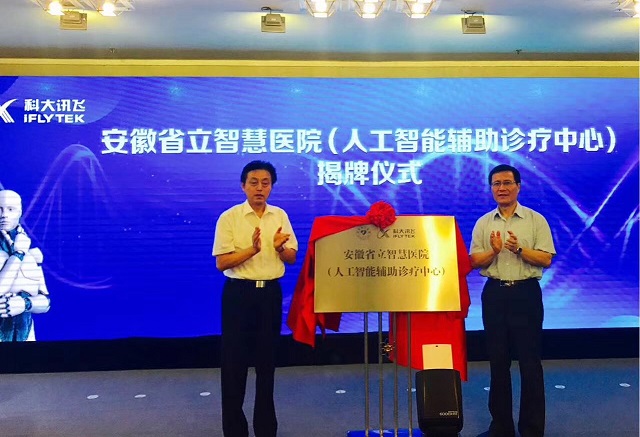
Jin Xiaotao, Deputy Director of the National Health and Family Planning Commission, and Xie Guangxiang, Vice Governor of Anhui Province, unveiled the plaque.
According to Xu Geliang, President of Anhui Provincial Hospital, this smart hospital comprises three components: smart medical services, smart diagnosis and treatment, and smart management.
In addition to providing online registration, appointment scheduling, and patient guidance services, the Outpatient Department of Anhui Provincial Hospital deployed two iFlytek intelligent medical guide robots, “Xiao Yi,” this June.
In less than two months, after continuously “learning” from 53 medical textbooks and related data, Xiao Yi currently supports physician schedule inquiries across 47 departments, navigation to 618 locations, navigation to 607 functional sites, as well as queries about operating hours for 227 locations and answers to 260 frequently asked questions. The accuracy rate of its responses has increased from an initial 81% to 90.81%.
At the outpatient pharmacy of Anhui Provincial Hospital, by adoptingAutomated Medication Dispensing Equipment, the time required to dispense a prescription has been reduced from 30 seconds with manual dispensing to 8 seconds, significantly shortening patients' medication waiting times and allowing pharmacists more time to provide pharmaceutical care services.
In June 2016, Anhui Provincial Hospital collaborated with iFlytek to develop an AI-powered medical imaging computer-aided diagnosis system. Over the past year, the system has learned from 680,000 lung CT scan images,Assisted physicians in diagnosing approximately 11,000 cases of CT imaging data at the CT Department of Anhui Provincial Hospital, achieving a diagnostic accuracy rate of 94%.。
Following preliminary integration and debugging, the AI-assisted diagnostic platform interfacing with Anhui Province’s “Medical Imaging Cloud” and the teleconsultation platform of the Medical Consortium of Anhui Provincial Hospital will officially go live today.
The platform can provide intelligent auxiliary diagnosis and quality control services for chest CT and mammography imaging to 41 county-level hospitals. During the commissioning and debugging phase,The platform has performed quality control on approximately 1.5 million chest CT images from over 10,000 patients, issuing quality control recommendations in more than 500 cases.。
iFlytek also stated that it will explore and promote the “Intelligent Medical Assistant Project” for primary care general practitioners across the province, expanding its service coverage from 41 counties to 105 counties.
The People's Hospital of Shannan Prefecture in Tibet, which receives targeted assistance from Anhui Provincial Hospital, has also been connected to this platform.
As research continues to deepen, the platform’s level of intelligence and service capabilities will continue to improve, and its service scope will continue to expand.The platform has currently been trained on 20,000 mammography images and approximately 200,000 brain MRI scans, showing promising potential for assisting in the diagnosis of breast cancer and advancing clinical research on Alzheimer’s disease.。
Through collaborative research and development with iFlytek, artificial intelligence voice technology has been widely applied in various scenarios at Anhui Provincial Hospital, including medical rounds and ultrasound examinations. The patient information data entry process, which previously took tens of minutes or even hours to complete, can now be conveniently accomplished through voice dictation.
Currently, doctors at Anhui Provincial Hospital use the “Cloud Medical Voice” mobile app nearly 1,000 times per day, accessing approximately 5,300 pages for functions such as electronic medical records, laboratory tests, and diagnostic examinations.。
As a National Demonstration Center for the Application of Gene Testing Technology, Anhui Provincial Hospital has currently conducted over 250,000 gene testing screenings for various diseases, including colorectal cancer, cervical cancer, leukemia, hereditary deafness, and hepatitis, as well as nearly 2,000 pharmacogenetic tests. Leveraging gene testing technology, it is capable of performing genetic diagnoses for more than 1,000 types of monogenic hereditary disorders.
After more than three years of implementing the SPD (Supply, Processing, and Distribution) project for medical supplies, Anhui Provincial Hospital has achieved full-process traceability management for approximately 2,000 types of medical consumables across five major categories through IoT technology, thereby minimizing the risks associated with their use to the greatest extent possible.
Through the implementation of this project, an unattended management model for medical consumables has been established in 60 consuming departments (ward areas), resulting in annual savings of 43,800 hours in manual management time and approximately RMB 2.64 million in consumables inventory costs.。
Currently, Anhui Provincial Hospital has established a clinical informatics application system centered on electronic medical records (EMR) and based on the hospital information platform. This system provides intelligent management tools to enhance medical quality and safety in areas such as clinical medication support, health insurance cost control, critical value management, medical safety assurance, and the application of medical knowledge bases.
Core Technologies, Industry Experts, and Big Data: iFlytek Healthcare’s Three Key Strengths
As a partner of Anhui Provincial Hospital, iFlytek’s medical AI products have reached the average diagnostic proficiency of physicians at Grade 3A hospitals in the auxiliary diagnosis of lung cancer and breast cancer using medical imaging.
In the future,iFlytek aims not only to leverage AI to assist physicians in interpreting medical images, but also to support them in generating diagnostic and treatment prescriptions, thereby further enhancing the clinical proficiency of frontline physicians.. To excel in this endeavor, iFlytek has made substantial efforts across three key dimensions: core technologies, industry experts, and big data.
Core Technology Level, three technologies are indispensable: first,Human-Computer Interaction Technology: During the doctor's consultation process, artificial intelligence can continuously capture information from doctor-patient communication through intelligent speech and natural language understanding technologies, helping doctors conduct more comprehensive and precise consultations. In this aspect, iFlytek has already reached a global leading level.
Second,Medical Imaging Technology: The volume of medical imaging data is enormous, with each CT scan comprising hundreds of images. This imposes a heavy workload on frontline physicians, making oversights inevitable due to fatigue. In contrast, artificial intelligence does not suffer from fatigue, and its accuracy has reached the average level of physicians at tertiary Grade A hospitals.
iFlytek broke the world record in LUNA, an authoritative international benchmark for medical imaging, this August, ranking first globally. In the future, iFlytek will expand its AI-assisted diagnostic capabilities in medical imaging to fields such as magnetic resonance imaging (MRI) and pathological images.
Third,Machine Self-Learning and Reasoning: iFlytek has successively achieved first-place results in authoritative competitions related to machine reasoning and self-learning, including the Winograd Schema Challenge for international cognitive intelligence, the KBP competition organized by the U.S. National Institute of Standards and Technology (NIST), and the SQuAD machine reading comprehension challenge.
Furthermore,"Medical experts and big data resources are also 'essential needs' for AI + healthcare research."”. Since co-establishing the “Joint Laboratory for Medical Artificial Intelligence” with Anhui Provincial Hospital in June 2016, iFlytek has subsequently entered into deep collaborations with institutions such as the Chinese Academy of Medical Sciences/Peking Union Medical College, the Chinese PLA General Hospital, Peking University School and Hospital of Stomatology, and the People’s Medical Publishing House. Leveraging professional, authoritative industry big data and under the guidance of numerous top medical experts, these partners are jointly advancing the development of medical artificial intelligence.
Government Encourages the Development of "AI + Healthcare"
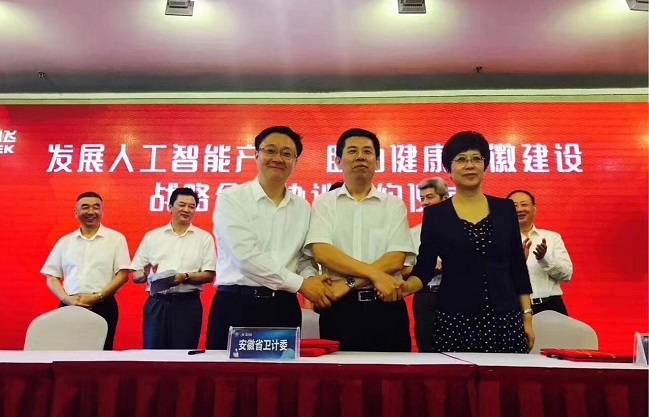
Anhui Provincial Health and Family Planning Commission, Hefei Municipal Government, and iFlytek Sign Tripartite Strategic Agreement
In China, artificial intelligence can play a significant role as a technological support in improving the quality of medical services, optimizing the allocation of medical resources, enhancing doctor-patient relationships, and alleviating contradictions in medical supply.Previously, the People’s Daily published a commentary addressing the issue of uneven medical resource distribution in China, calling for more high-quality physicians to be deployed to primary care settings so that better medical resources can reach the grassroots population.
Artificial intelligence can largely address this issue: by “empowering” healthcare professionals, AI enables physicians at top-tier tertiary hospitals to improve their work efficiency, while also allowing doctors in primary care institutions to receive guidance and recommendations from specialists, thereby enhancing diagnostic and treatment standards. This will significantly ameliorate the current challenges in China’s healthcare system, including insufficient medical resources and the uneven distribution of high-quality medical services.
Li Bin, National Health and Family Planning CommissionThe Director has repeatedly stated that pilot applications of intelligent voice and artificial intelligence-related technologies should be supported and encouraged in Anhui Province and Hefei City, with rapid replication and nationwide promotion based on these initial efforts.
Anhui Provincial Party Secretary Li Jinbin and Governor Li GuoyingIt also pointed out: efforts should be made to strengthen scientific and technological support, with an emphasis on applying information technologies such as artificial intelligence and big data. Highlighting the foundational role of primary care, the province will explore and promote the “Intelligent Medical Assistant Project” for general practitioners at the grassroots level, comprehensively enhancing their medical service capabilities, and explicitly put forward the requirement to build AI-enabled hospitals.