

Chongqing and Tencent Forge Strategic Partnership to Build a Mobile Payment Smart City with Healthcare as a Key Component
“Leaving home without a wallet, seeing a doctor without a health insurance card” may sound rather foolish. Yet today, whether dining out, shopping, traveling, seeking medical care, attending school, or going on vacation, everything can be handled with a single tap as long as you have WeChat. With the Chongqing Municipal Government placing high priority on the development of mobile payment infrastructure, Chongqing is accelerating its transition into a smart city powered by mobile payments.
Mobile Payments Facilitate Daily Necessities: Clothing, Food, Housing, and Transportation
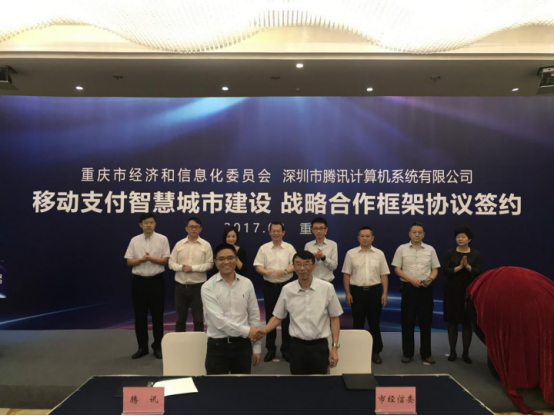
On August 20, the Chongqing Municipal Commission of Economy and Information Technology signed a strategic cooperation agreement with Tencent, launching in-depth collaboration in sectors including commerce, education, government services and public welfare, communities, healthcare, and transportation, to jointly build an open and shared mobile-payment-enabled smart city. The signing ceremony was attended by key officials and guests, including Chen Lüping, Member of the Standing Committee of the Chongqing Municipal Party Committee and Deputy Mayor; Guo Jian, Director of the Chongqing Municipal Commission of Economy and Information Technology; Ju Yan, Deputy Director of the same commission; Chen Guangyu, Vice President of Tencent’s Mobile Internet Group; and Cai Guangzhong, General Manager of Tencent Chongqing Branch. With this agreement, Chongqing became the first city in China to sign on as a mobile-payment-enabled smart city.
According to the "2017 China Smart Life Index Ranking" released by Tencent Research Institute, Chongqing ranked 7th among 351 cities nationwide. WeChat Pay has achieved comprehensive coverage across various scenarios in people's daily lives, including supermarket shopping, dining at restaurants, paying utility bills, taking public transportation, seeking medical care at hospitals, and children’s schooling, among others.
Due to its mountainous terrain, Chongqing’s transportation system has long appeared “fantastical and defy-the-odds” to outsiders. As a result, taking public transport is often the best option for tourists from other regions and even many local residents. However, it can be quite awkward if you happen to forget your change or find insufficient balance on your bus card when heading out...
The potential awkwardness has been resolved on the 15 buses operating on the two initial dedicated routes from Beibei to Niujiaotuo and Caijia in Chongqing: passengers can now pay their bus fares directly via WeChat Pay. It is reported that in the near future, WeChat Pay will be accepted for ticket purchases across various modes of transport, including city buses, subways, and long-distance coaches. Even drivers will be able to top up and pay tolls at major highway toll booths using WeChat Pay.
In terms of medical care, WeChat has also spared citizens the hassle of long queues. Currently, 22 hospitals in Chongqing, including Southwest Hospital, the First Affiliated Hospital of Chongqing Medical University, the Second Affiliated Hospital of Chongqing Medical University, and Chongqing Three Gorges Central Hospital, have all enabled online appointment registration services. Citizens can simply access the “City Services” section on WeChat to schedule their appointments.
Last December, the Children’s Hospital of Chongqing Medical University officially became China’s first flagship hospital to integrate WeChat Pay. To date, 59% of all medical payment transactions have been completed via WeChat Pay. At this hospital, virtually every step—from parking and registration, through consultation, inquiry, and payment, to inpatient admission procedures—even meal ordering services, can be handled entirely through WeChat. Some appointment slots can be booked up to 30 days in advance, allowing patients to easily complete registration from home.
“In the future, patients will no longer need to carry their medical insurance cards when visiting hospitals; they can avoid queues for payment and medication pickup, as WeChat handles it all,” said Chen Guangyu, Vice President of Tencent’s Mobile Internet Group. He introduced that major hospitals in Chongqing will fully leverage Tencent’s payment capabilities and user ecosystem. Residents will be able to use their smartphones to access services such as online appointment registration, in-clinic payments, and retrieval of examination reports and visit records via WeChat, while also completing mobile payments for both medical insurance-covered and out-of-pocket expenses.
In terms of government services, WeChat also helps governments enable citizens to spend less time and make fewer trips when handling affairs. Taking the entry-exit procedures handled by the Chongqing Public Security Bureau as an example, the once “routine” queueing for payment can now be completed in under 30 seconds.
Leveraging Tencent’s WeChat Pay platform, the Chongqing Public Security Exit-Entry Administration developed a WeChat Pay system to implement full-process closed-loop management of exit-entry fees, covering receipt requisition, allocation, invoicing, POS card swiping, payment confirmation, and reconciliation/write-off, thereby creating “Fingertip Exit-Entry Services.” The administration developed a WeChat Pay system for exit-entry document processing fees and deployed 24-hour self-service kiosks in high-traffic areas such as exit-entry application halls and police stations in commercial districts. This initiative has freed up more than 50 police officers, reduced paper receipt usage by 70%, and increased the share of self-service payments to 56%.
It is reported that online tuition payments via WeChat, as well as WeChat-based online payments for government services in public security, transportation, civil affairs, and other sectors, will soon be realized.
Through this strategic partnership, Tencent will also collaborate with relevant ecosystem partners to actively participate in the development of mobile payment infrastructure within Chongqing’s commercial districts and tourist attractions. Together, they will create scenarios such as “Mobile Payment Commercial Districts,” “Mobile Payment Markets,” and “Mobile Payment Tourist Attractions,” thereby facilitating the upgrade of offline commerce in Chongqing and building a modern commercial system that integrates online and offline development.
In the near future, Chongqing residents and tourists from around the world will be able to use WeChat for convenient mobile payments across major commercial districts and scenic areas in Chongqing. Whether shopping or traveling, carrying less cash reduces physical and mental burdens, allowing you to more fully enjoy the pleasures of life.
Building a Benchmark Smart City for Mobile Payments
Guo Jian, Director of the Chongqing Municipal Commission of Economy and Information Technology, stated that the construction of the “Mobile Payment Smart City” will integrate mobile payment into sectors related to public livelihood and government services, including commerce, transportation, healthcare, and education. This initiative aims to better meet the diverse financial needs of the public and the real economy, holding significant importance in promoting “greater convenience and inclusiveness in social public services, a healthier industrial ecosystem, and more vibrant market entities.”
Chen Guangyu, Vice President of Tencent’s Mobile Internet Group, stated that Chongqing boasts a solid foundation for mobile payments. Tencent will fully leverage its capabilities in WeChat Pay, security, cloud computing, location-based services (LBS), and big data marketing to jointly advance the development of mobile payment infrastructure in both commercial and government service sectors, aiming to establish Chongqing as a national benchmark for smart cities powered by mobile payments.