

After IBM and Oracle, Baheal Pharma Announces Strategic Partnership with Takeda for Prescription Drug Retail Innovation
VCBeat (WeChat ID: vcbeat) learned on August 20 that during the “2017 West China Pharmaceutical Conference,” Baiyang Pharmaceutical and Takeda Pharmaceutical held a joint press conference to announce their strategic cooperation in new retail for prescription drugs at the Boao Forum for Asia Hotel. Six prescription drug products under Takeda Pharmaceutical, including Pantoloc, Takepron, Benexate, Ecotrin, Blopress, and Protonix, will be authorized to Baiyang Pharmaceutical for distribution to retail terminals through a novel marketing model for prescription drugs. Both parties will leverage their respective resources to jointly launch a “grand retail” strategy in the pharmaceutical sector, charting a new blueprint for the industry. This marks another major partnership for Baiyang Pharmaceutical following its agreements with IBM and Oracle. Given that the agreement involves the outflow of prescription drugs from hospitals and was announced at the West China Pharmaceutical Conference, it has attracted widespread attention within the pharmaceutical industry.
According to VCBeat, Takeda Pharmaceutical is Japan’s largest pharmaceutical company and the 15th largest globally, with annual sales reaching $19 billion. It boasts the seventh-largest R&D pipeline among global pharmaceutical companies and possesses a substantial portfolio of original new drugs. Historically, pharmaceutical giants of this scale have adopted independent sales models in the Chinese market. However, Takeda’s prescription drug retail collaboration with Baiyang Pharmaceutical sets a precedent for overseas pharmaceutical companies entrusting their retail channel operations in China to domestic firms.
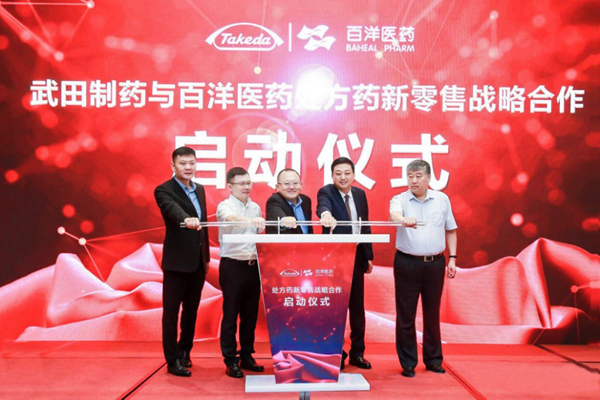
Takeda Pharmaceutical and Baiyang Pharmaceutical Launch Strategic Cooperation in New Retail for Prescription Drugs
(From left to right: Sun Chao, Director of Supply Chain and Distribution Management at Takeda China; Wu Han, President of Sinohealth Information; Fu Gang, Chairman of Baiyang Pharmaceutical Group; Ruan Hongxian, Chairman of Hongxiang Yixintang Pharmacy; Li Wenjie, Chairman of Shuyu Civilian Pharmacy)
Prescription Outflow Becomes a Trend, with Prescription Drugs Emerging as a New Growth Pillar for the Retail Sector
In terms of policy guidance, the outflow of prescription drugs from hospitals has become a trend. Last year’s “Key Tasks for Deepening the Reform of the Medical and Healthcare System in 2016” stipulated that “hospitals are prohibited from restricting the outflow of prescriptions.” Earlier this year, the “Several Opinions of the General Office of the State Council on Further Reforming and Improving Policies for Drug Production, Circulation, and Use” explicitly stated: The mechanism of subsidizing medical services with drug profits shall be further dismantled; outpatient patients may freely choose to purchase medications at either medical institutions or retail pharmacies, and medical institutions shall not restrict outpatient patients from purchasing medications at retail pharmacies based on their prescriptions.
Meanwhile, as healthcare reforms deepen and initiatives such as zero-markup drug pricing and the separation of prescribing from dispensing advance, the retail market will become the primary arena for pharmaceutical sales. Looking at overseas markets, Japan’s retail pharmacy sector has expanded rapidly, with the chain pharmacy market achieving a 6% growth rate this year and reaching a market size of ¥6.5 trillion (RMB 406.2 billion). The U.S. pharmaceutical market exceeds $400 billion, with the retail segment accounting for 70% of the total market size.
In contrast, in the domestic market, data from Zhongkang CMH monitoring shows that in 2016, the total size of China's pharmaceutical terminal market (excluding medicinal materials) was RMB 1.4909 trillion, with the prescription drug market accounting for approximately RMB 1.267 trillion. Constrained by sales channels, since prescription drug sales must rely on doctors' prescriptions and medical orders, tiered hospital terminals (including urban tiered hospitals and county-level hospitals) remain the main channel for prescription drug sales, capturing an 80% market share, while retail terminals account for only 9.18%.
However, in terms of trends, hospital terminals in cities have shown a clear lack of growth momentum. Although the retail pharmacy terminal is not large in scale, under the influence of policies such as medical insurance cost control, drug proportion limits, and the cancellation of drug markups, the prescription drug segment in hospitals will shift from being a “profit center” to a “cost center.” The regulatory authorities’ positive stance toward prescription outflow has become increasingly clear, making it virtually certain that prescription drugs will flow from hospitals to retail pharmacies.
Multinational Pharmaceutical Companies Innovate Marketing, Partner with Baiyang to Deepen Presence in Prescription Drug Retail Terminals
In today’s China, where the pharmaceutical market and health demands are growing and expanding continuously, multinational pharmaceutical groups partnering with domestic pharmaceutical companies is gradually becoming a new trend to effectively capture the domestic market. As the first case of close collaboration between a multinational pharmaceutical company and a local pharmaceutical enterprise in China, Takeda Pharmaceutical has undergone comprehensive analysis and evaluation. VCBeat learned at the press conference that Baiyang Pharmaceutical’s drug marketing capabilities, DTP pharmacy layout, and marketing technical service capabilities were the core elements driving this partnership.
As a commercial pharmaceutical enterprise with 12 years of industry experience, Baiyang Pharmaceutical covers more than 12,000 hospitals and 230,000 pharmacies. With the development of mobile internet technology and the widespread adoption of smartphones, information fragmentation and noise have become the greatest challenges for enterprises in formulating marketing strategies. Against this backdrop, Baiyang Pharmaceutical elevated content marketing to a strategic level starting in 2016. By collaborating with mature and professional entertainment IPs, continuously generating interactive topics, and leveraging public relations tactics to engage precisely targeted audiences, the company has not only significantly enhanced its brand’s visibility during dissemination but also accumulated substantial positive word-of-mouth from celebrities, key opinion leaders (KOLs), and consumers, thereby further strengthening brand trust.
Not long ago, Baiyang Intelligent Technology, a subsidiary of Baiyang Pharmaceutical Group, partnered with Oracle Marketing Cloud to create “Mingjing Smart Marketing Cloud,” a marketing management platform within the Baiyang ecosystem. The initiative aims to integrate online and offline marketing channels through information technology and cloud services, and to facilitate tripartite interaction and precision marketing among brand owners, pharmacies, and patients via intelligent marketing tools.
Given the specialized and professional nature of prescription drug sales, Baiyang Pharmaceutical’s extensive DTP (Direct-to-Patient) pharmacy resources were also a key factor in facilitating this collaboration with Takeda Pharmaceutical. Pharmacy branding will be a major trend in future development, and Baiyang Pharmaceutical has proposed comprehensive solutions for the marketing upgrade of brands and pharmacies.
For upstream partners, Baiyang Pharmaceutical provides technology- and service-intensive controlled distribution and DTP (Direct-to-Patient) pharmacy management services, enabling the pharmaceutical manufacturing industry to enjoy secure, efficient, and intensive support during its transition from centralized to distributed marketing. For downstream channels, following a strategic layout that prioritizes physicians before patients, Baiyang Pharmaceutical selects target enterprises among its 230,000 partnered terminal pharmacies for DTP pharmacy transformation. It is reported that the number of pharmacies contracted by Baiyang Pharmaceutical has currently exceeded 20,000, with this figure projected to reach 100,000 in the future.
Following the press conference, Fu Gang, Chairman of Baiyang Pharmaceutical Group, stated in interviews with VCBeat and other media outlets, “In the past, multinational corporations’ distribution structures in China were hospital-centric, as 80% of pharmaceuticals were sold through hospitals. However, with healthcare reforms, the implementation of zero-markup policies for drugs in hospitals, and the separation of prescribing from dispensing, the retail sector is increasingly becoming the primary battleground. This successful partnership with Takeda marks the first time a multinational pharmaceutical company has entrusted its retail distribution channels in China to a domestic enterprise. We also believe that more multinational pharmaceutical companies will entrust their retail channels to specialized local firms like Baiyang Pharmaceutical in the future.”
Embarking on a New Journey in Prescription Drug Marketing
VCBeat attended the press conference where Baiyang Pharmaceutical signed agreements with IBM and Oracle. In the past, our coverage of this company focused more on its IT services and informatization initiatives. However, following the recent signing with Takeda Pharmaceutical, Fu Gang reiterated, “Baiyang Pharmaceutical is not a traditional ‘porter-style’ commercial distributor; we are a technology-intensive service operator that offers both products and services. Looking ahead, we aim to help a wide range of branded pharmaceuticals manage their supply chains within retail enterprises. We are also actively promoting the classification of retail pharmacies and hope to collaborate with more multinational corporations to jointly foster new development in the pharmaceutical industry.”
It is reported that SinoHealth Info played a significant bridging role in this signing ceremony. Wu Han, President of SinoHealth Info, stated, “The collaboration between Baiyang Pharmaceutical and Takeda Pharmaceutical holds substantial significance for the pharmaceutical sector and the future development of retail pharmacies. SinoHealth Info is also committed to leveraging its robust data management capabilities and superior resource integration platform to facilitate the efficient implementation of this partnership.”
After years of development, multinational pharmaceutical companies operating in China have gained a substantial understanding of the Chinese market. As China accelerates its integration with the global community and the significance of its pharmaceutical market continues to be recognized, collaborations between multinational and domestic pharmaceutical enterprises are becoming more frequent and diverse in form. Leveraging its robust ecosystem-driven synergistic capabilities, Baiyang Pharmaceutical Group maintains close partnerships with numerous renowned multinational corporations, including not only Takeda Pharmaceutical, which signed an agreement recently, but also IBM and Oracle.
Amid the trend of outpatient prescription outflow, how to undertake this business in a compliant manner with professional expertise has become a significant hurdle for the entire retail pharmaceutical channel. The collaboration between Baiyang Pharmaceutical and Takeda Pharmaceutical has arguably paved a smooth path forward. Baiyang Pharmaceutical boasts an extensive marketing system and robust IT infrastructure, enabling it to provide a cloud-based information platform for electronic prescription exchange between hospitals and pharmacies. Takeda Pharmaceutical, on the other hand, offers high-quality prescription drugs and a rich portfolio of originator medicines. By leveraging Zhongkang Info’s big medical database to carefully select professional pharmacies, this operational logic is remarkably clear. VCBeat will continue to closely monitor the subsequent development of this partnership and Baiyang Pharmaceutical’s new moves in the retail prescription drug sector.