

Hydee Software: A Pioneer in Pharmaceutical IT with 20-Fold Net Profit Growth in Five Years and Over 50% CAGR in Revenue
With over a decade of dedicated expertise in its niche sector, the company has proactively expanded its product portfolio through robust R&D, anticipating customer needs to deliver “one-stop solutions.” By extending its services across the upstream and downstream value chain, it has achieved deep and comprehensive penetration in pharmaceutical informatization.
What Lessons Can Be Learned from Hi-Tech Software, a “Star Company” in the Pharmaceutical Informatics Industry? Recently, VCBeat (WeChat ID: vcbeat) interviewed Yang Jun, co-founder of Hi-Tech Software, and uncovered the secrets behind the company’s rapid growth.
Ten Years: From Startup to Listing on the NEEQ
Haidian Software was established in December 2004, co-founded by Xia Qifeng, Yang Jun, and others, all of whom have backgrounds in the pharmaceutical industry or pharmaceutical informatics.
Xia Qifeng has a technical background and previously served as the head of information technology for a chain pharmacy; Yang Jun comes from a sales background and excels in marketing. The two met through work, hit it off immediately, and promptly decided to enter the vertical sector of pharmaceutical informatics.
At that time, the pharmaceutical informatics industry was still in its infancy. First, distributors and pharmacies were small in scale with relatively simple operations, resulting in weak motivation to invest in information system construction and a limited market for pharmaceutical informatics. Second, there were no systematic solutions available in pharmaceutical informatics, leaving startups to explore and develop approaches on their own.
Nevertheless, Haidian has gradually gained market recognition with its strong product R&D and market expansion capabilities, securing numerous large pharmaceutical commerce and retail chain clients, while also accumulating a base of small- and medium-sized pharmaceutical wholesalers and chain pharmacy customers.
In 2014, after a decade of development, Haidian Software was listed on the National Equities Exchange and Quotations (NEEQ). Its public transfer prospectus stated: “Since its establishment, the company has remained committed to the development of its core business, with no significant changes occurring.” Persistence—arguably the primary factor behind Haidian’s continuous growth.

Haidian Software’s Listing Ceremony on the NEEQ; Yang Jun, Co-Founder, is Second from the Left
Haidian’s products are primarily applied in pharmaceutical commerce, chain pharmacies, logistics, and traditional Chinese medicine clinics. Centered on its proprietary software products, the company provides customers with comprehensive information technology solutions for pharmaceutical distribution, including project implementation, ongoing maintenance, and product upgrade services.
From a product perspective, Haidian can add functional modules or conduct secondary development on the basis of standard pharmaceutical circulation management software according to end-user needs, thereby providing products that meet customers’ personalized requirements. Key modules include a Warehouse Management System (WMS), the Yaoyicai procurement platform, online-offline integration, an O2O platform, and member CRM. These functional modules can be deployed individually or in combination to form a comprehensive pharmaceutical circulation management software suite, serving applications in pharmaceutical retail, pharmaceutical wholesale, and pharmaceutical e-commerce. Rich functional modules, flexible assembly mechanisms, and professional services are key factors contributing to Haidian Software’s success in terms of products and services.
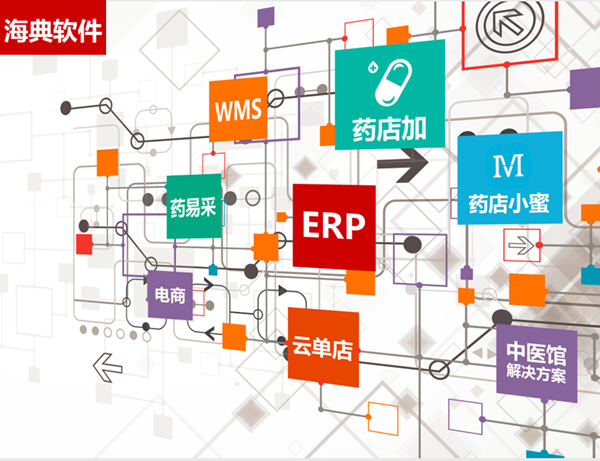
Haidian Software Product Line
In terms of technological reserves, Haidian Software possesses technologies such as storage compression, dynamic decision-making reports based on relational databases, message push technology, multi-solution coupling technology, and automatic switching between C-S and A-S architectures. The company maintains its technological leadership by continuously expanding its R&D team. According to Haidian Software’s public transfer prospectus, R&D personnel account for 27.59% of its workforce, a proportion that leads the industry.
Based on financial data, Haidian Software has maintained rapid growth over the past five years. Its compound annual growth rate (CAGR) for operating revenue exceeded 50%, rising from approximately RMB 10 million in 2012 to RMB 77.3181 million in 2016. Net profit increased more than 20-fold, growing from RMB 631,800 in 2012 to RMB 14 million in 2016.
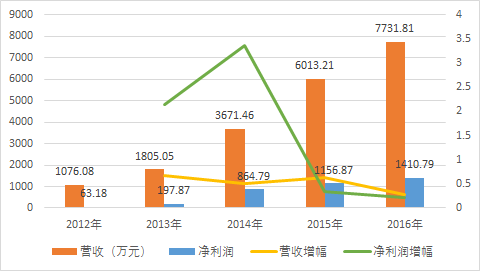
Haodian Software's Revenue Growth Over the Past Five Years
In June last year, the National Equities Exchange and Quotations (NEEQ) implemented a tiered mechanism, and Haidian Software became one of the first companies to enter the “Innovation Layer.” Additionally, Haidian Software has initiated the selection process for a new round of listing advisory firms, with plans to list on the main board market.
Regarding the listing on the New Third Board, Yang Jun told VCBeat, “Listing on the New Third Board is a significant step toward standardized operations for us and signifies recognition of our past performance. Since going public on the New Third Board, we have strived to align our business processes and information disclosure practices with those of publicly traded companies. However, given the limited liquidity on the New Third Board, Haidian will not stop here; we may pursue a listing on the main board and are working toward this goal.”
Professionals Doing Professional Work
Yang Jun stated that, based on customer figures, Haidian currently serves over 1,500 pharmaceutical companies and more than 55,000 pharmacies. Its major clients include Sinopharm, China Resources, Gongxinwang, Deshengtang, Qianjin, and Xinhu.In previous sessions ofPharmaceutical RetailChainTop 100RankingInside, HaidianCustomer has arrived.60Home,Already inIt is pharmaceutical informatization.EnterpriseFirst Tier.

Yang Jun Delivers Keynote Speech on Pharmaceutical Informatics
However, Yang Jun did not consider this to be the core competitiveness of Haidian. He stated, “The era of competing on the number of clients in pharmaceutical informatization has passed. It is no longer about comparing who has slightly more software features, better cost-performance ratios, or larger user bases.” He believes that after several years of development, the products of enterprises that still hold a position in the industry are generally of good quality, with similar basic functionalities. Therefore, the key differentiators going forward will be their strategic planning for the next three to five years and the quality of their professional services.
So, what can future pharmaceutical informatics solutions offer to pharmaceutical retail enterprises? The answer is a solution that spans the entire supply chain. This system enables seamless integration with upstream manufacturers or supply chains, allowing the two systems to connect without friction. It facilitates rapid price inquiries and comparisons on the platform, significantly enhancing communication and procurement efficiency.
Furthermore, retail enterprises can facilitate effective internal communication, enabling the exchange of best practices among individual stores and simplifying cross-store comparisons. These are challenges that legacy ERP systems failed to address; previously, data was merely accumulated without being leveraged for actionable insights.
Another issue concerns membership management and marketing. The previous membership management system was relatively simple, with member data utilized only during medication purchases, resulting in a lack of engagement. Promotional efforts were also insufficiently targeted. In the future, new tools can be leveraged for precision marketing, enabling personalized strategies (“a thousand faces for a thousand people”) tailored to customers of different age groups and medical conditions. By integrating online and offline channels and connecting with the WeChat platform for O2O services, pharmacies can also create digital coupon wallets to manage various discount coupons.
Haidian has designed three products to address the aforementioned scenarios: YaoYiCai, Pharmacy Assistant, and Pharmacy Plus. These products respectively facilitate communication between pharmaceutical retail and supply chains, enable resource sharing and communication within chain store groups, and provide terminal user management through Pharmacy Plus, thereby delivering more professional internet and mobile internet services to customers.
In addition, Haidian Software has introduced internal management initiatives such as a Project Management Office (PMO) for implementation management and an internal Customer Relationship Management (CRM) system for sales, along with upgrades to product technology and R&D methodologies. By implementing a ticketing system and introducing the “consultant” role, supported by corresponding organizational structures and compensation and performance management systems, Haidian Software has achieved a comprehensive upgrade in customer service, ultimately driving its industrial transformation.
Yang Jun stated that the core competitiveness of Haidian lies in providing customers with the most professional services through the most professional perspective and execution capabilities.ofInformation Technology Solutions.
Trend: How to Achieve New Retail in the Pharmaceutical Industry
During the interview, Yang Jun also introduced the concept of new retail in the pharmaceutical sector. He noted that while the entire pharmaceutical retail industry is discussing “new retail,” what truly distinguishes it from traditional retail? Traditional retail systems revolve around “products” and “physical stores,” whereas new retail places “people” at its core. By leveraging various digital tools and data analytics, new retail aims to better serve consumers. This is the essence of new retail. In this context, information technology companies can continuously enhance their functionalities, clearly define their market positioning, and assist pharmaceutical retailers in management and marketing, thereby enabling the realization of new retail in the pharmaceutical industry.
Of course, in addition to the proactive digital transformation underway, the pharmaceutical retail industry itself has generated numerous positive developments. For instance, the continued expansion of market size and the rising chain pharmacy penetration rate have created a fertile ground for IT enterprises to develop innovative business models.
According to data recently released by Menet, the pharmaceutical terminal market in 2016 was approximately RMB 1.5 trillion, representing a year-on-year growth of 8.3%. Among this, the second terminal, namely the pharmacy channel, reached a market size of over RMB 330 billion, with a growth rate exceeding that of the overall pharmaceutical retail market during the same period. Additionally, influenced by factors such as the separation of prescribing and dispensing and the outflow of prescriptions from hospitals, the market size of the pharmacy channel is expected to continue expanding.
Second, there has been a structural shift in the composition of pharmaceutical retail entities. According to the statistical bulletin issued by the China Food and Drug Administration (CFDA), from 2012 to the end of November 2016, the number of pharmacies nationwide increased by 20,000, reaching a total of 446,000. Among these, chain pharmacies increased by 70,000, while independent pharmacies decreased by 50,000, reflecting a trend characterized by “the retreat of independent pharmacies and the expansion of chain pharmacies.”
Both factors are beneficial to the pharmaceutical informatization industry, which will share in the dividends arising from the expansion and structural adjustment of the pharmaceutical retail market.
Additionally, policy drivers constitute another significant factor. On July 13 of last year, the China Food and Drug Administration issued Order No. 28, promulgating the Decision on Amending the Good Supply Practice for Pharmaceutical Products, which revised the previous version of the GSP and took effect on the date of its promulgation.
The latest version of the Good Supply Practice (GSP) mandates that wholesale enterprises “shall establish computerized systems capable of meeting the requirements for whole-process operational management and quality control, thereby achieving drug traceability.” Meanwhile, retail enterprises are also required to “establish computerized systems that comply with operational and quality management requirements and satisfy the needs of drug traceability.” These provisions undoubtedly provide policy-level endorsement for the pharmaceutical informatization industry.
With these factors combined, we have reason to believe that the pharmaceutical informatics industry will become a highly coveted high-growth sector in the future, and companies like Haidian, which consistently “stay one step ahead,” may once again deliver impressive performance.