

Genlun Century Files for IPO: AI-Driven, Systems Theory-Based Platform Spanning the Full Medical Care Continuum
As an architect-turned-entrepreneur who advocates systems theory, Dr. Yu Zhong, founder of Jinglun Century, did not focus on any single specific product in the early stages of his venture. Instead, he established a comprehensive product architecture framework covering the entire healthcare process for the company.。
This system encompasses the four core processes of healthcare services: disease prediction, prevention, diagnosis and treatment, and rehabilitation. Each component is designed based on big data and artificial intelligence methodologies. While the general public might dismiss such a “comprehensive and all-encompassing” architecture as mere rhetoric, the Jinglun Century team led by him has been dedicated to its development for seven years. This effort covers the overall architecture, technology platform, and application systems. Currently, products that have been finalized and launched into the market include: a Health and Medical Big Data Management and Analysis System; Disease Screening and Assessment Systems (for thyroid nodules and diabetic retinopathy); Disease Diagnosis and Treatment Systems (including an Expert System for Auxiliary Diagnosis and Treatment of Chronic Diseases and an Intelligent Doctor’s Assistant Robot); a Disease Rehabilitation System (for post-thyroidectomy care); a Health Management System; as well as the cloud platform and medical resources that support these products.
After several years of exploration,Dr. Yu Zhong not only developed the product but also identified payers for AI-driven healthcare products, establishing a business model based on multi-party collaboration.. Today, he leads a team of over 100 employees at the company, continuing to refine his product architecture framework. He told VCBeat, “Our current products and business logic are clearly defined and effectively implemented, but we have endured countless hardships along the way. The difficulties encountered in the process far exceeded our initial expectations.”
The Perfect Integration of Systems Theory and Medicine
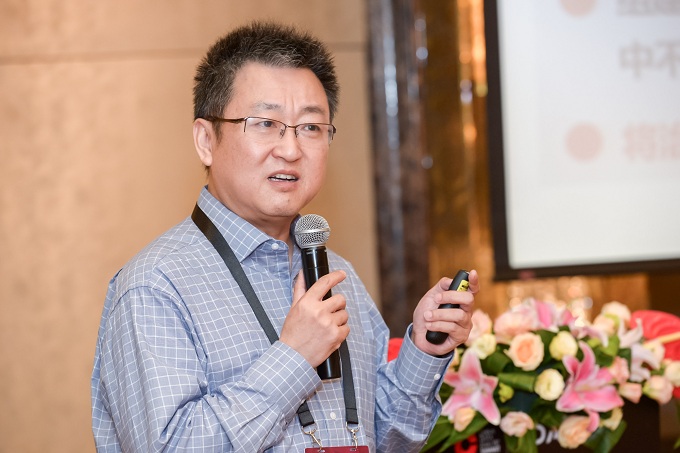
Dr. Zhong Yu
Like most overseas Chinese, Dr. Yu Zhong’s decision to return to China to start a business was partly driven by sentimental attachment to his homeland.
Before returning to China, he lived and worked in Silicon Valley, USA, for over 20 years. He studied at the California Institute of Technology, where he earned his Ph.D. in Electrical and Computer Engineering under the supervision of Professor Robert McEliece, a world-renowned expert in Shannon information theory and communication networks, a member of the U.S. National Academy of Engineering, a recipient of the Shannon Award, and former President of the IEEE Information Society.
After graduation, Dr. Yu Zhong served as Technical Director and Chief Network Architect at AT&T in the United States, as well as holding leadership positions in numerous international telecommunications standards organizations. He is widely regarded as a quintessential success story. In 2010, by serendipitous chance, he returned to China as a high-level overseas talent for Beijing Municipality and a specially appointed government advisor, with the intention of pursuing endeavors different from his previous work.
After returning to China, Dr. Yu Zhong chose to embark on an entrepreneurial venture in the healthcare sector. This decision was partly driven by his experience at AT&T, where he worked on network and IT projects related to healthcare informatization, giving him a certain understanding of how IT technologies can facilitate medical services.More importantly, it has been influenced by the systems medicine and 4P medicine theories of Leroy Hood, a member of the U.S. National Academies (National Academy of Sciences, National Academy of Engineering, and National Academy of Medicine).。
4P Medicine Based on Systems Theory Refers to Predictive, Preventive, Personalized, and Participatory.This theory posits that individuals should be viewed holistically, grounded in systems thinking and methodology. By leveraging modern molecular and biomedical sciences along with high-tech tools and instruments, it aims to achieve continuous prediction, continuous prevention (with differentiated targets), continuous intervention, and the promotion of physical health throughout the life cycle.。
Furthermore, given the variations in individuals’ living environments, physical constitutions, and personality traits, 4P medicine places greater emphasis on individual specificity. In modern society, as public self-awareness and health consciousness continue to rise, an increasing number of patients are moving away from the passive role of having treatment decisions made solely by physicians, and are instead actively participating in their own disease management and healthcare.
4P medicine is proposed based on systems theory, and Dr. Yu Zhong’s academic background lies precisely in systems theory and information theory. From the perspective of 4P medicine, he believes that his expertise holds a natural advantage when integrated with healthcare, which laid the foundation for the product system of Jinglun Century, which he later founded.
A Product System Built by an Architect
In the early stages of entrepreneurship, as an architect and practitioner of Systems Theory 4P Medicine,Dr. Yu Zhong did not rush to develop a specific product; instead, he first established a product framework for his company.This product ecosystem encompasses healthcare big data, a medical AI engine, and an intelligent decision-support and management system, with the aim of addressing challenges across the entire healthcare continuum, including disease prediction, prevention, diagnosis and treatment, and rehabilitation.

To date,Jinglun Century’s products and services include healthcare big data processing, disease risk prediction models, and virtual doctors. Among these, the disease risk prediction models are used for thyroid screening assessment, diabetic retinopathy screening assessment, chronic disease management, and health management.。
As an AI company in the healthcare sector, data forms the foundation of our business and development. In 2016, 800 million health checkups were conducted in China. Many of these individuals have undergone regular checkups over multiple years, resulting in continuous health records. These health examination reports serve as the foundational data for Jinglun Shiji’s disease risk prediction, health forecasting models, and health management services.
Dr. Yu Zhong leads his team in assisting healthcare industry organizations with various medical research and application projects as a technical partner,Through key scientific research and appropriate technology application projects in collaboration with the China Health Promotion Foundation, the Chinese Medical Association, the Chinese Society of Clinical Oncology, and the Chinese Medical Doctor Association, Jinglun Century has gained access to big data from health examinations and disease diagnosis and treatment involving hundreds of Grade 3A hospitals across China and nearly 60 million individuals.。
Once data is acquired, the next step involves cleaning and governing the data and its fusion—a highly arduous task that includes standardization of metrics, data standardization, deduplication/deletion, and data security processing. Only after such cleaning and governance can the data be utilized for subsequent analysis and mining, enabling the development of various analytical models and the implementation of big data applications.
To date, China has not yet established a unified standard for health and medical big data. In collaboration with experts from industry organizations, Jinglun Century has developed specifications for health and medical big data tailored to big data application services, by referencing international and domestic standards and guidelines for medical informatization. These efforts include establishing unified descriptions, converting unstructured data into structured formats with standardized coding, building standardized databases, and creating corresponding mappings and knowledge graphs for various medical parameters (indicators, symptoms, and diseases) within these databases.
It took Jinglun Century nearly two years to build this data cleaning system, knowledge base, and big data management platform. Although the process was time-consuming, this big data management platform laid the foundation for the subsequent development of other products.。
Leveraging the aforementioned health and medical big data management platform, Jinglun Century conducts big data analytics and machine learning to establish a series of disease prediction models for disease screening and chronic disease management, including thyroid screening assessment, diabetic retinopathy screening assessment, chronic disease risk prediction, and chronic disease diagnosis, treatment, and follow-up management.。
By integrating disease prediction models with evidence-based clinical practice guidelines, Jinglun Century has developed a unique expert system for disease prediction and diagnosis/treatment, simulating the entire process of medical care provided by a physician to patients.
In actual service delivery, the system performs disease prediction and diagnosis for patients/clients based on their consultations, questionnaires, and test results. It then formulates corresponding treatment or intervention plans, comprehensively tracks and manages the entire implementation process, and continuously evaluates therapeutic efficacy. This initiates a subsequent cycle of prediction, diagnosis, planning, tracking and management, and efficacy evaluation. Through this iterative loop, the system ultimately achieves sustained and effective treatment and intervention outcomes.
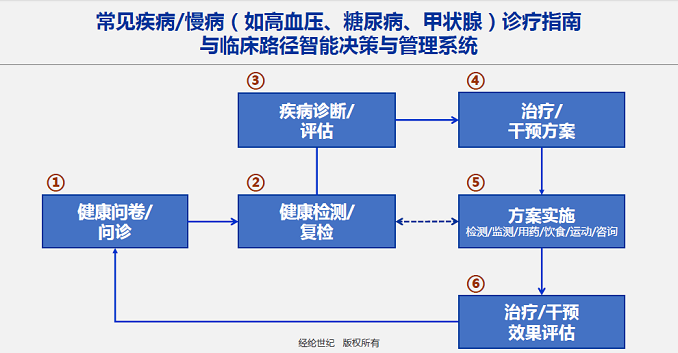
The Jinglun Shiji Disease Prediction and Diagnosis & Treatment Expert System deeply integrates big data, machine learning, and disease diagnosis and treatment knowledge to establish an auxiliary system for disease diagnosis and clinical management.
Dr. Yu Zhong told VCBeat that the idea of developing a “virtual doctor” had already taken shape before he returned to China in 2010, as he believes it will be one of the most milestone products of artificial intelligence in the healthcare field.
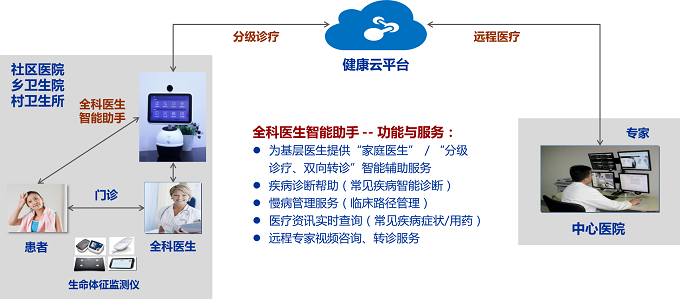
A virtual doctor is an AI-powered physician built upon the Jinglun Century Disease Prediction and Diagnosis & Treatment Expert System. Deployed on intelligent service robot hardware, it leverages capabilities such as speech recognition, image/video recognition, perceptual computing, and proactive interaction to engage patients and clients in disease diagnosis, treatment, and follow-up management. Through continuous information exchange and feedback with users, the system constantly collects data and learns, thereby enhancing its knowledge base and optimizing system rules. Ultimately, this process trains the robot to serve as a virtual doctor specializing in standardized medical services, making it an ideal partner for human physicians.
Dr. Yu Zhong, a member of the Expert Committee on Application Standards Assessment and Assurance for Health and Medical Big Data under the National Health and Family Planning Commission, believes that the policy of “tiered diagnosis and treatment with two-way referrals” is highly important, but the core issue lies with primary care general practitioners. If these frontline GPs are unable to conduct effective basic diagnoses and assessments of patients, tiered diagnosis and treatment may become merely a formality, failing to achieve its intended outcomes.
China’s grassroots communities and townships suffer from a severe shortage of qualified general practitioners (GPs). Training new GPs is time-consuming, and even after successful training, retaining talent remains uncertain. Therefore, the “GP Intelligent Assistant,” a virtual doctor developed by Dr. Yu Zhong based on his years of contemplation of the “virtual doctor” concept, is poised to become the premier technological product and solution for assisting grassroots GPs in delivering family doctor contracted services, including diagnosis and treatment of common diseases, chronic disease management, and public health initiatives.
“General Practitioner Intelligent Assistant” virtual doctors will efficiently assist general practitioners in their work. For example, the virtual doctor provides detailed diagnostic and treatment plans for hundreds of common diseases.
During the medication treatment of patients with chronic diseases, the system assists primary care physicians in conducting accurate consultations, collecting information, diagnosing and treating common diseases, and managing chronic disease tracking and follow-up reminders. Based on patients’ medical records and physical signs, and considering factors such as individual physiological differences and drug resistance, the system continuously adjusts medication regimens and provides corresponding prescription recommendations. Currently, the “General Practitioner Intelligent Assistant Robot” product has been included in government pilot projects.
Designate enterprises, commercial insurance, and social medical insurance as payers
Developing AI products for healthcare is challenging, and due to their innovative nature, they often disrupt existing ecosystems, making it difficult to identify the right payers. From a business model perspective, establishing a simple “two-sided market” (buying and selling) logic is hard to achieve. Through continuous exploration, Jinglun Century has developed a “multi-sided market” business model.。
For manyEnterpriseFor enterprises, employee health management is a key concern. Jinglun Century provides companies with AI-based disease screening and chronic disease management services. It offers significant improvements over previous health management products in terms of intelligence, user experience, and evaluation of management effectiveness, thereby better meeting corporate needs for implementing employee health management programs.
ForCommercial Insurance CompaniesFor insurers, cost containment has always been key to revenue performance. Jinglun Century’s big data–based disease risk assessment model, disease screening and evaluation tools, and chronic disease tracking and management system can help insurance companies deliver both health protection and health management services. For example, Jinglun Century partnered with Sunshine Insurance Group to develop a health risk assessment model and an underwriting engine tailored to the Chinese population, which are used in insurance product design, differential pricing, and cost control.
ForGovernment Medical InsuranceFor the government, disease screening and prevention, as well as the implementation of tiered diagnosis and treatment, are key priorities. Jinglun Century’s disease prediction model can provide effective services for “preventing major diseases.”
Jinglun Century’s expert system for disease diagnosis and treatment can provide effective “chronic disease management” services. “Preventing major diseases and managing chronic conditions” is a key national initiative to reduce healthcare expenditures. Additionally, the government is deploying virtual doctors to assist primary care physicians in diagnosing and treating common diseases, thereby effectively implementing tiered diagnosis and treatment.
Dr. Yu Zhong emphasized,Jinglun Century is not merely providing a simple medical product, but rather building a closed-loop service ecosystem that encompasses disease prediction, prevention, diagnosis and treatment, and rehabilitation. By supporting comprehensive services, it aims to stimulate payers’ willingness to pay.. Through continuous practice, Jinglun Century has organically integrated the aforementioned components to develop a “multi-sided market” business model, with payers including enterprises, commercial insurance, and public medical insurance.
Jinglun Century’s product framework has been established, and its business model has been finalized. The next task is to carry out large-scale market deployment within this framework, with a particular focus on accelerating the pilot testing, upgrading, and deployment of its “General Practitioner Intelligent Robot” virtual physician product. Meanwhile, the company will continue to refine its product portfolio by developing and integrating additional healthcare service offerings to serve a broader population.