

How Kingsoft Cloud Leverages Cloud Computing to Implement Tiered Diagnosis and Treatment: An Overview of Its Solutions and Products
From the perspective of many industry insiders, cloud computing took ten years to achieve successful implementation starting from 2006, and in the next decade, it will become the “standard configuration” across all industries. Its applications have gradually extended from the internet sector to traditional industries, rapidly penetrating various sectors such as finance, manufacturing, and healthcare.
In the process of informatization in the healthcare industry, issues such as information silos and fragmented data urgently need to be addressed. With the rapid development of technologies such as cloud computing, big data, mobile internet, and artificial intelligence, the application of these new technologies in medical and health services will be key to solving various challenges.
Furthermore, as a key measure to rationally allocate medical resources and promote the equalization of basic healthcare services, tiered diagnosis and treatment has become the top priority of healthcare reform. How to leverage information technology to facilitate the implementation of tiered diagnosis and treatment has emerged as a significant challenge facing healthcare professionals.
To address these industry pain points,At the 2017 China Hospital Information Network Association Conference (CHIMA 2017) held recently, Huang Guohua, Partner at Kingsoft Cloud and General Manager of the Government, Enterprise, and Healthcare Division, delivered a keynote address titled"Technology Empowerment: The Application of Artificial Intelligence in Grassroots Tiered Diagnosis and Treatment"Speech.
In this presentation,Huang Guohua not only introducedof Kingsoft Medical CloudThe integrated “1+4” structure further demonstrates how enterprises canBased on this architecture, the Kingsoft Tiered Diagnosis and Treatment Auxiliary Management Platform was deployed to provide IT-enabled healthcare services covering the entire patient care cycle.
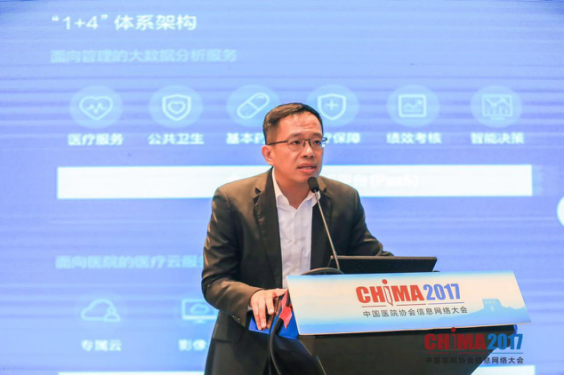
Huang Guohua, Partner at Kingsoft Cloud and General Manager of the Government, Enterprise, and Healthcare Division, Delivers Keynote Address at CHIMA 2017
“ABC”: Technology Empowerment, Reshaping Healthcare Services
In recent years, leveraging its leading technological capabilities and scale advantages in the cloud computing industry, Kingsoft Cloud has continued to make significant strides in gaming, video, government services, healthcare, and artificial intelligence. It has rapidly built a strong reputation in China’s public cloud market and played a substantial role in driving the widespread adoption of cloud computing technologies across various industries.
According to the “2016-2017 Annual Research Report on China’s IaaS Market” released by CCID Consulting, Alibaba Cloud, Tencent Cloud, and Kingsoft Cloud ranked first, second, and third, respectively, in terms of market share in China’s public cloud market in 2016.For the healthcare industry, Kingsoft Cloud iswith remarkable rapidityMove forward at a steady pace.
The core philosophy of Jinshan Medical Cloud can be interpreted through the acronym “ABC,” where A stands for Algorithm, B for Big Data, and C for Cloud Computing.
Kingsoft Medical Cloud aims to empower the healthcare industry by leveraging its extensive technological expertise, applying dedicated cloud security technologies, AI-based recognition technologies (including voice, imaging, and text), medical data interoperability solutions, big data analytics, regional imaging cloud platforms, and smart hardware/IoT technologies. This initiative seeks to reshape health information services, enhance primary healthcare capabilities, and establish seamless connectivity of regional medical and health data.
Based on the core philosophy of “ABC,” Jinshan Medical Cloud has established an integrated “1+4” structure, comprising one cloud data center and four platforms tailored to different user groups—namely, the Jinshan Big Data Analytics Platform for healthcare administrators, and hospital-facingKingsoft Infrastructure Cloud PlatformandBig Data Analytics Platform, oriented toward grassroots institutionsJinshan Primary Healthcare Cloud Service Platformand resident-orientedJinshan Public Health Cloud Platform。
These platforms cover the three layers of IaaS, PaaS, and SaaS, jointly forming an integrated, interconnected healthcare service platform.
Hierarchical Diagnosis and Treatment Assistance Management Platform Breaks Through the "Imbalance" Challenge
In his keynote address, Huang Guohua pointed out that the most prominent issue currently facing the healthcare industry is “imbalance,” which severely hinders its rational development, exacerbates the burden on medical insurance, and impedes the implementation of policies designed to benefit the public.
“Imbalance” is primarily manifested in the concentration of human, financial, and material resources, as well as informatization resources, in large hospitals, with insufficient decentralization to primary care institutions. Large medical institutions boast abundant resources, concentrated talent, and advanced management, but consequently bear a disproportionately high burden of patient demand. Physicians face excessive outpatient volumes, placing a heavy workload on medical staff. In contrast, primary healthcare institutions suffer from resource shortages, talent scarcity, and lagging management, resulting in low patient visits and low rates of first-contact consultations, which also hinders the professional development of physicians.
The key to resolving the “imbalance” issue lies in advancing tiered diagnosis and treatment. However, the implementation of tiered diagnosis and treatment faces three major challenges.
First, address the issue of interoperability of medical data within a region; second, develop efficient tools for two-way patient referrals; and third, establish a platform capable of providing disease early-warning alerts and automatically assisting in the assessment of patients' condition severity.
To address these challenges and strengthen the implementation of tiered diagnosis and treatment at the primary care level, Kingsoft Medical Cloud has developed and deployed the Kingsoft Tiered Diagnosis and Treatment Support Management Platform, based on its “1+4” architecture. By leveraging technology to empower and enhance primary healthcare capabilities, the platform focuses on individual diagnostic and therapeutic services to deliver comprehensive health informatics solutions throughout the entire care continuum.
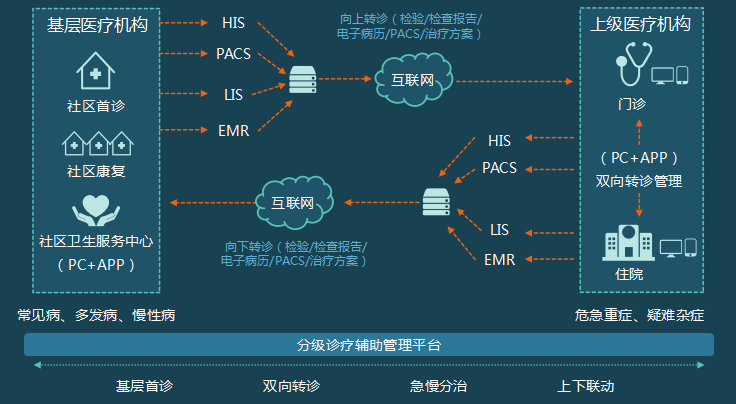
Jinshan Hierarchical Diagnosis and Treatment Assistance Management Platform Architecture Diagram
Jinshan Tiered Diagnosis and Treatment Assistance Management Platform leverages intelligent diagnostic support to help primary care physicians accurately assess disease conditions and provide decision-making recommendations on whether referrals to higher-level hospitals are necessary, based on factors such as disease complexity and urgency. This approach keeps common, frequently occurring, and chronic diseases within primary healthcare institutions, allowing tertiary medical centers to focus on critical, severe, and complex cases. By integrating personal patient data—including individual health profiles, disease status, and insurance information—with comprehensive healthcare data such as the geographic location, specialty focus, and clinical capabilities of local medical institutions, the platform recommends the most suitable referral destinations for patients, ensuring seamless information continuity before and after referral.
Following treatment at a tertiary medical institution, the platform will automatically and in real time assess whether the patient can be transferred to a primary care hospital for rehabilitative therapy, while providing personalized, intelligent referral management plans tailored to the patient. The Jinshan Tiered Diagnosis and Treatment Assistance Management Platform leverages big data and artificial intelligence technologies, integrating natural language understanding, speech recognition, and facial recognition into its system. This not only saves physicians’ time and effort but also enhances triage efficiency and reduces the risk of misidentification.
Beyond this, the Jinshan Tiered Diagnosis and Treatment Support Management Platform generates individual health profiles for residents, enabling a comprehensive understanding of each resident’s health status and empowering both physicians and residents with access to complete personal health information. By leveraging these individual health profiles in conjunction with urban integrated management data, the platform constructs city-level health profiles. The aggregation of multiple city-level health profiles further yields a regional health map, serving as a powerful tool for healthcare administrators to enable real-time monitoring, prevention, and diagnosis and treatment.
In his speech, Huang Guohua stated that the Jinshan Tiered Diagnosis and Treatment Auxiliary Management Platform will leverage information technology—particularly the integrated interoperability of data and artificial intelligence—to drive innovation in tiered diagnosis and treatment applications. This approach aims to meet the needs of patients, healthcare professionals, and healthcare industry administrators in their respective roles through comprehensive, full-cycle informational services.