

HealthMir IPO Prospectus Highlights: Beyond AI Diagnosis – Three Key Insights from India’s Emerging Digital Health Innovator
HealthMir, an Indian startup that recently secured seed funding, leverages AI technology to deliver health services to consumers through a chatbot interface. Although it is still a small company in its early stages, there are several insights worth deeper consideration.
HealthMir has developed a mobile application called Sympler, which allows users to inquire about adverse symptoms through text-based human-computer dialogue. Its database covers 500 different medical conditions. One might assume that HealthMir’s core focus is intelligent diagnosis; however, this is not the case. In fact, the content provided may be more important than the diagnostic function itself. HealthMir offers relevant health information for user reference through personalized recommendations, primarily featuring 2,000 video contents.
This health content service has attracted many potential patients. After acquiring medical and health knowledge through HealthMir, they may still need to visit a hospital for treatment. Users can schedule appointments via HealthMir, which covers 2,000 doctors across 100 hospitals.
Here are several intriguing points worthy of deeper reflection.
First, the focus is not on diagnosis, but on content.
It is not easy for machines to provide diagnoses directly, especially through a chatbot interface and when the scope of potential diseases is ill-defined. Although many online symptom queries are common, for a machine acting as an initial triage point, diagnosis occurs in a context with no predefined boundaries. This necessitates considering a far broader range of possibilities compared to diagnoses within well-defined, specialized disease categories. In the United States and the United Kingdom, internet healthcare companies that have operated for more than five years—such as HealthTap and Your.MD in the U.S., and Babylon Health in the U.K.—have also launched diagnostic chatbots. Their diagnostic capabilities rely heavily on previously accumulated online consultation data. However, for a startup, acquiring such data is no easy feat.
HealthMir provides potential assessments based on machine-generated questions and user-reported symptoms; however, these are not precise diagnoses but rather a range of possible conditions associated with the reported symptoms, often involving multiple possibilities. Additionally, HealthMir recommends personalized medical and health video content based on users’ historical symptom queries and registered personal information.
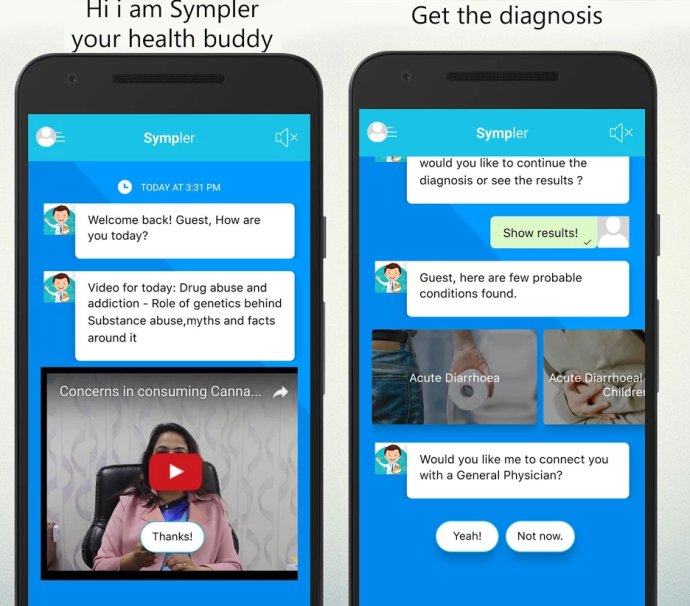
Healthmir App Sympler Interface Illustration
Second, high-quality content services will always be scarce.
In fact, consumers have long sought greater control over their health, yet progress has been slow, primarily due to a formidable knowledge gap. While a wide variety of medical and health content has historically been available to help consumers understand health issues, no truly effective model has emerged thus far. Such information is often either too obscure and prone to misinterpretation when taken out of context, or overly complex and difficult to apply to specific symptoms, lacking the personalization needed for diverse individuals. Furthermore, the neutrality of platforms publishing medical and health content is often questioned, casting doubt on the credibility of the information itself.
HealthMir’s model may not fully resolve this issue, but it certainly represents a novel attempt. In fact, AI-driven interactive content consumption models have already emerged in other fields. For instance, viewers can now use chatbots to catch up on plot details of popular TV series. This approach filters out content you are not interested in, allowing you to ask exactly what you want to know in a simple and direct manner. The health and medical information sector could also adopt this new approach. It offers at least one significant advantage: enabling users to quickly locate the specific information they truly need from a vast and complex array of health-related content through human-AI conversational Q&A. Furthermore, HealthMir appears to have invested considerable effort into producing these videos. The choice of video over text or other formats is likely because video explanations can be more professional and easier to understand, while also presenting a higher barrier to entry for content producers.
3. Low-Cost Personalized Online Services
In fact, AI-powered preliminary diagnosis has become a user acquisition tool here. For consumers experiencing adverse symptoms who seek advice online, it is ideal to have websites or apps that provide real-time, direct answers. Compared with traditional mobile online consultations, although the accuracy may be lower, the response speed is faster and the service is free. For operators, there is no need to pay subsidies to doctors to incentivize them to respond quickly to patients in order to attract traffic. Subsequently, personalized medical and health content serves as the stickiness factor to maintain long-term user engagement. This is particularly relevant for patients with chronic diseases, who may benefit from personalized tracking services.
The ultimate goal of AI capabilities is to deliver personalized online health services. Personalized online services encompass more than just online diagnosis; there is strong user demand for personalized content, triage guidance, and community-based services. Without AI, personalized services are either prohibitively expensive or insufficiently tailored, often amounting to little more than segmented treatment of user groups.
Ultimately, the focus returns to users’ actual medical expenditures. After gaining a preliminary understanding of user needs, HealthMir recommends more suitable doctors or hospitals and enables online appointment scheduling.
Extension
HealthMir is merely a small-scale case in its early stages; presenting it here is not to suggest that it is highly representative or indicative of broader trends. Rather, certain practices adopted by HealthMir can offer inspiration for entrepreneurship and innovation in smart healthcare. By way of extension, I would also like to provide several additional recommendations for grassroots AI+ healthcare entrepreneurs:
1. Don’t take on porcelain work if you don’t have a diamond-tipped drill. Without top-tier AI technical capabilities and a background in clinical medicine, do not attempt to tackle high-difficulty problems such as AI-assisted diagnosis. The stronger the clinical relevance, the higher the barrier to entry. At this stage, applying AI technology to healthcare—particularly in deep clinical domains—entails multiple high barriers: technological, industry-related, talent-related, and more. What chance of success do grassroots medical and health entrepreneurs truly have?
2. Non-clinical needs also warrant attention. Clinical needs require a medical professional background and entail higher industry entry barriers. Non-clinical needs may involve pain points in healthcare operational processes, issues of healthcare resource allocation, and so forth. Many non-clinical needs in the healthcare sector remain urgent to address.
3. AI Can Deliver a Superior User Experience. AI has the potential to create enhanced user experiences, giving rise to the concept that “AI is the new UI.” From another perspective, this means AI can be leveraged solely to improve the experience without altering the core service offerings. In other words, users continue to access existing services—such as healthcare information, triage guidance, and patient communities—but enjoy them through an improved experiential interface.
By Gu Beini, who has long been engaged in innovative business research and provides strategic consulting for technology startups. She holds a Master’s degree in Management and has over ten years of experience in the consulting industry and financial media. In 2014, she co-founded VCBeat. For discussions on entrepreneurial pathways and methodologies, please feel free to contact the author (WeChat: gugreaty; personal WeChat official account: Future Agenda).