

How This B2B Pharma E-commerce Platform Became a Supply Chain Connector: Over 100,000 Registered Users and Monthly Transactions Exceeding RMB 100 Million
“Lao He” is the affectionate nickname by which he is known in the industry.
He graduated in 1996 and is not considered young in the entrepreneurial circle, with some media outlets describing him as an “entrepreneurial uncle.” He dislikes public sharing, believing that it is often filled with false flattery and prone to making people impetuous, which makes him thoroughly “old-school.”
He has embarked on three entrepreneurial ventures in his life, with the third initiated after achieving financial freedom. Guided by the belief that “a person’s value is determined by their contribution to society,” he aimed to undertake initiatives beneficial to the public. In just the second year of the project’s launch, it secured three rounds of financing from top-tier domestic investment firms within a single year, totaling over RMB 100 million. By the third year, the platform had amassed more than 100,000 B-side registered users, with average monthly transaction volume exceeding RMB 100 million. Despite this success, he described his mindset as “treading cautiously, as if walking on thin ice.”
VCBeat (WeChat ID: vcbeat) conducted an exclusive interview with He Side, founder of Yaopin Terminal Network, to discuss his entrepreneurial journey.

He Side, Founder of Drug Terminal Network
Three Entrepreneurial Ventures in Life
He Side is a native of Sichuan. After graduating in 1996, he worked at a pharmaceutical informatics company for six years. In 2002, he returned to Chengdu and embarked on his first entrepreneurial venture.
The first venture was a software agency company specializing in selling the information technology software of his former employer, with decent performance. However, at that time, the pharmaceutical informatics industry was undergoing rapid changes, end-user demands were shifting, and industry consolidation had begun, leading Old He to consider withdrawing from the business.
In 2005, Mr. He embarked on his second entrepreneurial venture, developing and selling internet-based management software with a product model similar to SaaS. This market proved challenging as well; the business required “executing projects, selling products, and providing solutions,” necessitating daily efforts to acquire new customers and imposing significant operational pressure. It was during this period that Mr. He turned his attention to the pharmaceutical e-commerce sector. In his words, e-commerce for pharmaceuticals was inevitably the future trend, and succeeding in this field would also benefit society.
“Looking back on the initial motivations for starting the business, there was certainly an element of idealism. At that time, my income was already sufficient to maintain a comfortable lifestyle. The reason I founded this company was my belief that there was still room for optimization in the pharmaceutical industry, and achieving a certain level of improvement would create tangible value for society.”
“Your value is determined by your social value.” It was this deep-seated sense of mission that led Old He to enter the pharmaceutical industry and establish his company in 2010. After its founding, Old He devoted time to research and planning, ultimately deciding to focus on facilitating transactions to streamline the pharmaceutical supply chain.
There are several key reasons why Lao He chose to enter the pharmaceutical e-commerce sector. First, after years of development, the internet industry has established a solid foundation; in terms of e-commerce, mature models from other sectors have already achieved scale and can be adapted and applied to the pharmaceutical field. Second, the “Internet + Healthcare” initiative has sparked a wave of entrepreneurship, with both healthcare services and pharmaceuticals beginning to gain momentum. Third, following the “New Healthcare Reform,” the operational environment for the pharmaceutical industry has shifted, prompting many pharmaceutical companies to seek transformation, thereby creating fertile ground for the growth of pharmaceutical e-commerce.
However, the pharmaceutical industry remains subject to stringent regulation, and the qualification barriers for engaging in B2B pharmaceutical e-commerce are considerable. It took Yaopin Terminal Network two years, from determining its strategic direction to formally launching operations, to obtain the Class A license for pharmaceutical e-commerce and commence official operations.
From the broader macroeconomic perspective, the emergence of Yaopinzhongduan.com (Drug Terminal Network) was also “timely.” Pharmaceutical e-commerce began with initial experiments in online pharmacies at the end of the last century. The industry officially took off in 2005 when the competent authorities issued the Interim Provisions on the Approval of Internet Drug Transaction Services. In the following years, online pharmacies experienced rapid growth, popularizing the concept of pharmaceutical e-commerce. After 2013, B2B pharmaceutical e-commerce also began to take off, and Lao He’s Yaopinzhongduan.com rode this wave of opportunity.
Streamlining the Pharmaceutical Supply Chain
The strategic vision of Yaopin Terminal Network is to establish a seamless channel connecting pharmaceutical manufacturers, wholesalers, and retail endpoints, thereby “flattening” the pharmaceutical distribution landscape, enhancing efficiency, reducing costs, and integrating the entire pharmaceutical supply chain.
Old He uses a diamond shape to describe the business system of Yaopinzhongduan.com. The top of the diamond represents manufacturers, the lower left side represents pharmaceutical commercial companies, and the lower right side represents agency marketing companies. All these ultimately converge at the end-user demand for pharmaceuticals. Yaopinzhongduan.com sits in the center, serving as a connecting hub.
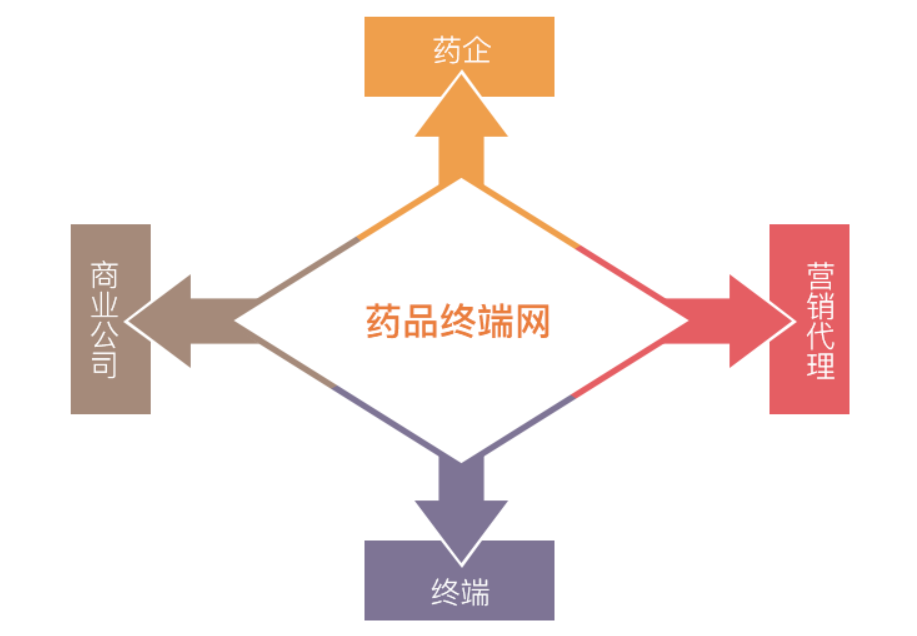
The Role of Pharmaceutical Terminal Network in the Industry Chain
“The core tenets of our business model are twofold: first, e-commerce, which facilitates B2B transactions; and second, a platform dedicated to optimizing industry supply chains and fostering interconnectivity among stakeholders.”
With the core logic in place, getting the business up and running was far from simple. Lao He frankly admitted that the initial rollout of Yaopin Terminal Network’s operations was extremely “tortuous.”
“Tell the pharmaceutical distributors that joining the platform can drive sales volume, but initially there aren’t enough end-user terminals; tell the end-user terminals that procurement will be more convenient, but there isn’t sufficient distributor support to back it up.” In Lao He’s view, this is essentially a “chicken-and-egg” problem: only when both sides are present can the platform gain traction.
Therefore, Yaopin Zhongduan Wang launched a “campaign” to win over these two user segments. For pharmaceutical distribution companies, the platform offered free onboarding and even assisted with e-commerce page design; “for some companies, we even took the product photos ourselves,” gradually attracting a number of distributors to join the platform.
For retail terminals, Yaopin Terminal Network has opted for a relatively “rudimentary” approach: on-the-ground promotion. “We have invested heavily in this area. Our field promotion team, comprising over 100 members, travels across China, even reaching retail terminals at the district/county and township levels, to invite them to register accounts and guide them through online procurement.”
It is precisely this pragmatic approach that has earned the trust of pharmaceutical commercial companies and retail terminals for Yaopin Terminal Network. He Side recalled that 2015 was a period of rapid growth for Yaopin Terminal Network, with month-on-month user growth rates reaching 30% to 40%.
In terms of transaction volume, the total value of transactions completed on the Drug Terminal Network platform reached RMB 28 million in 2014 and surged to RMB 380 million in 2015, representing a 12-fold year-on-year increase.
Capital Is a Key Support for Development
Amid rapid business growth, Drug Terminal Network has also attracted significant investor interest, completing three rounds of financing in 2015 alone.
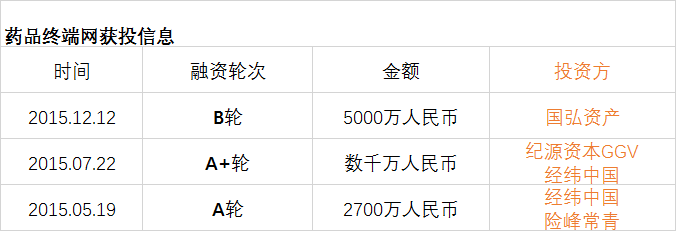
In May 2015, Yaopinzhongduan.com secured RMB 27 million in Series A financing from Matrix Partners China and Xianfeng Changqing. Two months later, Matrix Partners China and GGV Capital invested in the company’s Series A+ round. By the end of the year, Yaopinzhongduan.com announced a new round of financing led by Guohong Assets with an investment of RMB 50 million. These three rounds cumulatively raised over RMB 100 million, setting a financing record in the B2B pharmaceutical e-commerce sector that year.
Reflecting on the strong fundraising performance of Yaopin Zhongduan Wang, Mr. He attributed it to several factors. First, the pharmaceutical e-commerce industry was experiencing rapid growth and strong momentum at that time. Second, capital markets began to focus on the pharmaceutical e-commerce sector. Third, Yaopin Zhongduan Wang itself had solid fundamentals, with a robust business foundation and pragmatic operational strategies. Fourth, there was an element of “luck”: capital markets were relatively active in 2014 and 2015, but entered the so-called “capital winter” by 2016.
At this point, Mr. He expressed special gratitude to the investors in Yaopin Zhongduan Wang (Drug Terminal Network), including Zhang Ying, Founding Managing Partner of Matrix Partners China, and Yu Zhiyun, Investment Director overseeing healthcare investments. Mr. He stated that Matrix Partners China provided excellent post-investment management. Given their extensive experience with predominantly early-stage investments, they advised Yaopin Zhongduan Wang to promptly initiate subsequent fundraising rounds after completing its first round of financing.
“At that time, Jingwei advised us to ‘stockpile grain,’ emphasizing that raising ample capital would do no harm to the company. They also warned of an impending ‘capital winter’ and urged us to promptly address issues such as funding costs.” After 2015, the venture capital sector indeed entered a “winter” period, but Yaopin Terminal Network had amassed sufficient capital reserves, enabling it to weather the downturn smoothly.
In business, pacing is crucial.
In 2015, Mr. He drafted a “Seven-Year Development Plan” for Drug Terminal Network. The years 2014, 2015, and 2016 were designated as the foundation-building phase for Drug Terminal Network, with a primary focus on expanding user scale. In 2017, the company implemented its business model. Over the following three years, it scaled up its operations and introduced innovative services. Looking back, every step taken by Drug Terminal Network was well-timed, characterized by steady progress and strategic consolidation.
Since the second half of last year, Yaopin Terminal Network has begun charging upstream suppliers, with full implementation rolled out in March this year. The transition from a free-to-use model to a paid one has validated Yaopin Terminal Network’s business model.
Lao He stated, “In essence, a business model ultimately manifests as revenue; it is the process by which our revenue model takes shape. The transition from free to paid services has been a psychological trial for us. We were concerned about potential user churn, but evidence has shown that the platform delivers value, and it is this value that drives users’ willingness to pay.”
Over the past six months, the Drug Terminal Network has achieved a monthly average transaction volume exceeding RMB 100 million, with a cumulative transaction volume surpassing RMB 700 million. The platform’s monthly revenue has also exceeded RMB 2 million, demonstrating that its monetization model is largely proven and operational.
While adjusting its business model, Yaopin Terminal Network is also controlling the pace of its expansion. The company aims to deepen and thoroughly optimize its existing services to demonstrate the platform’s value, ensuring customers perceive their spending as worthwhile. Consequently, it has slowed down its expansion efforts.
“Pacing is crucial in running a business. Pausing to adapt to new models must be done steadily; overly aggressive moves can easily disrupt operations, potentially leading to failure.”
Certainly, Lao He’s decision to slow down is also closely tied to the original intention behind his entrepreneurship. The core values of Yaopin Terminal Network are “Self-Rectification and Altruism.” Self-rectification entails stringent quality control and rigorous merchant vetting; altruism means delivering genuine value to the industry, including facilitating better market access for suppliers’ products at the terminal level, enabling more effective procurement by terminals, improving the efficiency of pharmaceutical distribution, and reducing costs in the pharmaceutical supply chain.
“We currently have a workforce of over 100, approaching 200 employees, covering eight provinces and municipalities across the Southwest, Central, and South China regions. With more than 100,000 registered end-users and an ever-growing sphere of influence, we exercise great caution in our decision-making.”
Lao He even described his current state of mind as “treading on thin ice, filled with trepidation.” He remarked that when he first founded the company, he had nothing to lose and was therefore unafraid to take risks and experiment. However, as the business scaled up and its impact on more people grew, a sense of urgency emerged, leading to more cautious actions rather than bold moves. This shift in approach is also why the pace has slowed down.
Following the implementation of its business model, Yaopin Terminal Network will innovate with an “M2B” (Manufacturer-to-Business) approach and systematically expand its coverage across East and North China. The M2B model connects suppliers directly to retail endpoints, optimizing traditional supplier marketing practices to enhance marketing efficiency. Expansion into East and North China will build on operational experience gained in other regions, thereby benefiting local pharmaceutical retail endpoints.
From the perspective of the overall development landscape of B2B pharmaceutical e-commerce, the past two years have marked a turning point for the industry, shifting its focus from scale expansion to service quality. The inclusion of pharmaceutical e-commerce-related content in the 2015 Statistical Bulletin on Pharmaceutical Circulation by the Ministry of Commerce for the first time underscores the significance attached to this sector. According to its statistics, the total transaction value of pharmaceutical e-commerce reached RMB 61.2 billion in 2016, with B2B pharmaceutical e-commerce accounting for RMB 57.6 billion. Given that the overall pharmaceutical circulation market is nearing RMB 2 trillion, B2B pharmaceutical e-commerce platforms such as Yaopin Terminal Network still have substantial room for growth.
Overall, Yaopin Zhongduan Wang entered the right market at an opportune time and won recognition from both the market and investors with its pragmatic and steady approach, thereby securing first-mover advantages in terms of timing and resources. Amidst industry transformation driven by policy support for pharmaceutical e-commerce, Yaopin Zhongduan Wang is poised to sustain its growth momentum leveraging these first-mover advantages, with promising prospects ahead.