

Guangdong True Health Medical Technology Development Co., Ltd. Files IPO Prospectus Featuring Proprietary 'M-Score' Health Behavior Index Validated by National Authorities
The Outline of the Healthy China 2030 Planning mentions strengthening individual health responsibility, improving national health literacy, and guiding the formation of autonomous and self-disciplined healthy lifestyles that align with personal characteristics. It emphasizes effectively controlling factors that influence health-related behaviors and fostering a social atmosphere that values, pursues, and promotes health. This requirement has become the "golden rule" for the health management industry.
A team with cross-disciplinary thinking always delivers unexpected innovations. Why can’t health behaviors be quantified? Kong Fei, CEO of More Health, led his team in pioneering an approach that uses a single number to assess users’ health behaviors, providing a more intuitive understanding of health through this metric. This index, proposed by More Health, is called the “Health Behavior Index,” abbreviated as the “M Value” (More Health Behavior Score).
One year after the online launch of the Miao Health Health Behavior Index (hereinafter referred to as the “M-Value”), it has achieved a qualitative leap. The Health Behavior Index has been reviewed and accepted by an expert panel composed of multiple national professional associations and institutions, including the Chinese Health Promotion and Education Association, the Health Development Research Center of the National Health and Family Planning Commission, and the Institute for Health Communication at Tsinghua University. It is recognized as China’s first comprehensive index that quantifies individual health behaviors. In the future, this index will be widely applied in the fields of healthcare, insurance, and pharmaceuticals, leveraging Internet Plus, big data, and artificial intelligence to advance both the theory and practice of health behavior management in China.
This time, the Health Behavior Index has emerged as an authoritative, big-data-driven health metric. What exactly is this concept? What cutting-edge algorithms does it encompass? And how will it change our lives? A reporter from VCBeat (WeChat ID: vcbeat) conducted an exclusive interview with Kong Fei to find out.
On the Health Management Index—M Value

The Health Behavior Index is a proprietary health behavior algorithm developed by More Health, abbreviated as the “M Value” (More Health Behavior Score). By comprehensively analyzing data such as users’ health behaviors, physical metrics, and medical examination reports, it quantifies users’ health behaviors into a numerical score, helping them intuitively understand their health behavior status.
Furthermore, tailored health behavior promotion plans are developed based on each user’s behavioral habits, guiding them to improve unhealthy practices across multiple dimensions—including exercise, nutrition, sleep, and mental well-being—thereby genuinely helping users embrace the advocated health philosophy of “100 M-Points Daily, Healthy Living Every Day.”
The higher the user’s M-value, the healthier their behavior. By consistently engaging in daily health-promoting activities and completing health tasks prompted by the app, users can achieve the target M-value. Over time, this guided health behavior gradually evolves into lasting healthy habits, effectively improving users’ overall health status.
The Navigator for Healthy Living: Guiding Users in Health Management
A professional observer in the health management industry once proposed a concept: Health management is an experience economy. Understood through a product mindset, this means that products should solve users’ problems rather than create new ones. Miao Jiankang precisely addresses the challenge of how users can effectively manage their health.
Lifestyle is increasingly valued, yet it encompasses every aspect of daily life, and many people remain unclear about what constitutes a healthy lifestyle. Miao Health adopts the Health Behavior Index as its standard and employs gamification as its method, encouraging users to proactively manage their behavioral health by leveraging user interests and providing rewards. Users have vividly likened this approach to a “navigator for healthy living.”
When WeChat Sports was first launched, it gained immense popularity among WeChat users due to its unique social features and the concept of using step counts as an index. It also provided a reason for sedentary individuals to get up and move around. However, since single-dimensional step counting is more entertaining than scientific, the emergence of the Health Behavior Index quantifies and visualizes health from multiple dimensions, allowing users to have a clear understanding of their own health.
“Most people want to improve their health but don’t know how. So, we aimed to simplify and quantify complex, multifaceted health information, guiding users to make daily improvements in their health behaviors. Over time, this leads to a gradual enhancement of their lifestyle,” Kong Fei told the reporter.
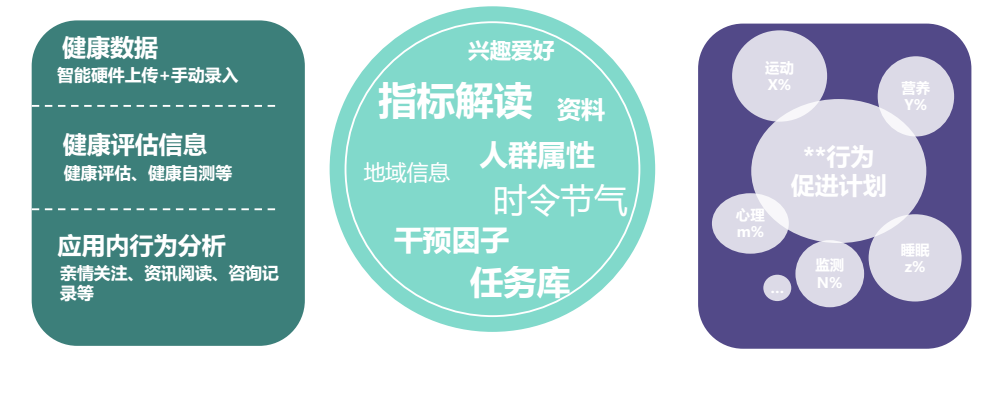
Miao Health Behavior Guidance System
AI Algorithms for Health Management Built on an M-Value System Leveraging Data from Tens of Thousands of Users
Since its inception, Kong Fei, CEO of Miao Health, has set two major goals for the company: to build data integration capabilities (including smart wearable devices, health examination data, and user self-assessment data) and to develop artificial intelligence algorithms that can truly help users achieve effective health management.
“Health management cannot be achieved through single-dimensional data analysis and management; instead, it requires comprehensive analysis and management of various health-related data,” said Kong Fei. To help users import health data from different smart devices, Miao Health has built an open health data platform.
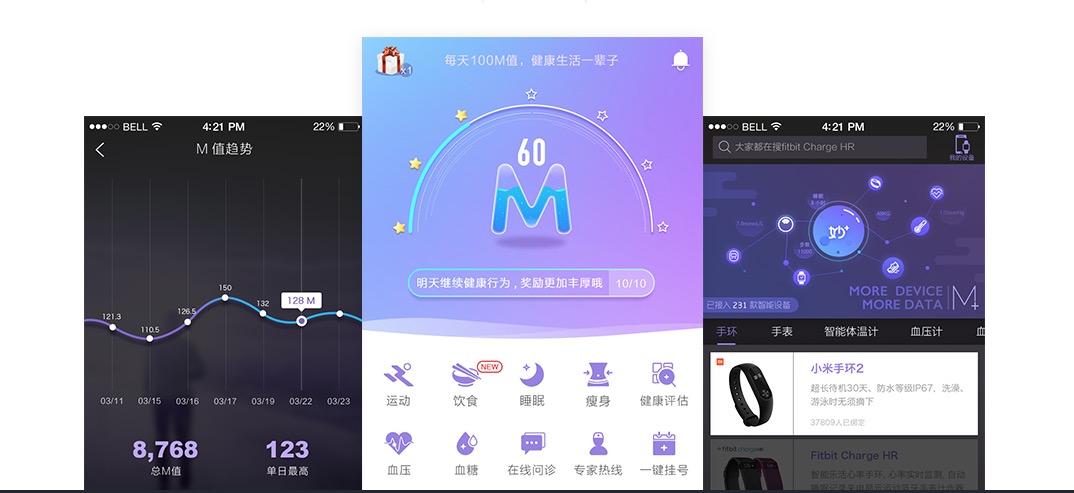
Miao Health App Interface
Miao Health generates basic user data by integrating smart hardware and enabling manual user input. Meanwhile, the platform conducts health assessments and self-tests. By analyzing users’ health data and behavioral preferences within the Miao Health App—such as age, BMI, blood pressure, blood glucose levels, news reading history, and consultation records—it creates user profiles to provide targeted guidance for healthy behaviors. The “M-Score” is used to evaluate users’ health-related behaviors, and periodic monitoring of M-Score data helps assess user compliance with the guided health interventions.
Kong Fei told reporters, “We collect user information through multiple channels to accurately understand their behavioral patterns. Big data analytics and artificial intelligence enable more precise user profiling, making health behavior guidance more targeted and better aligned with users’ needs and preferences.”
The development of the Health Behavior Index system was established through expert panel research and deliberation, based on comprehensive literature reviews. Implemented via the Miao platform, a one-year longitudinal study involving tens of thousands of users confirmed that the Health Behavior Index effectively guides users in enhancing their health literacy and improving their health behaviors.
It is reported that the sub-project of the Health Big Data X Initiative—namely, the “Health Behavior Promotion Project”—is led by Su Jing, Deputy Director of the Institute for Health Communication at Tsinghua University, and He Li, Director of the Science and Technology Division at the National Institute for Nutrition and Health, Chinese Center for Disease Control and Prevention. Accordingly, VCBeat conducted a dedicated interview with Su Jing; her insights are shared below.
Quantified Health Data Enables Customized Personalized Health Solutions
Su Jing believes that following the release of the Outline of the Healthy China 2030 Plan, there has been a significant shift in national strategy: from the earlier focus on healthcare reform to enhancing national health literacy and promoting healthy behaviors among citizens. In other words, the focus has shifted toward the concept of “keeping people from getting sick,” with prevention as the priority and treatment as supplementary.
Miao Health has addressed our long-standing challenge—how to more accurately describe health management behaviors—by adopting an index-based approach. “First, a critical aspect of applying the Health Behavior Index is that it quantifies health management behaviors, making each individual’s efforts toward health visible and measurable.”
“In the past, discussions on health merely emphasized ‘eating less and moving more,’ applying uniform dietary or exercise regimens to everyone without accounting for individual differences. The lack of internet-based tools also hindered continuous personal health management.” From this perspective, Su Jing believes that the concept of health big data embodied in Miao Health’s “M Value” provides customized management solutions for individuals requiring health management, thereby addressing the long-standing issue of one-size-fits-all health education.
“The ‘one-size-fits-all’ approach has significantly slowed the improvement of national health literacy. In Su Jing’s view, achieving refined management of personal health data via the internet is a challenging endeavor. Miao Health addresses this by breaking down health indicators into granular metrics, recognizing that health outcomes vary for each individual, and applying ‘tagging’ to user data. ‘It is impossible to require users to input all their medical examination results, sleep patterns, and other data online; users simply would not register. Instead, Miao Health adopts a dynamic, modeling-based concept. The data entered by each user continuously expands across multiple dimensions. User data is mapped to specific tags, based on which tailored tasks are pushed to different individuals, thereby delivering personalized health management solutions.’”
The M-Value Algorithm System Continues to Improve, and Health Big Data Holds Great Application Prospects
In the interview, Su Jing repeatedly expressed her recognition and appreciation for Miao Health’s development of the M-Value algorithm.
She believes that for such projects, “distinguished experts and scholars should actively engage in collaborations with enterprises to better translate research findings into the design of metrics and their practical applications. Furthermore, evaluating the effectiveness of health behavior guidance on adherence requires the involvement of more experts and leveraging interdisciplinary strengths for research. Miao Jiankang has effectively created a highly valuable model.” Currently, the Miao Health M-Value System employs advanced artificial intelligence and big data technologies. The algorithmic indicators based on the M-Value are undergoing continuous adjustment and upgrading, becoming increasingly refined.
“From a macro perspective, health is an open-ended concept. Health education and health promotion face the challenge of high input with unmeasurable outputs, as the public’s health status is difficult to quantify. Consequently, the value of big health data is gradually coming to light. Beyond the Health Behavior Index, Miao Health has introduced concepts such as Miao+ and Miao Cloud. This represents a strong integration of ideas and a substantial platform. The data currently being collected has long been coveted by the insurance cost-containment sector.” Su Jing holds a highly favorable view of the data value offered by Miao Health.
2014 marked the inaugural year of mobile health, with various “Internet + Healthcare” startups emerging in rapid succession. Capital continued to flow into this hot sector through the first half of 2015, driving the industry into a period of intense fervor. However, healthcare investment cooled in the second half of 2015. Against this backdrop of overall industry decline, Miao Health achieved counter-trend growth during the “capital winter” in the medical sector. By securing a total of RMB 350 million in financing over just two years, it became the most highly valued company in the health management field.
Su Jing believes that in today’s health management industry, where the good and the bad are often mixed together, it is reassuring to see Miao Health still holding high the banner of health management. “Scientific health management needs to be destigmatized and embrace new growth within the internet context, thereby better serving the concept of a favorable social health atmosphere as proposed in Healthy China 2030.”